宇宙
星と踊る – CHEOPS と TESS 宇宙望遠鏡が同期した惑星軌道を発見

Over the past few years, interest in astronomy has been skyrocketing – and with good reason. Between efforts made by companies like SpaceX (SPCX ) to bring humans to Mars or the stunning discoveries made by the James Webb Space Telescope (JWST), there has been no shortage of stunning achievements to revel in. To wit, astronomers have just announced the discovery of a sextuplet of planets engaged in a synchronized orbiting pattern and ‘precise waltz’. This discovery, which was originally touted as an ‘unsolvable riddle’, was made possible by a joint effort involving teams at the University of Bern and the University of Geneva.
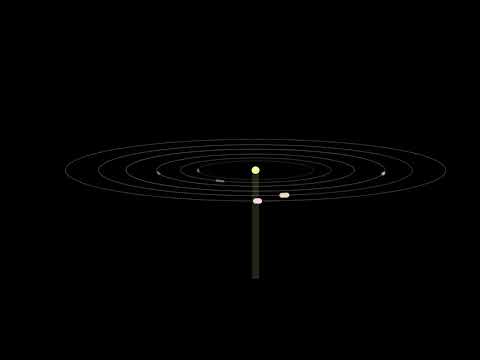
HD110067 システム
The sextuplets of planets exist in a system dubbed ‘HD110067’. What makes them so interesting is a rare harmonic resonance, where the planets follow a synchronized orbital pattern. This intriguing arrangement was initially a puzzle, as only the orbits of the inner two planets were clear from initial TESS data. However, precise observations from CHEOPS clarified the orbits of the remaining planets, revealing a unique chain of resonances in successive pairs (3:2, 3:2, 3:2, 4:3, 4:3).
A resonance chain is expressed as a ratio based on rotations around a star given a fixed amount of time. The antecedent/numerator refers to the number of rotations completed by the inner planet, while the consequent refers to those completed by the outer planet in the pair. What is significant about this finding is the extent of synchronization.
「太陽以外の星を周回する5,000以上の系外惑星が発見されている中で、共鳴は珍しいものではなく、複数の惑星を持つ系も珍しくありません。」
「しかし、6つの惑星にわたる長いチェーンで共鳴が続く系を見つけることは極めて稀です。」 – Dr. Hugh Osborn, CHEOPS フェロー(ベルン大学)
Essentially, the ratios found (3:2, 3:2, 3:2, 4:3, 4:3) indicate that each of the following will occur in the exact same amount of time.
- 惑星1の3回転 = 惑星2の2回転
- 惑星2の3回転 = 惑星3の2回転
- 惑星3の3回転 = 惑星4の2回転
- 惑星4の4回転 = 惑星5の3回転
- 惑星5の4回転 = 惑星6の3回転
As a result, this discovery has now marked HD110067 as a key system for future studies, as the bright nature of the star should facilitate detailed investigations into the planets’ atmospheres and compositions, potentially uncovering whether they are gas- or water-rich. Astronomers have noted that these findings hold significant promise for future explorations, particularly with instruments like the James Webb Space Telescope, in understanding the nature of exoplanetary systems.
望遠鏡によるトランジット法の活用
The aforementioned discovery was made possible primarily through the use of what is called the “transit method” – a widely used technique for discovering exoplanets, which are planets outside our solar system. This method involves monitoring the brightness of stars over time to detect periodic dimming, which indicates a planet might be passing in front of the star, blocking a small fraction of its light.

*イラスト用画像*
Here’s a more detailed explanation:
星光の観測: トランジット法では、天文学者は星が放つ光を長期間にわたって観測します。Kepler、TESS、または地上望遠鏡などの宇宙望遠鏡を使用し、何千もの星の明るさを継続的に監視します。
トランジットイベント: 惑星が星を周回すると、星と観測者の間を直接通過する可能性があります。この現象は「トランジット」と呼ばれます。トランジットが起こると、惑星は星の光のごく一部を遮り、明るさに小さくても目立つ減少が生じます。
規則的な暗暗パターン: 星の光が定期的に暗くなる場合、惑星が星を周回し、繰り返しトランジットしていることを示唆します。惑星が遮る光の量から、天文学者は惑星のサイズを推測できます。大きな惑星ほど多くの光を遮り、明るさの減少がより顕著になります。
軌道周期と距離: トランジットの頻度(光が暗くなる頻度)は、惑星の軌道周期に関する情報を提供します。軌道周期は惑星が星の周りを一周するのに要する時間です。これにより、惑星と星との距離を推定するのに役立ちます。
観測方向の特異性: トランジット法は、惑星の軌道が私たちの視点から見てエッジオン(横向き)である場合にのみ機能します。軌道が傾いていて惑星が星の前を通過しない場合、トランジット法では検出できません。
サイズと大気研究における利点: トランジット法は特に惑星のサイズを測定するのに効果的です。さらに、分光法と組み合わせることで、惑星大気の組成に関する情報も得られます。
フォローアップ観測: トランジット法で潜在的な系外惑星が検出された後、さらなる観測と分析が行われ、存在が確認され、特性がより詳細に研究されます。
To date, the transit method has been highly successful in the exoplanet hunt, contributing to the discovery of thousands of exoplanets since the early 2000s. It’s particularly effective for finding planets that are close to their stars, such as those in the habitable zone where conditions might be right for liquid water — a key ingredient for life as we know it.
宇宙望遠鏡
While it may be the James Webb Space Telescope that has captivated the public’s attention since its launch, it is by no means the only such device in use by astronomers today. In fact, the discovery of these synchronized plants was made by the following.
CHEOPS(系外惑星特性化衛星):
Launched in 2019, CHEOPS is operated by the European Space Agency (ESA), with contributions from several European countries. It was designed to observe known exoplanets orbiting bright stars. Its primary goal is to measure the sizes of these planets with high precision. By determining the planet sizes and combining this information with existing data on the planets’ masses, scientists can calculate their densities and hence infer their compositions.

*イラスト用画像*
More specifically, CHEOPS focuses on exoplanets ranging from Earth-sized to Neptune-sized. It aims to provide more detailed information about these worlds, many of which were discovered by other missions like the Kepler telescope. This is done through the use of the previously described ‘transit method’, where it measures the dip in starlight as a planet passes in front of its host star.
TESS(トランジット系外惑星サーベイ衛星):
Launched in 2018, TESS is operated by the United States-based National Aeronautics and Space Administration – better known as NASA. While CHEOPS is meant to observe known exoplanets, TESS is tasked with a main objective to discover them by monitoring the brightest stars in the sky. It’s particularly focused on finding Earth-sized and super-Earth-sized planets.
To achieve its goal, TESS surveys the entire sky, dividing it into numerous sectors, with each being observed for about a month. This comprehensive survey approach has allowed TESS to discover thousands of new exoplanets. Like CHEOPS, TESS also uses the transit method to detect exoplanets. Its all-sky survey approach helps identify planets around a wide variety of star types, including those that are nearest and brightest and, therefore, easier for follow-up studies.
Both telescopes are significant contributors to the field of exoplanet research. While CHEOPS is more focused on studying known exoplanets in greater detail, TESS is designed to find new exoplanets and add to the rapidly growing catalog of these distant worlds. Their findings not only help us understand the properties of exoplanets but also contribute to the broader quest of searching for potentially habitable worlds beyond our solar system.
業界プレーヤー
Humans are explorers by nature. Over time, we have continually sought out, and adapted to living in all but the most extreme environments around the world. Looking forward, if humans are to continue satiating an innate desire to expand our horizons, it will be advancements in science and the Aerospace sector. With that in mind, the following are a few of the many companies working towards such a future.
*以下の数値は執筆時点で正確でしたが、変更される可能性があります。潜在的な投資家は指標を確認すべきです*
上場企業
1. Northrop Grumman Corporation
NOC 価格チャート
NOC 価格チャート
| 時価総額 | P/E レシオ | 1株当たり利益 (EPS) |
| 71,421,409,432 | 15.55 | $30.48 |
Northrop Grumman Corporation (NOC ) は、世界的なセキュリティ企業として、宇宙旅行と探査の推進に重要な役割を果たしています。航空宇宙技術の革新で知られ、数々のハイプロファイルな宇宙ミッションに貢献してきました。その宇宙分野でのハイライトの一つは、ジェームズ・ウェッブ宇宙望遠鏡への重要な貢献であり、複雑な宇宙システムの開発における専門知識を示しています。
The company’s involvement in space extends to manufacturing satellites, contributing to the International Space Station, and developing launch vehicles. With a strong focus on next-generation technologies and a robust portfolio in defense and aerospace, Northrop Grumman continues to be a key player in shaping the future of space travel, positioning it as an attractive prospect for investors looking toward the expanding frontiers of aerospace and defense.
2. Lockheed Martin Corporation
LMT 価格チャート
LMT 価格チャート
| 時価総額 | P/E レシオ | 1株当たり利益 (EPS) |
| 110,459,750,386 | 16.3 | $27.37 |
Lockheed Martin Corporation (LMT ) は、航空宇宙と防衛分野の巨人として、宇宙探査に大きく貢献しています。NASA の主要請負業者として、先進的な宇宙船や衛星の設計・製造に携わっています。特に、深宇宙探査を可能にする Orion 多目的乗員船などのプロジェクトに不可欠な役割を果たしています。衛星技術、宇宙探査機、そして火星探査ミッション(火星ローバーを含む)への関与は、宇宙に対する理解を進める上で重要です。
Lockheed Martin の継続的な投資は、ミサイル防衛や宇宙探査のイニシアチブを含み、宇宙産業の成長に関心のある投資家にとって魅力的な選択肢となります。この先見的なアプローチは、宇宙の新たなフロンティアへの世界的な推進と一致し、Lockheed Martin を国家防衛と宇宙探査の未来における重要なプレーヤーに位置付けています。
3. Boeing Company
BA 価格チャート
BA 価格チャート
| 時価総額 | 予想 P/E(1年) | 1株当たり利益 (EPS) |
| 137,855,699,746 | -38.10 | $-4.70 |
Boeing は長い航空宇宙の歴史を持ち、多くの宇宙ミッションやイニシアチブに重要な貢献者です。衛星製造から宇宙船開発まで幅広いプロジェクトに関与しています。特に、国際宇宙ステーション(ISS)プログラムの主要パートナーであり、CST-100 Starliner 宇宙船の開発に取り組んでおり、ISS や低軌道の他の目的地への乗員輸送を目指しています。
Boeing の宇宙探査への関与は、航空宇宙と防衛における広範なポートフォリオの重要な部分であり、業界の主要プレーヤーとしての地位を確立しています。
非上場企業
SpaceX
SpaceX, led by visionary entrepreneur Elon Musk, stands at the forefront of the private space exploration industry. Although not publicly traded, SpaceX has garnered significant attention from investors and the space community alike for its groundbreaking achievements.
The company has revolutionized space travel with its reusable rocket technology, significantly reducing the cost of access to space. Its Falcon rockets and Dragon spacecraft have become central to both cargo and crew missions to the International Space Station. Additionally, SpaceX’s ambitious Starlink project aims to provide global internet coverage via a constellation of satellites, showcasing its innovative approach to space-based services. The company is also leading the charge towards Mars colonization with its development of the Starship spacecraft.
SpaceX’s continued advancements and disruptive approach in the space sector make it a company of great interest for potential future investors and a key player in shaping the future of space exploration and travel.