Connect with us

メガプロジェクト

Vera C. Rubin Observatory: Surveying The Whole Universe

mm
Securities.io maintains rigorous editorial standards and may receive compensation from reviewed links. We are not a registered investment adviser and this is not investment advice. Please view our affiliate disclosure.

The Mega-Telescope Era: Scaling Up Humanity’s View of the Cosmos

As optical sciences have progressed from Galileo’s first telescope to today’s giant telescopes, astronomers have gained a deeper understanding of the Universe.

As a rule, every generation of telescope has become more precise, able to see with a greater level of magnification and in a broader range of light wavelength spectrum.

In some cases, this requires the telescope to be in space, away from the interference of the Earth’s atmosphere and human light pollution, like for the James Webb Space Telescope (JWST). In other cases, this can be achieved with the building of massive networks of telescopes, like, for example, in the case of the Square Kilometer Array Observatory (SKAO) for radio wave detection. (Follow the links for detailed explanations on these astronomical megaprojects.)

A different type of telescope aims not to look at specific astronomical objects more deeply, but at the sky at large. They are called survey telescopes and can observe a significant portion of the sky at once. By doing so, they can detect special regions of space, variability in star activity, or moving space objects that would otherwise be missed by classical telescopes.

Because the goal of survey telescopes is fundamentally different, their design is as well. A new tool is being added to the field, the Vera C. Rubin Observatory. It is barely starting its testing phase, and has already discovered thousands of new asteroids and changed how we understand interstellar space.

Survey Astronomy vs Classical Astronomy: Key Differences

A good explanation of the difference between survey astronomy and classical astronomy is that survey astronomy is similar to recording a time-lapse video of a given landscape, while classical astronomy is more akin to looking very close to a specific area with binoculars.

Binoculars will give a lot more details about a given object, but each observation will likely be short in time. This is because there are only a few very powerful telescopes in the world, and millions of stars and other stellar phenomena to observe, so astronomers are always competing with each other for observation time.

As a result, the variability of stars’ light or quickly-moving nearby asteroids is most likely going to be missed. This is why the “time lapse” type of astronomy is needed as well.

Vera C. Rubin Observatory Overview

This telescope was previously known as the Large Synoptic Survey Telescope (LSST). Vera Rubin was an American astronomer whose work provided convincing evidence for the existence of unseen “dark” matter in the Universe. More precisely, she discovered through the study of galaxies’ rotations that some invisible mass is holding the galaxies together despite high velocity rotation.

The observatory is located in Chile, a country with a lot of astronomical projects, thanks to some of its regions having the winning combination of low light pollution and very clear sky in high-altitude deserts. The chosen location has 270 average clear nights per year.

Source: Wikipedia

The primary mission of the Vera C. Rubin Observatory will be to conduct a 10-year survey of the entire available southern sky, creating a time-lapse record of half the universe (due to Earth curvature, another similar project in the northern hemisphere would be needed for a complete overview of the entire Universe).

The survey is called the Legacy Survey of Space and Time (LSST), and is expected to generate more data than all the other optical telescopes on Earth combined in its first year, or 20 terabytes of data every night.

Vera C. Rubin Telescope Specs: Power, Resolution, and Imaging

Component Specification
Primary Mirror 8.4 meters (27.5 ft), 16,783 kg
Secondary Mirror 3.5 meters (11.4 ft)
Total Telescope Weight ~350 metric tons
Camera Resolution 3,200 Megapixels
Field of View 9.6 square degrees (~45x size of full moon)
Images Per Night 1,000 images (1 every 5 seconds)
Data Collected 20 Terabytes per night

This is by far the most powerful survey telescope ever made, and it shows in its technical specs.

The project took 29 years from conception to completion (1996-2025), of which 10 years were active construction.

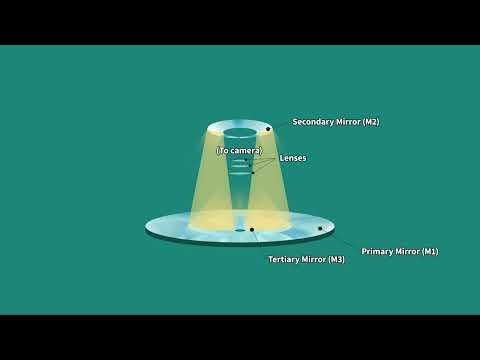
The primary mirror is 8.4 meters wide (27.5 feet), weighing 16,783 kg (37,000 lbs), to which is added a 3.5-meter secondary mirror (11.4 feet). The total telescope weight is ~350 metric tons (~386 US tons).

The primary mirror traveled 7,000 miles from Tucson, AZ, to the mountaintop in Chile—and had less than a foot (~30cm) of clearance to fit through a road tunnel on the way.

The optics include three corrector lenses to reduce optical aberrations, with the first lens, at 1.55 m in diameter, being the largest lens ever built.

Source: Wikipedia

The camera used to capture the images is 1.65 meters tall and 3.65 meters long (5.4 x 12 feet), reaching a resolution of 3,200 megapixels. Put another way, it would take about 400 Ultra HD TV screens to display a single Rubin image.

The camera will take 1,000 pictures per night (every 5 seconds), with a total of 2 million pictures taken in the 10 years of the LSST. This is possible thanks to a powerful motor moving quickly the 220-ton mount without vibration.

Source: Wikipedia

It has a wide field of view, capable of capturing images of an area of sky 45x larger than the full moon.

Source: Wikipedia

The images are processed with 6 different camera filters, giving a wide range from near-ultraviolet to infrared light.

In total, the Vera C. Rubin Observatory should be able to detect in the southern night sky 17 billion stars, 20 billion galaxies, 10 million supernovae, and 6 million objects in the Solar System.

The project has involved more than 30+ countries, and has 130 full-time employees (80 in the United States / 50 in Chile).

Legacy Survey of Space and Time (LSST)

The primary goals of the LSST are:

Fitting for a telescope named after the discoverer of the phenomenon, so far explained by dark matter, this goal of the LSST will catalog millions of galaxies.

The size and mass of a clump (or “halo”) that can turn into a galaxy depend on the properties of dark matter.

If we see a whole bunch of small galaxies, that would support our current best guess for the properties of dark matter.

The mapping of our galaxy, the Milky Way, will help us understand how it formed, including how it previously absorbed smaller galaxies, forming “streams” of stars, of which 23 are already known.

As the Rubin Observatory will observe and take images of the entire southern night sky every three nights, it will be able to do a time-lapse of the whole sky every 3 days.

As a result, we will be able to immediately tell if something has changed. Most of the discoveries will be objects that change brightness.

This will be especially important to find supernovae, but also solar flares in other stars than our Sun, or more exotic stellar objects like neutron stars.

It could even detect rare events like neutron stars or black holes colliding with each other, or stars being torn apart by black holes.

Lastly, close space objects appear to move a lot quicker than background objects. So regular pictures get a spot of light moving fast, revealing them to be nearby asteroids.

We know of around a million such asteroids and comets, but scientists suspect there are at least tens of millions more undiscovered, as these objects are hard to find: they’re small, far away, and usually dark.

Notably, scientists have found fewer than 30% larger than 140m asteroids (460 feet) in size. Rubin’s discoveries will increase that percentage to 60-90%.

Also important, the telescope could detect objects coming from outside of the solar system, and it already seems to have done just that. (See below the results from the first observations for more on that topic.)

Rubin Observatory’s Data Processing Pipeline

20 terabytes of data per day is a massive amount to process. This is the equivalent of three years of watching Netflix, or over 50 years of listening to Spotify.

Rubin will do real-time, within 60 seconds, world-public alerts for objects that have moved or changed. This will help other scientists to point their own telescopes at newly found objects of interest.

These results will, however, be filtered at a classified US government facility in California for classified spy satellites and other confidential data, which will be released unredacted only 3 days later.

The transfer and collection of data use multiple fiber-optic cables, including some specially installed for the telescope, and involve many different universities and research institutes.

The data will be accessible through the Internet via the online portal Rubin Science Platform. It will be accessible to all scientists in the USA and Chile, as well as members of Rubin’s contribution program. After two years, anyone in the world will be able to access Rubin data.

Rubin Observatory First Light: Early Discoveries

Nebulae & Galaxies

On June 23rd of 2025, the first images from the Vera C. Rubin Observatory were released.

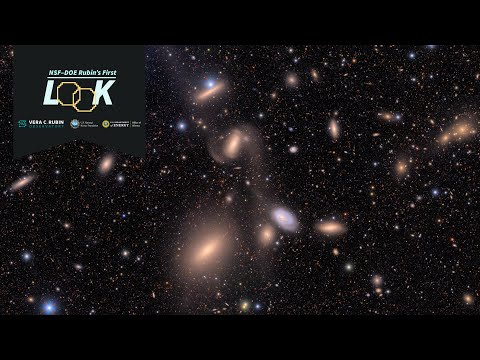
And even if this was just a calibration test, it already produced results that have impressed the scientific community. Among some of the images released were the Triffid & Lagoon Nebulae, a bright, colorful cloud of gas and dust about 5,000 light-years away, and the Virgo cluster, the nearest large collection of galaxies to our own Milky Way, about 55 million light-years away from Earth.

From sizable stars to sprawling galaxies, Rubin transforms seemingly empty pockets of space into glittering tapestries.

Pulsating Stars

The Rubin telescope found 46 subtly pulsating stars, which vary in brightness over time, usually over the course of less than a day.

Over the next 10 years, Rubin will detect up to about 100,000 of these stars extending out to more than a million light-years away, allowing scientists to map the outer reaches of our Galaxy and explore the structure of the Galactic halo that surrounds the Milky Way and extends nearly halfway to our closest neighbor, the Andromeda galaxy.

A Swarm Of New Asteroids

These preliminary images have also revealed 2104 new asteroids in the Solar System. It includes:

  • 2015 asteroids in the main asteroid belt.
  • 7 near-Earth objects.
  • 11 Jupiter Trojans (sharing Jupiter’s orbit).
  • 9 trans-Neptunian objects (icy objects beyond Neptune’s orbit).

An Unexpected Interstellar Visitor

However, what no one expected to be found in this initial round of testing was an asteroid/comet coming from outside our solar system.

Not so much because these types of objects cannot be found by the Vera C. Rubin Observatory, it is perfectly designed to find such fast-moving, low luminosity interstellar objects. But because they are expected to be very rare. Finding one that quickly put into question this expectation.

Source: NASA

It was dubbed 3I/ATLAS, as it is the only third space object of this kind ever detected, after “1I/Oumuamua” discovered on 19 October 2017 and 2I/Borisov discovered on 29 August 2019.

The object seems to be a comet, making the determination of its exact size difficult, as its nucleus is hidden behind the comet’s halo made of gas and ice.

It nevertheless seems massive, with size estimates ranging from a little below a kilometer to 11 kilometers. Its trajectory and speed suggest it could come from the galactic core and be more than 7 billion years old, or more than the entire solar system.

Now that it has been detected, more powerful telescopes with a narrower field of vision will likely spend the next months studying ATLAS while it comes closer to our Sun, very close to Mars’ orbit, before it leaves our solar system forever.

Source: NASA

Conclusion

The Vera C. Rubin Observatory is a remarkable feat of engineering and scientific achievement, becoming by far the world’s largest survey telescope ever made.

It is barely starting, and has already discovered thousands of new asteroids, and even the third ever detected interstellar object to visit our Solar System.

This illustrates the incredible potential of this new astronomical tool. Much more is expected in the coming 10 years of observation, which should catalog and observe tens of millions of asteroids, stars, supernovae, and galaxies.

The telescope will likely be the source of many new points of interest in the sky for astronomers worldwide, who will then further study variable stars, black holes, and asteroids.

Overall, Rubin is likely to make our understanding of the Universe progress in one major leap, as well as give us a detailed understanding and extensive catalog of everything in our Solar System.

Investing in Aerospace

Intuitive Machines

(LUNR )

Projects like the Vera C. Rubin Observatory are mostly funded by philanthropic and public funds, as they are not likely to generate a direct return on investment.

However, by cataloging the entirety of the solar system, it brings us closer to the point where we could start sending automated or manned missions to mine asteroids, especially near-Earth objects. This sort of project will likely be the next step or done in parallel to the return of manned missions to the Moon, planned for the upcoming years.

Founded in 2013 in Houston, Texas, Intuitive Machines is, for now, a very “Moon-focused” company, as indicated by its stock ticker, and has already been selected for 4 NASA lunar missions, and employs 400+ people.

It was the first commercial company to successfully land and transmit scientific data from the Moon. It also performed the 1st firing of LOx/LCH4 (liquid oxygen, liquid methane) engine in space.

The company is working on many projects that will form the base of a lunar infrastructure for exploration and settlement.

The first one is the “data transmission service”, with the technology being tested, and ultimately looking to end with a lunar data transmission constellation around the Moon’s orbit.

The second part is the “Infrastructure as a Service”. It should include an LTV capable of autonomous operations, the telecommunication service, and GPS localization services.

The last segment is the delivery of material to the lunar surface. So far, the company has delivered scientific payloads with the Nova-C lander, a 4.3-meter-tall lander (14-feet) able to deliver 130kg of payload to the Moon.

The next step will be with the Nova-D lander, able to deliver 1,500-2,500 kg of material to the Moon. This payload capacity and size will be the one required for delivery of the Lunar Terrain Vehicle (LTV), as well as the 40kW Fission Surface Power nuclear reactor expected to power the Moon base.

The company has landed many valuable contracts with NASA, for example, the Near Space Network contract, with a maximum potential value of $4.82B.

The LTV contract final decision by NASA between the 3 potential suppliers is expected for the end of 2025, and would be worth up to $4.6B as well.

Besides NASA, the company is trying to diversify its client base, having been selected in April 2025 for a grant up to $10M by the Texas Space Commission. This will support the development of an Earth reentry vehicle and orbital fabrication lab designed to enable microgravity biomanufacturing.

This reentry vehicle will also provide a backup option and reduce risks for the Company’s future lunar sample return missions.

Another project is the development of low-power nuclear stealth satellites for an Air Force research laboratory JETSON contract.

As the company reaches a positive free cash flow point in Q1 2025, and with the lunar telecommunication contract, it is now becoming a lot safer for investors, moving away from a cash-burning startup to an established services provider to the growing space economy.

As the development of new instruments for the LTV indicates, NASA is not going to let go of the Artemis project, even if elements like the SLS rocket might be overhauled. So the future for annex equipment providers like Intuitive seems promising.

And it could form the building block of further deep space exploration and utilization of space resources, supported by the data generated by a telescope like the Vera C. Rubin Observatory.

Latest Intuitive Machines (LUNR) Stock News and Developments

Jonathanは元バイオケミストの研究者で、遺伝子分析と臨床試験に従事していました。現在は、株式アナリストおよびファイナンスライターとして、革新、市場サイクル、地政学に焦点を当てた出版物 'The Eurasian Century" に貢献しています。

Advertiser Disclosure: Securities.io is committed to rigorous editorial standards to provide our readers with accurate reviews and ratings. We may receive compensation when you click on links to products we reviewed. ESMA: CFDs are complex instruments and come with a high risk of losing money rapidly due to leverage. Between 74-89% of retail investor accounts lose money when trading CFDs. You should consider whether you understand how CFDs work and whether you can afford to take the high risk of losing your money. Investment advice disclaimer: The information contained on this website is provided for educational purposes, and does not constitute investment advice. Trading Risk Disclaimer: There is a very high degree of risk involved in trading securities. Trading in any type of financial product including forex, CFDs, stocks, and cryptocurrencies. This risk is higher with Cryptocurrencies due to markets being decentralized and non-regulated. You should be aware that you may lose a significant portion of your portfolio. Securities.io is not a registered broker, analyst, or investment advisor.