材料科学
NUS、銅不使用の高温超伝導材料を発見

超伝導の可能性
Electricity is one of the most important technologies ever invented by mankind. In its usual form, it always deals with some level of electrical resistance, generating heat when an electric current circulates.
This can have severe limitations for some applications requiring too powerful current or magnetic fields, as it would lead to any electrical system simply melting down.
電気は人類が発明した最も重要な技術の一つです。通常の形態では、常にある程度の電気抵抗が伴い、電流が流れると熱が発生します。
このため、非常に大きな電流や磁場を必要とする一部の用途では、電気系統が溶けてしまうという深刻な制約が生じます。
An alternative is superconductivity, a phenomenon where electrical resistance drops to zero. However, for a very long time, it could only be observed at ultra-low temperatures, close to absolute zero (0 K), or about -273°C/-387°K.
代替手段として超伝導があります。これは電気抵抗がゼロになる現象です。しかし長い間、絶対零度(0 K)付近、すなわち約‑273°C/‑387°F の極低温でしか観測できませんでした。
This changed with 1987年にノーベル物理学賞を受賞した発見: high-temperature superconductors made of copper oxides.
Without superconductivity, plenty of modern technology would not be possible, including particle accelerators (for example, the CERN), MRIs, and maglev trains.
Superconductivity will equally be a crucial component of the most promising megaprojects and technological innovations, like ITER and nuclear fusion, mass drivers, quantum computers, etc.
Zero-loss electric power lines could also be crucial in developing ultra-long grid connections helping buffer the production of renewables over weather conditions and time zones, solving some of the limitations of solar and wind power.

出典: XOT Metals
高温 超伝導
For now, the low-temperature requirement makes superconductivity economically viable only for high-end applications: maglev, MRI, etc.
現在、低温が必要なため、超伝導は磁気浮上列車やMRIなどのハイエンド用途でのみ経済的に実用可能です。
And while scientifically interesting, superconductivity under high pressure is relatively useless in terms of practical applications.
また、科学的には興味深いものの、高圧下での超伝導は実用面ではほとんど価値がありません。
Quite a lot of progress occurred in the superconductivity space recently that might change the situation:
- It now seems that the material produced in high pressure might be able to retain some of its superconductivity at lower pressure 圧力クエンチプロトコル(PQP)と呼ばれる実験手法によって.
- WSe₂(タングステンセレニウム)のねじれ二層構造 appeared to be a good material candidate for higher-temperature superconductors as well.
- Another new class of potential superconductors, bilayer nickelates, might have been also added to the list this year.
- Then appeared the puzzling case of LK-99(a form of copper-substituted lead apatite – CSLA), potentially a new type of ambient-pressure, room-temperature superconductor.
- The claim was immediately contested and criticized as a hoax or a measurement error, but 他の研究者が何らかの現象が実際に起きている可能性を発見しました.
Despite these new discoveries, to a large extent, superconductivity is a not well understood phenomenon, with a lot of shots in the dark to try to find new materials with that characteristic. So a better theoretical framework is required.
これらの新発見にもかかわらず、超伝導は依然として十分に解明されていない現象であり、適した材料を見つけるための試行錯誤が多く行われています。したがって、より優れた理論的枠組みが必要です。
One piece of the puzzle 2025年3月に、超伝導の可能な高温(Tc)に関する理解が進み、パズルの一片が見つかりました.
Another one is the creation by researchers at the National University of Singapore of a new theoretical model that has already led to the discovery of copper-free superconducting material. This achievement was recently announced in the prestigious scientific publication Nature1, under the title “Bulk superconductivity near 40 K in hole-doped SmNiO2 at ambient pressure”.
New Superconductivity Model
Explaining Superconductivity
The researchers worked on developing a new theoretical model explaining how superconductivity works. This is a complex topic, which can be summarized more simply with a few key concepts:
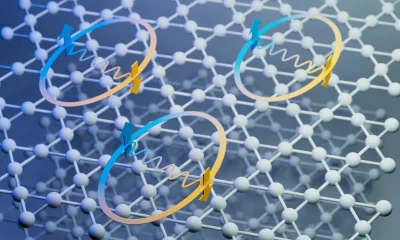
クーパー対、または量子効果によって結合した二つの電子は、材料を超伝導にする重要な要素です。
It is the condensation of Cooper pairs that creates superconductivity, at least according to the researchers that explained superconductivity in the first place (the Bardeen–Cooper–Schrieffer theory, or BCS theory), and won the 1972年のノーベル物理学賞 for this idea.
It is フォノン, or the vibration at the quantum level of the material lattice, that drive the pairing of electrons in Cooper pairs. When enough Cooper pairs form, this allows for the movement of electrons throughout the material without collision, eliminating electrical resistance.

出典: Fiveable
Predicting And Producing New Superconductors
The new model predicting Cooper pair formation helps the researcher predict many potential superconductors, including many that do not include any copper atoms.
They then successfully synthesized one of the predicted materials: samarium-europium-calcium-nickel oxide (Sm-Eu-Ca)NiO₂.
“As we predicted and designed, this non-copper-based superconducting oxide demonstrates high-temperature superconductivity under atmospheric pressure at sea level, without the need for additional compression—just like copper oxides.
This finding suggests that unconventional high-temperature superconductivity is not exclusive to copper but could be a more widespread property among elements in the periodic table.
They also confirmed zero electrical resistance (superconductivity) well above 30 K in this compound. This is not only a new material to experiment with, but a proof that the model they used has predictive value, likely meaning that the other superconductive material predicted could also work. This is the first discovery of such high temperature superconductor since the 1990s.
Zhaoyang Luo, a National University of Singapore PhD student, demonstrated the high crystallinity and pure-phase nature of the synthesized material using electron microscopy. This makes the new material very stable, making it a good candidate for potential future industrial applications.
“This is the first time since the Nobel-winning discovery that a copper-free high-temperature superconducting oxide has been found to function under ambient pressure.
Additionally, this new material is highly stable under ambient conditions, significantly improving its accessibility.
The production method of the new material is rather robust too, with no structural defect appearing during it, further increasing the potential for practical applications.
Applications And Future Development
Now that they have a more solid theoretical framework, the researchers can try to fine-tune some specific parameters of the superconducting materials. Notably, they mention atomic and molecular characteristics like electronic occupancy shifting and hydrostatic pressure.
より確固たる理論的枠組みが得られたことで、研究者は超伝導材料の特定パラメータを微調整できるようになりました。特に、電子占有の変化や等方圧などの原子・分子特性に言及しています。
This could open the way to either entirely new types of superconductors or maybe even a new family of superconductors with even higher operating temperatures.
Any higher temperature superconductor that can be manufactured at scale could have two main impacts:
- Drastically reduce the cost of technologies currently using superconductors, democratizing their use, especially maglevs and MRIs.
- Open new fields of use, especially if the Tc temperature reaches high enough to match liquid nitrogen (-196°C / -320°F), a much cheaper and easy to produce coolant than the ones currently used for superconducting material.
- These new applications could include power transmission, energy storage, lasers, ships, space propulsion & access to orbit (mass drivers), etc.
This observation has profound implications for both theoretical understanding and experimental realisation of a broader scope of superconducting materials with practical applications in modern electronics,
Leaders in Superconductivity Solutions
AMSC 価格チャート
AMSCは電力網、船舶、風力エネルギー向けのエネルギーソリューションを提供する企業です。一般に、電力消費が大きい、または規模が大きいシステムほど、過熱を防ぐために超伝導技術が必要となります。
名前に反して、ASMCは超伝導システムだけでなく、例えば風力タービン用のギア駆動系も提供しています。
同社は、電化やデジタル化(AIデータセンターを含む)のトレンド、米国製造拠点の回帰、そして英語圏海軍の近年の地政学的リスクへの対応としての近代化需要といった複数の成長要因に乗っています。

出典: American Superconductor Corporation [securities_stock_price_tag symbol="AMSC" exchange="NASDAQ"]
電源供給部門では、AMSCは受注が着実に増加しています。これは、半導体工場が電力網の変動から保護されることや、再生可能エネルギーの間欠性に対応するため、産業サイトでの電源・制御が求められることが要因です。
風力タービン部門では、主に電気制御システム(ECS)に注力しています。かつては2 MWタービン向けに強みがありましたが、徐々に縮小してきました。AMSCは新しい3 MWタービン設計により、特にインド市場に焦点を当てて回復を目指しています。
軍用船向けには、AMSCは「AMSCの高温超伝導磁気機雷対策」システムを提供しており、船舶の磁気シグネチャを変更して機雷から保護します。このシステムは米国、カナダ、英国海軍に販売され、現在までに7,500万ドル相当の受注があります。
全体として、ASMCは現在実用化可能なニッチな応用分野で超伝導技術を活用することで最も成功していますが、将来的にさらなる技術進歩を展開できる体制も整えています。投資家は、同社株が過去に極度のボラティリティを示したことを留意し、リスクを適切に計算すべきです。
Latest on American Superconductor Corporation
Studies Referenced:
1. Chow, S.L.E., Luo, Z. & Ariando, (2025) A. Bulk superconductivity near 40 K in hole-doped SmNiO2常圧下で。Nature. 20 2025年3月. https://doi.org/10.1038/s41586-025-08893-4