メガプロジェクト

NEOM:サウジアラビアを再創造し、都市が意味するもの

mm
Securities.io maintains rigorous editorial standards and may receive compensation from reviewed links. We are not a registered investment adviser and this is not investment advice. Please view our affiliate disclosure.

NEOMとサウジ・ビジョン2030:新経済のための新都市

Historically, it was common for new cities to be funded in unpopulated regions, representing the expansion of a civilization into new territories, like for example the Romans founding Londinium (London), Colonia Claudia Ara Agrippinensium (Cologne), Barcino (Barcelona), and Vindobona (Vienna), or the Western powers founding Boston, New Amsterdam (New York), Buenos Aires, São Paulo and many, many other urban centers in the Americas.

これは現代ではかなり稀であり、通常は国が都市開発や政治の方向性を変えようとする欲求を反映しています。例えば、ブラジリアは1950年代にゼロから作られ、ブラジルの首都となり、リオ・デ・ジャネイロより国内のほぼ中央に位置する政治的中心地を作ることを目的としました。

他の国々も同様の道をたどっています。例えば、エジプトは砂漠に新首都「ニュー・アドミニストレイティブ・キャピタル(NAC)」を建設しており、最終的に650万人を収容する計画です。

A similar project is happening today, except it is even more ambitious than Brasilia or NAC by a wide margin: サウジアラビアのNEOM.

サウジアラビアの石油依存とNEOMが存在する理由

Saudi Arabia is an economy famous for being built upon its gigantic energy resources of oil (and a little gas). Oil & gas represents around 40% of the Saudi’s GDP, and 70-80% of the government revenues. It is also essentially the only export of the country, with oil & gas making up 80-90% of exports.

実際には、石油依存はそれ以上に強く、乾燥したサウジアラビアで大規模な人口が生き残るには、石油・ガスで作られる電力と、電力で稼働する淡水化プラントから供給される淡水が不可欠です。

さらに問題を加えると、サウジの人口は急速に増加しており、1960年代初頭の300万人未満から現在は10倍以上に達しています。

出典: Macrotrends

石油からグリーンテックへの再構築

石油容量の転換とエネルギー転換シグナル

While not yet depleted, there is a clear sign that the oil bonanza is coming to an end at some point for Saudi Arabia.

It might be first due to declining production, as all of the country’s oil mega-fields have been discovered several decades ago, and are likely going to see at best stagnant production from now on. A fact that is, for now, described as a choice.

“Saudi Arabia’s oil rig count dropped to its lowest level in more than 20 years, as the kingdom focuses on expanding its natural gas infrastructure.

On 2024年1月30日, Saudi-listed Aramco said that, on government direction, it was scrapping plans to expand to 13 million barrels per day capacity by 2027 from the current 12 million bpd. ”

The other threat to the Saudi economy is the ongoing energy transition, which risks making oil a lot less valuable, as solar & nuclear energies, and overall electrification, reduce the future value of fossil fuels. Concerns about climate change are only accelerating that trend.

サウジ・ビジョン2030の内部: 多様化目標

To escape a potential economic and social collapse when the time comes when oil is not as valuable as it once was, Saudi Arabia is looking to revolutionize the core of its economy, turning it into a modern industrial and technological country instead.

This is the core of the “2030 Vision”, with very ambitious goals:

  • 50% of Saudi exports are non-oil exports, instead of just 18.7% today.
  • Increase the private sector contribution to GDP to 65%, compared to today’s 40%
    • As almost all government spending today is funded by oil, it could be argued that oil is actually much more than 40% of GDP.
    • Increase foreign investments’ contribution to GDP from 3.8% to 5.7%.
  • Increase the SMEs (Small and Medium Enterprises) role in GDP from 20% to 35%.
  • Raising Saudi Arabia’s ranking in the global Logistics Performance Index from today’s 49thplace to 25th.
  • Increase women’s participation in the workforce from 22% to 30%.
  • Lower unemployment from 12.3% to 7%.

In order to achieve all these goals, social reforms are slowly being implemented, and better governance tools and policies are being deployed. But the more spectacular part is a series of megaprojects to radically reshape the Saudi economy.

ビジョン2030メガプロジェクト

NEOM以外: ROSHN、Red Sea Global、Qiddiya、Diriyah

While the new megacity of NEOM is the most impressive part of the Vision 2030 megaprojects, a few others are also worth mentioning:

  • ROSHN: The new city will build 400,000+ residential units, 1,000 schools, and an 11-kilometer canal to provide it with water.
  • The Red Sea Project: A regenerative tourism megaproject over the Red Sea, aiming to build 50 hotels with 8,000 rooms, as well as more than 1,000 residential properties across 22 islands and 6 inland sites.
  • Qiddiya: A massive entertainment project, including the  Six Flags Qiddiya City, the Aquarabia waterpark, a Formula One racetrack, a gaming and esports district, a giant stadium, and a performing arts center.
  • Diriyah: The original home of the House of Saud, this city will be transformed by a $62.2B of investment into a sustainable tourism landmark, with 38 hotels and resorts under construction, as well as 9 museums, 31 mosques, and 20,000 residential units with a traditional design.

However, all these projects together do not reach the ambition of NEOM.

NEOM概要

NEOM takes its name from a neologism meaning “New Future,” deriving from the Ancient Greek prefix “neo” (meaning “new”) and the Arabic word “Mustaqbal” (meaning “future”). The letter “M” pays tribute to the name of the project instigator, the de facto future ruler of the country, Crown Prince Mohammed bin Salman.

The city and its associated side projects will be entirely powered by renewable energy, be optimized for a minimal impact on the environment, change how we think a city operates (for example, no cars at all), and almost single-handedly change traditionalist and oil-focused Saudi Arabia into a futuristic nation.

At the core will be “The Line”, surrounded by the other projects in a wide radius of dozens of kilometers.

出典: NEOM

The estimated budget for this project is hotly debated, with an initial estimate at $500B, but might run as high as 8.8 trillion dollars, or 25x the Saudi annual budget.

The sheer scale of NEOM has, of course, made it a matter of debate and criticism, something we discuss below as well.
スクロールしてスワイプ →

地域 計画ハイライト 規模 ステータス / マイルストーン 主要情報源
The Line 車なしの線形都市;5分アクセス;20分で全長を走破できる鉄道 全長170km;高さ500m;幅200m;面積34km²;最大人口9M 2030年までに30万人未満の居住者にスケールダウン予定;建設継続中(Hidden Marina) NEOM、Bloomberg、Dezeen
Oxagon 浮体式産業ハブ、港、淡水化、水素 中心エリア48km²;1.5M TEU港目標 土木工事と港湾掘削が進行中;クレーン納入済み;ターミナル1は2026年目標 NEOM、IPCSA、NEOM newsroom
Trojena 年間を通じた山岳リゾート;スキー、湖、3,600室 面積1,413km²;最高峰約2,600m 建設中;2029年アジア冬季大会開催予定(予備的議論あり) Vision 2030 portal、Dezeen
Sindalah ラグジュアリー島;マリーナ;プレミアム小売 約0.84km²;86泊マリーナ 2024年10月公式オープン;費用は約40億ドル(初期予算の約3倍) Wikipedia、ツアーオペレーターのまとめ

e it a matter of debate and criticism, something we discuss below as well. スクロールしてスワイプ → Region Planned Highlights Scale Status / Milestones Key Sources The Line Car-free linear city; 5-min access; 20-min end-to-end rail 170 km length; 500 m tall; 200 m wide; 34 km² footprint; up to 9M people Scaled expectations to

The Line

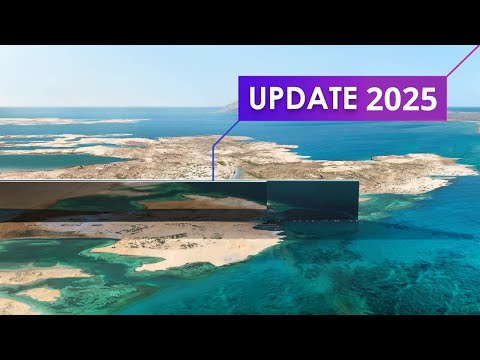
The core of NEOM is “The Line”, which would be the first linear city in the history of mankind.

170 kilometers long (105 miles), the city would be cutting straight from the Red Sea into the Saudi desert. Despite this size, the central high-speed railroad should make the maximum commute time less than 20 minutes.

From the center of the line, it would take less than 5-minute walks to reach nature and all facilities. The Line should become the home of 9 million people.

Reduced commutes will create more time for leisure. Not paying for expenses like car insurance, fuel, and parking will mean higher disposable incomes for citizens.

The city is looking to minimize its footprint and save time. So homes, offices, parks, and schools are stacked vertically to preserve the natural desert landscape.

The initial vision sees these vertical buildings as two parallel & massive continuous buildings separating the city from the surrounding desert.

出典: NEOM

The outside would have a mirrored surface, and be as high as 500m (1,640 feet) tall and 200m (656 feet) wide, reducing the total footprint to just 34 square kilometers (13 square miles)

出典: NEOM

The design should generate natural air flow, reducing the impact of the often scorching hot temperature of the region.

出典: NEOM

The Line’s location was considered strategically:

  • It is less than 6 hours by air from 40% of the world.
    • The NEOM Bay Airport currently has 2 terminals, and will be just one of four airports that are projected in the city.
  • It is close to the Red Sea and the Suez Canal, by which 13% of its international trade passes.
  • It will include diverse landscapes, from the Red Sea coast to deserts and snow-topped mountains.

出典: NEOM

Oxagon

At the Southwest corner of the NEOM project, south of The Line, will also be built the Oxagon, a floating city dedicated to industrial production.

The site will be 7 kilometers in width (4.3 miles), and 48 square kilometers in surface (18.5 square miles). This too will be 100% powered by renewable energy, and should be inhabited by 90,000 people.

出典: NEOM

Key infrastructure will include a desalination facility, a hydrogen production plant, 4 GW of renewable energy generation, and a marine research institute.

The main focus of the city should be to build “end-to-end new industries”, like green hydrogen & energies, semiconductors, data centers & AI, biotechnologies, recycling, etc.

The industrial infrastructure will be supported logistically by 2 million square meters of automated harbor facilities, including a terminal with 1.5 million TEU (Twenty-Foot Equivalent Unit) capacity.

Trojena

More similar to the other tourism and foreigner-focused projects besides NEOM, Trojena will be a year-round global mountain destination, offering outdoor skiing and adventure sports.

It will be located in a 1,413 square kilometer mountainous region, of which 57 square kilometers (22 square miles) will be dedicated to construction and development. The highest mountain in the area is 2,600 meters above sea level (8,500 feet).

The project will include a 2.8 square kilometer artificial lake, 30 km of ski slopes, 3,600 hotel rooms and apartments, expecting 700,000 tourists per year.

The all-year-round average temperature will be 10 °C, helping to maintain the all-year-round ski capacity.

Sindalah

Reserved for tourists that can afford it, and “yachting enthusiasts”, the island of Sindalah is designed as a premium luxury destination, including 3 luxury hotels, an 86-berth marina, and 81 luxury retail outlets.

As an ultra-premium location, this site is expected to receive only 2,400 daily visitors and aims to be an entry point for the richest into NEOM.

NEOM批判: 人権、予算、遅延

建設&人権

Far from a paragon of democracy or liberalism, even though it is slowly opening up, Saudi Arabia is often the target of human rights activists.

One concern is the fate of the local inhabitants in the way of the NEOM project. For example, the BBC reported in 2024 that “Saudi forces were ‘told to kill’ to clear land for eco-city”。

Bulldozed villages and displaced ethnic minorities (for example, the Huwaitat tribe) seem to have been considered as a “price to pay” for NEOM to move forward.

Opposition to the project, eventually turning violent, has led to a series of arrests.

47 other villagers were detained after resisting evictions, many of whom were prosecuted on terror-related charges, according to the UN and ALQST. Of those, 40 remain in detention, five of whom are on death row, ALQST says.

現実的な予算

Megaprojects in Saudi Arabia, and generally in the Gulf region, tend to often start very ambitiously, with massive and professional press relations, to then be quietly scaled back a few years later.

For example, the now-abandoned “World Islands” that were supposed to be built in Dubai for the mega-rich.

出典: Unilad

Similarly, NEOM and the associated Vision 2030 projects feel a little ambitious, even for a country as rich in natural resources as Saudi Arabia.

One key issue is that the country is known for struggling with corruption, with nepotism and political connections to the royal family often playing a larger role than skill to secure contracts.

As costs mounted, multiple reports in mid-2025 said NEOM was weighing layoffs of up to ~1,000 roles and relocating roughly another 1,000 staff to Riyadh; final decisions were not confirmed at the time.

遅延

NEOM was first announced in 2017. 8 years later, there is still little to be shown, and it seems that the initial goal of everything being up and running by 2030 is not going to happen.

According to Bloomberg, fewer than 300,000 will live in the city by 2030, instead of the expected 1.5 million. Overall, it seems that The Line is the part of the project that is struggling the most, maybe unsurprisingly, as this is by far the most complex and largest element of NEOM.

This is not to say that no progress is being made, with an aerial picture showing the city under construction. Named Hidden Marina, this first phase of construction should be enough to host 200,000 people.

出典: Dezeen

In contrast, serious progress has been made on other components:

  • In practice, it seems that the opening was a little premature, and there are not many visitors to Sindalah yet.
    • Trojena, which will host the Asian Winter Games 2029, is progressing in its construction as well.
  • But it might not be finished on time, or at least be certain to be finished on time, which might force the Asian Winter Games to relocate to Korea or China, which would be a blow to the image of NEOM.
    • The Oxagon is progressing as well, with earthwork and deepening of the industrial harbor ongoing:

“We have made further progress on the dry earth moving activities in Saudi Arabia for the Oxagon phase 2 in preparation for cutter suction dredging work to start later this year.”

結論

NEOM is maybe one of the most ambitious projects ever made, in large part fueled by the exceptional riches that oil has created for Saudi Arabia.

It is also an impressive attempt to reinvent the country’s economic model, which currently has ways to generate income besides oil & gas (and pilgrimages to Islam’s holy sites).

The smaller and more defined parts of NEOM, like Sindalah and Trojena, and even Oxagon, seem to be more on track, although with a budget swelling several times larger than the optimistic initial estimates.

Still, it is The Line that will likely make or break the NEOM project, as this is the only one at a scale sufficient to provide economic opportunity and employment for the large and growing Saudi population.

It is also the one project that is not just one more luxury resort for ultra-rich tourists, but a truly innovative attempt to reinvent what a city can look like.

On this front, the very ambitious design might have been a little too daring, with its costs likely more in the multi-trillions than the initial forecast of $500B. With oil prices struggling to keep above $70/barrel, even Saudi Arabia might end short of funds to materialize the initial vision.

Most likely, a scaled-down version of The Line will be finished first, to have something to show by 2030, with more construction down the road, funded either from oil money or foreign investment.

NEOMへの投資

Saudi Arabia and NEOM are taking outside money for the project, but if you are not a large international fund or enterprise, this is likely not a possibility open to you.

Similarly, the NEOM Investment Fund is mostly a vessel for the Saudi state to channel oil money into the project.

So investors interested in benefiting from NEOM should mostly look to participate through contractors hired to build The Line and other infrastructure.

This includes quite a few companies listed in Europe and in Asia:

  • The Italian WeBuild(MI), hired for $4.7B to build the dam for Trojena.
  • Larsen & Toubro(NS), a large Indian conglomerate with contracts for renewable energy infrastructure.

Air Products & Chemicals

(APD )

Among American companies, Air Products & Chemicals is one of the important partners of NEOM, with a role in the creation of what should be the world’s largest green hydrogen plant, in collaboration with the German industrial group Thyssenkrupp (TKA.DE).

The NEOM hydrogen plant, able to produce about 600 tons of hydrogen per day, which will be converted into ~1.2 million tons per year of green ammonia for export, with commissioning targeted around 2027, will include:

  • 257 wind turbines, generating 1.6GW.
  • A 2.2 GW solar farm the size of Manhattan.
  • A dedicated transmission grid to carry all that energy to the hydrogen plant.

Founded in 1940, APD was a producer of purified gas, starting with oxygen used for high-elevation flights of the US and Allied Air Forces.

Today, APD is the #1 supplier of hydrogen in the world, with $12.1B in sales in 2024.

The company is active in 50 countries, controls 1,800 miles of industrial gas pipelines, and produces from 750+ facilities.

Most of the sales are very stable, embedded into the company’s clients’ industrial process, with contracts lasting 15-20 years.

Its expertise in hydrogen might make it a key actor in the replacement of fossil fuels by hydrogen or ammonia, including for shipping. In that context, the location of the ammonia plant in the Red Sea makes a lot of sense, as it could refuel ships on route from Europe to Asia.

While NEOM makes for a large part of Air Products’ future projects, it is also not the only one, limiting the risk if it gets delayed some more.

The company has been growing its dividends for 40+ years consecutively, demonstrating its commitment to shareholders. So it could be a good bet to capitalize on NEOM as a green energy hub for ammonia production, irrespective of the cost overrun or delays affecting The Line, with the Oxagon a much more important part of the project for APD.

最新 Air Products & Chemicals (APD) 株式ニュースと動向

Jonathanは元バイオケミストの研究者で、遺伝子分析と臨床試験に従事していました。現在は、株式アナリストおよびファイナンスライターとして、革新、市場サイクル、地政学に焦点を当てた出版物 'The Eurasian Century" に貢献しています。