
Biotechnologie
Nouvelles approches de la santé dentaire grâce aux technologies modernes

 Ajouter Securities.io à vos sources préférées sur Google

Progrès en dentisterie
La dentisterie a beaucoup progressé depuis l’époque où l’on arrachait principalement les dents cariées sans anesthésie. L’imagerie, les matériaux et les outils numériques ont continué à évoluer. De nouvelles technologies pourraient encore transformer la prévention, les prothèses et certains traitements.
Certaines entreprises cherchent à éviter des interventions ultérieures difficiles ou douloureuses. D’autres développent des prothèses personnalisées. La biotechnologie explore même la possibilité de faire apparaître de nouvelles dents, mais cette approche reste expérimentale.
Cet article présente plusieurs innovations susceptibles de transformer le secteur. L’étude de marché citée évaluait le marché dentaire à 39 milliards de dollars et prévoyait 95 milliards d’ici 2032, avec une croissance annuelle composée de 11,8%. Ces chiffres dépendent du périmètre et des hypothèses de l’étude.
Prévenir la formation des dents de sagesse
Problèmes liés aux dents de sagesse
Les dents de sagesse, ou troisièmes molaires, se trouvent au fond des mâchoires. Elles apparaissent généralement à la fin de l’adolescence ou au début de l’âge adulte. Elles peuvent manquer de place, rester incluses ou pousser dans une mauvaise position.
Dans certains cas, elles provoquent des douleurs, des infections ou des dommages aux dents voisines. Leur présence ne signifie toutefois pas automatiquement qu’une extraction est nécessaire.

Source : Triagenics
La présentation commerciale citée avance que plus de 80% des dents de sagesse nécessiteraient une intervention et qu’environ 5 millions de personnes seraient traitées chaque année aux États-Unis. Ces estimations ne doivent pas être interprétées comme une indication médicale d’extraction pour chaque patient.
La même présentation évoque un coût annuel de 3 milliards de dollars, soit environ 600 dollars par personne concernée. Les coûts et les suites de l’intervention varient selon les cas.
L’extraction peut entraîner des complications, notamment une infection ou une lésion des nerfs, des dents voisines ou des sinus. Le dentiste évalue les bénéfices et les risques en fonction de la situation individuelle.
Éliminer le problème à la racine
Une dent se développe à partir d’un germe dentaire. TriAgenics a conçu Zero3 TBA, une procédure visant à empêcher le germe d’une troisième molaire de former une dent. L’entreprise rapporte un taux de réussite de 100% dans ses études animales et une durée d’application de 60 à 90 secondes par germe. Ces résultats précliniques ne démontrent pas encore une efficacité ou une sécurité équivalente chez l’humain.
La campagne historique citée sur StartEngine visait une levée de fonds de 4 millions de dollars pour TriAgenics, avec une valorisation annoncée de 33,87 millions. Il ne s’agit pas d’une campagne nécessairement encore ouverte.
L’entreprise envisageait un prix d’environ 350 dollars par germe. Les économies potentielles, la douleur et l’expérience des patients devront être évaluées dans des études humaines et selon les conditions de prise en charge.
TriAgenics espère une couverture par les assurances dentaires si la procédure obtient les autorisations et les preuves nécessaires. Cette prise en charge ne peut pas être considérée comme acquise.
Des prothèses mieux adaptées
Les prothèses dentaires ont besoin d’améliorations
Après un accident, une maladie ou une perte de dents liée à l’âge, des millions de personnes utilisent des prothèses dentaires. Elles répondent à des besoins fonctionnels, notamment la mastication, et esthétiques.
L’estimation citée évaluait ce marché à 2,29 milliards de dollars en 2024 et prévoyait 3,79 milliards en 2032, notamment sous l’effet du vieillissement de la population.
Malgré leur utilité, les prothèses peuvent présenter plusieurs difficultés.
La première concerne la résistance à l’usure et à la rupture. Lorsqu’une prothèse casse, attendre sa réparation ou son remplacement peut être contraignant.
La seconde est l’adaptation à la bouche. Un mauvais ajustement peut provoquer une gêne, des douleurs ou des lésions des gencives.
L’impression 3D pour personnaliser les prothèses
La dentisterie est devenue un débouché important pour l’impression 3D. Les prothèses et de nombreux dispositifs dentaires doivent être adaptés à l’anatomie de chaque patient.
Les méthodes traditionnelles utilisent notamment des empreintes et des modèles physiques, dont la fabrication demande du temps et des matériaux.
Les procédés numériques peuvent partir d’un modèle 3D pour fabriquer directement certains éléments. Ils peuvent faciliter la personnalisation et la reproduction, mais un ajustement parfait dépend toujours de la qualité du relevé, de la conception, du matériau et du contrôle clinique.

Source : Desktop Health
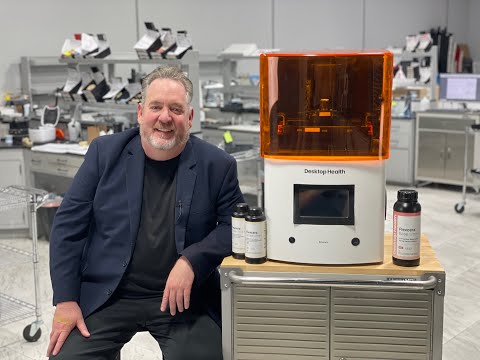
Des matériaux comme la résine dentaire Flexcera Smile Ultra+ peuvent servir à certaines restaurations. Dans une prothèse « all-on-X », le X désigne le nombre d’implants qui soutiennent une prothèse d’arcade, et non le nombre de fausses dents soutenues par cette prothèse.
Le fabricant annonce pour Flexcera Smile Ultra+ une résistance à la déformation supérieure de 70% et une résistance à l’humidité multipliée par 2 dans les comparaisons et essais qu’il précise. Ces résultats sur matériau ne garantissent ni l’absence de rupture ni un ajustement permanent chez chaque patient.

Source : Desktop Health
Cette résine est utilisée avec des équipements de Desktop Health, activité de Desktop Metal, dont Nano Dimension avait annoncé le projet d’acquisition en 2024. La fabrication numérique peut raccourcir les délais, parfois jusqu’à une livraison le lendemain selon le laboratoire, mais ce délai n’est pas universel.
La biotechnologie entre sur le marché dentaire
Éviter certaines interventions et améliorer les prothèses représenterait déjà un progrès pour les patients.
Une autre piste serait de remplacer les dents absentes ou endommagées par de nouvelles dents naturelles.
C’est l’objectif de recherches en biotechnologie visant à réactiver certains mécanismes de développement dentaire. Il reste à établir leur efficacité et leur sécurité chez l’humain.
L’être humain forme naturellement des dents temporaires puis permanentes, tandis que certains animaux remplacent leurs dents tout au long de leur vie. Ces observations inspirent la recherche, mais ne suffisent pas à rendre possible une régénération dentaire chez l’adulte.
À la recherche du gène de la petite souris
Les chercheurs de l’université de Kyoto se sont intéressés aux mécanismes génétiques qui contrôlent le nombre de dents, notamment aux anomalies produisant des dents supplémentaires.
Les protéines morphogénétiques osseuses, ou BMP, participent à de nombreuses étapes du développement, y compris celui des dents. Il ne s’agit pas d’un unique « gène BMP ». Leur rôle étendu rend nécessaire une intervention aussi ciblée que possible.
Les chercheurs ont étudié USAG-1, une protéine qui module notamment les voies BMP et Wnt. Ils ont développé des anticorps monoclonaux capables de perturber son interaction avec BMP afin de favoriser la formation de dents dans les modèles expérimentaux.
(Les anticorps monoclonaux sont utilisés dans de nombreuses thérapies, notamment contre certains cancers et maladies inflammatoires. Pour en savoir plus, consultez « Les anticorps monoclonaux : une thérapie de précision pionnière ».)
Les résultats publiés en 2021 comprenaient des expériences chez la souris et le furet. La conservation de certaines voies biologiques entre espèces motive des essais humains, sans garantir leur succès.
Dents à la demande ?
En 2024, les chercheurs japonais et leurs partenaires du Kitano Hospital à Osaka préparaient un premier essai humain. L’essai de phase I annoncé devait d’abord évaluer une administration unique de TRG035 chez des adultes en bonne santé. Le développement thérapeutique visait ensuite l’agénésie dentaire congénitale. Le traitement des pertes de dents acquises constituait une perspective ultérieure, non une indication déjà démontrée.
L’année 2030 était évoquée comme objectif de développement, pas comme date d’autorisation garantie. Une utilisation courante en 2035 restait également spéculative. Le prix d’un éventuel traitement dentaire ne peut pas être déduit de celui d’anticorps utilisés en cancérologie, dont certains traitements peuvent dépasser 100 000 dollars.
Investir dans la santé dentaire
Les soins dentaires constituent un segment important de la santé. Le vieillissement démographique et l’attention portée à la santé buccale peuvent soutenir la demande, mais la croissance et la rentabilité varient selon les marchés et les entreprises.
Les actions d’entreprises du secteur peuvent être achetées auprès de différents intermédiaires. Sur securities.io, nous présentons des guides de courtiers pour les États-Unis, le Canada, l’Australie, le Royaume-Uni et de nombreux autres pays.
Une autre approche consiste à utiliser des fonds de santé diversifiés, comme iShares U.S. Medical Devices ETF (IHI), SPDR S&P Health Care Services ETF (XHS) ou VanEck Bionic Engineering UCITS ETF (CYBO). Leur exposition est plus large que la seule dentisterie et dépend de leurs positions, de leur disponibilité et du profil de l’investisseur.
Entreprises dentaires
1. Nano Dimension
NNDM Graphique du prix
De nombreuses entreprises de fabrication additive travaillent sur les métaux et les polymères. Nano Dimension (NNDM ) s’est notamment spécialisée dans l’électronique imprimée en 3D, avec des encres conductrices ou diélectriques. Son portefeuille comprend aussi des technologies de fabrication céramique utilisées dans des composants spécialisés.
Ces technologies recoupent certains thèmes abordés dans notre article « L’impression 3D à l’échelle nanométrique se rapproche de la commercialisation ». Toutes les impressions électroniques ne sont toutefois pas réalisées à l’échelle nanométrique.
Nano Dimension s’est développée par des acquisitions et par sa propre recherche et développement.

Source : Nano Dimension
Cette stratégie a franchi une étape avec l’accord annoncé en juillet 2024 pour acquérir Desktop Metal. À la date de l’annonce, l’opération restait soumise à des conditions de réalisation. Le rapprochement envisagé devait élargir l’offre dans les métaux, les céramiques et les applications dentaires.
Alors que la régénération de dents reste expérimentale, les prothèses personnalisées imprimées en 3D constituent déjà un débouché concret. Leur part future du marché dépendra de la qualité clinique, des coûts et de l’adoption par les professionnels.
Le rapprochement envisagé pouvait aussi élargir la clientèle, comprenant notamment SpaceX (SPCX ), Tesla (TSLA ), GE, Honeywell, Emerson, Raytheon, la NASA et Medtronic. Les économies d’échelle restaient un objectif, non un résultat déjà acquis.
Nano Dimension, société israélienne, et Desktop Metal, société américaine, disposaient de réseaux commerciaux différents. Leur intégration pouvait créer des synergies géographiques, sans réduire Nano Dimension à une entreprise européenne.

Source : Nano Dimension
Dans ses comparaisons sur certains procédés de fabrication électronique, Nano Dimension annonçait des réductions pouvant atteindre 94% des émissions de CO2, 100% de l’eau utilisée, 98% des matériaux et 82% des produits chimiques. Ces chiffres sont des affirmations du fabricant liées au périmètre de ses essais, pas un bilan environnemental universel de toute fabrication additive.
Nano Dimension ambitionnait ainsi de renforcer sa place dans la fabrication additive. Sa réussite dépendait notamment de l’intégration des acquisitions, de l’adoption des technologies et de la maîtrise des coûts.

Source : Nano Dimension
Les investisseurs doivent cependant tenir compte des flux de trésorerie négatifs des deux entreprises avant l’opération envisagée. Atteindre la rentabilité nécessiterait une croissance suffisante, des économies ou d’autres améliorations opérationnelles.
2. Align Technology, Inc.
ALGN Graphique du prix
Align développe Invisalign, un système de gouttières transparentes pour certains traitements orthodontiques. Ces dispositifs sont moins visibles que des appareils métalliques, mais peuvent provoquer une gêne et ne conviennent pas à tous les cas. La présentation historique citée faisait état de 15 millions de patients traités, dont 4 millions d’adolescents.
Les améliorations successives et l’adoption des gouttières ont soutenu la croissance. Le taux annuel composé de 23% depuis 2001 cité dans la présentation concerne la période et l’indicateur alors retenus ; il ne prédit pas la croissance future.
De nombreux adultes envisagent un traitement orthodontique, et certains privilégient les gouttières pour leur discrétion. La demande potentielle dépend néanmoins de l’indication médicale, du coût et des préférences des patients.
Align propose également les scanners intraoraux iTero pour créer des modèles numériques des dents. Certains modèles et protocoles peuvent réaliser un relevé rapide, parfois en moins de 60 secondes dans les conditions annoncées, mais la durée varie selon l’appareil et l’examen.
Ces données peuvent aider à concevoir des restaurations ou des prothèses. La précision du résultat dépend aussi de la qualité du relevé et des étapes de fabrication et d’ajustement.
Le système peut s’intégrer à des outils de conception et de fabrication assistées par ordinateur, à des laboratoires dentaires et à d’autres logiciels compatibles.
iTero s’inscrit dans un ensemble de services numériques pour les cabinets, comprenant des outils de gestion, de suivi à distance, de prise de rendez-vous et de communication avec les patients, selon les produits et les marchés.

Source : Align
Invisalign dépend des professionnels dentaires pour prescrire et suivre les traitements, notamment des réseaux de cabinets. Align a annoncé un investissement en fonds propres de 75 millions de dollars dans Heartland Dental en 2023. La présentation citait également 188 ouvertures de cabinets sur trois ans ; ces données sont historiques.
La communication directe d’Invisalign s’appuie notamment sur les réseaux sociaux et les influenceurs pour faire connaître les gouttières. La publicité ne remplace pas l’évaluation clinique ni une information équilibrée sur les résultats possibles.
Align développe également ses outils numériques. Exocad fournit des logiciels de conception dentaire assistée par ordinateur. Des outils distincts, comme les simulations de sourire à partir d’une photo, permettent d’illustrer un résultat possible ; ils ne constituent ni un plan de chirurgie faciale ni une garantie du résultat final.
Investir dans Align revient notamment à miser sur l’adoption de ses solutions orthodontiques et numériques. La concurrence, les coûts, la demande et la valorisation du titre doivent être pris en compte : une forte croissance durable ne peut être considérée comme acquise.



