
Megaprojects
NEOM Green Hydrogen: The World’s Largest Clean Fuel Hub

Securities.io maintains rigorous editorial standards and may receive compensation from reviewed links. We are not a registered investment adviser and this is not investment advice. Please view our affiliate disclosure.

NEOM Between Reduced Ambitions And Progress
When it comes to state-funded megaprojects, skepticism is in order, as more often than not, the ambitions of politicians, dictators, or kings are much grander than what is realistically achievable.
To some extent, it seems that the grandiose NEOM project in Saudi Arabia is falling in this category. Initially planned to be a whole new city in the desert, with a revolutionary linear design, the project is being scaled down due to budget constraints.
(You can see more of what was planned in our article “NEOM: Reinventing Saudi Arabia And What City Means”)
Still, not all of NEOM is being scaled down or canceled. The industrial and energy part of the project is progressing well, with most notably the NEOM Green Hydrogen project almost reaching completion and scheduled to start in mid-2026, ahead of its initial estimate.
The $8.4B project will become one of the world’s largest hydrogen generation plants, and could play a key role in the country’s economic future and in decarbonizing shipping globally.
NEOM Overview
NEOM Update
Persistently low oil prices in the past few years have hit Saudi Arabia’s budget, limiting its ability to finance ambitious projects like NEOM. In addition, it became clear that the timetable for the construction was overly ambitious, as building an entire city out of the desert requires building infrastructure first.
As a result, NEOM is being partially reconsidered, following a royal order in early February 2026 relieving Investment Minister Khalid Al-Falih of his post. This likely indicates a realignment of the country’s investment plans, and a scaling back or postponing of some of the planned investment, including part of NEOM.
The 2029 Asian Winter Games, initially planned to occur in NEOM, are being postponed, with no new timetable.
“Saudi Finance Minister Mohammed AlJadaan said last year that the kingdom had “no ego” when it comes to reassessing the feasibility of some initiatives as it shifts focus to sectors capable of delivering quicker returns, including tourism, religious pilgrimages, industry and artificial intelligence.”
Overall, it seems that the 1.5 million people imagined for NEOM might be reduced to 300,000 people.
“A $5 billion contract in NEOM was canceled just one day before its official signing ceremony. The first phase of “The Line,” originally planned to stretch 170 kilometers, has also been cut to just five kilometers by 2030.”
NEOM’s Industrial Side
Overall, it seems that the housing and tourism part of NEOM is going to take longer than planned, and might be revised to a less ambitious scale. But the megacity part of NEOM (Dubbed “The Line”) was just part of the overall project of modernizing Saudi Arabia and making it less dependent on oil.

Source: NEOM
Another one is the Oxagon, a massive industrial part looking to “reboot” industrial production. The site will be 7 kilometers in width (4.3 miles), and 48 square kilometers in surface (18.5 square miles). It will be 100% powered by renewable energy (4GW capacity), and should be inhabited by 90,000 people.
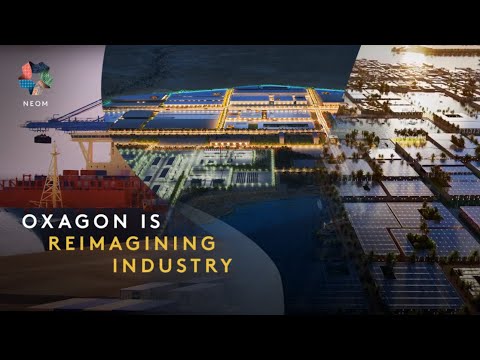
The main focus of the city should be to build “end-to-end new industries”, like renewable energies, semiconductors, data centers & AI, biotechnologies, recycling, etc.
The industrial infrastructure will be supported logistically by 2 million square meters of automated harbor facilities, including a terminal with 1.5 million TEU (Twenty-Foot Equivalent Unit) capacity.
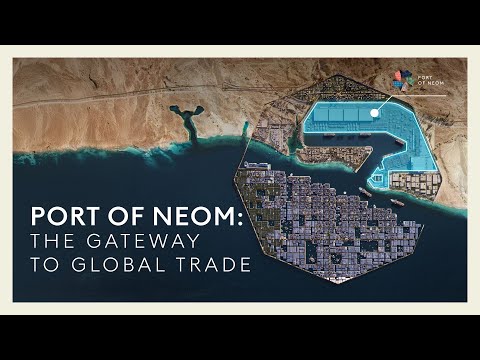
Key infrastructure will include a desalination facility, a hydrogen production plant, 4 GW of renewable energy generation, and a marine research institute.
It is this hydrogen generation plant that is now making the headlines, as it hit the 90% completion in February 2026.
NEOM Green Hydrogen
The Project Itself
The green hydrogen plant is expected to produce as much as 600 tonnes per day of carbon-free hydrogen in the form of green ammonia. This should correspond to 1.2 million tonnes of green ammonia a year.
The project includes 2.2GW worth of electrolyzers and is the first step for the country in becoming a hydrogen giant, as it also recently announced another project not linked to NEOM, the Yanbu 4.4GW hydrogen production plant, scheduled to begin commercial operations by 2030.
Its financing was secured in 2023, and the building of the facility is now being finished, with the first run expected for mid-2026.
This news comes on top of 27 deals for green hydrogen and other technologies signed by ACWA Power, a Saudi Arabian developer, investor and operator of power generation, water desalination, and green hydrogen plants, which include the Yangu hydrogen plant.
Overall, the project is expected to produce enough green fuel to be the equivalent of up to 5 million tonnes of CO2 per year.
Swipe to scroll →
| Metric | NEOM Green Hydrogen |
|---|---|
| Total Investment | $8.4 Billion |
| Electrolyzer Capacity | 2.2 GW |
| Hydrogen Output | 600 tonnes/day |
| Ammonia Output | 1.2M tonnes/year |
| Commercial Launch | Mid-2026 (expected) |
| Exclusive Offtaker | Air Products |
Current Green Hydrogen Markets
Currently, the green ammonia produced at the plant is planned for export, with Air Products as the exclusive off-taker, via a dedicated jetty to load the cargo abroad. This is because currently, green hydrogen and ammonia are mainly used for applications that currently use so-called “grey” hydrogen, mostly chemical processes.
Another international market is also opening, green steel production, where green hydrogen is used to refine and prepare raw iron into green steel, removing the need for coking coal entirely.
Another likely usage in the longer run is to directly power industries in the Octagon Industrial Park.
This can be done directly through burning the hydrogen or ammonia, or indirectly, using the fuel production as a long-duration “battery” to supplement solar production at night or during low production periods.
In the long run, another much larger market could be fueling a significant portion of international shipping not with oil, Saudi Arabia’s current main export, but green ammonia.
Red Sea Shipping Lanes
Until the recent conflict with the Houthis, the Red Sea was one of the world’s busiest trade lanes, bypassing the whole of Africa for all trade between Europe and the Middle East (including the Persian Gulf oil & gas) and Asia.

Source: Next Big Future
So far, these ships have been refueling with oil at various ports all over the world. But as the world is decarbonizing, shipping too is trying to reduce its environmental impact.
However, this is a lot easier said than done. A big reason is that weeks-long travels by sea absolutely require the energy density of liquid fuels, at least as long as we are not using nuclear energy, a proposition not seriously considered for cargo ships.
Batteries, hydrogen, or other forms of electrification simply are not light and small enough to work for the shipping industry, and are likely to stay this way.
So the most likely low-carbon alternative to fossil fuels, especially the dirty bunker oil used by ships, will need to be either:
- Artificial fuels, chemically identical to normal oil but produced from hydrogen and CO2.
- This option helps to “green” older ships, without requiring a new engine, but is more expensive.
- Green ammonia, which will be directly burned to power the ship’s engine.
- This is cheaper than synthetic fuel, and provides a fuel that is safer, denser, easier to store and transfer, and more stable than hydrogen.
- However, it requires new types of ship engines, so the transition is likely to occur slowly.
Located on the Red Sea coast, NEOM and the future Yangu hydrogen generation power plant are ideally located to provide refueling to the passing cargo ships on their way between Europe and Asia.
The overabundance of sun in the Saudi desert is an extra bonus, as the so-far almost completely unused massive space can be turned into a giant solar power plant, which in turn can be used to power massive green ammonia generation.
Saudi Arabia’s Green Transition
So in the coming decades, the NEOM hydrogen power plant could become the next step of Saudi Arabia’s economy, turning from a massive fossil fuel producer to a massive shipping fuel producer, but this time depending on the country’s large size and climate, instead of its underground natural resources.
This would also be a more natural evolution of the country’s economy, as the transition from a major fossil energy exporter to a major green energy exporter could be quite smooth.
This is especially true as manipulating and processing massive volumes of energy-rich gas and liquid requires a very similar skillset for both oil & gas or green hydrogen & ammonia.
This also means that it does not really matter for investors if NEOM manages to create a whole new type of city, with major industrial hubs focused on the knowledge economy and advanced technology.
Even if this plan fails, the export potential for green hydrogen, potential local green steel production, and refueling a large bulk of the world’s ships with green ammonia will benefit from the local abundant sunlight and low cost of energy.
Investing In NEOM Green Hydrogen
Air Products and Chemicals, Inc.
(APD )
Among American companies, Air Products & Chemicals is one of the important partners of NEOM, with a role in the creation of what should be the world’s largest green hydrogen plant, in collaboration with the German industrial group Thyssenkrupp (TKA.DE).
Founded in 1940, Air Products & Chemicals was a producer of purified gas, starting with oxygen used for high-elevation flights of the US and Allied Air Forces.
Today, Air Products & Chemicals is the #1 supplier of hydrogen in the world, with $12.1B in sales in 2024. This also made it the perfect partner for distributing the production of the world’s largest hydrogen production plant.
The company is active in 50 countries, controls 1,800 miles of industrial gas pipelines, and produces from 750+ facilities.

Source: Air Products & Chemicals
Most of the sales are very stable, embedded into the company’s clients’ industrial process, with contracts lasting 15-20 years.

Source: Air Products & Chemicals
Its expertise in hydrogen might also make it a key actor in the replacement of fossil fuels by hydrogen or ammonia, including for shipping, as a key partner for shipping companies.
While NEOM makes for a large part of Air Products’ future projects, it is also not the only one, limiting the risks and with stable and then decreasing capex in the coming years.

Source: Air Products & Chemicals
The company has been growing its dividends for 40+ years consecutively, demonstrating its commitment to shareholders.
So it could be a good bet to capitalize on NEOM as a green energy hub for ammonia production, irrespective of the cost overruns or delays affecting The Line, with the Oxagon a much more important part of the project for the company.
NEOM Green Hydrogen represents one of the largest real-world tests of green ammonia as a global shipping fuel. For investors, diversified exposure through Air Products offers lower volatility access, while electrolyzer manufacturers and regional developers may offer higher beta opportunities tied to hydrogen infrastructure scaling.
Latest Air Products and Chemicals (APD) Stock News and Developments



