Science des matériaux
Les bandes plates des métaux kagome pourraient ouvrir la voie aux supraconducteurs de demain

 Ajouter Securities.io à vos sources préférées sur Google

Nouveaux progrès dans les supraconducteurs kagome
Les supraconducteurs transportent l’électricité sans résistance, mais ils ne fonctionnent jusqu’ici que dans des conditions extrêmes. Les métaux kagome pourraient changer la donne. »
Pour comprendre cette avancée, il faut d’abord rappeler le fonctionnement de ces matériaux.
En novembre 2024, nous avons discuté d’un nouveau matériau pour de nouvelles théories magnétiques, développé par des chercheurs de l’Université Rice.
Cette découverte s’appuie une publication de 2022sur une étude de 2022 dans laquelle les chercheurs ont constaté que «le matériau kagome», un type de cristal métallique, présente des propriétés magnétiques surprenantes.
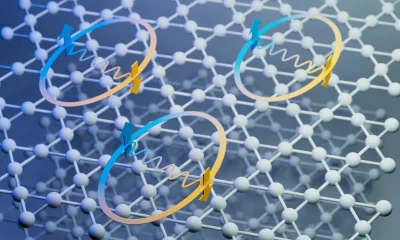
Le nom vient du motif de tressage kagome de l’artisanat japonais traditionnel, ou pavage trihexagonal, composé de triangles superposés et de grands vides hexagonaux.

Source: Research Gate
De même, les matériaux kagome, comme les cristaux magnétiques de fer-germanium, sont organisés selon ce motif à l’échelle atomique.
Selon le dernier article de chercheurs de l’Université Rice, publié dans Nature Communications, un autre métal kagome à base de chrome, CsCr₃Sb₅ (césium-chrome-antimoine), présente un potentiel considérable pour de futurs composants électroniques, notamment les supraconducteurs, les isolants topologiques et l’électronique fondée sur le spin1, sous le titre «Spin excitations and flat electronic bands in a Cr-based kagome superconductor».
Propriétés magnétiques et électroniques des matériaux kagome
Dès 2022, plusieurs propriétés singulières des matériaux kagome avaient été observées :
- Les effets magnétiques exigent que les électrons circulent autour des triangles kagome, comme dans la supraconductivité.
- Bien que ces effets magnétiques et ces ondes de densité de charge ne constituent pas une supraconductivité au sens classique, les chercheurs ont confirmé qu’ils peuvent persister dans les matériaux kagome à température et pression ambiantes. Ils représentent donc des étapes importantes vers la découverte de supraconducteurs fonctionnant à plus haute température.
- La présence d’une «onde de densité de charge», dans laquelle les électrons « fusionnent » en une onde collective qui transporte le courant électrique.
- Contrairement à une supraconductivité « normale », le phénomène apparaît par impulsions, comme l’eau qui goutte d’un robinet, plutôt que sous la forme d’un flux continu d’électrons.
- Malgré leurs ondes de densité de charge, les matériaux kagome présentent aussi des propriétés magnétiques, deux caractéristiques généralement incompatibles.
La structure très ordonnée des matériaux kagome pourrait faciliter l’étude de phénomènes situés aux limites de notre compréhension de l’électromagnétisme, tels que la «supraconductivité non conventionnelle» ou «les fluctuations permanentes entre états magnétiques dans les liquides de spin quantiques».
Fabrication d’un supraconducteur kagome
Bande plate Électrons
Électrons à bande plate sont des électrons situés dans un type particulier de bande d’énergie à énergie constante, dite à dispersion « plate » : leur énergie cinétique reste identique quelle que soit leur quantité de mouvement.
En termes moins techniques, il s’agit d’un état extrêmement dense dans lequel les électrons peuvent se comporter comme dans un supraconducteur, sans les conditions habituellement nécessaires, telles qu’une température extrêmement basse ou une pression très élevée.
Jusqu’ici, il était difficile de stabiliser les réseaux kagome afin d’amener les bandes plates au niveau d’énergie requis. L’utilisation de CsCr₃Sb₅ a changé la situation.
« Nos résultats confirment une prédiction théorique surprenante et ouvrent une voie pour concevoir une supraconductivité exotique grâce au contrôle chimique et structurel. »
Pengcheng Dai – Département de physique et d’astronomie de l’Université Rice
Construire le bon cristal
CsCr₃Sb₅ cristallise naturellement sous la forme d’un réseau hexagonal stratifié.

Source: Nature Communications
Pour observer l’effet à grande échelle et obtenir un matériau utilisable dans de futures applications commerciales, il fallait toutefois disposer d’un cristal bien plus grand.
En perfectionnant leurs méthodes précédentes, les chercheurs ont réussi à produire des échantillons cent fois plus grands.
Analyse ARPES et RIXS du supraconducteur kagome CsCr₃Sb₅
Pour visualiser la structure électronique de CsCr₃Sb₅, les chercheurs ont utilisé la spectroscopie de photoémission résolue en angle (ARPES). Cette technique cartographie les électrons à l’aide de la lumière produite par un accélérateur de particules, ou synchrotron.

Source: Nature Communications
Les mesures ont révélé des signatures distinctes associées à des orbitales moléculaires compactes, signe de bandes électroniques plates, et confirmé que toutes les géométries de polarisation contribuent à la formation de ces bandes.
« Les résultats ARPES et RIXS de notre équipe offrent une image cohérente : les bandes plates ne sont pas de simples spectatrices, mais participent activement à la formation du paysage magnétique et électronique. »
Qimiao Si – Département de physique et d’astronomie de l’Université Rice
Les chercheurs ont ensuite utilisé la diffusion inélastique résonante des rayons X (RIXS) pour mesurer les états d’excitation magnétique.
Cette mesure a elle aussi confirmé la présence de bandes plates, indépendamment des résultats ARPES.

Source: Nature Communications
Effets de la température sur le potentiel de supraconductivité kagome
Les scientifiques ont ensuite étudié l’effet des variations de température sur les propriétés du nouveau matériau.
Contrairement à d’autres matériaux supraconducteurs potentiels, ses propriétés étaient meilleures à 140°K (-133°C / -207°F) qu’à 10°K (-263°C / -441°F).

Source: Nature Communications
Dans l’ensemble, ces expériences ont non seulement identifié un nouveau matériau très prometteur, mais aussi montré que la géométrie du réseau est directement liée à l’émergence d’états quantiques.
« En identifiant des bandes plates actives, nous avons démontré un lien direct entre la géométrie du réseau et l’émergence d’états quantiques. »
Ming Yi – Université Rice, professeur associé de physiqueet d’astronomie
Applications potentielles
La densité d’états des bandes plates se situe à des niveaux d’énergie proches d’un point critique quantique, ce qui pourrait permettre la supraconductivité.
Il s’agit également d’une amélioration par rapport aux réseaux métalliques kagome précédents, car les bandes plates kagome offrent une forte densité d’états sur une partie beaucoup plus vaste du matériau.
CsCr₃Sb₅ supprime aussi l’onde de densité observée dans d’autres matériaux kagome, renforçant encore son potentiel supraconducteur.
Un supraconducteur kagome fonctionnant à haute température ou à température ambiante révolutionnerait l’informatique quantique, les composants spintroniques à faible consommation et les matériaux topologiques (similaire au nouvel état de la matière développé par Microsoft (MSFT ) équipe de calcul quantique).
Même en tant que « simple » supraconducteur à haute température, il pourrait servir aux trains à sustentation magnétique, aux technologies militaires et à la production d’électricité.
Glissez pour faire défiler →
| Application | Avantage des supraconducteurs kagome |
|---|---|
| Informatique quantique | Qubits stables provenant d’états à bande plate |
| Spintronique | Mémoire magnétique à faible énergie & logique |
| Maglev & Transport | Voyage à grande vitesse, sans friction |
| Technologie militaire | Systèmes furtifs & à faible consommation d’énergie |
| Production d’énergie | Réduction des pertes du réseau, efficacité accrue |
Entreprises de pointe dans les solutions supraconductrices
AMSC Graphique du prix
AMSC est une entreprise qui fournit des solutions énergétiques pour le réseau électrique, les navires et l’énergie éolienne. En général, plus un système consomme d’énergie ou est massif, plus il nécessite une technologie supraconductrice pour éviter la surchauffe.
Malgré son nom, AMSC fournit non seulement des systèmes supraconducteurs, mais aussi, par exemple, des transmissions à engrenages pour éoliennes.
L’entreprise bénéficie de plusieurs moteurs de croissance, de la tendance à l’électrification et à la numérisation (y compris les centres de données IA), mais aussi du rapatriement des capacités de fabrication américaines et du besoin pour les marines du monde anglophone de se moderniser face aux risques géopolitiques croissants.

Dans le segment de l’alimentation électrique, AMSC a constaté une hausse constante des commandes. Cela a été stimulé par les usines de semi-conducteurs cherchant à être protégées des fluctuations du réseau, à aider le réseau à gérer la nature intermittente des énergies renouvelables, ainsi que par l’alimentation et les contrôles sur les sites industriels.
Dans le segment des éoliennes, AMSC est principalement actif avec son Système de Contrôle Électrique (ECS). Historiquement, l’ESC était un segment fort pour l’entreprise avec les éoliennes de 2 MW, mais il a progressivement décliné. AMSC vise un rebond grâce au nouveau design d’éolienne de 3 MW, avec un accent particulier sur le marché indien.

Pour les navires militaires, AMSC fournit son système supraconducteur à haute température de lutte contre les mines magnétiques, qui modifie la signature magnétique des bâtiments afin de les protéger des mines marines. Il équipe les marines américaine, canadienne et britannique, pour un montant de commandes atteignant 75 millions de dollars.
Dans l’ensemble, AMSC est l’une des entreprises les plus avancées dans l’exploitation de la supraconductivité pour des applications de niche déjà viables, tout en étant bien placée pour adopter de futurs progrès. Les investisseurs doivent néanmoins tenir compte de la forte volatilité passée du titre.
Dernières actualités et performances de l’action American Superconductor Corporation (AMSC)
Étude référencée
1. Wang, Z., Guo, Y., Huang, HY. et al. Spin excitations and flat electronic bands in a Cr-based kagome superconductor. Nature Communications 16, 7573 (2025). https://doi.org/10.1038/s41467-025-62298-5