
Robotik
Ultraschallmuskeln: Die Zukunft der weichen Robotik

 Securities.io zu deinen bevorzugten Quellen auf Google hinzufügen

Aufbau schallgesteuerter Muskeln
Während des größten Teils der Geschichte wurde mechanische Energie von Muskeln bereitgestellt, sei es von Menschen oder Tieren. Erst mit dem Beginn der Industriellen Revolution konnte Energie aus Wind (Windmühlen), Wasser (Wassermühlen und Dämme) und Verbrennung (Dampfmaschinen, Verbrennungsmotoren) gewonnen werden.
Aber diese mechanischen Systeme waren stets etwas minderwertig gegenüber natürlicher Bewegung und erforderten komplexe Systeme und Wartung, um im Vergleich eine relativ geringe Bewegungsfreiheit zu erreichen.
Dies ist nach wie vor ein Problem für Roboter, die in der Regel sehr komplexe Anordnungen von Elektromotoren und fortschrittliche Software benötigen, um aufrecht zu bleiben. Das Problem besteht allgemein darin, eine vollständig kontrollierbare und ausreichend flexible Bewegung zu erzeugen.
Da der Muskel eine so überlegene Methode zur Erzeugung von Bewegung darstellt, haben Wissenschaftler versucht, eine künstliche Variante zu entwickeln, die mit Strom betrieben werden kann. Bisher haben vorgeschlagene Materialien in Bezug auf Leistung, Kosten oder Fertigungsverfahren immer wieder nicht überzeugt.
Dies könnte sich ändern, dank eines neuen Designs für künstliche Muskeln, das von Forschern der ETH Zürich (Schweiz), der Universität Münster (Deutschland) und der University of Nebraska‑Lincoln (USA) vorgeschlagen wurde.
Sie veröffentlichten im renommierten Fachjournal Nature1 unter dem Titel “Ultraschallgesteuerte programmierbare künstliche Muskeln”.
Wie Ultraschallgesteuerte Muskeln funktionieren
Muskeln funktionieren, indem sie ihre Länge vergrößern oder verkleinern und dabei am jeweiligen Knochen ziehen, an dem sie befestigt sind.

Bislang haben künstliche Muskeln versucht, diese Idee mit verschiedenen Materialarten nachzuahmen:
- Kohlenstoffnanoröhren
- Formgedächtnislegierungen
- Pneumatik (Luft) oder Hydrauliksysteme
All diese Systeme litten entweder unter mangelnder Zuverlässigkeit, ungenauer Steuerung, hohem Energieverbrauch oder zu hohen Kosten.
„Chemische Methoden erfordern oft potenziell toxische Brennstoffe, lichtbasierte Systeme leiden unter begrenzter Gewebepenetration und möglicher thermischer Schädigung, und magnetische Systeme benötigen sperrige Hardware und bergen das Risiko von Joule‑Erwärmung.“
Die Forscher dieser Studie gingen in eine neue und andere Richtung, um den künstlichen Muskel zu steuern: über Schall.
Die Vorteile von Ultraschall
Ob für Anwendungen in der Robotik oder bei biomedizinischen Implantaten, Ultraschall hat den Vorteil, dass er eine leicht zu erzeugende Steuerungsmethode ist, die völlig nicht‑destruktiv ist.
Ultraschall ist zudem drahtlos, fernsteuerbar, dringt harmlos durch äußere Schichten (einschließlich organischer Gewebe) und bietet eine hohe räumliche Selektivität (Zielgenauigkeit).
Es ist außerdem eine Technologie, die häufig zu geringen Kosten eingesetzt wird, auch im klinischen Umfeld.
Insgesamt ist Ultraschall perfekt für biomedizinische und In‑vivo‑Anwendungen, kann aber auch in anderen Bereichen wie der Robotik, insbesondere der sogenannten weichen Robotik, eingesetzt werden.
Ultraschall wird bei Forschern immer beliebter, die ihn nutzen, um medizinische Implantate drahtlos zu betreiben, um lebendes Gewebe zu biodrucken und für Biomonitoring.
Mikrobläschenmaterialien in künstlichen Muskeln
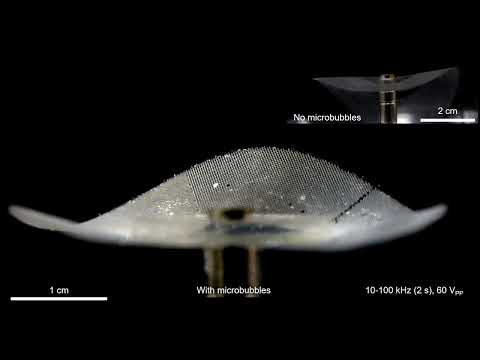
In dieser Studie entwickelten die Forscher ein Material, das ein präzise hergestelltes Array von Mikrobläschen enthält, das bei Anregung mit der richtigen Ultraschall‑Resonanz das Material zum Biegen bringt.

Quelle: Nature
Durch Variieren der Größe des Mikrobläschen‑Arrays kann geändert werden, auf welche Ultraschallfrequenz ein bestimmter Abschnitt des Materials reagiert.

Quelle: Nature
Bisher war die durch Ultraschall in künstlichen Muskeln erzeugte Kraft zu schwach für praktische Anwendungen. Dieses neue Design ist jedoch deutlich stärker (7,6 μN/mm2) und bringt ein solches Konzept an die Spitze potenzieller künstlicher Muskelmaterialien.
Ein hochauflösendes Formteil wurde mit Mikropillar‑Arrays erstellt, die mittels Soft‑Lithografie auf einem Siliziumwafer strukturiert wurden, um als Negativformen für zylindrische Mikrolöcher zu dienen.
Anschließend wurde eine dünne Schicht Polydimethylsiloxan (PDMS) auf den Wafer gesponnen, wodurch das gewünschte Mikrobläschen‑Material entstand.
Das Endmaterial bildete einen künstlichen Muskel (3 cm × 0,5 cm × 80 μm), der über 10.000 einheitliche Mikrobläschen in Hohlräumen (40 μm Durchmesser, 50 μm Tiefe) enthält.
Erzeugung kontrollierter Bewegung mit Ultraschall
Da verschiedene Teile des Materials auf unterschiedliche Frequenzen reagieren, kann die Modulation des Ultraschalls genutzt werden, um beispielsweise eine präzise gesteuerte Wellbewegung zu erzeugen. Die Forscher testeten zudem die Interaktion des Materials mit der realen Welt, indem sie damit eine Fischlarve fingen, eine Mandel rotieren ließen oder ein Grashalm bewegten. Es zeigte sich außerdem, dass die Methode für lebende Organismen harmlos ist, ohne Erwärmung oder negative Effekte durch den Ultraschall.

Die Forscher prüften anschließend, ob das Material zum Anhaften und Bewegen von organischem Gewebe verwendet werden kann. Zu diesem Zweck testeten sie es an einem Schweineherzen. Die ultraschallgesteuerten Aktuatoren blieben haften und bewegten sich weiter, wobei sie Kraft auf das Gewebe übertrugen.

Quelle: Nature
Sie testeten außerdem das Potenzial des Materials für die Medikamentenabgabe, wobei Ultraschall als Auslöser für die Freisetzung des Materials aus dem Mikrobläschen‑Patch diente.
Bewegung von In‑vivo‑Robotern
Abschließend entwickelten die Forscher einen „Mini‑Rochen‑Bot“, dessen Wellbewegungen die Fortbewegung in einer flüssigen Umgebung steuern können.

Quelle: Nature
Sie testeten anschließend erfolgreich die Bewegung des Rochen‑Bots im Magen und Darm eines Schweins.
Nach dem Loslassen bewegt sich der Rochen‑Bot mit einer Anfangsgeschwindigkeit von etwa 0,8 Körperlängen pro Sekunde vorwärts und demonstriert damit die Fähigkeit des Systems, sich innerhalb der inneren Organe eines Tieres zu bewegen.

Quelle: Nature
Insgesamt bestätigten diese Experimente das Potenzial des Materials für den In‑vivo‑Einsatz von drahtlosen und tragbaren Geräten.
Anwendungen
Die Studie konzentrierte sich auf potenzielle biomedizinische Anwendungen, da dies die naheliegendste Anwendung dieser Technologie sein könnte. Weiche Robotik wird zunehmend eingesetzt, um Materialien in der Medizin zu integrieren, beispielsweise um Antikrebstherapien oder andere Behandlungen gezielt an das richtige Organ zu liefern.
Diese Methode kann zudem auf größere Bauteile, mindestens bis zur Zentimeterskala, ausgeweitet werden und bietet viele Freiheitsgrade der Bewegung.
Zukünftig könnten solche künstlichen Muskeln für Robotik, flexible Elektronik, tragbare Technologien, Prothetik, biomedizinische Instrumentierung usw. eingesetzt werden.
Weitere Verbesserungen könnten dieses Konzept noch leistungsfähiger und nützlicher machen:
- Es scheint, dass konvergierende trapezförmige Hohlräume etwa dreimal stärkere Strömungsgeschwindigkeiten erzeugen als divergierende Formen. Eine Optimierung von Geometrie und Dichte könnte daher Aktuatoren mit maßgeschneiderten Deformationsprofilen erzeugen.
- Eine konfokale Schallquelle könnte stärkere Deformationen und eine präzisere Zielrichtung eines bestimmten Teils des künstlichen Muskels erreichen.
- Hydrogele und biologisch abbaubare Polymere könnten ebenfalls für weitere biomedizinische Anwendungen eingesetzt werden.
Wischen zum Scrollen →
| Anwendungsbereich | Beispielanwendung | Adoptionspotenzial |
|---|---|---|
| Weiche Robotik | Flexible Greifer und Laufroboter | Hoch |
| Biomedizinische Implantate | Drahtlose Aktuation für innere Gewebe | Sehr hoch |
| Medikamentenabgabe | Ultraschall‑ausgelöste Freisetzungsmechanismen | Hoch |
| Tragbare Geräte | Intelligente Patches und haptische Rückmeldesysteme | Mittel |
| Prothesen | Integration künstlicher Muskeln für lebensnahe Bewegung | Hoch |
Investieren in HealthTech
PHG Preisdiagramm
Philips ist eine bekannte Marke für Kleinelektronik im Konsumgüterbereich (Rasierer, elektrische Zahnbürsten) und zugleich im Gesundheitswesen aktiv. Beispielsweise war das Unternehmen 2022 in Europa das führende Unternehmen bei MedTech‑Patentanmeldungen und in den folgenden Jahren unter den Top 3.
Es ist in vernetzten Medizinprodukten aktiv, von Wearables über Bildgebung bis hin zu Beatmungsgeräten und medizinischen Robotern.
Das Unternehmen ist zudem im Bereich Halbleiter (einschließlich Magnetschwebetechnik) sowie Hoch‑Tech/Robotik/Automatisierung tätig, wobei alle Aktivitäten auf einer gemeinsamen technologischen Basis beruhen.

Quelle: Philips
Philips bietet Wearables für kardiale, respiratorische und Aktivitätsmetriken an. Seine Sensoren können in Smartwatches, Gesundheitsmonitoren, medizinischen Patches und Aktivitätstrackern integriert werden.
Philips’ Fachwissen in biokompatiblen Sensoren, Halbleitern und drahtlosen Lösungen könnte es zu einem führenden Anbieter fortschrittlicher medizinischer Implantate machen, die Ultraschall nutzen.
Für Medizinprodukte bevorzugt Philips eine Partnerschaftslösung, bei der es für Dritte deren vernetzte IoT‑Medizingeräte entwickelt, die vollständig mit den übrigen Philips‑Lösungen kompatibel sind. In diesem Kontext bietet es seinen Kunden Prototyping, regulatorische Beratung, End‑to‑End‑Produktentwicklung und Produktion im industriellen Maßstab.
Damit ist Philips ein technologieorientiertes Unternehmen und ein wahrscheinlicher Kandidat, neue Innovationen schnell in bereits bestehende Medizinprodukte zu integrieren. Insgesamt beeinflussen Philips‑Geräte direkt über 1,8 Milliarden Menschen.
Das Unternehmen möchte ein vollständig integriertes digitales Gesundheitsumfeld schaffen, in dem Sensoren zu Geräten passen und mehrere Konnektivitätslösungen genutzt werden, um in die Philips HealthSuite‑Cloud‑Lösung zu integrieren und tiefgehende Datenanalysen zu ermöglichen.

Quelle: Philips
Als MedTech‑Industriezulieferer, der häufig für andere Marken produziert, ist Philips im Sektor nicht so sichtbar wie andere, bekanntere Unternehmen. Dennoch ist es ein Experte im Bau von Hochleistungs‑Elektronikgeräten und Sensoren und erweitert häufig die Grenzen des Möglichen in seinem Nischenbereich Gesundheit und Wearables.
Da Wearables und medizinische Elektronik zunehmend in Gesundheits‑ und medizinische Protokolle integriert werden, wird Philips’ Healthcare‑Segment voraussichtlich als Teil des Konglomerats wachsen.
Neueste Koninklijke Philips N.V.( PHG) Aktiennachrichten und Entwicklungen
Studie referenziert
1. Shi, Z., Zhang, Z., Schnermann, J. et al. Ultraschallgesteuerte programmierbare künstliche Muskeln. Nature 646, 1096–1104 (2025). https://doi.org/10.1038/s41586-025-09650-3



