
에너지
우라늄 매장량이 캐나다가 미래 친환경 에너지의 주요 플레이어가 될 준비가 되었음을 시사한다

 Securities.io를 Google의 선호 소스에 추가

핵 재생을 이끄는 힘
When talking about green energy, solar and wind power are usually included, along with maybe geothermal. However, nuclear energy is increasingly being included. This is because nuclear energy is equally low in carbon emissions, which is the main reason for the push toward renewables.
It is also able to produce energy continuously and in a very predictable fashion, no matter the weather, something renewables are still struggling to do without 비싼 유틸리티 규모 배터리 팩.
And the need to decarbonize our power source is urgent enough that the massive amount of oil, gas, and coal, still the large majority of our energy mix, should also be replaced by available nuclear power, instead of waiting too long for battery technology maturity and deployment to be ready.

But nuclear power plants need to be supplied with uranium, a resource increasingly at the mercy of geopolitical adversaries of the West like China and Russia. Luckily, one country is picking up the slack: Canada.
우라늄, 전략적 자원으로서
Uranium has been a strategic resource since the dawn of the nuclear age, and the USA’s access to large amounts of ore was a key factor in the success of the Manhattan Project, which led to the development of the first atomic bombs.
The destructive power of the atom made the production or access to a sufficient amount of uranium a vital national interest for all the great powers, from the USA & The Soviet Union to France, the UK, China, etc.
After the end of the Cold War and the dismantling of parts of the nuclear arsenals, uranium became a more “boring” commodity, frequently supplied in large amounts to the USA and Western powers by Russia and former Soviet Union countries like Kazakhstan.
Today, a massive part of the world’s nuclear supply comes from Kazakhstan, often refined into usable fuel in Russia. The differential between the supply of mined and demand by nuclear power plants was caused by the uranium supplied by disarmed nuclear bombs.

새로운 불안정한 세계 질서
The post-Cold War era is certainly over, with great powers like Russia and China challenging the US and its allies. This has a few consequences for the uranium markets.
The first is that the supply from atomic bomb dismantling, which had already slowed down drastically, is over. Not only that, but it is likely that nuclear weapons are going to be net consumers of uranium moving forward, especially with China rapidly building up a nuclear arsenal of up to 1,000 bombs by 2030:
“China is undergoing the most rapid expansion and ambitious modernization of its nuclear forces in history.
Compared to the PLA’s nuclear modernization efforts a decade ago, current efforts dwarf previous attempts in both scale and complexity.”
It should also be noted that this is still a lot smaller than the US and Russian nuclear bomb stockpiles, respectively, 3,748 and 5,580 warheads, maybe indicating that China will keep this effort or even accelerate it.
After all, at the peak of the Cold War, the Soviet Union had 46,000 warheads and the US 31,225, which explains why disarmament could provide the market with surplus uranium for decades post-1990.
우라늄, 지정학적 무기로서
The supply of uranium to Western nations by Russia, using Kazakh and Uzbek ore, has been a hot topic since the beginning of the Ukraine war.
The US banned the import of Russian uranium in 2024년 5월 (but authorized temporary exemptions), Niger (the world’s 7th largest producer) revoked the license of a major uranium mine belonging to the French company Orano after a pro-Russian coup in the country, and Putin said Russia is considering uranium export restrictions in 2024년 9월.
In 2024년 11월, Russia announced it would stop exporting uranium to the USA entirely.
This could be a big deal, as the USA imports a lot of the uranium feeding its nuclear power plants, with its largest suppliers being Canada (27%), Kazakhstan (25%), Russia (12%), Uzbekistan (11%) and Australia (6%).

출처: EIA
Kazakhstan’s main uranium miner, Kazatomprom, recently hinted that it might stop exporting to the West altogether due to sanctions on Russia making exports difficult logistically:
“It is much easier for us to sell most, if not all, of our production to our Asian partners — I wouldn’t call [out] the specific country . . . They can eat up almost all of our production or our partners to the north.”
Meirzhan Yussupov – Kazatomprom’s CEO
Kazatomprom’s declaration also comes in parallel to China’s plan to build a massive park of 100+ nuclear power plants for the decades to come, essentially guaranteeing rising Chinese demand, even without taking into account China’s nuclear weapon build-up.
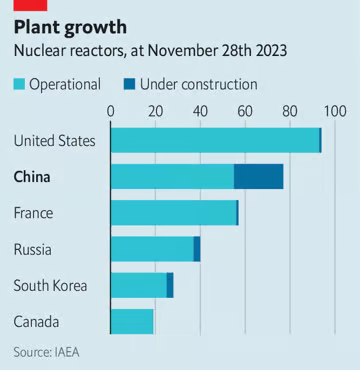
출처: The Economist
Nuclear power plants supply the US with 19% of its electricity, almost as much as renewables (21%). So it is clear that a lot of Eurasian uranium supply will need to be replaced by more reliable and safe sources, and urgently.
캐나다, 서방의 우라늄 수도가 되다
Canada, especially the Athabasca Basin in the northern Saskatchewan region, is very rich in uranium, with ore rich enough to be commercially viable. The high-grade ore generally makes production cheaper, more ecological, and easier to scale up.
Source: Denison
“Uranium can be found around the world, though it is heavily present in Canada, Australia, and Kazakhstan.
But what makes Canada’s Athabasca Region unique is that its uranium is especially high grade.“
This includes several active uranium mines like Cameco’s (CCJ ) Rabbit Lake and Mc Arthur River, and many other proposed mines.

The country also has several nuclear fuel cycle installations, that turn the raw uranium ore into richer usable nuclear fuel. So overall, Canada is already a one-stop shop for nuclear fuel, with the potential to keep growing bigger.
The large deposits in the Athabasca Basin and the growing demand for uranium have created a rush for new mining projects.
They are going to sit together with the existing massive production from Cameco, the 2nd largest uranium producer in the world, which we cover in detail in a dedicated article: “Cameco (CCJ) Spotlight: The Foundation of the Western Nuclear Renaissance”. Cameco also 2022년부터 Westinghouse의 49%를 보유, making it both a Canadian uranium mining stock and a leading nuclear powerplant manufacturer.
새로운 캐나다 우라늄 프로젝트
넥스트젠
NXE 가격 차트
One of the largest future uranium mines in Canada is NextGen, a potentially massive mining company that, if fully cleared by regulators, could push Canada to become the world’s largest producer of uranium over the coming decade, knocking Kazakhstan out of the number one spot. By itself, it could provide up to 50% of Western supply.
This is a very ambitious project tapping into a massive deposit, which could make NextGen the world’s largest supplier of uranium.

출처: NextGen
Ultimately, NexGen’s uranium production is expected to be enough to power 46 million homes (1/3rd of the US), with 300 million tons of CO2 emissions avoided, or the equivalent of 70 million cars off the roads every years.
데니슨 마인즈
DNN 가격 차트
The company’s flagship project is the Wheeler River 프로젝트, which includes the Phoenix and Gryphon uranium deposits. The first production is targeted for 2027-2028.
It owns 69.44% of the Waterbury Lake project.
A key feature of the Denison mines project is that they are forecasted to be very low cost, some even competitive with the very cheap-to-operate Kazakh mines.

출처: Denison Mines
The company also has an interest (22.5%) in the McClean Lake Uranium Mill & Mines. This facility processes 11% of the global uranium. It also already has approval for expanded tailing (mining residues), giving the potential to increase production in response to an increase in Canadian uranium production.
The company also has various minor participation in other uranium potential projects, including 22.5% in McClean Lake (Orano), 25.17% in Midwest (Orano), and 15% in Millennium (Cameco).
팔라딘 에너지
PDN 가격 차트
Contrary to many other Canadian junior uranium miners, Paladin is already producing some uranium from the Langer Heinrich Mine (LHM) in Namibia, which was put in care & maintenance in 2018 and restarted production in 2024. LHM is owned 75% by Paladin and 25% by the Chinese national company CNNC.
However, the core of the future business will be the Michelin Project, which will concern six uranium deposits, some of the largest in North America, with a total of 127.7Mlb of mineral resources.
And here too contrary to most Canadian uranium companies, Paladin Michelin Project is located in Labrador, in the East of the country. It is also doing exploration for projects in Australia (Mount Isa and Manyingee).

출처: Paladin Energy
Paladin is looking 인수하려는 사스카처원 우라늄 개발사 Fission for C$1.1 billion, 하지만 이 거래는 현재캐나다 혁신·과학·산업부 장관에 의한 확대된 국가 안보 검토.



