
에너지
4세대 원자력: 더 저렴하고, 더 깨끗하며, 더 안전하게

 Securities.io를 Google의 선호 소스에 추가

공상과학에서 정체까지
Saying that nuclear energy is controversial is an understatement. Many see it as an extremely dangerous idea, bringing up the specter of Chernobyl and Fukushima as proof, and the problem of nuclear waste as something unsolvable. Others see it as a potential civilization-saving technology, thanks to its ability to generate baseload power with extremely low carbon emissions and land footprint.
이러한 분열은 기후 변화가 논의되기 전부터 이미 존재했습니다.
세계는 히로시마와 나가사키에 대한 원자폭탄 투하를 통해 핵의 엄청난 힘을 처음 인식했으며, 곧 H-폭탄과 냉전이 뒤따랐습니다. 이러한 기원에서 원자에 대한 새로운 통제력의 파괴적 잠재력이 명확해졌습니다.
곧 평화적 목적을 위해 이를 활용하려는 생각도 자리 잡았습니다. 먼저 “Atom For Peace” 이니셔티브가 있었고, 그 뒤로 전 세계에 원자력 발전소 건설 물결이 일었습니다. 한때는 미래가 원자력이라고 여겨졌으며 석탄·석유·가스 연소는 네덜란드의 풍차처럼 구시대적인 것이 될 것이라 여겨졌습니다.
실제로 원자력 발전은 1990년대 후반 체르노빌 이후 성장세가 멈추었고, 이후 전 세계적으로 정체되었습니다. 다만 중국의 생산 증가가 유럽 원자력 산업의 감소를 보완하고 있습니다.

수년간은 주로 중국과 러시아만이 원자력 개발에 의지를 보였습니다.
특히 중국은 다른 어느 나라보다 빠르게 원자력 발전소를 건설하고 있다는 평가를 받고 있습니다.
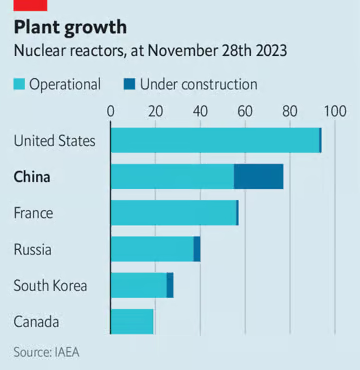
출처: The Economist
오늘날 원자력은 전 세계적으로 다시 부상하고 있으며, 몇 년 전만 해도 상상할 수 없었던 규모로 확대되고 있습니다. 여러 뉴스가 전 세계 정책 변화에 주목하고 있습니다:
- 일본, 세계 최대 원자력 발전소 재가동 추진
- 미국 에너지부 장관 제니퍼 그란홀름, 미국 원자력 함대 3배 확대 촉구
- 한국 에너지 초안에 신규 원자력 포함
- 프랑스, 재생에너지 목표를 포기하고 새로운 에너지 법안에서 원자력을 우선시
- 영국, 스코틀랜드에 신규 원자력 발전소 건설 계획
- 인도, 2032년까지 13.8GW 용량의 18개 원자력 발전소 건설
빠진 탈탄소화 연결고리?
Safety concerns are still very much alive, and they are the justification behind Germany’s decision to shut down its nuclear power plants.
하지만 탄소 배출과 기후 변화에 대한 우려가 점점 커지고 있으며, 원자력은 모든 에너지 원 중 가장 적은 탄소를 배출하는 원천으로, 풍력·태양광보다 훨씬 적은 토지와 원자재를 필요로 합니다.

눈에 띄고 파장이 큰 사건에도 불구하고, 실제로 원자력은 재생에너지와 마찬가지로 사망자 수 측면에서 매우 안전합니다. 주요 재난을 포함해도 말이죠.
따라서 객관적으로 보면 원자력은 전력망과 전체 경제의 탈탄소화에 활용될 도구 중 하나가 되어야 합니다. 특히 전기차(EV)와 열펌프 등 교통·난방 전동화, 그리고 AI 데이터센터와 같은 새로운 수요가 증가함에 따라 더욱 필요합니다.
대체해야 할 석탄·석유·가스 양은 어마어마합니다. 재생에너지와 전기차 보급이 진전되었음에도 오늘날 에너지 소비의 대부분을 여전히 차지하고 있습니다.

핵폐기물은 어떨까요?
The real safety profile of nuclear, however, leaves the question of nuclear waste.
미래 세대에게 수천 년 동안 위험을 남길 독성 폐기물을 남긴다는 생각은 최소한 충격적이라고 할 수 있습니다.
기후를 구하기 위해 미래를 독살해야 할까요? 다행히도 기술 진보를 통해 두 가지 해결책이 떠오르고 있습니다.
첫 번째는 핵폐기물을 재활용하는 것이고, 두 번째는 거의 폐기물을 배출하지 않는 것입니다. 두 경우 모두 이른바 4th 세대 원자력 발전소에 해당합니다.
자세한 내용은 아래의 고속 반응로와 토륨 반응로를 참고하십시오.
물론 이후에 초고신뢰 로켓을 이용해 우주로 폐기물을 보내는 등 다른 해결책도 고려될 수 있습니다. 하지만 현재로서는 발사 실패 시 대륙 절반에 걸쳐 폐기물이 퍼지는 위험을 감수하기는 어렵습니다.
원자력 발전소 세대
The 1st generation of nuclear power plants were essentially prototypes with no commercial utilization.
The 2nd generation of nuclear power plants represents the bulk of the current fleet. They were built in the 1965-1996 period.
The 3rd generation of nuclear power plants was built following the lessons learned from the 2nd generation and tried to remedy the flaws that led to rare but catastrophic nuclear disasters. They were built in the 1996-2016 period. Sometimes, a 3+ generation is described as the generators built in the 2017-2021 period, with a focus on increased safety.
The 4th generation of nuclear power is only getting started and represents a departure from the previous ones, with a target for new design, concept, and even maybe changing the nuclear fuel instead of incremental improvements.
There is also a 5th-generation nuclear power plant in discussions. These designs are theoretically possible but have not been actively researched. This is usually due to economic viability issues, missing technologies, or concerns about safety.
4th 세대 원자력 발전소
What makes a nuclear power plant part of the 4th generation is hotly debated among experts in the industry.
In this article, we will mostly discuss plant design radically departing from the 3rd generation designs.
And we will try to keep the explanation as simple as possible, glossing over some details when needed.
초고온 반응로 (VHTR)
This design is characterized by very high temperatures, in the range of 1,000°C. This is the only 4th generation nuclear power plant already operating, with the commercial launch in 2023 of Huaneng Shandong Shidao Bay Nuclear Power Plant in eastern China.
The design often relies on a “pebble bed”, where ceramic spheres small enough to be held in hand protect a core of uranium, with tens of thousands of these spheres in one reactor.

출처: CGTN
X-Energy (XE ) is also developing a similar technology in the USA.
Because the reaction requires high temperature and is passively cooled, this is a design inherently safer than 3rd generation nuclear power plants.
The advantage of the pebble design is to allow for replacement without interrupting the reactor production, with the ceramic also avoiding any risk of leakage of radioactive material.
용융염 반응로 (MSR)
In these reactors, the coolant is a molten salt mixture instead of water or gas. In some cases, the fuel is also contained in the molten salt.
Molten salt reactors tend to have higher output efficiency, burn fuel more efficiently, and create less nuclear waste. Because they are hotter, they are sometimes gathered together with VHTR into the “thermal reactor” category.
However, a problem with molten salts is that they are corrosive, a problem compounded by the potential weakening of structure by radioactivity. This implies a need for extremely cautious maintenance and checks of the system’s piping, pumps, etc.
토륨
Since the 1950s, almost all reactors have used uranium as fuel. This leads people to assume that it is the only solution.
But this was actually a mostly political choice, as uranium plants create plutonium. It was seen as a good thing at the time, as it helped nuclear powers to create the material for nuclear bombs.
An alternative with its resource 3x more than uranium is the element thorium. The by-products of a thorium reactor are also very unlikely to be turned into material for atomic weapons.

출처: ACS
Another key advantage of thorium is the possibility of producing up to 100x less waste, at least when using a liquid fluoride thorium reactor design (a molten salt thorium reactor).
Here, China is also leading with a thorium reactor that can run waterless, making it a good fit for desert regions. And with container ships to be powered by a thorium reactor revealed by China State Shipbuilding Corporation (CSSC).
고속 / 번식 / 연소 반응로
Fast reactors rely on “fast neutrons” which are not slowed down by moderators like in classical nuclear reactors. This allows to design the reactor so it can use the fast neutrons to consume elements part of the actinides family (which include uranium and plutonium).

출처: Sciences Notes
Because classical reactor fuel turns into a complex mix of long-lived actinides, this class of elements is the main problem in nuclear waste.
Burner reactors transmute most of the problematic actinides in spent nuclear fuel, making the resulting processed waste less active, 90-98% less voluminous, and problematic for only decades or centuries instead of millennia.
This category of reactors is usually classified according to its cooling system, which can be using gas, sodium, or lead.
While classified as 4th generation, this is not really a new or untested technology. Notably, France’s Phénix and Superphénix burned nuclear waste throughout the 1970s-1990s, before ultimately being closed for reasons of operation costs and political pressure from the Green party.
Modern versions of fast breeder reactors include, for example, the designed but not built PRISM by GE-Hitachi.
소형 모듈 원자로 (SMRs) & 마이크로 원자로
Most nuclear reactors are conceived as the typical large power plants we think of as nuclear plants.
A new type of design is looking to downsize nuclear plants to a size that could be carried by a truck (SMR) or even in a standard container (microreactors).

출처: Nuscale
Overall, SMRs are expected to be used to power the grid or large industrial processes, while microreactors will more likely be used for remote areas, military facilities, and space exploration.
The smaller size and standardized design should also make the adoption of SMRs easier for smaller countries.
Another advantage of SMRs is that they can be produced in series, like trucks or ships, instead of the unique custom design usually favored by the industry. In theory, this should provide economies of scale and cost reduction.
In practice, costs might be higher than expected, at least for the prototypes. This led to a bit of a fall in enthusiasm about SMRs after having maybe become a little overhyped.
Still, SMRs are likely to expand quickly, with for example projects progressing in Finland, Norway, Poland, USA, Canada, and Argentina.
You can read more about the status of SMR technology in our article “Update on SMRs (Small Modular Reactor) – Still The Future of Nuclear Power”
부유식 원자력 발전소
While maybe not technically 4th generation, floating power stations are a new concept that provides a radical departure from the usual nuclear power plant concept.
Mostly advocated by Russia’s Rosatom, this concept is different from nuclear-powered ships, like, for example, some aircraft carriers.
Here, the whole purpose of the ship is to be a power station, although a mobile floating one. Due to size constraints, this could also be described as an SMR, albeit a very large one.

출처: Power Technology
The application of these concepts was in the Russian Arctic, powering cities on the coast mostly focused on mining and oil & gas extraction. In this environment, the “waste heat” of the station is not wasted and can be used for district heating.
A broader application could be to bring nuclear power to developing countries without experience in operating nuclear technology. The station can be operated by its manufacturer, and the power is sold to the mainland simply by “plugging” it into the power grid.
The concept could also provide power to islands and remote regions, as well as a quickly mobilized disaster relief system.
For example, Guinea is already looking to work with Russia on such a project.
Westinghouse and Prodigy are also investigating the idea, as well as Korea’s KSOE & Kepco, or Danish’s Seaborg combining molten salt technology with seaborne power plants.
비용
One last criticism leveraged against nuclear power is cost.
This is largely due to the latest nuclear projects in the USA and Europe having suffered from massive cost overruns. For example, the Vogtle power plant in Georgia ended up costing $37B, of which $20B are cost overruns. Or the €11B Olkiluoto-3 plant in Finland, instead of the initially expected €3B.
The fact that Vogtle took 14y to build and Olkiluoto went into service 12 years after the initial estimate is largely responsible for the ballooning costs.
But this is not a fatality. In the same period, Bloomberg revealed that China built 6 nuclear reactors for only $17B.
The growth in cost in the West is linked mostly to three factors:
- Growing regulatory burden.
- While part of this is due to increasing scrutiny over safety, some have been decrying it as bureaucratic red tape and politically motivated hindrances for the industry.
- Growing cost of capital.
- As nuclear power plant costs are mostly upfront from construction, low capital costs reduce the final price drastically. Typically, Chinese nuclear projects are given access to low-interest loans by the state.
- Too few projects.
- If more plants are built in a row, manufacturers can standardize production and produce equipment in batch or series, instead of one-of-a-kind custom design each time.
- A more steady stream of projects also helps train and retain skilled personnel.
Each of these problems can be solved.
Oversized regulatory burden can be scaled down, capital mobilizing by the government. And more projects and a stable energy policy will rebuild the supply chain.
원자력 기업
1. Cameco Corporation
CCJ 가격 차트
원자력은 우라늄 공급에 의존합니다. 우라늄은 매우 희귀한 자원은 아니지만, 고농도 매장량을 찾기란 쉽지 않습니다.
시장은 카자흐스탄의 Kazatomprom과 캐나다의 Camec가 지배하고 있습니다. 다른 우라늄 생산자도 존재하지만, 이 두 기업이 압도적으로 규모가 크고 생산 비용이 낮습니다. 따라서 Cameco는 기존 및 미래 원자력 발전소에 필요한 원료 공급의 중심에 서게 됩니다.

출처: Cameco
하지만 Cameco의 채굴 사업만이 전부는 아닙니다. 2022년에 Cameco가 미국 최고의 원자력 발전소 건설업체인 Westinghouse의 대다수 지분을 인수하기로 결정했으며, 이는 대형 투자회사 Brookfield와 함께 진행되었습니다.
이를 통해 Cameco는 기존 발전소 유지보수에서 나오는 안정적인 수익과 핵 공급망의 큰 부분을 장악하게 되었습니다. 엄격한 규제로 인해 새로운 발전소, 기존 발전소, SMR 모두에 필요한 부품과 장비는 반드시 해당 공급망을 통해 조달해야 합니다.
Westinghouse의 혁신 잠재력을 보여주는 사례가 최근 공개된 AP300 SMR 설계이며, 이는 슬로바키아, 핀란드, 스웨덴에 배치될 가능성이 있습니다.
따라서 Cameco는 우라늄 가격에 대한 베팅이자, Westinghouse가 여전히 핵 발전소 건설 시장을 견고히 장악하고 있다는 점에서 중요한 역할을 합니다. 또한 Brookfield와의 공동 소유는 $19B 규모의 Brookfield Renewable Partners (BEP.UN.TO ) (BEPC ) (BEP ) (BEP)와 같은 대규모 재생·저탄소 전력 부문을 보유하고 있어 추가적인 시너지 효과를 기대할 수 있습니다.
2. Mirion Technologies, Inc.
MIR 가격 차트
반응로와 연료 기술 외에도 원자력 발전은 많은 센서, 부품 및 기타 “소규모” 장비에 크게 의존합니다. 이들 장비는 완벽히 작동해야 합니다.
그 중 하나가 방사선 탐지 분야이며, 이는 Mirion(미국)의 핵심 사업입니다. 원자력 규제는 인원·환경의 방사선 노출을 매우 엄격히 점검하고, 누출·오염 가능성을 조기에 감지하도록 요구합니다. 이는 암 치료·영상 등 의료 분야에서도 동일하게 적용됩니다.

출처: Mirion
이 회사는 과학 분석·연구용 물리 측정, 방위 산업·사이버 보안·훈련 서비스용 폐기·오염 제거 장비, 그리고 2020년 IPO를 통해 자금을 조달한 기업이기도 합니다.
Mirion의 매출은 의료 부문과 산업 고객 부문이 균형을 이루며 꾸준히 성장하고 있습니다.
Mirion은 새로운 반응로 설계·고밀도 연료·군사 응용을 개발하는 것이 아니라, 방사선을 모니터링·측정하는 “삽·괭이” 역할을 수행합니다. 이는 재무적으로도 매력적인 부분입니다.
따라서 Mirion은 원자력에 대한 지속적인 관심과 투자가 재개될 경우 혜택을 받을 “삽·괭이”형 주식이며, 여전히 높은 대중의 원자력 회의론으로 인해 전방위적인 방사선 센서·모니터링 요구가 강화될 때도 이익을 얻을 수 있습니다.



