
Spazio
Ripensare il viaggio ipersonico con il motore a detonazione ram‑rotor (RRDE)

 Aggiungi Securities.io alle tue fonti preferite su Google

La terza generazione della propulsione aeronautica
Since the Wright brothers’ first flight, the central concept of mechanized flying has been compressing air to generate propulsion. This was first done with the ever-larger propellers in WWI and WW2 planes.
Il passo successivo è stato il motore a getto, con il primo velivolo a propulsione jet, l’Heinkel He 178, lanciato nel 1939. In un motore a getto, le parti in movimento comprimono l’aria e iniettano carburante per creare un potente effetto di combustione, che viene poi indirizzato verso la turbina e l’ugello del getto per generare propulsione.

Fonte: Wikipedia
Questo è stato successivamente migliorato con il ramjet, dove il movimento dell’aereo crea la compressione dell’aria, consentendo velocità ancora più elevate. Superata una certa velocità, le parti in movimento di un turbojet si muoverebbero troppo rapidamente e si romperebbero. Il primo aereo a utilizzare un ramjet è stato il Leduc 0.10 nel 1949.

Fonte: Tech Brief
Esiste una versione migliorata del ramjet, chiamata scramjet (ramjet supersonico). Questo motore non necessita di rallentare l’aria in ingresso per la combustione, mantenendo invece un flusso supersonico e ottenendo una maggiore efficienza del carburante.
Gli scramjet sono stati concettualizzati già nel 1958, ma sono stati messi alla prova solo nel 2001 con l’X‑43A della NASA. Tre anni dopo, l’aereo sperimentale ha raggiunto velocità di Mach 6.8 (5 217 mph o 8 396 km/h) e Mach 9.6 (7 366 mph o 11 854 km/h).
Questo è stato impressionante, ma la tecnologia dei jet sta raggiungendo i propri limiti, in modo analogo a come le eliche dei primi anni del XX secolo non potevano superare una certa velocità.
This is why scientists and engineers are now looking at an entirely different concept: rotating detonation engines.
Motori a detonazione rotante
From a thermodynamic point of view, detonations are more efficient than the more commonly known deflagration (classic combustion). So, theoretically, they could be used to burn fuel more efficiently and/or achieve higher flight speeds.
Of course, explosions are much more difficult to leverage into actual propulsion in a plane engine without … exploding mid-flight.
In a rotating detonation engine, this is achieved by creating detonation waves propagating continuously around a ring-shaped combustion chamber. As the detonation happens at a high frequency, this creates an almost continuous thrust.

Such an engine was tested successfully for the first time by NASA in 2020.
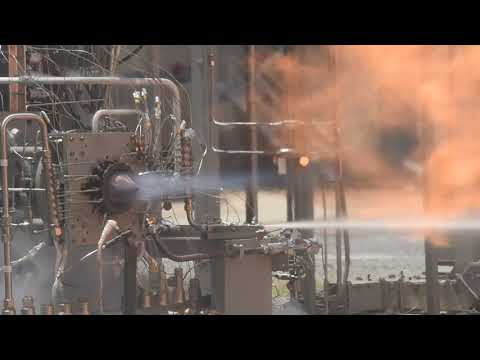
This sort of engine is expected to be up to 25% more efficient than “normal” combustion-based jet engines. They also do not need the large compressor upstream of the combustor which saves immense amounts of weight, which is likely to boost further the overall efficiency of the plane.
These sorts of engines have only recently become possible thanks to advanced materials. The main limiting factor was the ability of the materials to withstand extreme temperatures, an endless stream of shockwaves, and oxygen-rich flow simultaneously.
Un ramjet a detonazione?
A serious drawback of rotating detonation engines is that they work much less efficiently at atmospheric pressures. So similar to ramjets and scramjets, they ideally need to be propelled to supersonic or hypersonic speed first before activation.
Now, an even more advanced concept is emerging, the ram-rotor detonation engine. It was developed by Chinese scientists working at the School of Aerospace Engineering, in Tsinghua University, Beijing. They published their work in the Chinese Journal of Aeronautics, under the title “Primary Investigation on Ram-Rotor Detonation Engine”.
Motore a detonazione ram‑rotor (RRDE)
The key idea of a RRDE is to stabilize the detonation within a high-speed rotor. The flow channel compresses the air-fuel mixture to the ideal conditions for detonation, whatever the intake speed.

The detonation wave is held in place by balancing the relative velocities of intake airflow and the expanding gases and shockwaves leaving the exhaust.
Through this process, the detonation wave keeps stationary relative to the blades.

Vantaggi del RRDE
Flessibilità
Because the engine can modulate the compression of the air, it acts more like a classical turbojet than a ramjet, which requires the speed of the airplane to perform the air compression.
This means that the RRDE can operate at all speeds, and can function as a stand‑alone engine. In that case, the RRDE will need to be matched with suitable intake and exhaust components, such as adjustable diffusers, guide vanes, and nozzles, to expand its stable operating range and scenarios.
Potentially, it could be used in combination with turbojet as well, similar to how most ramjet and scramjet designs are made today.
Motori per aerei ipersonici
By definition, detonation waves travel quicker than the speed of sound, often much quicker. The RRDE is expected to generate stable detonation waves that can reach a Mach number of 4 to 6 relative to the incoming flow.
This could allow RRDE‑equipped planes to be capable of hypersonic flight over Mach 5+ (3 836 mph / 6 174 km/h), at considerably higher efficiency than other detonation engines.
Higher efficiency would not only reduce fuel costs but also allow for a longer range with the same fuel. Or a higher carrying capacity for the same range as less heavy fuel needs to be carried.
Dalla teoria alla pratica
So far, the RRDE exists only as a design and has proven itself only in theoretical and simulated lab tests.
So there is still quite a long road before a practical prototype, and even a longer path toward commercial, mass‑produced RRDEs.
This will imply solving real‑world problems that might not have been taken into account in the simulation. For example, it has taken a long time to sustain a detonation wave in a static ring channel for rotating detonation engines. Keeping the detonation wave stable in a high‑speed rotor will be even more difficult.
Le pale del rotore dovranno essere sufficientemente leggere da ruotare rapidamente ed efficientemente, ma anche abbastanza robuste da gestire flussi d’aria di ingresso ipersonici … così come continue detonazioni esplosive tra le pale.
Rotating Explosion Engine Company
So far, most of the research done on this new type of engine has been done by public research institutes, mostly space and military agencies, including NASA, the US Air Force, the Japan Aerospace Exploration Agency (JAXA), Russian Energomash, etc.
There is however one private company that has demonstrated its ability to build a rotating detonation engine back in 2023: General Electric (GE.TO ).
GE Grafico dei prezzi
General Electric Aerospace is the result of the break up of the GE conglomerate in 3 parts in 2024: GE Aerospace (GE ), GE HealthCare (GEHC ), and GE Vernova (energy) (GEV ).
This was done to refocus the company on core competence, after several decades of financialization that has ultimately proved a net negative.
The company is a central supplier to the aeronautic industry, with around 3 billion people traveling using GE Aerospace technology per year, and around 900,000 people flying in GE-powered aircraft at any time (3 out of 4 commercial flights). This was built on a series of engines for all aircraft sizes and applications.

Fonte: GE Aerospace
In the long term, this array of engines is expected to be replaced by a new generation with higher fuel efficiency, achieved through long-term R&D efforts. This could be in the range of 10-15% fuel efficiency improvement for civilian aircraft and up to 25% for military aircraft.

Fonte: GE Aerospace
Besides engines, the company is also offering silicon carbide technology for electrical power systems, and avionics (aircraft electronics and computers).
The company has long been a leader in aircraft propulsion systems. By far its activity is driven by the civilian sector ($23.9B revenues in 2023), followed by the defense segment ($9B).
70% of the company’s revenues are derived from services, especially engine maintenance and repair, making it a very stable income.

Fonte: GE Aerospace
The company is invested in future technology to retain its edge, notably 3D printing with GE Additive, the only OEM (Original Equipment Manufacturer) in metal additive manufacturing with a full end‑to‑end solution.

Fonte: GE Aerospace
Motore a detonazione rotante di GE
As discussed before, GE also achieved the world‑first hypersonic dual‑mode ramjet (DMRJ) rig test with rotating detonation combustion (RDC) in a supersonic flow stream.
This was made possible thanks to GE’s mastery of high‑temperature ceramic matrix composites (CMCs), silicon carbide power electronics, additive technologies, and advanced thermal management.
“The significant results we have had to date give us confidence that we are moving in the right direction.
The team has moved very fast, it took just 12 months from start to finish for the DMRJ with RDC demonstration. The team is on track with its goal to demonstrate a full DMRJ with RDC at scale next year.”
Hypersonic engines like this one might be first used in advanced military applications, from warplanes to missiles. But it will also likely make its way into civilian hypersonic planes one day, and GE’s presence in both markets should help capitalize on this emergent technology.
Overall, after a long period of being a directionless conglomerate and focusing on financial engineering, it seems that GE is back on track to reestablish itself as a center of American engineering and manufacturing, at a time when re‑industrialization and re‑shoring are strong trends.



