
Biotecnologia
Gli acidi nucleici sferici migliorano drasticamente la somministrazione della chemioterapia

 Aggiungi Securities.io alle tue fonti preferite su Google

Somministrazione terapeutica guidata dalla nanotecnologia nel cancro
Our understanding of cancer has greatly progressed over the last few decades, leading to the discovery of various molecules able to kill cancer cells. The problem is, however, that cancer cells are still part of the body, even if they act abnormally and will ultimately kill the rest of the cells.
Questo significa che gli stessi farmaci che uccidono le cellule tumorali possono essere anche molto tossici per le altre cellule del corpo. Inoltre, le anomalie metaboliche e genetiche delle cellule tumorali spesso ostacolano la loro capacità di assorbire le sostanze chimiche utili contro di esse.
Per entrambi questi motivi, il processo di consegna dei farmaci oncologici alle cellule tumorali può essere tanto importante, se non più importante, dell’efficacia stessa del farmaco. In questo modo, non solo si riducono gli effetti collaterali negativi, ma il trattamento risulta sufficientemente efficace da salvare il paziente.
Un targeting preciso è anche fondamentale per ridurre il rischio di recidiva, poiché una maggiore efficienza comporta minori probabilità che cellule tumorali residue “si nascondano” al trattamento.
Un metodo di somministrazione particolarmente promettente utilizza gli Acidi Nucleici Sferici (SNA), un nuovo tipo di nanomolecola ben tollerata dall’organismo. Ricercatori della Northwestern University hanno recentemente dimostrato che gli SNA possono aumentare radicalmente l’efficacia di un farmaco per la leucemia.
They published their results in ACS Nano1, under the title “Chemotherapeutic Spherical Nucleic Acids”.
Problemi nella somministrazione dei farmaci oncologici
A lot of the increase in survival rate from cancer in the past 2 decades has been linked to better delivery systems for cancer treatments. For example, antibodies, especially monoclonal antibodies, have risen to become one of the best therapeutic options for many cancer types.
Un’altra opzione è l’utilizzo di un sistema di targeting passivo dei farmaci, in cui biomolecole o nanoparticelle mirano specificamente alle cellule tumorali.

Fonte: MDPI
Mentre le anticorpi hanno dominato l’oncologia negli ultimi anni, un’alternativa in crescita è la nanotecnologia, con nanoparticelle appositamente progettate in grado di attaccarsi direttamente alle cellule tumorali e di somministrare la chemioterapia oltre la membrana cellulare.

Fonte: MDPI
Acidi Nucleici Sferici (SNA)
The researchers in this study used liposomal spherical nucleic acid (SNA) constructs. They are built of a nanoparticle core, surrounded by a shell made of a densely packed, highly oriented arrangement of nucleic acids.

Fonte: Nature
Gli SNA sono stati creati per la prima volta nel 1996 da Chad Mirkin presso Northwestern University, che è anche il capo ricercatore di questo studio.
Molti SNA diversi possono essere creati variando la natura del nucleo della nanoparticella (oro, argento, silice, liposoma, proteine, ecc.) e le sequenze degli acidi nucleici (DNA, RNA, ecc.).

Fonte: Cancers
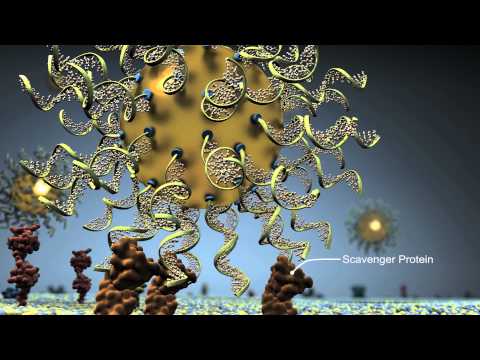
Nanomedicina strutturale: una nuova era nella somministrazione dei farmaci
In previous studies, it was discovered that cells recognize SNAs and invite them inside. More importantly, cancer cells, due to their excessive activity, are incorporating SNAs at a much higher rate than healthy cells.
So the very nature of cancer cells makes them more reactive to SNAs.
“La maggior parte delle cellule possiede recettori scavenger sulla superficie. Ma le cellule mieloidi sovra‑esprimono questi recettori, quindi ne hanno ancora di più.
Se riconoscono una molecola, la tirano dentro la cellula. Invece di dover forzare il loro ingresso, gli SNA vengono naturalmente assorbiti da questi recettori.”
This is part of the overall growing field of structural nanomedicine, which uses precise structural, as well as compositional, control to fine-tune how nanomedicines interact with the human body.
There are 7 SNA-based therapies currently in clinical trials, not only for cancer, but also for infectious diseases, neurodegenerative diseases, and autoimmune diseases.
Risultati pre‑clinici nella leucemia mieloide acuta (AML)
Costruzione di SNA per la chemioterapia
The researchers tested their liposomal SNA for the treatment of leukemia. They used 5-fluorouracil (5-Fu), with the nucleic acid component of the SNA made of 10 units of chemically interconnected 5-fluoro-2′-deoxyuridine

Fonte: ACS Publications
La chemioterapia tradizionale 5‑Fu spesso non riesce a raggiungere le cellule tumorali in modo efficiente. Può anche causare numerosi effetti collaterali problematici: nausea, affaticamento e, in rari casi, anche insufficienza cardiaca.
The problem is not only the toxicity of the drug itself, but that barely 1% of the treatment dissolves in the body. So it clumps or retains a solid form, and the body cannot absorb it efficiently.
We all know that chemotherapy is often horribly toxic. But a lot of people don’t realize it’s also often poorly soluble, so we have to find ways to transform it into water-soluble forms and deliver it effectively.”
The over-expression of SNA receptors by myeloid cells (which are causing leukemia) means that even a lower dose of 5-Fu will still reach the cancer cells, but a much lower dose reaches healthy cells.
An extra bonus is that the liposome SNAs are very soluble, removing that problem as well.
“Today’s chemotherapeutics kill everything they encounter. So, they kill the cancer cells, but also a lot of healthy cells. Our structural nanomedicine preferentially seeks out the myeloid cells.
Instead of overwhelming the whole body with chemotherapy, it delivers a higher, more focused dose exactly where it’s needed.”
Miglioramenti di efficacia con la somministrazione SNA
The SNA-driven delivery of 5-Fu to inside cells is 12.5x higher than without the SNA. More importantly, in an in-vitro study, a 4 orders of magnitude (>1,000x).
In mice used to simulate human leukemia, the chemotherapeutic SNA had a 59x higher antitumor efficacy than 5-Fu alone. Maybe even more importantly, the mice did not display any of the side effects of 5-Fu when treated with SNAs.
“In animal models, we demonstrated that we can stop tumors in their tracks.
If this translates to human patients, it’s a really exciting advance. It would mean more effective chemotherapy, better response rates and fewer side effects.”
Swipe to scroll →
| Metrica | 5‑Fu libero (standard) | 5‑Fu somministrato con SNA (SNA liposomale) |
|---|---|---|
| Assorbimento cellulare (cellule AML) | 1× (baseline) | ~12,5× più alto |
| Potenza di uccisione cellulare in vitro | 1× (baseline) | Fino a ~10.000× più alta |
| Efficacia antitumorale nei topi (modello AML) | 1× (baseline) | ~59× maggiore riduzione del tumore |
| Tossicità / effetti collaterali osservati (nello studio) | Effetti collaterali noti significativi del 5‑Fu (nausea, affaticamento, cardiotossicità) | Nessuna tossicità evidente osservata nei parametri valutati (studio su topi) |
Applicazioni cliniche e commerciali future degli SNA
SNAs are quickly becoming a very promising delivery mechanism for chemotherapy drugs.
The next step will likely be to look at other drugs on the same animal model, to see if the results can be improved even further. For example, another chemotherapy drug known for its toxicity problems but highly efficient at killing cells could be made tolerable or almost harmless with SNAs, while becoming even more able to kill cancer cells.
In the long run, human studies for evaluating the potential of this technology in real patients will need to be done. This is often a costly process, starting from phase I (testing healthy people to determine if they can tolerate the drug) to phase III (testing on many real cancer patients).
Commercializzazione e start‑up SNA
CancerVax
Chad A. Mirkin, the lead scientist of this study and discoverer of SNAs, is also the scientific founder of Flashpoint Therapeutics, a company dedicated to deploy SNAs into human therapeutical applications.
They claim from 9 in‑vivo studies that SNAs show a 35x improved delivery, 80x stronger immune activation, and 6.5x increased tumor killing by T‑cells. The SNAs can be absorbed by more than 60 different types of cells.

Fonte: Flashpoint Therapeutics
The company has announced a research agreement with CancerVax, a company developing a universal cancer treatment platform that uses the body’s immune system to fight cancer.
Direct investment in CancerVax is only possible for accredited investors, but an equity fundraising through crowdfunding is also ongoing, open to all types of investors, at $2.1/share, putting the company at a valuation above $80M.
“CancerVax’s Universal Cancer Treatment platform requires precise, multi-component delivery to effectively detect and mark cancer cells.
Our technology is uniquely suited to this challenge, offering the ability to package and deliver Smart mRNA payloads with the efficiency and accuracy needed to realize the full potential of this promising therapeutic approach.”
Besides cancer, SNAs could also be used for delivery of CRISPR-based therapies.
LNP‑SNAs entered cells up to three times more effectively, caused less toxicity, boosted gene‑editing efficiency threefold, and improved precise DNA repairs by more than 60%, compared to standard lipid nanoparticle delivery systems.
Overall, SNAs are clearly reaching the point where they are a very promising technology from in‑vitro and in‑vivo animal studies, and are ready to explore human applications for cancer, gene therapy, and other key medical applications.
They are also likely going to benefit from the emergence of other precision therapies and technologies, like CRISPR, which will boost the potential of SNAs.
Studio citato
1 .Taokun Luo, Young Jun Kim, Zhenyu Han, Jeongmin Hwang, Sneha Kumari, Vinzenz Mayer, Alex Cushing, Roger A. Romero, Chad A. Mirkin. Chemotherapeutic Spherical Nucleic Acids. ACS NanoVol 19/Issue 44. 29 ottobre 2025. https://pubs.acs.org/doi/10.1021/acsnano.5c16609



