

Megaprojects
Grand Paris Express: Investing in Europe’s Largest Transit Expansion

Securities.io maintains rigorous editorial standards and may receive compensation from reviewed links. We are not a registered investment adviser and this is not investment advice. Please view our affiliate disclosure.

Summary:
- Grand Paris Express is Europe’s largest metro expansion, adding ~200 km of new lines and 68 stations to reshape suburb-to-suburb mobility.
- The build is a showcase for driverless metro automation, infrastructure digital twins, and low-carbon construction methods at megaproject scale.
- Bentley Systems (BSY) is a direct “picks-and-shovels” beneficiary via digital twin workflows used across complex infrastructure programs.
Grand Paris Express: Europe’s Largest Automated Metro Expansion
Self-driving vehicles are grabbing the headlines, but with most of the attention focused on cars or trucks, as they are more visibly present in our daily lives.
But another form of transportation is responsible for billions of trips: trains and subways. These systems are traditionally driven by humans, but they, too, are getting automated.
One massive project of this kind is the Grand Paris Express, a massive expansion of the French capital’s subway system, adding four new lines to the Paris Metro network.
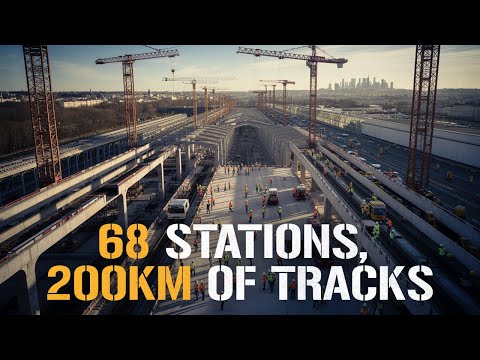
A total of 120 miles (200 kilometers) of new tracks and 68 new stations are to be added, serving a projected 2 million passengers a day. Both will connect to the two large airports of the city, Aéroport Charles de Gaulle in the northeast, and Aéroport Orly in the South.

Source: Ville de Creteil
The project was supposed to be well ahead for the 2024 Olympic Games held in the city, but delays made it miss this deadline. 2026 marks the peak of high-volume testing of Line 15 South, the first of the new automated ring lines, with an expected opening in spring 2027.
The project will not just add new lines to the Metro, but also represent a massive step forward in digitalization and automation of subways and overall innovation in railway transportation. It includes autonomous trains, a complete digital twin of the project, low-carbon concrete, special tunneling technology, automated ticketing, digital monitoring, etc.
This is part of an even larger program, the Grand Paris, which will be the widest urban design programme to hit the country since Baron Haussmann’s massive urban renewal scheme back in the 19th century.
It will be combined with new high-speed railroad connections and train stations to airports, new economic centers, connect Paris suburbs with each other without passing by the center, build new industrial and economic centers, etc.
Grand Paris Express By The Numbers
Initiated in 2012, and building on the previous iteration of the idea, Grand Paris Express is looking at a massive addition to France’s largest city subway system, split into 4 different new lines and another 2 lines extension:
- Line 11 extension: a 6-kilometer (3.7 miles) & 6 stations eastern extension, which opened in June 2024.
- Line 14 extension: an 8-station north/south extension brought into service in June 2024, with the final station (Villejuif – Gustave Roussy) opening in January 2025.
- Line 15: a 75-kilometer (46 miles) & 36-station orbital line, planned to open in phases from 2027 through 2031.
- Line 16: a 25-kilometer (16 miles) & 10-station new line, with initial sections targeted for late 2027 and phased openings extending into 2028–2031.
- Line 17: a 25-kilometer (16 miles) & 9-station new line, with initial sections targeted for late 2027 and phased openings extending into 2028–2031.
- Line 18: a 35-kilometer (22 miles) & 10-station new line, planned to open in phases starting October 2026.
So in total, 200 km of additional automatic metro lines, 68 new stations, and all the 4 new lines will be automated. In total, the system will also require the addition of 183 new train sets (locomotive + rolling stock).
The newly built infrastructure is expected to carry up to 3 million people daily, while also drastically reducing travel times across Paris’s suburbs. When finished, it will make it possible for 90% of people living within the Grand Paris radius to have a metro station less than 2km from them.
One unique feature of the trains on the new lines is that they will travel much faster, at average speeds of 55-65 km/hr (around 30 miles/hour), with trains arriving every 2-3 minutes. This is almost triple the current Paris metro average, thanks to the automated trains, and reflects the much larger distance covered by these new lines compared to downtown ones.
The budget for the project is equally massive, with €36.1B to over €42B (around $45B) expected total costs, much higher than the initially planned €18.3B.
At peak construction, the project has supported roughly 15,000 direct jobs across tunneling, civil works, systems integration, and station construction, excluding indirect and supply-chain employment.
The lines also see an addition of 6 operations centers for the control, maintenance, and repair of the line and trains, with over 1,000 direct skilled jobs created by the centers.
How Grand Paris Express compares to a typical legacy metro build
Swipe to scroll →
| Metric | Legacy Paris Metro (Typical) | Grand Paris Express (New Lines) | Why It Matters |
|---|---|---|---|
| Network role | Primarily radial, center-focused | Orbital suburb-to-suburb + airport access | Reduces transfer dependence and cuts cross-suburb trip times |
| Automation level | Mixed (many driver-operated) | Designed for fully automated, driverless service | Enables higher frequency and more resilient operations |
| Average speeds | Lower due to dense stop spacing | 55–65 km/h planned averages on new orbital lines | Improves end-to-end travel times at regional scale |
| Service frequency | Varies by line and signaling | 2–3 minute headways targeted on core segments | Boosts throughput without proportional track expansion |
| Delivery complexity | Incremental upgrades and small extensions | Megaproject with system-wide digital coordination | Raises demand for digital twins, monitoring, and lifecycle analytics |

Source: Grand Paris Express
Grand Paris Express Technology
Autonomous Trains
One of the most talked-about parts of the project’s tech is its automated subway trains.
The technology is developed by the French train manufacturer Alstom (ALO.PA). The automatic train technology allows for up to 45% less energy consumption, up to 30% more passenger capacity, and up to 3 minutes faster per journey.
Autonomous trains differ from simply automatic trains by being able to share tracks with other trains, with the system seeing ahead and around tracks, and being able to communicate and make decisions.
The automation also reduces the wear and tear, further reducing costs by reducing the need for maintenance and providing more reliable transport.
The Grand Paris Express project is by far the largest yet for the company’s autonomous trains, but it has solid experience in delivering this technology to a mine in Kiruna, Sweden, freight automation in the Netherlands, Luxembourg rail infrastructure, and even in India with the future new 160 km/h, 82.5 km-long rapid rail line between Delhi and Meerut. It also produced an autonomous tram for Paris tramway line 7 and an automated people mover (APM) vehicle to Denver International Airport (DEN).
Alstom is also a world leader in train digitalization, from WiFi Connectivity to fleet management software, and security & control systems (OnVia Vision).
Electrification
While the Paris subway was already fully electrically powered, in a country where power is mostly supplied by low-carbon nuclear power plants, the new metro goes one step further.
The modern carriage design includes an all-electric service braking and LED lighting to make it as energy efficient as possible. The lighting will be brighter or dimmer depending on the time of the day.

Source: Grand Paris Express
It will also have wide door openings (80cm / 31.5 inches), USB ports for riders to charge devices, and a large screen displaying the route ahead in a panoramic view.

Source: Grand Paris Express
Sustainability
The largest sustainability contribution of the project is the inherent electrification and low-carbon transport metro transit system provided to the population of the Paris region. The better energy efficiency of the modernized trains and rolling stock is another one.
This will help to cut 10.9 million tonnes of CO2 equivalent of greenhouse gas emissions in the Paris region over the next 20 years after the launch of the metro, or the equivalent of the yearly carbon emission of 1 million French citizens.
Besides these contributions, the project also developed “T-Rex”, a software to track all trash produced by the construction efforts. Each truck, barge, or train loaded with waste (including all the rocks and debris from tunneling) receives a digital ticket tracking the origin, quality, size, destination, transport method, associated company, and time of departure.
More than one million such tracking tickets have been created during the construction, keeping track of the eventual pollution at a scale and detail level impossible before for such a large project. In addition, 70% of the soil dug will be reused for making materials such as bricks, ceramics, tiles, cladding, and concrete.
Low-carbon concrete has also been used, with fiber-reinforced concrete instead of reinforced concrete, which has a 40% smaller carbon footprint than conventional concrete, saving 10,000 tonnes of CO2 equivalent for every 10 km of tunnel.
The project also took special measures during the bird nesting season, reducing the impact of dust & noise on local residents, mapping biodiversity in the area crossed, etc.
Digital Twin
In order to plan and deliver (almost) on time such a massive infrastructure project, an entire “digital twin” has been created to model and anticipate all the work that was going to be needed.
It also greatly facilitates the coordination of work between many participants, different companies, different sub-projects, etc., through cloud-based synchronization.
All changes were updated and communicated to project stakeholders via the cloud.”
This was achieved using the iTwin (Infrastructure Digital Twin) platform created by Bentley Systems (see below for more info on the company from an investment point of view). 3D model and videogame engine Unity (U +13.54%) and French company Vectuel were also involved, as well as Dassault Systèmes’ (DASTY) 3DEXPERIENCE.
Digital twins are a digital recreation of the real-world conditions, as close to reality as possible, giving engineers, planners, and policymakers an easy-to-grasp and manipulate copy of the place where a real project will take place.

Source: Bentley Systems

Source: Bentley Systems
While mostly used today for construction projects, digital twins of urban landscapes could be in the future integrated with IoT (Internet of Things) sensors, 5G connectivity, AI, and BIM (Building Information Modelling) for a real-time digital representation of the real-world version.

The same technology is also used to replicate industrial and mining sites, roads, energy and water infrastructures, etc.
“Regardless of infrastructure type, over time, the digital twin of an asset or project will become both its lifeblood and its central nervous system. We believe that to achieve sustainable infrastructure digital twins, it is imperative that you build your systems around open-source technology so the keys to your destiny remain in your hands.”
Infrastructure Intelligence: Bentley Systems (BSY) Analysis
Bentley Systems, Incorporated (BSY -3.98%)
As previously mentioned, the company’s digital twin technology was used to modelize the planned 200km of tunnels, railroads, bridges, train stations, and service centers. The company described itself as “THE Infrastructure Engineering Software Company”.
The digital twin technology will also be an extra source of revenue as it provides extra data that can be reused for AI accessibility of infrastructure projects.
While road & bridge and rail make a large part of the company activity and it is a leader in these segments, it is also making a large part of its revenues from electric grids, municipal & water & waste, and industrial production and resource production (mining, logging, etc.).

Source: Bentley Systems
This dominance in its field was established through vertical integration of the many acquired firms and software by Bentley over the past years, with the latest being the acquisition of digital twins & AI firms Talon Aerolytics and Pointivo.

Source: Bentley Systems
The company has been growing its revenues steadily in the past decades, with a net acceleration driven by digitalization from 2017. Most of these revenues are recurring (92%), coming from long-term license of the company software, and have grown 10-12% yearly since 2020.

Source: Bentley Systems
The company has a very diversified user base, with +41,000 accounts in 189 countries, and most enterprise accounts linked to companies making $250,000 of revenues per year or more.

Source: Bentley Systems
Overall, Bentley is becoming a key partner globally for all large and complex infrastructure projects that require proper management of digital twins, 3D designs, 4D analytics (3D + time), etc.
Investor Takeaways:
- Infrastructure digital twins are becoming the operating layer for major capital projects, supporting recurring software revenue and long-duration public spend.
- Driverless metro increases capacity via frequency and reliability, raising demand for modern signaling, monitoring, and predictive maintenance stacks.
- “Picks-and-shovels” winners include engineering design, asset performance management, and real-time monitoring platforms.
Latest Bentley (BSY) Stock News and Developments
Bentley Systems Announces 2026 Year in Infrastructure Event and YII Awards Honoring the World's Most Innovative Use of Infrastructure Engineering Software
businesswire.com
•
March 18, 2026
Wall Street Analysts Believe Bentley Systems (BSY) Could Rally 25.56%: Here's is How to Trade
zacks.com
•
March 12, 2026
Will Bentley Systems (BSY) Gain on Rising Earnings Estimates?
zacks.com
•
March 9, 2026
SEA (NYSE:SE) & Bentley Systems (NASDAQ:BSY) Head to Head Survey
defenseworld.net
•
March 9, 2026
Bentley Systems: Positive On Q4 Outperformance And Above-Consensus Guide
seekingalpha.com
•
February 27, 2026
Bentley Systems, Incorporated (BSY) Q4 2025 Earnings Call Transcript
seekingalpha.com
•
February 26, 2026



