
Biotechnologie
Nieuwe benaderingen van tandheelkundige gezondheid via moderne technologie

 Voeg Securities.io toe aan je voorkeursbronnen op Google

Vooruitgang in de tandheelkunde
Dentistry has progressed a lot since the days of mostly only pulling decayed teeth out without anesthesia. However, it has been a little stagnant in the last decades, with dental procedures in the 1990s still very much in line with the current ones. This might be changing quickly, thanks to technological progress.
Sommige bedrijven richten zich op het voorkomen van later pijnlijke en moeilijke tandheelkundige ingrepen. Anderen maken het mogelijk om op maat gemaakte kunstgebitten te creëren die perfect passen in iemands mond. Ondertussen kan het zelfs mogelijk worden om verloren tanden volledig te laten teruggroeien, dankzij vooruitgang in de biotechnologie.
So, in this article, we will explore the future of dentistry and how innovation might radically change de $39B tandheelkundige markt, naar verwachting groeiend tot $95B tegen 2032, met een solide CAGR van 11.8%.
Niet-chirurgische verwijdering van verstandskiezen
Problemen met verstandskiezen
Verstandskiezen zijn de tanden aan het uiterste einde van ons kaakbeen. Ze groeien ook later dan andere tanden, meestal rond de tienerjaren. Om verschillende redenen groeien ze vaak scheef en/of zonder voldoende ruimte om correct te ontwikkelen.
Dit kan diverse problemen veroorzaken, van aanhoudende pijn tot het scheefzetten van de rest van de tanden.

Bron: Triagenics
In totaal moet meer dan 80% van alle verstandskiezen worden verwijderd. Dit is een niet-levensbedreigend maar ernstig gezondheidsprobleem, waarbij jaarlijks 5 miljoen mensen in de VS lijden aan behandeling of verwijdering van verstandskiezen.
Deze procedures kosten $3B per jaar, of $600 per getroffen persoon, en zijn over het algemeen pijnlijk en onaangenaam.
The surgical removal of wisdom teeth is also far from simple and can result in multiple complications like bacterial infections or damage to the jaw, nerve, teeth, or sinuses.
Het probleem bij de kiem aanpakken
Tooth growth is initiated by a structure called a tooth bud. TriAgenics has developed a procedure called Zero3 TBA that blocks the ability of the tooth bud to ever form a tooth, with a 100% success rate in its animal studies. This is a very quick and much simpler procedure than removing a grown tooth, taking 60-90s per tooth bud.
TriAgenics werft momenteel $4M aan financiering op het Start Engine crowdfunding investeringsplatform, bringing the company’s valuation to $33.87M.
With an expected cost of the procedure of $350 per bud, this makes it not only painless and more pleasant than a wisdom tooth removal, but also a net cost saving compared to waiting for the wisdom teeth to come out and need care.
Thanks to its success rate and superior cost and patient experience, the company expects Zero3 TBA to be covered by dental insurance, a key factor in the future commercial success of the technology.
Perfect passend kunstgebit
Kunstgebitten hebben verbetering nodig
Of het nu nodig is na een ongeluk of door ouderdom, kunstgebitten worden door tientallen miljoenen mensen gebruikt. Ze vervullen zowel een praktische functie (comfortabel kunnen kauwen) als een esthetische functie.
The market is standing at $2.29B in 2024 en wordt naar verwachting tot $3.79B tegen 2032 gegroeid, grotendeels dankzij een verouderende bevolking.
Despite their usefulness, dentures are often suffering from a number of issues.
The first one is that of durability, as the constant use in chewing can lead them to break. And having to wait sometimes several weeks to get a replacement can be an unpleasant experience.
The second issue is one of fitting in the mouth, with any not-perfect fit causing discomfort or pain, and potential health issues like damage to the gum.
3D-printen voor perfecte pasvorm
Dental work has grown into a major business segment for 3D printing companies. This is because the massive denture and mouth implant market requires a custom fit for each patient’s mouth.
This used to rely on a custom mold, which was expensive to produce and was wasted after each usage.
3D printing can instead move from the 3D model previously used to make the mold and directly print a perfect copy of it. This allows for a much better fit, increasing the comfort of the denture greatly.

Bron: Desktop Health
Innovative designs and materials (Flexcera Smile Ultra+ tandresin) are now allowing for “all-on-X” prosthetics, where X means any number of implants (fake teeth) can be supported by the denture.
Flexcera Ultra+ resin is 70% more resistant to deformation, helping keep the fit perfect and reducing the risk of the denture breaking. It is also 2x more resistant to moisture, making the denture even less likely to break and more lasting.

Bron: Desktop Health
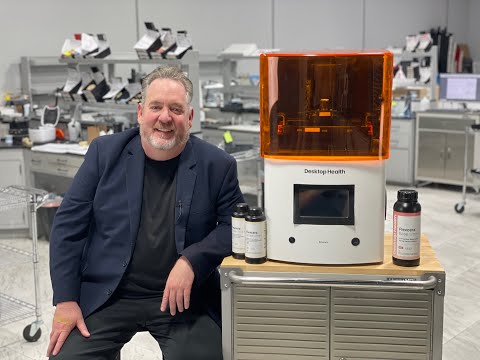
The resin is 3D printed with equipment from Desktop Metal, recent overgenomen door Nano Dimensions om een gigant van 3D-printen te vormen . It not only provides a better product but also can be delivered to a doctor the next day, bringing an unprecedented level of services to patients in need of a new denture.
Biotechnologie betreedt de tandheelkundige markt
Of course, preventing procedures like wisdom teeth removal or providing better artificial replacement will be a great improvement over current dental care.
But what if we could replace missing or damaged teeth with natural alternatives?
This is the promise of leveraging progress in biotechnology to regrow teeth in adults. In theory, it is not as outstanding as it sounds.
After all, the body has the ability to grow new teeth well after birth, so this should be a somewhat more reachable goal than other regenerative medicine projects. And for that matter, some animals are able to regrow teeth their whole adult life as well.
Het vinden van het tandelfje-gen
The starting point for researchers at Kyoto University, Japan, was to study people with a genetic mutation leading to an abnormal number of teeth, and more specifically, with too many teeth.
They found that a key development gene, BMP (for Bone Morphogenetic Protein), involved in most embryo development was also key in tooth generation. Because BMP is very important in the body, they had to find a way to affect it only through its tooth-creation program and nowhere else.
They found a way to interfere with the USAG-1 (Uterine Sensitization–Associated Gene-1), which was known to modulate BMP activity. So, they created a monoclonal antibody that hindered the interaction between USAG-1 & BMP, hoping it would trigger the creation of teeth.
(Monoklonale antilichamen worden gebruikt in veel van de recentste biotechnologische therapieën, van kanker tot ontstekingsziekten en zenuwaandoeningen. Je kunt er meer over lezen in “Monoclonal Antibodies: The Original Precision Therapy”).
En het werkte, ten minste in muizen en fretten in 2021. However, as genes like BMP tend to have a very well-conserved pattern of activity between species, the transition to human medicine has a good chance of working.
Tanden op aanvraag?
In 2024 zoeken de Japanse onderzoekers, nu in samenwerking met het Medical Research Institute Kitano Hospital in Osaka, de eerste klinische proef bij mensen te starten. It will target people who never grew teeth in the first place, or tandagenesie, as well as older patients with missing teeth.
If these clinical studies do well, we might see an approved treatment as soon as 2030. More realistically, it might take up to 2035 to see such a treatment become commonplace for any missing teeth. It might also be expensive, with monoclonal antibodies generally on the expensive side, more than $100,000 for cancer treatments.
Investeren in tandheelkundige gezondheid
Dental care is a small, but profitable and important segment of healthcare. It is also growing steadily at a double-digit rate, driven by people paying more attention to their teeth and the aging of the population.
You can invest in dental-related companies through many brokers, and you can find here, on securities.io, our recommendations for the best brokers in de VS, Canada, Australië, het VK, en ook vele andere landen.
If you are not interested in picking specific dental health companies, you can also look into healthcare ETFs like iShares U.S. Medical Devices ETF (IHI), SPDR S&P Health Care Services ETF (XHS), or VanEck Bionic Engineering UCITS ETF (CYBO) which will provide a more diversified exposure to capitalize on the dental and healthcare industry.
Tandheelkundige bedrijven
1. Nano Dimension
NNDM Prijsgrafiek
De meeste additieve fabricagebedrijven richten zich op metaal en plastic, met een focus op complexe mechanische onderdelen. Nano Dimension (NNDM ) richt zich daarentegen op 3D-geprinte elektronica. Dit omvat zeer gespecialiseerde technologieën zoals geleidende of diëlektrische inkten en keramiek. Deze kunnen bijvoorbeeld worden gebruikt voor het bouwen van optische of radio‑componenten.
This is one of the possible applications of 3D printing to the nanoscale, which we explored further in “Nanoscale 3D Printing Looks Primed for Commercialization”.
Nano Dimension has grown through a mix of acquisitions and internal R&D.

Bron: Nano Dimensions
This strategy driven by acquisitions took a new turn with de overname van Desktop Metal in 2024. Together, the 2 companies will have a much stronger position in metal and ceramics 3D printing at all scales, including a strong leadership in dental implants.
So while biotech solutions to regrow teeth might be the endpoint, for the coming decade, perfectly fitted 3D printed dentures are probably going to take over the market.
This also creates economies of scale by merging the customer base that includes SpaceX (SPCX ), Tesla (TSLA ), GE, Honeywell, Emerson, Raytheon, NASA, Medtronics, etc.
Lastly, the two companies were mostly active in different geographic areas, with Nano Dimension in Europe and Desktop Metal in the US, allowing for synergy by merging their sales teams.

Bron: Nano Dimensions
The company claims it can reduce the ecological footprint of manufacturing, with a reduction of 94% in CO2 emissions, 100% in water, 98% in materials, and 82% in chemicals.
Overall, we can expect Nano Dimension to emerge as one of the leaders in 3D printing technology.

Bron: Nano Dimensions
However, investors need to be aware that both per-acquisition Nano Dimension and Desktop Metal had negative cash flows, so the resulting company will need to cut costs or grow sufficiently to turn a profit in the future.
2. Align Technology, Inc.
ALGN Prijsgrafiek
Align staat achter het Invisalign-merk, een revolutionaire orthodontische oplossing voor het rechtzetten van tanden. Zijn unieke aanbod is om orthodontische behandeling (het opnieuw uitlijnen van tanden) minder pijnlijk en bijna onzichtbaar te maken. Het heeft tot wel 15 miljoen patiënten behandeld, waarvan 4 miljoen tieners.
The company is turning embarrassing and painful braces into a much more tolerable treatment, and continuous improvements have supported a 23% CAGR growth since 2001.
The segment is under-treated, with plenty of patients reluctant to undergo the classic methods, as illustrated by the high number of adults among Invisalign clients.
The company’s second product is iTero, an intra-oral scanner. This solution creates a full 3D digital model of the patient’s teeth in less than 60 seconds.
This can make it a great option to collect data and create a perfect virtual copy of the mouth in preparation for 3D-printed dentures.
It also integrates with other software like CAD/CAM systems, orthodontic labs, third-party scans, etc.
iTero comes on top of a completely digital platform, including dental practice software, remote dental medicine, online scheduling solution, doctor locator, patient financing, and marketing solutions.

Bron: Align
Invisalign relies on dental practice to recommend, sell, and install its products. Especially multi-location Dental Service Organizations (DSO). One such key partner, Heartland Dental, which opened 188 new practices in the last 3 years, received a $75M investment from Invisalign.
Invisalign direct marketing relies heavily on social media, influencers, and the need to create a wider awareness that the product exists and delivers on its promises.
The company is working on expanding its offer, especially in IT. Notably, Exocad, for guiding facial surgery and a smartphone-based 3D face scan, allows the user to generate an “after” picture once the treatment is over through AI.
Align is a bet on the company successfully taking over the orthodontic market and being at the forefront of digitalizing dental practices. This could deliver explosive growth for years or even decades. Investors will need to be wary of new competitors to the market and not overpay for this growth potential.



