에너지

지열 발전: 뜨거운 녹색 에너지

mm
Securities.io를 Google의 선호 소스에 추가
공개: Securities.io는 검토한 제품 링크 이용 시 보상을 받을 수 있습니다. 이는 편집 평가에 영향을 주지 않습니다. 당사는 등록된 투자 자문사가 아니며, 이는 투자 조언이 아닙니다. 제휴 공개를 확인하세요.

재생 가능한 베이스로드 전력 탐구

As solar and wind energy grow, we are still highly dependent on fossil fuels for our global energy mix, when including transportation, manufacturing, shipping, fertilizer production, etc.

Partially, this is due to mankind’s enormous hunger for energy, with a constantly growing consumption since the 1900s.

A few other factors play a role as well. The first is that solar and wind have become cost-competitive with fossil fuels only recently. So there is a lot of catch-up to do in terms of investment and energy infrastructure that will take years and decades to achieve.

Another second factor, more problematic, is that wind and solar are inherently intermittent energy sources.

So, as they are becoming a larger and larger part of the electric grid, they are increasingly required to be coupled with expensive energy storage systems, from batteries to pumped hydro or compressed, something we covered in more detail in “에너지 저장의 미래 – 유틸리티 규모 배터리 기술” and “에너지 전환을 위한 비화학적 배터리 대안.”

베이스로드 전력 옵션

Hydropower is maybe the only baseload/deliverable on-demand renewable energy, but it is limited in scope by natural resources and geography, with most of the potential already in use.

Another carbon-neutral option that is making a comeback is nuclear power. It is also good at providing baseload power no matter the weather (although drought can reduce output)

This is in large part driven by technological innovation, from SMRs (Small Modular Reactors) to 4th 세대 원자로 설계 (전체 보고서는 링크를 따라 확인하세요). In addition, AI companies like 마이크로소프트가 원자력 계약을 체결하고 있습니다 to secure electricity for their AI data centers for the next 2 decades.

But nuclear energy is still controversial, potentially dangerous, and unlikely to dominate the energy mix of many countries skeptical of this technology.

There is a 4th form of renewable energy, besides solar, wind, and hydropower, that has been barely tapped so far:  geothermal energy.

지열 에너지

All other forms of renewable energy are ultimately solar energy, including wind and hydro (rain) created from the weather patterns powered by the Sun.

But geothermal energy is different, with it being powered by radioactive reactions at the core of the planet. As this heat slowly emerges from the depth of the Earth, it is remarkably stable and predictable.

Depending on the technology used, it is even possible to postpone by a few hours the conversion of geothermal heat -> electricity. This makes it a perfect complement to wind and solar, with geothermal able to pick up the slack when they are underperforming.

Like all other renewable energy forms, the potential for geothermal energy is very location-dependent. Interestingly, this can be located in regions that are otherwise poor in energy resources, both renewable and fossil, like for example Central Europe and Japan.

지열 잠재력 평가

Geothermal energy depends on the temperature of the underground layers of rocks. This can vary greatly, with volcanic or mountainous regions being much hotter, as well as any area with seismic activity.

Another factor, at least for deep drilling, is the presence of underground water and the permeability of the rock. The more, the better, as it allows for heat to be conducted quicker and over a greater distance around the drill site.

In a 2020 study by the CNR in Italy, titled “지열 발전소의 지리적 적합성 예측“, a global map of geothermal potential was drawn (see above).

When zooming on the USA, we see that most of the geothermal potential is located in the West of the country, also some segments of Texas and Louisiana are interesting.

출처: EIA

In Europe, the geothermal potential is strong as well and distributed throughout the continent. Interestingly, is it especially strong in the industrial centers of the Rhine Valley and Central Europe. The center of Italy has also a potential almost as high as Iceland, notoriously advanced in geothermal energy, with other notable points being Corsica, Portugal, and Greece.

출처: International Journal of Terrestrial Heat Flow and Applied Geothermics

In Asia, nations in the “Ring Of Fire” (Japan, Indonesia, etc.) around the Pacific Ocean have the largest potential.

지열 에너지 규모

When talking of geothermal energy, we need to distinguish between 3 levels of depth and, therefore, technical complexity and energy.

얕은 열 펌프

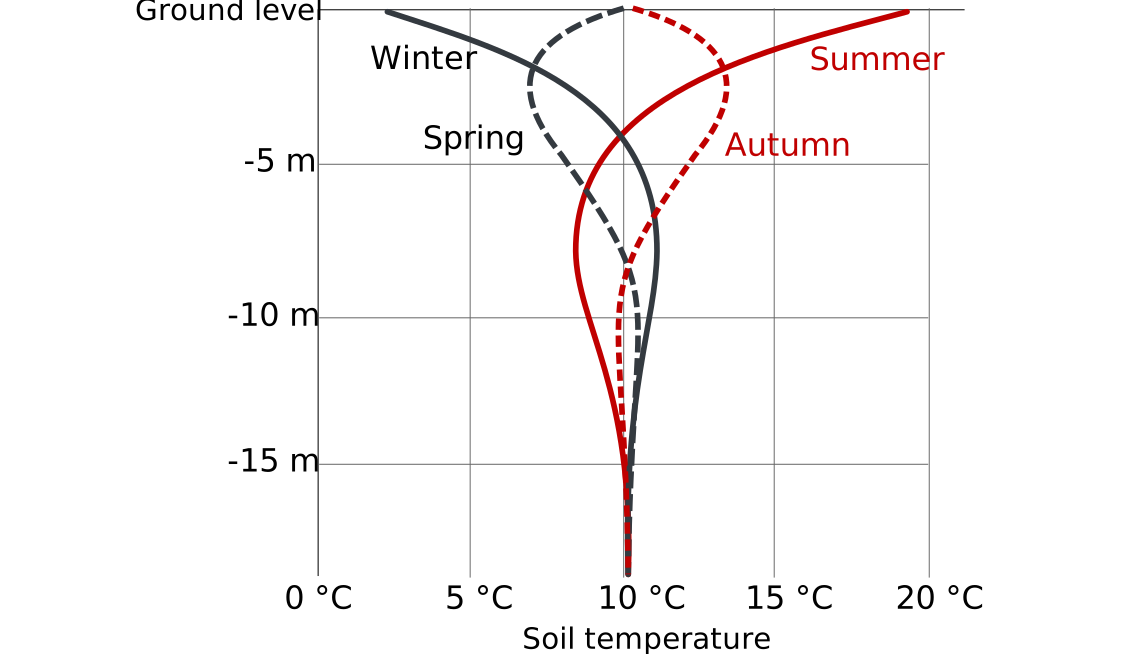
Geothermal heat pumps are now a somewhat common system in many countries. The idea is not so much to tap into geothermal energy than to use the capacity of the ground to stay at a constant temperature and have a lot of thermal inertia.

If the ground is deep enough, its temperature becomes the year’s average. This means you can extract heat from it in winter and cold in summer.

출처: NPR


There are many variants of this technique, depending on how the loop to extract heat from the ground is built.

출처: GSI

While most systems use a heat pump to maximize the energy transfer and save energy, it is also possible to use a passive geothermal system, notably to heat greenhouses as we discussed in “지열 및 수동 온실 – 농업 탄소 배출 감소”.

심층 지열 에너지

This is usually when heat is extracted from depths of 500m or deeper (1,640 feet). At these depths, the temperature increases steadily for every kilometer of extra depth, depending on the local geothermal resources.

In England, the 1000m, 3000m, 5000m에서 평균 지하 온도는 각각 약 40°C, 90°C, 140°C.

Usually medium-depth, as in “only” 1,000-2,500 meters (0.6-1.5 miles) are usually drilled for heat production only, like for directly heating buildings or industrial facilities, especially through district heating (centralized heating for a whole block for example).

For example, Paris Orly Airport in France extracts 300 cubic meters of water at 74°C. This generates a thermal output of 10 megawatts, reducing fossil fuel consumption by an estimated 4,000 metric tons of oil equivalent per year.

초심층 지열 에너지

This can also be called high-temperature geothermal energy.

Below 3,000 meters, drilling can become more complex, as the rock will usually start to go above boiling water temperature, pressure increases, and more advanced drilling machinery is required to survive the extreme conditions.

This is also where the heat is the most intense, allowing for the maximum energy production, including electricity generation.

[caption id="attachment_264834" align="aligncenter" width="749"] 출처: BGS

지열 에너지로 전력 생산

While still niche in most of the world, a few countries have demonstrated the potential of geothermal energy in power production. Notably, Kenya (50% of national power generation), Iceland (30%), and the Philippines (17%).

In some of these cases, like Iceland, it can even be argued that more could be extracted if there was a way to export it abroad. Many nations like the USA, Japan, France, and Italy have very large untapped geothermal potential.

In most cases, the ultra-hot water (>150°C) can be used for both electricity generation and co-generation of heat as well.

전통적, 향상형 및 고급 지열

전통적 지열

Traditional geothermal energy generation relies on finding the perfect situation of hot enough rocks, preexisting water, and high rock permeability.

This is indeed the ideal situation, but this is also what has hindered the development of geothermal energy. The risk of drilling and not finding rock, or the right permeability could kill a project and generate massive financial loss.

So traditional geothermal drilling is not very different from oil drilling, where the often poorly understood underground geology determines the economic viability.

향상형 지열

In contrast, enhanced geothermal techniques use “hydraulic stimulation.”

The idea is to inject water into the rock layer’s preexisting cracks to increase permeability. What differs from fracking in oil & gas extraction is that it does not require the creation of additional fractures (fracking), nor to use frack sands to maintain the fractures in an open state.

In theory, enhanced geothermal power can be used everywhere in the world. In practice, the ideal conditions are deep granite covered by a 3–5 kilometers (1.9–3.1 mi) layer of insulating sediments that slow heat loss and located in high-temperature regions.

Still, enhanced geothermal can radically increase the potential site for geothermal activity, and maybe more importantly, generate a much more predictable output.

고급 지열

폐쇄 루프

Some researchers and companies are looking to go a step beyond enhanced geothermal. Instead of injecting water and collecting it back, they want to develop a fully closed-loop system.

In theory, a closed loop system could be installed anywhere, with only the local rock temperature and depth varying the final energy output.

초임계 지열

The idea here is to tap into super hot rocks at 400°C. At these temperatures, the reservoir liquid is expected to be supercritical, a matter state where gas and liquid states merge.

Supercritical liquids can contain 4-10x more energy than normal ones. 200°C EGS 프로젝트가 5MW 용량을 가질 수 있는 반면, 400°C 초임계 프로젝트는 50MW로 용량이 10배가 됩니다. 400°C 우물 3개는 200°C 우물 42개보다 더 큰 용량을 가집니다.

The 아이슬란드 심층 시추 프로젝트 (IDDP) is the most prominent project in that field, although there have not been many updates since 2022.

Another company working on this project is Quaise. They are developing a microwave ‘gyrotron-powered drilling platform’ that vaporizes boreholes through rock. They plan to use the technology to reach a depth of 20km and access 500°C heat, or “terawatt-scale power”, with the open goal of replacing all baseload power with supercritical geothermal energy.

광물 추출

In some cases, the underground water that is extracted for its heat is also rich in dissolved brine. These brines can be abundant in useful minerals, and as the extraction process is already done, it provides a complementary revenue stream to the geothermal energy producer.

For example, the company Vulcan Energy (VUL.AX) is looking to generate heat and power, as well as lithium from underground brine in the Rhine Valley (see more about Vulcan below).

협동 발전

The heat produced with geothermal energy is usually either used as heat for housing or for producing electricity.

However, other applications could be developed to maximize the use of energy on-site, especially in remote locations. For example, it could be used to desalinate seawater or produce hydrogen and/or ammonia, which could then be exported where it is needed.

지열 경제학

Geothermal energy is overall a relatively cheap energy source. The market 2023-2033 기간 동안 연평균 성장률(CAGR) 3.14%만큼 성장할 것으로 예상됩니다.

One advantage of this technology is that it leverages decades of experience in drilling in the oil & gas industry. In practice, it could also be a good way to maintain employment and the technical skills of oil workers during the green transition.

When compared to other energy sources, geothermal holds its own against solar + energy storage at the utility scale.

출처: Lazard

And that’s without taking into account that geothermal might be better suited to regions with poor solar potential, or with massive heat and energy demand in cold winters when solar is producing the least (like Germany, Norway, and some parts of North America).

So geothermal energy generation can be profitable. It is however suffering from the need for massive upfront investments, with the return on the initially spent capital likely taking a decade or two.

This is also a type of green energy poorly covered by subsidies, tax incentives, and overall green policies, that have historically favored solar and wind (see the graph above to see the effect of subsidies in making geothermal more expensive than solar).

With the need for storage and the issues related to solar & wind intermittency coming at the forefront of policymakers’ awareness, this might change.

지열의 장점 및 단점

최고의 녹색 에너지?

Geothermal energy is truly renewable, while also being easy to produce on demand and stable throughout the day and year, making it a good equivalent for hydropower more than solar or wind.

Another advantage over all other renewables (including hydro) is a very limited land footprint, with most of the facilities invisible underground. This leads to minimal ecological and environmental disruption, where the same capacity would have covered hectares in solar panels or wind turbines or under the water of a dam.

출처: Wikipedia

Lastly, geothermal energy mostly uses drilling technology used by the oil & gas industry. If anything, this is a technology most advanced in Western countries, reducing drastically the risk of dependence on supply chains located in China, as in the case of solar panels, wind (rare earth magnets), and batteries.

지열 문제

자원 고갈

Underground heat does replenish over time. However, geothermal heat extraction can remove heat quicker than it is accumulating.

So the real rate of production should be calculated to either avoid depletion totally or to incorporate that the resources need a production pause of a few years /decades after 30-50 years of extraction.

지진 위험

Any drilling, especially one affecting deep underground water layers, can theoretically cause earthquakes. For example, 지열 에너지 프로젝트가 2017년 한국 포항에서 규모 5.5의 피해를 입힌 지진을 일으켰다.

This is mostly due to the same phenomenon causing fracking to be linked to earthquakes. By adding fluids underground, the process lubricates the rock layers, making it easier for them to move.

Overall, these earthquakes are not enormous but can be damaging locally.

So in some cases, especially in very seismically active regions, it could be best to produce power with geothermy in relatively remote or uninhabited regions.

Alternatively, seismic but geothermally rich regions might benefit best from closed-loop designs, that do not disturb the rocks past the initial drilling, nor inject water in the underground rock layers.

지열 에너지에 투자하기

The sector is still relatively small compared to other renewables, and quickly evolving technologically.

This means that many of the most advanced startups in the sector are still privately listed. For example, closed-loop geothermal energy Eavor, supercritical geothermy Quaise, or funds only accessible to accredited investors like Baseload Capital.

This also means that some advanced geothermal companies, like Iceland Drilling, might be just a small part of a much larger oil & gas drilling company (Archer Wells – ARCH.OL in this case).

Still, some companies are publicly listed and available to retail investors. You can invest in geothermy-related companies through many brokers, and you can find our recommendations for the best brokers on this website in 미국캐나다호주영국 다른 많은 국가.

If you are not interested in picking specific space-related companies, you can also look into ETFs like the Shares Global Clean Energy ETF (ICLN), the First Trust NASDAQ Clean Edge Green Energy Index Fund (QCLN), or the ALPS Clean Energy ETF (ACES) to capitalize on the growth of the geothermal energy sector.

지열 기업

1. Ormat Technologies, Inc.

Ormat is the world’s 2nd largest geothermal owner and operator and the largest publicly traded. The company has assets in the US, Kenya, Indonesia, and Central America + the Caribbean, with a capacity of 1.23 GW and 125 MW in development.

ORA 가격 차트

Ormat is also entering the energy storage market, with 190 MW online. The company aims to reach a capacity of 1 GW by 2028.

출처: Ormat

The company is targeting a strong growth of power production capacity, notably with projects in New Zealand and Indonesia.

It is also a provider of geothermal technology, with 3.4GW of geothermal installed over the years, making it the 3rd largest provider of geothermal plants, behind Fuji Electric and Toshiba.

The Inflation Reduction Act supports Ormat’s aggressive growth targets, which should provide up to $125M in cash proceeds annually from tax benefits.

출처: Ormat

Geothermal energy is currently a quickly growing sector, but also one that is still very conservative due to the lack of familiarity with the technology for most utilities and industrial companies.

In that respect, this makes Ormat well positioned to capitalize on the growing demand, while also being one of the most established players in the industry.

2. Vulcan Energy (VUL.AX)

Vulcan is a German company targeting geothermal energy production in the Rhine Valley while also extracting lithium from the geothermal brine.

The project targets the production of renewable heat for 1 million people, enough lithium for 1 million EVs per year, and 1 million tons of CO2 emission avoided per year.

The heat production matches well the local market, with Germany rich in district heating systems currently relying on coal or gas.

Phase one of the project should result in 275 GWh of power and up to 560 GWh of heat per year.

출처: Vulcan Energy

The company has yet to produce lithium but has already secured off-take agreements with Stellantis, Volkswagen, LG, Umicore, and Renault. This is also reflected in the ownership, with Stellantis owning 6% of the company through a $50M investment.

The lithium resource is expected to decline very slowly, with less than 50% dilution even by 2055. Production should start at the end of 2025. It should also have one of the lowest lithium production costs in the world, beating all the mined lithium and almost all the brine-sourced lithium.

Vulcan is a more speculative project, with no significant cash flow expected before 2026. Still, the first lithium production in 2024 demonstrates the project’s viability, and the prospect of low extraction costs going hand-in-hand with geothermal power generation is interesting.

This could also reduce the carbon footprint for EU-made EVs, as currently, most lithium is extracted using fossil-fuel-powered engines and facilities running at least partially on fossil fuels, making Vulcan the only CO2-neutral, zero-fossil fuel lithium project in the world. It is also the largest lithium resource in Europe.

Jonathan은 유전 분석 및 임상 시험을 수행한 전직 생화학 연구원입니다. 그는 현재 주식 분석가이자 금융 작가이며, 혁신, 시장 주기 및 지정학에 초점을 맞춘 출판물 'The Eurasian Century'을 운영하고 있습니다.