
Proyek mega
Lunar Gateway: Membangun Langkah Pertama Menuju Bintang-bintang

 Tambahkan Securities.io ke sumber pilihan Anda di Google

Stasiun Luar Angkasa Berikutnya
In the history of space exploration, space stations have been an important milestone, as they allowed space agencies to develop and test countless systems required for long-term presence in space. They also gave us insight into the effect of weightlessness on the human body and provided a safe structure from which to perform many scientific experiments.
With the ISS expected to begin de-orbiting in a few years, it might seem that the more recent Chinese space station Tiangong, now opening for non-Chinese astronauts, most likely first to Russian astronauts, will be the largest inhabited structure in space for the foreseeable future.
China plans to double the station from 3 to 6 modules in the coming years. This would bring its mass to 180 metric tons, or just 40% of the ISS’s 450 tons.

Sumber: Wikipedia
But this is incorrect, as a much more ambitious project than the ISS is being built: the Lunar Gateway.
Lunar Gateway is a keystone of the Artemis program, a series of deep space missions looking to bring back Western astronauts to the Moon. You can read an overview of the Artemis missions and the rationale behind them in “The Artemis Mission: Fly Me To The Moon (Again)”.
The Lunar Gateway will eventually become an anchor point for future Artemis Moon landings and associated missions. It will also be the first deep space station, orbiting another celestial body than Earth, being located as far as ~350,000 km from Earth (210,000 miles), while the ISS was orbiting just 400km above us (250 miles).
Mengapa Membangun Lunar Gateway?
Menyesuaikan dalam Desain Artemis
The Artemis missions aim for long-duration stays on the Moon lasting days and weeks, and eventually, a permanent settlement of the place.
You can read a detailed account of the Artemis program in the dedicated report we published recently.
This means that a lot of material, spare parts, resupply, personnel, and potential help needs to be located in the immediate vicinity of the lunar missions, not a minimum of several days away, even when assuming a rocket is ready to launch immediately. This is why the Artemis mission IV will be, in large part, dedicated to building the Lunar Gateway, a space station orbiting the Moon.

Sumber: Explore Deep Space
The exact date of Artemis IV is unclear, as the program has suffered repeated delays. Currently, Artemis II is scheduled for April 2026, with Artemis III the first human Moon landing.
The “no earlier than 2027” timeline on the NASA website dedicated to Gateway should likely be understood more realistically as a 2028-2030 date.
Lunar Gateway Sebagai Tempat Perlindungan Aman
Melawan Debu
Overall, NASA and space agencies are a lot more comfortable with long-duration stays in space stations than on the Moon’s surface. This is because they have a lot of experience in doing so successfully with the ISS.
In contrast, the Moon will present a series of unique challenges.
The first one will be the presence of moon dust. Contrary to dust on Earth, the absence of atmosphere and erosion means that the moon dust is made of extremely sharp and abrasive microparticles.

This will likely quickly damage the spacesuits, seals, and equipment on the surface. So, having a dust-free safe space when not exploring the Moon might be a life-saver for the Artemis astronauts.
“The particles are jagged from millions of years of micrometeoroid impacts, sticky due to chemical and electrical forces, and extremely small. Even small amounts of lunar dust can have a big impact on equipment and systems.”
Josh Litofsky – Manajer proyek yang memimpin kampanye pengujian adhesi debu lunar Gateway
Regular travel to the Moon could ultimately also affect the Lunar Gateway, if too much lunar dust accumulates after the astronauts travel back to the station, leading to dust accumulation on the exterior of the station (and hopefully none inside).
This is why NASA is working on the Gateway On-orbit Lunar Dust Modeling and Analysis Program (GOLDMAP), which should predict how dust may move and settle on Gateway’s external surfaces.
Early GOLDMAP simulations have shown that lunar dust can form clouds around Gateway, with larger particles sticking to surfaces.
Menyediakan Kamp Rumah
Another reason to build Gateway is that this will provide a lot of storage and living space capacity that does not need to be landed on the Moon. This will save money and technical capacity, with a higher mass and volume installed in the Moon’s orbit this way.
Lastly, as a close-by independent station, it will provide the astronauts with a backup location in case something goes wrong on the Moon’s surface during exploration. Micrometeorites or technical failures could make the Moon-based habitats unsuitable for life, and the astronauts cannot just go into an evac emergency capsule like on the ISS if this happens. They would need a base camp as close as possible.
Besides these critical missions, the Lunar Gateway will also provide services to the Moon exploration mission, like high-speed telecommunications, stockpiling & relaying to Earth the collected Moon rock samples, scanning of the Moon surface for resources like water, etc.

Gambaran Arsitektur Gateway
Gateway will be built of 7 main modules, to which the Orion, the capsule carrying astronauts to the Moon orbit from Earth, will attach:
- Airlock Kru & Ilmu Penelitian, disediakan oleh Uni Emirat Arab, untuk melakukan aktivitas luar angkasa.
- Lunar-I-Hab, dengan ruang tinggal dan dukungan kehidupan, disediakan oleh Badan Antariksa Eropa (ESA) dan Badan Eksplorasi Antariksa Jepang (JAXA).
- HALO, disediakan oleh Northrop Grumman dan NASA, ruang tinggal kru.
- Lunar View, juga oleh ESA, dengan ruang kargo dan jendela besar.
- Sistem Daya dan Propulsi, termasuk 60kW daya listrik dari panel surya, yang paling banyak pernah diproduksi dalam sebuah pesawat antariksa.
- Modul Logistik, untuk pengiriman kargo dan eksperimen ilmiah masa depan, baik di dalam maupun di luar stasiun luar angkasa, yang akan berbasis pada Dragon XL milik SpaceX dan dioptimalkan untuk membawa lebih dari lima ton metrik kargo ke Gateway di orbit lunar.
- Kanada juga akan menyediakan lengan robotik Canadarm3, yang dapat bergerak ke berbagai bagian stasiun.

Sumber: NASA
(Anda juga dapat melihat a fully animated 3D model of the Lunar Gateway at this link.)
Membangun Lunar Gateway
The Power and Propulsion Element (PPE) will be built by Maxar, and the Habitation and Logistics Outpost (HALO) built by Northrop Grumman (NOC ) and both will first be launched by SpaceX (SPCX ) Falcon Heavy rocket.
Installed on HALO will be the large antenna HALO Lunar Communication System, which was developed by ESA. The communication debit will be a few Kb/s up to 25 Mb/s depending on distance, and consume up to 600W.
The PPE solar panel will be provided by JAXA, which will also fit it with batteries for when the space station is not in the sunlight.

Sumber: NASA
HALO and PPE will spend about a year traveling to lunar orbit, using high-efficiency solar-electric propulsion and the gravity of the Earth, Moon, and Sun to reach their destination.
Then, Artemis 4 will bring into lunar orbit the crewed Orion spacecraft and Lunar I-Hab Gateway, which will dock with the HALO module.

Sumber: NASA
The rest of the modules will be brought at a later date.
Artemis V will bring the Lunar View module and a Human Landing System spacecraft will dock at Gateway.
During the Artemis VI mission, the Gateway’s Crew and Science Airlock provided by the UAE Mohammed Bin Rashid Space Centre, which will permit crew and science transfers to and from the vacuum of space.
Canada’s main contribution will be Canadarm3, a robotic arm on the exterior of the lunar Gateway. This is an upgrade from Canadarm1, which was installed on every space shuttle, and Canadarm2, which was installed on the ISS.
It will help maintain, repair, and inspect Gateway, capture visiting vehicles, help astronauts during spacewalks, and enable science in Gateway’s lunar orbit.

Sumber: NASA
Orbit oval Gateway will provide access to both the North and South Pole areas of the Moon for orbital observations.
Eksperimen Lunar Gateway
While the primary role of Gateway is to support the manned Moon exploration missions, it will also perform its own scientific experiments.
Much of the initial science taking place on the Gateway space station will focus on radiation from the Sun and deep space.
ESA will provide the Internal Dosimeter Array (IDA), with instruments provided by JAXA, to study potential radiation inside Gateway.
Meanwhile, the Heliophysics Environmental Radiation Measurement Experiment Suite (HERMES) and European Radiation Sensors Array (ERSA) will hitch a ride on HALO’s exterior to measure radiation around the space station.
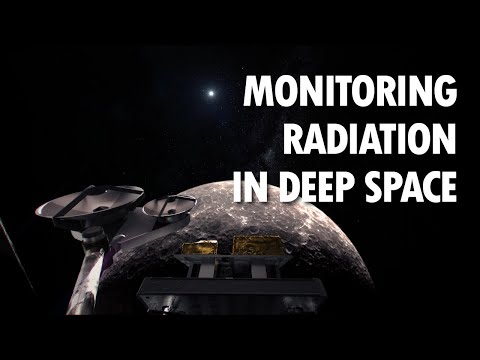
This is an important set of data to collect, as the Lunar Gateway will be the very first space habitat out of the protective magnetosphere of Earth. As such, the radiation levels will be higher, and much higher during solar storms.

Sumber: NASA
The radiation instruments will also be active when the Gateway components are moved toward their lunar orbit, passing through the Van Allen radiation belts, an area around Earth where high-energy particles are trapped by our planet’s magnetic field.
So these measurements will advance scientists’ knowledge of space weather to help them understand risks posed by radiation on both people and material.
This will be crucial information for any future space mission to Mars, with many months or even years of travel into deep space with similar exposure to radiation.
Masa Depan Lunar Gateway
With a lifespan initially expected of 15 years, it is likely that the Lunar Gateway’s main mission will mostly be Moon exploration.
It might, however, be a waypoint for the first manned expedition to Mars. The reason is that by that point, the ISS might not be in service anymore. But it would make a lot of sense to have astronauts have a quarantine and training time in orbit before departure for a multi-year travel. So they could be first ferried to the Lunar Gateway, and then onboard the spaceship (or maybe SpaceX Spaceship?) that will travel to Mars.
For that matter, the presence in deep space of a fully functional habitat equipped with air, food, crew, energy, and equipment might make Lunar Gateway a good base of operation for any human assembly work potentially required in preparing a future Martian spaceship.
Habitat Luar Angkasa Masa Depan
Habitat Heksagonal
Before stepping into the (still science fiction) realm of massive space habitats able to handle hundreds or even millions of people, space manufacturing will need to make serious progress.
The most likely first step is to give up on the tried and tested modular system used for the ISS and Lunar Gateway.
Instead, assembling the components required in space will likely be a lot more efficient.
“As humanity moves closer to becoming a spacefaring species, we will quickly outgrow the small, cylindrical tubes that have defined the first century of space flight.
The future lies in self-assembling, adaptive, and reconfigurable structures.”
The idea would be to use self-assembling hexagonal modules to build massive geodesic structures, instead of the premade and assembled on Earth cylindrical modules we are more familiar with.
One such example is TESSERAE.

Sumber: Aurelia Institute
This would leverage the absolutely massive lift capacity of rockets like Starship (150-200 tons), something the designers of space stations never had access to before.
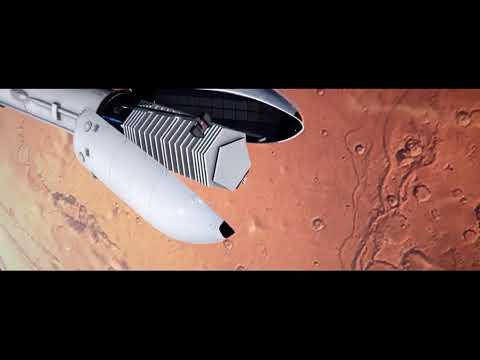
You can read more about this concept from the initial 2016 scientific publication written by MIT scientist Ariel Ekblaw.
Another example is developed by Think Orbital, looking to create a football-like structure in space, with a diameter of 4.5 up to 20m (15-65 feet), creating a 300 up to 4000 m3 volume.

Sumber: Think Orbital
Habitat Luar Angkasa yang Dapat Ditiup
For now, all space stations have been built using rigid, Earth-made & assembled modules. A new concept is starting to challenge this design, inflatable space habitats.
This idea relies on progress made in material science, like Vectran, a fiber manufactured from a liquid-crystal polymer (LCP), a material 5x stronger than steel and 10x stronger than aluminum.
Lockheed Martin (LMT ) is already testing this concept, as well as ILC Dover, a subsidiary of Ingersoll Rand (IR ) and Sierra Space.
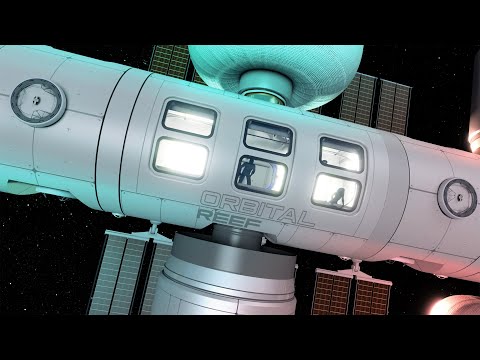
This design idea promises a much larger habitable space for the same mass than classical modules. It also can fit in the limited volume of most launchers, which can be as critical a constraint as total mass for large equipment.
These inflatable habitats could be used for space stations, but also Moon or Mars-based permanent stations as well.
Aldrin Cycler
A descendant of the Lunar Gateway could be a so-called Aldrin Cycler, or Mars Cycler, which would be permanently orbiting in such a way that it comes regularly in the vicinity of both Earth and Mars (in green below, with red being Mars’s orbit and blue Earth’s).

Sumber: Ethan MacDonald
This way, you could build a permanent space station for people to transit to and from Mars with minimal fuel requirements.
It could have heavier radiation shielding and local food production, as well as more comfortable and spacious rooms and sports facilities to keep people in shape despite the absence of gravity.
This would fill a similar function to the Lunar Gateway, by providing a safer and more spacious environment to astronauts than a spaceship, but for Mars exploration missions this time.
Such an installation would likely be a must for any development of a Martian economy including any transit of personnel or space tourism.
Pemanfaatan Sumber Daya In-Situ
Lifting anything from orbit still costs thousands of dollars per kilo. This is true for food, water, even air, and makes any truly large space structure or spaceship prohibitively expensive.
And even if super-heavy launchers like optimized Starship become commonplace and are mass manufactured, this cost will likely stay above $100-200/kilo.
This precludes some solutions that would be very efficient but require too much material, like, for example, a meter-thick layer of water to stop deep-space radiation.
However, if resources from the Moon or an asteroid could be used, this would change the equation entirely.
For example, even a small comet could provide millions of tons of water, enough for building radiation shields for space habitats, and massive space farms to feed the astronauts without having to lift food from Earth at all.
The same can be said of space stations. In the long run, mass-produced heavy iron/steel/titanium/aluminum panels and beams will likely form the structural elements of space habitats, with the raw resources coming from asteroid mining or Moon-based foundries. Similarly, Moon bases might be built out of 3D printed regolith, instead of imported materials.
Kesimpulan
Lunar Gateway is an ambitious project, looking to accomplish a lot of firsts: first deep space manned station, first lunar orbit permanent occupation, first off-Earth settlement not in LEO (Low-Earth Orbit).
At the same time, this is a project very similar to the ISS: it is based on multinational collaboration, built upon the modular design tested for previous space stations, and is designed primarily for scientific experiments and space exploration purposes.
That might likely also be the last of such space stations, as larger launchers open new possibilities with radically different design philosophies.
This could be modular self-assembling panels, inflatable stations, or even later on sending into space mining equipment and foundry for in-situ manufacturing.
But none of these projects will materialize without the Lunar Gateway first, the time mankind will step out of the Earth’s protection, and permanently settle in the void, hundreds of thousands of miles away.
Perusahaan Terkait Artemis
Lockheed Martin
LMT Grafik Harga
Lockheed Martin adalah salah satu perusahaan aerospace & pertahanan terbesar di dunia, yang kami bahas secara detail pada November 2025 dalam “Lockheed Martin (LMT) Spotlight: A Leader In Defense and Aerospace”.
Singkatnya, ini adalah perusahaan di balik pesawat seperti helikopter Black Hawk atau F-16, serta peralatan canggih seperti F-35, pesawat radar terbang, atau pesawat logistik seperti C-5 Galaxy & C-130J Super Hercules.

Sumber: Lockheed Martin
Ini juga merupakan produsen beberapa sistem misil paling penting militer AS seperti JAASM, Javelin, ATACMS, dan HIMARS, yang sangat diminati setelah persediaan menipis akibat konflik di Ukraina.
Ini juga penyedia penting sistem pertahanan anti-misil seperti AEGIS laut dan THAAD (Terminal High Altitude Area Defense) terhadap misil balistik.

Sumber: Lockheed Martin
Senjata memang bukan satu-satunya yang dilakukan perusahaan. Lockheed adalah kontraktor utama untuk desain, pengujian pengembangan, dan produksi pesawat luar angkasa Orion, yang mungkin menjadi bagian paling tidak kontroversial dari seluruh program Artemis.
Orion mencakup Callisto, sistem bantuan AI yang dikendalikan suara, bekerja sama dengan Alexa milik Amazon , yang juga menggabungkan uji dukungan video-chat dari Bumi bekerja sama dengan Cisco.

Sumber: Lockheed Martin
Apakah program ini pada akhirnya akan ditingkatkan berkat peluncuran yang lebih murah dan lebih sering menggunakan Starship? Hal ini dapat meningkatkan produksi Orion juga.
Juga terkait dengan Artemis, Lockheed telah mengumumkan bahwa ia menyelesaikan uji kritis prototipe panel surya lunar yang dapat berfungsi di kutub Selatan Bulan. Namun, proyek tersebut kalah dari Leidos untuk program rover Artemis.
(LDOS )Perusahaan ini aktif dalam program luar angkasa lainnya, seperti satelit cuaca GOES-R, pengumpulan sampel asteroid oleh OSIRIS-REx, probe Jupiter JUNO, rompi pelindung radiasi yang dapat dipakai AstroRad,
Secara keseluruhan, dari sistem militer utama hingga kendaraan dan program luar angkasa yang sama pentingnya, Lockheed Martin berada di garis depan inovasi Amerika dan tampaknya mempertahankan keunggulannya jauh lebih tajam dibandingkan banyak pesaing kontraktor pertahanan besar. Perusahaan ini seharusnya mendapat manfaat dari iterasi selanjutnya dari program Artemis, serta banyak misi ruang dalam dan berfokus pada Mars dalam jangka panjang.
Terbaru tentang Lockheed Martin



