
Megaprojetos
Observatório JUNO: Desvendando os Segredos da Massa dos Neutrinos

 Adicione Securities.io às suas fontes preferidas no Google

Capturando um Vislumbre da Partícula Mais Elusiva
A física fundamental avança por meio da interação entre teoria, experimentos e observações.
Entre suas grandes questões estão a natureza da gravidade, a origem das massas e as leis que regem o Universo. Os neutrinos são particularmente úteis para testar essas leis, mas não fornecem sozinhos a resposta para todas essas perguntas.
O megaprojeto chinês JUNO, sigla de Jiangmen Underground Neutrino Observatory, deverá ampliar nossa compreensão dos neutrinos e, em especial, da ordenação de suas massas.
Essa instalação de grande porte resulta de muitos anos de trabalho e de uma ampla colaboração internacional.
Seus resultados complementarão os do Deep Underground Neutrino Experiment (DUNE), uma experiência norte-americana que estudará um feixe de neutrinos ao longo de cerca de 1.300 km, entre o Fermilab e a Dakota do Sul.

Fonte: DUNE
O que são neutrinos?
Neutrinos são partículas eletricamente neutras com massa extremamente pequena. As primeiras formulações do Modelo Padrão os tratavam como partículas sem massa, mas as oscilações observadas mostram que pelo menos dois estados de massa não são nulos.
Ainda não sabemos por que os neutrinos têm massa nem qual mecanismo a produz. Esse mecanismo pode ser diferente daquele que dá massa aos demais férmions.
Os neutrinos às vezes são chamados de partículas “fantasmas” porque interagem muito raramente com a matéria. No Modelo Padrão, participam da interação fraca e, como toda energia, da gravidade.
A interação fraca atua em distâncias muito curtas e a gravidade é desprezível na escala de um neutrino. Por isso, eles normalmente atravessam a matéria sem serem detidos e viajam a uma velocidade muito próxima à da luz.

Neutrinos são partículas elementares conhecidas em três sabores: eletrônico, muônico e tauônico. Durante a propagação, podem mudar de sabor em um fenômeno chamado oscilação.
As oscilações dependem da mistura entre sabores e estados de massa, além das diferenças de massa ao quadrado. Seu estudo informa a física de partículas, mas não mede diretamente a massa absoluta de cada neutrino.
Também pode existir uma quarta categoria hipotética: os neutrinos estéreis. Eles não participariam da interação fraca comum, o que os tornaria ainda mais difíceis de detectar. Sua existência não foi estabelecida.

Neutrinos são produzidos por vários processos nucleares: fusão nas estrelas, decaimentos radioativos na Terra, supernovas, raios cósmicos e reatores artificiais. Os antineutrinos de reatores são essenciais para o projeto do JUNO.
Os neutrinos estão entre as partículas massivas mais abundantes do Universo. Dezenas de trilhões de neutrinos solares atravessam cada centímetro quadrado da Terra a cada segundo, sem efeito perceptível no corpo humano.
(Para saber mais, consulte o site “All Things Neutrino”, criado pelo Fermilab.)
Objetivo do JUNO: determinar a ordenação das massas
O JUNO foi projetado principalmente para determinar a ordem dos três estados de massa dos neutrinos, às vezes chamada de “hierarquia de massas”.

Fonte: Berkeley Lab
Os experimentos de oscilação medem principalmente diferenças de massa ao quadrado, e não as massas absolutas. Os dados ainda permitem duas ordens: a normal, na qual o terceiro estado é o mais pesado, e a invertida, na qual ele é o mais leve.
“Esperamos compreender como os léptons — os elétrons e suas partículas relacionadas — surgiram nos instantes após o Big Bang, um processo que pode ajudar a explicar por que há mais matéria do que antimatéria no Universo.
Na época dessa declaração, anterior ao Daya Bay, responder a algumas dessas questões exigia determinar se o ângulo de mistura θ13 era diferente de zero. Essa condição já foi confirmada experimentalmente.
Deslize para rolar →
| Tipo de ordenação | Ordem dos estados de massa | O que se sabe |
|---|---|---|
| Ordenação normal | m1 < m2 < m3 | Compatível com os dados atuais e geralmente favorecida, sem decisão definitiva |
| Ordenação invertida | m3 < m1 < m2 | Ainda compatível com parte dos dados; confirmá-la ou excluí-la aprimorará os modelos |
Projeto do JUNO
Na continuidade da experiência Daya Bay
O JUNO aproveita a experiência do detector de neutrinos de reator de Daya Bay, realizado por uma ampla colaboração internacional que incluiu laboratórios chineses e norte-americanos.

Fonte: Wikipedia
Após a descoberta das oscilações de neutrinos atmosféricos e solares no fim da década de 1990 e início dos anos 2000, o Daya Bay mediu com precisão, em 2012, um modo de oscilação relacionado ao ângulo θ13.
Essa medição completou o quadro experimental dos três ângulos de mistura e viabilizou experiências de nova geração voltadas, entre outros objetivos, à ordenação das massas. Ela não concluiu sozinha toda a teoria das oscilações.
Escolha do local correto
O detector Daya Bay foi concebido para medir os antineutrinos emitidos pelas usinas nucleares de Daya Bay e Ling Ao.

Fonte: ResearchGate
Inicialmente, o JUNO seria instalado em outro ponto da região. Os planos foram ajustados para limitar diferenças de distância entre o detector e os núcleos dos reatores, que confundiriam o padrão de oscilação buscado.
O local escolhido fica a cerca de 53 km das usinas de Yangjiang e Taishan, distância próxima ao primeiro máximo de oscilação útil à medição.

Fonte: ResearchGate
A distância aos reatores é decisiva porque a probabilidade de um antineutrino manter seu sabor varia com a distância percorrida e com sua energia.
Os efeitos da matéria, causados pelos elétrons da Terra, existem, mas são pequenos para os antineutrinos de reator e as energias do JUNO. O sinal principal vem da interferência entre as oscilações associadas às diferentes diferenças de massa ao quadrado.
O percurso de cerca de 53 km, bem maior que os aproximadamente 2 km do Daya Bay, permite resolver estruturas finas do espectro de energia necessárias para distinguir as duas ordenações.
Essa distância reduz muito o fluxo recebido; por isso, são necessários um detector muito maior, excelente resolução de energia e controle rigoroso dos ruídos de fundo.
A instalação está sob aproximadamente 700 metros de rocha para reduzir o número de múons cósmicos e os ruídos de fundo que eles produzem.

Fonte: Global Times
Essa cobertura rochosa atenua intensamente os raios cósmicos, mas não os elimina. O detector de água e as análises também ajudam a identificar os eventos residuais.
Proposto em 2008, aprovado pela Academia Chinesa de Ciências e pela província de Guangdong em 2013, o JUNO iniciou as obras subterrâneas em 2015.
A instalação do detector começou em dezembro de 2021 e terminou em dezembro de 2024.
“O JUNO tem um projeto experimental original que permite abordar vários objetivos de física.
Como projeto internacional liderado pela China, ele também fortalece a capacidade científica do país nessa área.”
Uma enorme esfera de cintilador
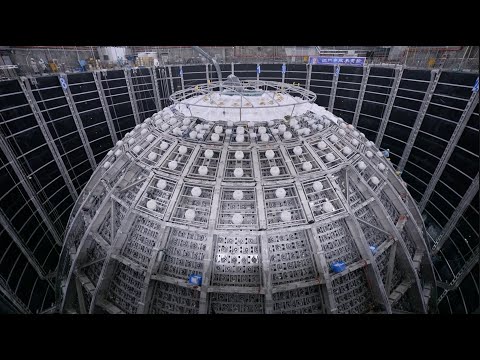
A estrutura central do JUNO é uma esfera de acrílico imersa em um grande tanque de água. Seus responsáveis a apresentam como um dos maiores e mais precisos detectores líquidos de neutrinos já construídos.
O detector usa um líquido cintilador. Quando um antineutrino interage com um próton por decaimento beta inverso, as partículas produzidas depositam energia e geram flashes de luz característicos.

Fonte: The European Physics Journal
Essa luz é captada por tubos fotomultiplicadores (PMTs) de 20 e de 3 polegadas. Eletrônica, cabeamento, compensação do campo magnético e painéis ópticos completam o sistema.
O alvo central contém cerca de 20 mil toneladas de cintilador líquido no centro de um tanque de água com aproximadamente 44 metros de profundidade.

Fonte: Global Times
Uma estrutura de aço inoxidável com 41,1 metros de diâmetro sustenta a esfera acrílica de 35,4 metros, cerca de 20 mil PMTs de 20 polegadas, 25.600 PMTs de 3 polegadas, a eletrônica frontal, cabos, bobinas de compensação magnética e painéis ópticos.
Os PMTs operam simultaneamente para coletar a luz de cintilação e convertê-la em sinais elétricos. Energia, posição e tempo reconstruídos são usados para selecionar interações candidatas.

Fonte: ResearchGate
Volumes enormes
A partir de dezembro de 2024, o tanque que envolve o sistema foi preenchido com água ultrapura a uma vazão anunciada de cerca de 100 toneladas por hora.
Em 45 dias, a equipe adicionou cerca de 60 mil toneladas de água ultrapura. Manteve a diferença de nível entre o interior e o exterior da esfera em poucos centímetros e controlou a vazão para proteger a estrutura.

Fonte: IIHE
Essa precisão e a estabilidade de longo prazo são necessárias para comparar espectros coletados durante vários anos. O JUNO, porém, registrará muitos eventos; não se trata de esperar anos entre dois neutrinos.
A colaboração prevê operação por várias décadas, condicionada ao desempenho, ao financiamento e à manutenção da instalação.
“O projeto exigiu não apenas novas ideias e tecnologias, mas também anos de planejamento cuidadoso, testes e perseverança. Cumprir os rigorosos requisitos de pureza, estabilidade e segurança exigiu a dedicação de centenas de engenheiros e técnicos.”
A água ajuda a proteger o detector da radioatividade da rocha e funciona como veto contra os múons cósmicos que atravessam a montanha e podem imitar algumas assinaturas de neutrinos.
“A injeção dos líquidos ocorreria em duas etapas. Durante os dois primeiros meses, água ultrapura preencheria os espaços dentro e fora da esfera acrílica do detector central.
Nos seis meses seguintes, a água ultrapura dentro da esfera seria substituída pelo cintilador líquido.”
O JUNO anunciou ter concluído o preenchimento de seu alvo com 20 mil toneladas de cintilador líquido e iniciado a coleta de dados em 26 de agosto de 2025.
Uma colaboração internacional
O JUNO reúne mais de 700 membros de 17 países e regiões. A colaboração inclui instituições chinesas, europeias, russas e norte-americanas; sua composição pode mudar ao longo do projeto.
Os dados são processados por vários centros internacionais, incluindo o Instituto Chinês de Física de Altas Energias, o CNAF do Istituto Nazionale di Fisica Nucleare na Itália, o Joint Institute for Nuclear Research na Rússia e o Centre de Calcul de l’IN2P3 na França.
Primeiros dados
A colaboração relatou um primeiro evento candidato de neutrino no cintilador em 24 de agosto de 2025, durante o comissionamento. Um evento isolado demonstra o funcionamento da cadeia de detecção, mas ainda não constitui um resultado sobre a ordenação das massas.

Fonte: EyesOnSci
Em novembro de 2025, a colaboração apresentou seus primeiros resultados com base em 59 dias efetivos de dados: medições de θ12 e Δm221 anunciadas como 1,5 a 1,8 vez mais precisas que os resultados anteriores. Essas medições de parâmetros de oscilação ainda não determinam a ordenação das massas.
Determinar a ordenação das massas ainda exigirá vários anos de dados, calibrações e análises controladas; o resultado não virá de uma medição direta da massa.
Evoluções futuras e experiências globais com neutrinos
Busca pela natureza de Majorana
O primeiro objetivo do JUNO é contribuir para determinar a ordenação das massas dos neutrinos, uma peça importante do quadro de oscilações. O resultado não resolverá sozinho todas as questões sobre as partículas ou o Universo.
Com medições mais precisas dos parâmetros de oscilação, os físicos poderão testar a coerência do modelo de três sabores e preparar melhor outras pesquisas em física de partículas.
No futuro, uma atualização do JUNO poderá participar da busca pelo duplo decaimento beta sem neutrinos, que testaria se o neutrino é sua própria antipartícula.
As antipartículas têm números quânticos opostos aos das partículas correspondentes, mas a mesma massa. Como o neutrino é neutro, ele pode teoricamente ser uma partícula de Majorana, porém isso ainda não foi demonstrado.
A observação do duplo decaimento beta sem neutrinos mostraria violação do número leptônico e indicaria que o neutrino é uma partícula do tipo Majorana. Nenhuma experiência observou esse processo hipotético de forma conclusiva.
Hyper-Kamiokande, DUNE e outros projetos
O Hyper-Kamiokande, ou Hyper-K, sucede o Super-Kamiokande, que forneceu em 1998 uma forte evidência das oscilações de neutrinos atmosféricos. Junto com outras experiências, esse resultado estabeleceu que os neutrinos têm estados de massa diferentes.
O Hyper-K amplia a tecnologia de detector Cherenkov em água do Super-Kamiokande, enquanto o DUNE usa argônio líquido e o JUNO usa cintilador líquido. Seu início está planejado para o fim da década de 2020, mas cronogramas de grandes projetos podem mudar.
O Hyper-K buscará, entre outros objetivos, uma diferença entre as oscilações de neutrinos e antineutrinos que possa esclarecer a violação de CP no setor leptônico.
DUNE, Hyper-K e JUNO são grandes projetos em diferentes estágios de construção ou comissionamento. Outros conceitos podem complementar suas medições.
Um deles é o Enhanced NeUtrino BEams from kaon Tagging (ENUBET), projeto europeu que pretende medir os léptons carregados produzidos junto com os neutrinos para conhecer melhor o fluxo do feixe e reduzir incertezas sistemáticas.
O conceito NuTag também explora a marcação de neutrinos: detectores de silício acompanhariam as partículas precursoras em uma nova linha de feixe. A ideia foi proposta em 1979, mas a resistência recente dos sensores à radiação a torna mais viável. Ela continua sendo um projeto de pesquisa.
Conclusão
O JUNO é uma experiência importante para precisar a ordenação das massas e vários parâmetros de oscilação. Seus resultados precisarão ser publicados, revisados e combinados aos de outras experiências antes de resolver questões abertas há décadas.
Essa pesquisa fundamental está distante das aplicações cotidianas, mas os grandes instrumentos, sensores, componentes eletrônicos e métodos de análise que ela desenvolve podem gerar benefícios tecnológicos indiretos.
O dispositivo Majorana 1 anunciado pela Microsoft (MSFT ) envolve quasipartículas de Majorana em um sólido, não neutrinos nem uma prova de que o neutrino seja sua própria antipartícula. As alegações da Microsoft sobre modos zero de Majorana e “topocondutores” ainda passam por avaliação científica independente.
Projetos científicos internacionais como o JUNO produzem antes de tudo conhecimento fundamental. Seus benefícios comerciais são possíveis, mas imprevisíveis e raramente diretos.
Investindo em tecnologias ligadas a neutrinos e quasipartículas de Majorana
Microsoft
MSFT Gráfico de preços
A Microsoft é uma das maiores empresas de tecnologia do mundo. Suas atividades incluem Windows, Microsoft 365, Azure, LinkedIn, Xbox, publicidade e GitHub. A empresa tem posição forte em vários mercados, mas não detém um monopólio geral e enfrenta concorrência e regulamentação relevantes.
A empresa investe intensamente em inteligência artificial, inclusive por meio do Copilot e da parceria com a OpenAI, ao mesmo tempo em que desenvolve modelos, infraestrutura e produtos próprios. A relação com a OpenAI continua materialmente importante e não pode ser resumida como independência completa.

Fonte: Microsoft
A Microsoft também pesquisa computação quântica e anunciou seu chip Majorana 1. A empresa afirma que nanofios supercondutores resfriados perto do zero absoluto e ajustados por campos magnéticos abrigam modos zero de Majorana. Esses resultados ainda não constituem um computador quântico tolerante a falhas e precisam de validação independente.

Fonte: Microsoft
(Você pode consultar nosso relatório dedicado às atividades, perspectivas e riscos da Microsoft.)
Neutrino Energy
A ciência dos neutrinos tem poucas aplicações comerciais diretas. A empresa privada alemã Neutrino Energy afirma desenvolver uma tecnologia chamada “neutrinovoltaica”; essas alegações devem ser avaliadas com extrema cautela.
A empresa propõe usar camadas de grafeno — um material bidimensional composto de carbono — e outros materiais para converter vibrações ou radiação ambiente em eletricidade. Ela atribui parte da energia aos neutrinos.
Entretanto, os neutrinos interagem tão raramente com a matéria que, segundo a física estabelecida, o fluxo natural não fornece potência elétrica útil em um pequeno dispositivo. Vibrações do grafeno podem vir do calor e de outras radiações ambientais; compará-las às raras interações observadas em detectores gigantes como o DUNE não valida a geração neutrinovoltaica. Não há aqui uma demonstração independente, revisada por pares, de potência útil.
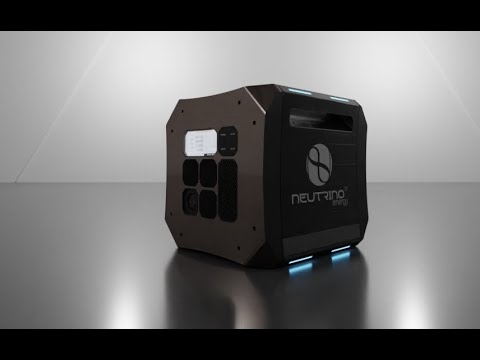
A empresa anuncia um protótipo chamado Powercube e diz usar inteligência artificial em seu desenvolvimento. O anúncio de um protótipo não demonstra a fonte de energia, potência líquida, durabilidade ou viabilidade econômica.
A empresa também anunciou trabalhos com o Centre for Materials for Electronics Technology (CMET), na Índia, em torno de um veículo descrito como “auto-recarregável”. Sem balanço energético independente e dados publicados, essa formulação não deve ser interpretada como validação científica.

O cronograma de comercialização, a potência, os custos e a eficiência da tecnologia não foram estabelecidos publicamente. A Neutrino Energy é uma empresa privada e especulativa; esse perfil não representa exposição direta aos resultados do JUNO nem recomendação de investimento.



