
지속가능성
절대 지지 않는 태양 – Reflect Orbital의 태양 에너지 혁신 대계획

 Securities.io를 Google의 선호 소스에 추가

태양광 상승
Solar energy is becoming one of the world’s major power sources due to its natural abundance, “fuel-free” nature, and no carbon emission when operating (but some during production if the panels are not made with green energy).
이러한 진전의 주요 이유는 광전지 기술의 향상이며, 태양광 패널의 효율이 급격히 상승하고 있기 때문입니다. 그리고 양면 패널, 페로브스카이트, 박막 카드뮴 텔루라이드, 혹은 양자점 등은 태양광 패널을 더욱 개선할 후보군으로 남아 있습니다.

이 내용은 “The Solar Age – A Bright Future To Mankind”에서 더 자세히 논의되었습니다. 효율이 향상됨에 따라 생산 비용도 급격히 감소하여 태양광이 화석 연료와 경쟁할 수 있는 완벽한 환경이 조성되었습니다.

출처: News Channel 3
하지만 태양광 발전은 한 가지 큰 약점을 가지고 있습니다. 밤에는 전력을 생산할 수 없으며, 흐린 날에도 매우 적게 생산합니다.
즉, 태양광 발전이 인류의 주요 전력원으로 작동하려면 이 문제를 완화할 해결책과 함께 사용되어야 합니다.
현재 고려되는 두 가지 주요 옵션은 저녁 및 햇빛이 없는 날을 위한 대규모 배터리 팩을 저장하는 방법과, 햇빛이 풍부한 지역에서 에너지를 전달하기 위한 장거리 전력 전송선 구축 방법입니다.
문제는 두 옵션 모두 비용이 많이 들고 자원 집약적이라는 점입니다.
이 때문에 또 다른 가능성이 논의되고 있습니다: 지구 궤도에서 직접, 날씨에 영향을 받지 않고 24시간 내내 빛나는 태양 에너지를 포착하는 방법.
궤도 태양광
What makes today and in the near future space solar concepts potentially viable is the crash in costs to launch material into orbit. This was mostly driven by the invention of reusable rockets by Elon Musk’s SpaceX (SPCX ), which has divided cost by 10x already and might do so again in the near future.

출처: Ark Invest
전력 위성
For a long time, the main strategy envisioned was to install photovoltaic panels in large arrays of satellites and beam back power to the surface with microwaves (which are not absorbed by clouds).

The issue with that strategy is that it is rather complex compared to ground-based solar:
- Ground-based: collect sunlight -> convert DC to AC -> send power into the grid.
- Space-based: collect sunlight -> convert microwaves -> convert microwave back to electricity -> convert DC to AC -> send power into the grid.
These many more steps require more equipment and, therefore, more weight to send into orbit. It also means that some energy is lost at every conversion step between sunlight, power, and microwaves.
So, while the sunlight is stronger and uninterrupted in orbit, the additional loss and equipment cost might make orbital solar not that much cheaper than ground-based one, even if it is more reliable.
햇빛을 판매하나요?
Another approach is being considered by a startup called Reflect Orbital.
The idea is to skip the step of bringing solar panels and microwave transmitters into orbit. And instead, just put into orbit a giant mirror reflecting the sunlight down to Earth.

출처: Reflect Orbital
Such a method was already tested by the Russian space program in 1990, so we know it works technically. Short funding in post-Soviet Union Russia, still expensive solar farms, and the cost of orbital launch back then made it not commercially viable at the time.
This concept has a few key advantages against “traditional” orbital solar designs:
- Power satellites will necessarily degrade over time. And contrary to solar panels on Earth, there is for now no realistic path to recycling, meaning that expensive and complex machinery are fully wasted at the end of their useful life.
- Space mirrors can be made of simple, thin metallic foil, which is way lighter than photovoltaic solar panels. This would reduce the launch costs drastically.
The way it would work in practice is that Reflect Orbital would “sell sunlight” to ground-based solar farms so they can keep producing after dark when electricity prices are the highest.
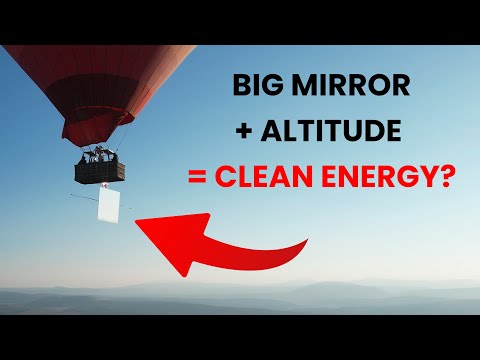
The company has already done a demo of the concept using a hot air balloon, partially as a marketing move to illustrate the concept more than a true prototype, which would require an actual satellite in orbit.
얼마나 진지한가?
팀
The Co-Founder and CEO of the company is Ben Novak. As a college freshman, he led SpaceX projects validating Crew Dragon propulsion components and worked again at SpaceX later on.
The CTO is Tristan Semmelhack, who was the youngest engineer at Zipline, the world’s leading drone delivery company.
Maybe more crucial for the potential success of the future prototype is Robert Salazar, the Heliostat Design Engineer. He worked on the design of the Starshade’s Optical Shield at NASA’s Jet Propulsion Laboratory; Robert went on to design ultralight deployable heliostats for the Transformers for Lunar Extreme Environments project.

출처: NASA
So, overall, the team seems to have some serious technical credentials when it comes to space projects and space mirrors. This is not just a marketing team with a crazy idea.
And we can assume Novak’s experience at SpaceX could help secure access to the company launchers in the future.
기술적 실현 가능성
As we said before, this technology was already tested in the 1990s, so we know it can work. It can reuse a lot of research done over the years about solar sails, inflatable antennas, and origami folding for maximizing the efficiency of the launch of solar panels and reflective foil.
In general, making ultra-light reflective surfaces for space is relatively easy, at least as far as space equipment can ever be called easy. From the ground, the reflectors would look like “mini-suns.”

In a study from 2022 titled “Enhancing solar energy generation and usage: Orbiting solar reflectors as an alternative to energy storage,” the reflectors were assumed to be made of a constellation of thirty 1-km diameter sized reflectors, with each reflector having a 20-year lifetime and weighing approximately 7860 kg.
The procurement cost would be $375/kg, or $3M per reflector and $90M for the whole constellation. This would be enough to generate additional illumination worth 100 MWh in power generation.
경제적 타당성
In the same study, the scientists then used a launch cost of $1400 per kg or the cost for the Falcon Heavy satellite launch in 2018. It is worth noting that by 2023, this launch cost has already fallen below the $1,000 threshold, and that is before the arrival of SpaceX Starship, which is much larger and, in theory, much cheaper as well.
In this analysis, the researchers calculate that in the current conditions, the project would not manage to generate money. They even calculated the launch costs required for orbital mirrors to reach breakeven in different market conditions:
Market condition 1 has relatively stable prices of electricity throughout the day, with India used as an example. In this case, launch costs for breakeven have to be $257/kg.

출처: Applied Energy (LC = Launch Cost, PC = Procurement Cost)
Market condition 2 has extreme price variation between moments of the day, with California used as an example. In this case, launch costs for breakeven need to be “only” $558/kg.

출처: Applied Energy (LC = Launch Cost, PC = Procurement Cost)
잠재적 적용 분야
첫 마케팅 시연
The company is discussing on its webpage the potential to “reserve a spot of light” for 4 min over 5 km, with limited availability starting in Q4 2025.
This would be achieved with satellites that will weigh only 35 pounds (16 kilograms) each and will be fitted with Mylar mirrors 33 feet by 33 feet (9.9 by 9.9 meters) in size that deploy in orbit.
In most cases, it would anyway be more of a demonstration and promotional tool than one targeting power generation, with a strong case that such an application could indeed go viral, with the possibility to ask for sunlight at night at the click of a smartphone app.
태양광 발전
The first and most obvious application would be sending light to large-scale solar farms, especially in the electricity market with very high power peak prices in the evening. Any space solar company will need to carefully select its market while keeping in mind the growing competition for constantly cheaper battery packs.
Another practical consideration will be choosing the right orbit, with as many customers as possible on the way of the satellites and their possible target for reflection.
Another possible use case would be to increase the solar intensity hitting solar farms in Nordic latitudes. For example, solar farms in Canada or Scandinavia could benefit from extra light to reach their maximum capacity, especially in winter when power demand is high and the sun’s intensity is at its lowest.
인공 도시 조명
Another consideration could be providing city light to large urban centers.
However, this might just not really be competitive with simpler-to-operate light poles with integrated solar cells and batteries.
농업
Another activity that requires light is farming through plant photosynthesis. Orbital lighting could maybe provide extra light for large-scale farming operations that currently use LED lights in their greenhouses.
This would only work for the largest farms but could make sense for some regions with massive greenhouse installations, like, for example, the Netherlands or the South of Spain.
Another option could be to illuminate Nordic regions in winter, where the growth season is very short. This might also be, in general, an option for the satellite to sell the reflected light in areas without sufficient demand from solar farms.
궤도 거울의 한계
Beyond just technical and economic considerations, orbital mirrors also have their critics.
One problem they could cause is even more light pollution that we experience today. Especially if it becomes a mass-adopted solution to handle peak electricity consumption all over the world. In the long run, this could make ground-based astronomy entirely impossible.
Another potential issue is the disturbance of natural ecosystems. We already know that light pollution from city lights can disturb nocturnal animals, migratory patterns, and insect populations. So, Reflect Orbital space mirrors could potentially make it worse.
태양광 투자
Solar energy production is constantly growing at a double-digit rate and will be a key driver to decarbonize the economy. It has still also a very long way to go, with the immense majority of our global electricity production and even more total energy coming from fossil fuels.
Over the years, it is a sector that has evolved to reward the largest companies, with economies of scale a key factor in managing to generate profit in a very competitive environment. With of course new technologies a potential disrupter of established polysilicon panel manufacturers.
Solar mirrors could also make solar even more attractive by not only solving the issue of peak prices in the evenings but also improving the production of existing solar parks, making them more profitable by increasing the number of hours where they produce.
You can invest in solar companies through many brokers, and you can find here, on securities.io, our recommendations for the best brokers in the USA, Canada, Australia, the UK, as well as many other countries.
If you are not interested in picking specific solar companies, you can also look into ETFs like Global X Solar ETF (RAYS), Invesco Solar ETF (TAN), or Global X China Clean Energy ETF (2809.HK) which will provide a more diversified exposure to capitalize on the solar and clean energy industry.
You can also read our article about the “Top 10 Solar Power Stocks to Invest In”.
태양광 및 우주 기업
1. Rocket Lab
RKLB 가격 차트
Rocket Lab (RKLB ) 은 재사용 로켓 시장에서 가장 유력한 경쟁자 중 하나입니다. 이 회사는 처음에 소형 로켓에 집중했으며, 전자(Electron) 발사 시스템(페이로드 320kg)을 점진적으로 부분 재사용 로켓으로 전환하고 있습니다. 현재까지 Electron은 44번의 발사에서 177개의 위성을 배치했습니다.
향후 Rocket Lab은 Falcon 9에 필적하는 중형 재사용 로켓인 Neutron을 개발하고자 합니다(완전 재사용 모드에서 LEO까지 8,000kg, 화성·금성까지 1,500kg). Neutron은 메탄 연소 로켓 엔진(Starship과 유사)으로 구동될 예정이며, 이는 차세대 로켓의 트렌드가 될 것으로 보입니다.
이 회사는 완전한 수직 통합 위성 제조 프로세스로 비용과 설계 속도를 최적화하는 것이 특징이며, 이를 통해 NASA 및 미국 정부와 다수의 계약을 체결했습니다. 여기에는 5억 1,500만 달러 규모의 군사 위성 계약과 Globalstar를 위한 1억 4,300만 달러 규모의 민간 계약이 포함됩니다.
Rocket Lab은 2022년 SolAero Technologies 인수 이후 위성용 태양광 패널의 주요 제조업체이기도 하며, 1,000개 이상의 위성이 이 패널로 전력을 공급받고 총 4MW 규모의 태양전지를 생산했습니다.

출처: Rocket Lab
현재 발사 시스템은 외부 공급업체에 의존하고 있지만, 일련의 전략적 인수를 통해 위성 설계·제조에서 이미 달성한 수직 통합을 발사 시스템에도 적용하려 하고 있습니다.
이 회사는 지속적인 수익 창출을 위한 통신 LEO 별자리 구축 가능성도 모색하고 있습니다. 또한 Varda Space Industries와 함께 우주 내 제조 연구와 궤도 파편 검사를 지원하고 있습니다.
SpaceX가 일론 머스크의 사업 감각으로 기술을 처음부터 개발한 반면, Rocket Lab은 연구개발과 인수를 결합해 필요한 기술을 수직 통합했습니다. 이는 위성 제조에서 큰 성공을 거두었으며, 현재 재사용 로켓에도 이 전략을 적용하려 하고 있습니다.
위성 생산 및 Electron 성공으로 인한 기존 현금 흐름을 고려할 때, Rocket Lab은 향후 수십 년 내에 대규모 전동기 및 기타 인프라가 구축될 때까지 SpaceX를 따라잡을 유력한 후보입니다.
2. JinkoSolar Holding Co., Ltd.
JKS 가격 차트
Jinko는 세계 최대 규모의 태양광 패널 제조업체 중 하나이며, 주로 중국에 기반을 두고 있습니다. 관세 회피를 위해 베트남에서 실리콘 웨이퍼를, 말레이시아와 미국에서 태양전지를 제조하며 생산 기반을 다변화하고 있습니다.

출처: Jinko Solar
어쨌든 이 회사는 서구 시장에 크게 의존하지 않으며, 중국, 아시아 태평양(APAC) 및 신흥 시장이 사업의 대부분을 차지합니다.

출처: Jinko Solar
Jinko는 회사 역사상 230GW의 태양전지를 공급했으며, 2024년 1분기에 20GW를 공급했습니다. 이는 1년 전 14.5GW에서 증가한 수치입니다.
이는 Jinko를 광전지 산업에서 1위로 만들었습니다.
Jinko의 최첨단 태양전지인 N-type은 놀라운 25.8% 에너지 효율을 달성합니다. 또한 양면 패널도 제공합니다.
2023년에는 N-type이 Jinko 매출의 대부분을 차지했으며, 전체 출하량의 80%를 차지했습니다. 56GW 생산 시설은 2024년 말까지 전면 가동될 예정이며, 연말까지 배송량의 90%를 차지할 것으로 예상됩니다.
총 생산 능력은 120~130GW에 이를 것으로 예상되며, 이는 회사 전체 누적 생산량의 거의 절반에 해당합니다.
제품 친환경화를 위해 Jinko Solar는 전적으로 재생 에너지로 생산된 최초의 N-type 태양광 패널인 NeoGreen을 출시했습니다(중국에서 일반적으로 사용되는 석탄 대신).
Jinko의 초공격적인 생산 능력 확대는 N-type 기술에 대한 자신감과 아시아, 아프리카, 남미 수출 시장 장악 의지를 반영합니다.
그리고 태양광이 세계 에너지 시스템을 장악하고, 아마도 태양 거울까지 포함해 수익성을 더욱 높일 전반적인 전망도 있습니다.



