
Aerospace
Space Infrastructure – Building Stairways To The Heavens

 Add Securities.io to your preferred sources on Google
Securities.io may receive compensation when you use links to products we review. This does not influence our editorial evaluations. We are not a registered investment adviser; this is not investment advice. Read our affiliate disclosure.

A New Space Age
With the invention of reliable reusable rockets by Elon Musk’s SpaceX (SPCX ), a new space race has kicked off. This is because it has cut the costs of reaching orbit by almost 10x, with even more cost-cutting expected from the massive Starship.

Source: Ark Invest
This led to the current situation, where in 2023, the immense majority of what was sent into orbit, both by mass and satellite numbers, was launched by SpaceX.
Starship will ultimately be able to send in low-Earth orbit (LEO) between 50-200 tons of material every launch, depending on estimates. This will be a major step forward, probably allowing for new milestones in humankind’s history, including:
- Permanent bases on the Moon.
- First human expedition to Mars.
If you want to learn more about how a world would look where these have already taken place, and how it could create a self-sustaining space-based economy, you can read more in our articles “The Future Space-Based Economy” and “The Future Martian Economy”.
Starlink and similar satellite constellations are massive space-based infrastructures already in construction. They make possible access to high-speed Internet everywhere on Earth and are expected to become the major cash flow source of companies like SpaceX, which already has millions of paying subscribers.

Source: Ark Invest
Still, rocket-based launches into space are ultimately limited by the physics on which the technology is based. One key part is that rockets need to expel a ridiculously large amount of fuel to take off. For example, SpaceX’s Falcon Heavy is a 22.2 tons rocket, with a 433 tons fueled mass. This means that in the end, most of the fuel is spent just to lift more fuel.
In order to go under the bar of $100/kg of launch costs, some completely different methods than the rocket will be required.
If the costs of leaving Earth’s gravity go down enough, many things could be built in space.
Great Achievements Require Infrastructure
Relying solely on rockets to reach space is similar to if we did all transportation and trade on Earth using only planes and helicopters. While technically not impossible, it would be absurdly expensive when building infrastructure like harbors, roads, and railroads allows us to use much cheaper alternatives.
It can be a bit of a chicken-and-egg problem when it comes to space. So far, large-scale infrastructures were not worth building, as our launch needs were only sending a few tens of satellites and a dozen astronauts into orbits.
With better launch systems becoming available, we will likely see in the next 2 decades a massive expansion of human activity in space. Some of these will be highly profitable or very well funded, including:
- Science mega projects, like building a radio telescope on the far side of the Moon.
- Moon bases from Western countries and China & Russia.
- Space tourism, either suborbital flight, orbital space stations, or on the Moon.
This will create a massive enough market that it will become profitable to invest tens or hundreds of billions just to capture market share from rocket companies like SpaceX.
Mass Drivers
One such infrastructure, called a mass driver, promises to cut launch costs drastically. It is most likely already doable with currently available technology. The key idea of a mass driver is that a shuttle could be sent into orbit by accelerating it enough on the ground that it would not need an onboard propellant.
The way scientists and engineers have looked at how to do it would be to create a maglev train similar to the Hyperloop concept, operating in a vacuum. This way neither friction with the rail nor with the air particles would slow down and heat up the launch vehicle.

Source: Acepedia
China is already looking at developing such technology, so it might be closer than we expect.
If successful, it could reduce by another 10x the orbital launch price already much lowered by SpaceX, with estimates putting costs at $60/kg.
On a side note, this type of system could be first used with smaller-size models to propel airplanes at a speed where hypersonic scramjet engines can work, allowing for very quick hypersonic flights.
A True Megaproject
Of course, an orbital mass driver would be required to reach extreme speed and be absolutely massive and powerful to carry and accelerate the hundreds or thousands of tons of payload to compete with Spaceship.
The launch track will also need to be hundreds, if not thousands of kilometers long, with the most promising candidate area being the Tibetan plateau.
However, mass drivers are still among the least ambitious proposed space infrastructure, as it is mostly constrained only by available funding and the skill to engineer it with known technology.
Space Elevator
Another known way to carry things up and down at the lowest possible energy cost is to use a counterweight, like in elevators. This way, the only energy spent is lifting the payload weight, and there is no need for extreme speed.
This is the idea behind a space elevator, where tens of thousands of kilometers-long tether is used to carry up and down mass from Earth. In theory, such a system could make reaching the orbit even cheaper than it currently costs to take a plane.

Source: ISEC
The key limitation here is not market demand or capital available (although those will count, too) but technology. Such an extremely long cable would require ultra-light material with tensile strength much above common materials like steel or titanium.
This might be changing, with supermaterials like graphene seemingly able to fit the technical requirements, a type of 2D material we discussed in detail in our article “2D Materials, Like Graphene, Open New Frontiers In Material Sciences”.
This would, however, require mass production of high-quality graphene crystal, something that has never been achieved so far. At the current price of graphene, it would be absurdly expensive.
However, it would be the ideal infrastructure for sustained human presence in space, orbital industries, and interplanetary trade, with a capacity of 30,000 tons per year to geosynchronous orbit, or the equivalent of tens of Starship launches every day.
You can see more about this concept in this 1-hour video from the International Space Elevator Consortium:
Orbital Megastructure
If we ever manage to build a space elevator or to set up large-scale manufacturing facilities on the Moon using material from asteroids, we could imagine an even grander type of infrastructure.
For example, an orbital ring is the idea to build a structure going around the entirety of the Earth.

Source: Isaac Arthur
Such a system would stay in orbit thanks to the centrifugal force compensating for Earth’s Gravity. It would provide habitats in space, maintenance stations, launch sites for deep space missions, anchor points for power generation (solar panels), and even potentially climate mitigation with solar shades.
However, such a concept is so ambitious from a technological and infrastructure standpoint that it will likely never be achieved until at least mass drivers and a space elevator are built first.
Mining Stations & Processors
The idea of mining asteroids for raw materials and processing the ore in space is much more accessible and realistic.
Many asteroids are very metal-rich; in fact, the asteroid belt in our solar system contains ~8% metal-rich (M-type) asteroids. With the whole asteroid belt weighing 2.4 quintillion tons, that’s a lot of metal.

Source: ESA – The two areas where most of the asteroids in the Solar System are found: the asteroid belt between Mars and Jupiter, and the trojans, two groups of asteroids moving ahead of and following Jupiter in its orbit around the Sun.
On Earth, we are digging as deep as 2-4 km for gold or platinum. But just one asteroid, 16 Psyche, might be a 200km chunk of metal waiting to be mined for a value (at current prices) of $10-700 quintillion.
So, there are 2 types of space mining that could be highly profitable:
- Rare materials like gold and platinum are to be shipped back down to Earth.
- Base materials that can be used in orbit to build spaceships, space hotels, etc., without having to pay the exorbitant cost of lifting these materials from Earth.
Most likely, an asteroid mining venture will make money from both, capturing and bringing close to Earth asteroids with high-value minerals. And using the mining tailing, made of carbon iron, nickel, etc. to build space stations, moon bases, rockets, etc.
Another advantage is that once mining equipment has been put in space, it can mine the asteroids in a weightless environment. This can make mining in space easier than on Earth, where moving thousands of tons of rocks is an energy-intensive and risky activity.
Solar Collectors
Another proposed space industry that could become the driver of a space-based economy is solar energy. In the right orbit, the Sun shines 24/7 and at a much higher intensity due to the lack of an atmosphere to absorb the light.
Such systems could be both a reason to build space infrastructure (reducing the cost of the power satellites) and an enabler of further progress (like powering refining stations mining asteroids).

Source: Space Solar
(We explore this idea in further detail in our article “Space-Based Energy Solutions For Endless Clean Energy”).
Laser Sail Propellers
To get off Earth, either rockets or advanced infrastructure are required. But to move in space, only a little energy is actually needed once you’re far from a gravity well. So little, in fact, that just light can provide enough power to do so.
This is the physics behind the concept of a solar sail. This is not a speculative science-fiction concept, but a real technology already being tested by NASA.
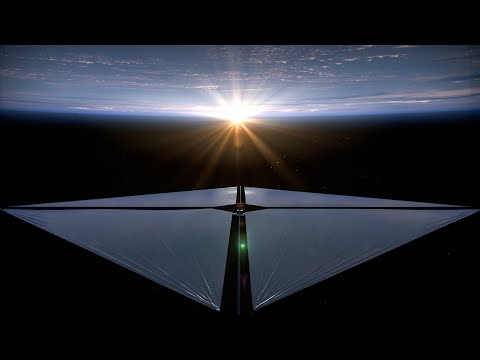
Such a sail could be propelled by the Sun rays but also could be propelled by laser. So potentially, instead of burning fuel, we could see interplanetary travel being powered by lasers from orbit or on the Moon, themselves powered by local solar power satellites.
Off-World Bases & Colonies
While discussing infrastructure, most will focus on the “flashy” technologically challenging projects, like space elevators.
However, there will be plenty of other infrastructure required in space, especially if we are building permanent settlements, from bases with accommodation for scientists and tourists to thriving cities on Mars.
This includes domed farms, indoor hydroponic and aquaponic food production, telecommunication, launch pads, fuel production and refueling stations, etc., as well as mundane but equally vital power plants, power lines, hospitals, roads, water pipes, etc.
Aldrin Conveyor / Cycler
Bases or colonies on the Moon will be “easy” to supply straight from Earth. Bringing in and out personnel or tourists will be done in a short trip, which will take a few days at most.
However, going to more distant destinations like Mars will require a trip that will likely take almost a year or weeks at best. This is not an issue for raw materials and equipment, where this just complicates a little logistics.
This is much more problematic for passengers. Space beyond the magnetosphere of Earth is exposed to heavy radiation. And in case of a hard-to-predict solar storm, passengers on the way to Mars might be exposed to even more radiation. So, past the initial daring adventurers to the first step on Mars, regular passenger travel will require a very heavy and shielded ship.
And maybe with some onboard food production and strong water recycling to limit the amount of supplies needing to be transported (we discussed in more detail the topic of food supply in space in our article “Space Food – How Will We Feed Humanity’s Next Wave of Pioneers?”).
This can be done in a classical rocket. But this will be a waste of fuel, having to accelerate and slow down the whole shield, life support, and food supply each time.
Instead, the Aldrin Cycler (proposed by Buzz Aldrin, the second man on the Moon), or Mars Cycler could be permanently orbiting so it comes regularly in the vicinity of both Earth and Mars.

Source: Ethan MacDonald
This way, you could build a permanent space station for people to transit to and from Mars. It would have heavy radiation shielding and food production, as well as more comfortable and spacious rooms and sports facilities to keep people in shape despite the absence of gravity.

Source: Buzz Aldrin
O’Neil Cylinder & Asteroid Colonies
Speaking of space habitats, more ambitious concepts than the pit-stop/hotel on the way to Mars, like the Aldrin Cycler, have been considered. This is the plan that Jeff Bezos is pursuing, with “a trillion people living in gigantic space stations also known as O’Neil cylinders.”
These are gigantic cylinders whose rotation would create an artificial gravity inside, large enough to have hundreds of thousands or millions of inhabitants.

Source: Blue Origin
They could either be used to offer ideal living conditions or to move heavy and polluting industries out of Earth’s ecosystems.
Such infrastructure would provide essentially unlimited living space for an uncountable amount of people throughout the solar system. It could even be used to colonize other stars, as they are essentially self-sustaining microplanets.
However, such infrastructure probably comes even later in the timeline of space colonization than orbital rings, as it would require an annual space manufacturing capacity in the trillions of tons, as well as transit back and forth to Earth at almost no costs.
Dyson Sphere
On the very end of the spectrum of speculative space infrastructure, the Dyson Sphere, or Dyson swarm.
Proposed first by Freeman Dyson, it is the idea of using all the available rocks and metal in the solar system, and building a swarm of space habitats even bigger than the O’Neil cylinders, potentially with as much surface as Earth each, in order to capture as much as possible of the Sun’s energy output.

Source: Wikipedia
This is also considered a sort of “endgame” for any space-faring civilization. It is hard to imagine more high-tech than literally dismantling planets to optimize the use of their matter and the Sun’s energy.
It has been a “techno-signature” intensely researched by astronomers to find signs of potential extraterrestrial technological civilizations.
This is obviously a highly controversial topic, but it seems that already 60 stars could match this profile. It is still strongly debated among astronomers, as it could simply be that they found a new type of star. It is nevertheless intriguing for people interested in space exploration and would open a whole new perspective on how far humankind could go if reaching for the stars.
You can also find a lot more beautiful concept art and miniature regarding space colonization and the infrastructure we discussed here at Spacehabs.
Investing In Space Infrastructure
Space is a very established industry experiencing a rebirth and explosive growth on the back of reusable rockets. We discussed how this will create whole opportunities in our article “Reusable Rockets To Create Multiple New Markets By Lowering Costs Drastically”.
The current space market is $443B. Even when ignoring more speculative (but potentially very lucrative) ideas like asteroid mining, space tourism & hypersonic flight could add another $350B in revenues, to which can be added a forecast of satellite-based Internet worth $17B, as well as military applications and subsidized Moon bases, scientific projects, etc.
You can invest in space-related companies through many brokers, and you can find on this website our recommendations for the best brokers in the USA, Canada, Australia, the UK, as well as many other countries.
If you are not interested in picking specific space-related companies, you can also look into ETFs like ARK Space Exploration & Innovation ETF (ARKX) or VanEck Space Innovators UCITS ETF (JEDI) to capitalize on the growth of the space sector as a whole.
Space Infrastructure Companies
1. Rocket Lab
RKLB Price Chart
Rocket Lab (RKLB ) is one of the most serious contenders in the reusable rocket market. The company has initially focused on small rockets, with the Electron launch system (320 kg of payload), which is progressively being turned into a partially reusable rocket. So far, Electron has deployed 177 satellites in 44 launches.
Later on, Rocket Lab is looking at creating a medium-size reusable rocket, the Neutron, comparable to Flacon 9 (8,000 kg to LEO in fully reusable mode, 1,500 kg to Mars or Venus). The Neutron will be powered by a methane-burning rocket engine (like Starship), which seems to become the trend for the next generation of rockets.
The company is remarkable for its fully vertically integrated satellite manufacturing process, allowing it to optimize costs and design speed. This resulted in multiple contracts with NASA & the US government, including a $515M military satellite contract. and a civilian $143m contract for Globalstar.
Rocket Lab is also a major manufacturer of solar panels for satellites after its 2022 acquisitions of SolAero Technologies, with 1000+ satellites powered by these panels, and 4MW solar cells manufactured in total.

Source: Rocket Lab
For now, its launch system is reliant on outside suppliers, but a series of strategic acquisitions should change that, replicating in the launch system the vertical integration already achieved in satellite design and manufacturing.
The company is also looking at the possibility of a telecom LEO constellation to generate recurring revenues. It is also contributing to research for in-space manufacturing with Varda Space Industries and orbital debris inspection.
While SpaceX had Elon Musk’s business talent to develop its technology from scratch, Rocket Lab used a mix of R&D and acquisitions to vertically integrate the technology required. This has proven very successful in satellite manufacturing, and they are now looking to replicate this strategy for reusable rockets.
Considering the existing cash flow from satellite production & the Electron successes, Rocket Lab is a good candidate to catch up with SpaceX, at least until mass drivers and other infrastructures are built in a few decades.
2. Virgin Galactic
SPCE Price Chart
The company was founded by Richard Branson and is focused on space tourism.
The tickets are in the $250,000-450,000 range, with a long waiting list. The first customers seem to be ecstatic with their experience:
“I always knew it was going to be the most extraordinary experience of my life. I always knew that. And people kind of told me it was going to be. But then when it is… and it’s on another level to the experience you thought you were going to have… then it’s very difficult to explain.”
“This has been the best day of my life, the most sensational day of my life. And you can’t get any better than that. It exceeded my wildest dreams.”
Virgin Galactic (SPCE ) has been working on improving its unit economics, with a new launch system, the “Delta”, able to carry 6 passengers instead of 4, and to perform 8 flights/per month instead of just one.
Together, these 2 improved metrics should boost revenue per unit by 12x, with a payback time of less than 6 months for each Delta shuttle. The Delta flight test is expected in mid-2025.

Source: Virgin Galactic
Markets were concerned when it was announced that Branson would not invest further into Virgin Galactic. Especially following the layoff of 185 employees and a pause of space flights in 2024, to wait for the arrival of the Delta shuttle and reduce cash burn speed.
Still, Virgin Galactic is forecasted to have enough cash to run until 2025 or 2026. So if the development of the Delta flight system goes smoothly (a risky proposition in the aerospace industry), the company should be able to focus on restarting and growing cash flow, with a system that is profitable on a unit basis. And bring the company to turn cash flow positive in 2026.

Source: Virgin Galactic
(It should be noted that Virgin Galactic is different from Virgin Orbit. Virgin Orbit filed for bankruptcy in April 2023, and provided launch services for small satellites, with Rocket Lab acquiring the company’s Long Beach facility, manufacturing, and tooling assets).
The recent bankruptcy of Virgin Orbit and distancing from Virgin Galactic by founder Richard Branson has damaged the company’s image with investors, resulting in a plummeting stock price in 2023 and 2024.
Caution regarding the stock itself is highly recommended.
At the same time, the previous customers’ satisfaction, a clear plan for a profitable design (Delta shuttles), and a long waiting list of potential clients show that the company might still be viable even without raising more funds.
As long as it can fly the Delta-class shuttle soon enough. So far, the factory to build Delta is finished, and construction should start in Q1 2025.
A lot will rely on the success of developing, manufacturing, and operating the Delta shuttle and achieving it before the end of 2025.
If this is the case, the much lower valuation would create an opportunity for investors to grab company shares at a discount.



