
Bærekraft
Hvordan Princetons solid-state batteriteknologi kan transformere energilagring

 Legg til Securities.io blant dine foretrukne kilder på Google

Det ultimate batteriet
As batteries have become the basis of EV powertrains, their performance and safety profile have improved. So far, this has been achieved with variations of lithium batteries, either lithium-ion (lithium-nickel-manganese NMC & lithium-nickel-cobalt-aluminum NCA) or lithium-ferrum-phosphate (LFP) batteries. It was a transformative technology that rightfully tildelte oppfinnerne Nobelprisen i kjemi i 2019 (follow the link for the history of lithium-ion invention).
Inntil nå ble det forventet at disse batteriene skulle fortsette å dominere batterimarkedet, takket være deres ekstremt høye energitetthet.

Kilde: S&P Global
Det finnes imidlertid en grense for hvor mye energi klassiske litium‑ion batterier kan lagre. Derfor ser forskere på andre alternativer, hvorav ett av de mest lovende er solid‑state batterier.
Solid‑state batterier forventes å være tryggere, ha høyere energitetthet og være mer holdbare enn tradisjonelle litium‑ion batterier. Imidlertid er de svært vanskelige å produsere pålitelig i stor skala på en kostnadseffektiv måte, noe som har bremset deres adopsjon.
Dette kan endre seg, og nye innsikter om hva som får solid‑state batterier til å svikte kommer fra forskere ved Princeton University, Purdue University, University of Michigan og Brookhaven National Laboratory.
De publiserte sine nyeste oppdagelser i to vitenskapelige artikler i Advanced Energy Materials1 og ACS Energy Letters2, henholdsvis, med titlene “Lithium Kinetics in Ag–C Porous Interlayer in Reservoir-Free Solid-State Batteries” & “Filament-Induced Failure in Lithium-Reservoir-Free Solid-State Batteries”.
They also analyzed the current state of the art of battery science regarding anode-free batteries and published it in Nature Materials3, under the title “Electro-chemo-mechanics of anode-free solid-state batteries”.
Anodefri solid-state batteri
Ideen med solid‑state batterier er å erstatte den flytende elektrolytten i litium‑ion med et lag av fast metall. Dette er den viktigste kilden til effektivitetssikring, siden elektrolytter er tunge og voluminøse.

Kilde: University Of Chicago
Dette forbedrer også sikkerhetsprofilen, da elektrolyttløsningsmidler vanligvis er brannfarlige, noe som skaper sjeldne men spektakulære batteribranner som har gitt tidlige elbiler et dårlig rykte.
Et annet steg har nylig blitt utforsket av forskere, som fjerner helt halve batteriet. Batterier består av en katode og en anode, hver med ulik elektrisk ladning.
Anodefrie batterier eliminerer helt behovet for en anode,
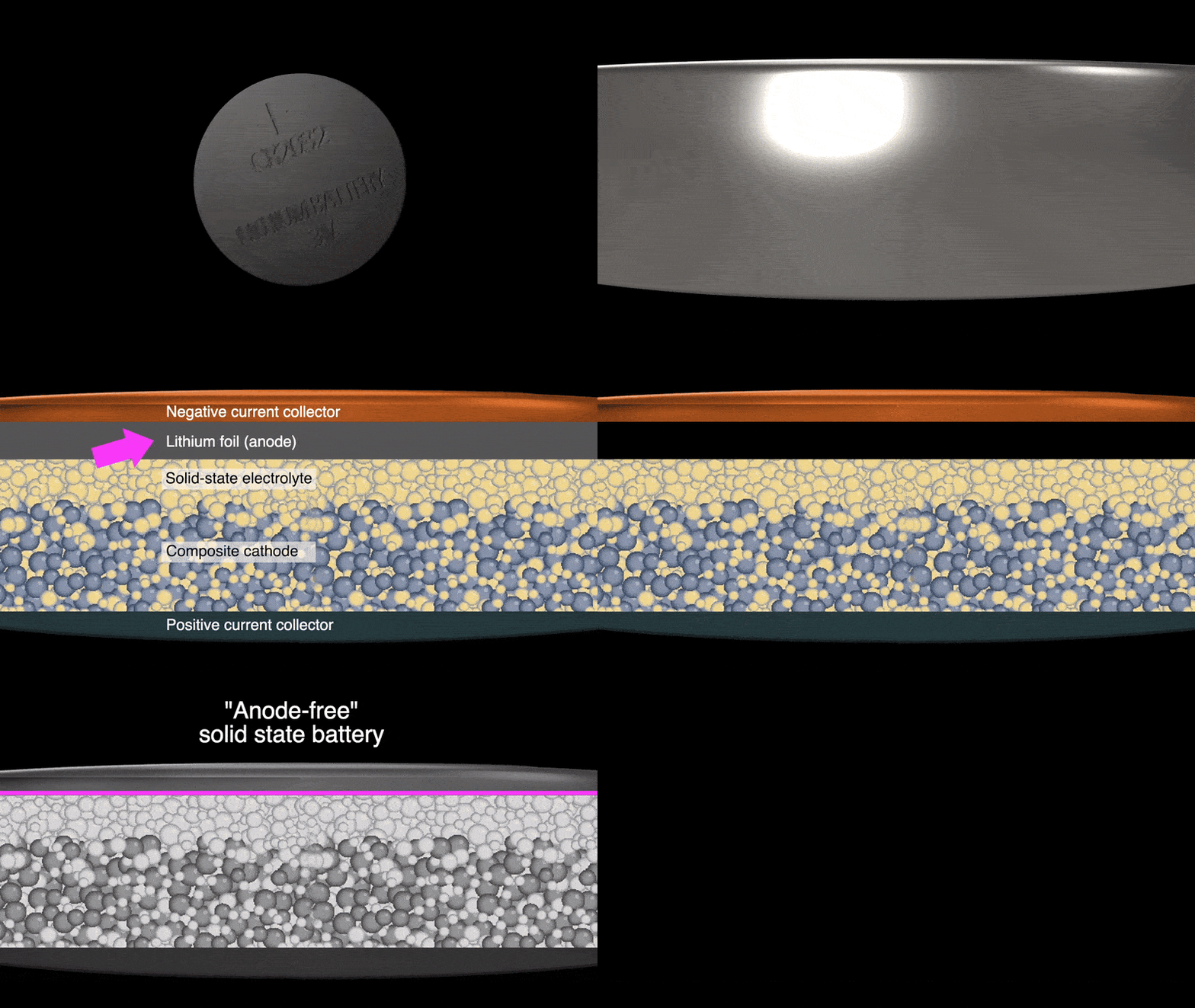
Kilde: Princeton University
I deres analyse av anodefri teknologi i dag argumenterer Princeton-forskerne for at hovedproblemet for å videreutvikle teknologien er en dårlig forståelse av den mekaniske effekten av lade‑ og utladesyklusen, mer enn kjemiske reaksjoner.
Solid-state utfordringer
I et klassisk batteri er tilkoblingen til elektrodene (anode og katode) relativt enkel, siden elektrolytten er i flytende form. I et solid‑state batteri må det faste metallet holde perfekt kontakt med strømlederen.
Hvis dette ikke er helt jevnt, blir områder med god kontakt til varmespunge, mens områder med dårlig kontakt danner hulrom.
For å forstå hvorfor dette skjer, må forskerne ha en fullstendig forståelse av den komplekse prosessen som foregår under batteriets lading og utlading. Dette er ikke bare et kjemisk fenomen, men også et mekanisk, der materialet endrer form litt over tid.
I den første artikkelen, de oppdaget at trykk kan spille en viktig rolle i hvordan det faste metallet reagerer.
Problemer med lavt trykk
Scanning electron microscopy reveals how lithium has increasing surface contact as pressure increases. So it means that too low pressure does not do enough to improve the uneven contact caused by those surface irregularities.

Kilde: ACS Publication
Til slutt førte den ujevne platingen til dannelse av skarpe metallfilamenter som, som små nåler, kunne trenge gjennom den faste elektrolytten og forårsake kortslutning i batteriet.
Problemer med høyt trykk
While the high pressure can create uniform plating and stripping, it is not a magical solution.
The researchers found that it forced the electrolyte and the current collector together so intensely that any imperfections on either were magnified until the mechanical stress caused fractures to form.

Kilde: ACS Publication
Using X-ray tomography, the researchers managed to map these cracks forming under high pressure.
As stack pressure is increased from 2 to 10 MPa, the entire volume of cracking grows. Many cracks extend to the counter electrode side (Figures 3b–e and S10), and a single lithium dendrite reaching the counter electrode can cause a short circuit.

Kilde: ACS Publication
Alt i alt vil det å finne den optimale balansen mellom lavt nok trykk, men effektiv kontakt, være sluttmålet for batteriindustrien.
«Den hellige gral i dette området vil være å finne ut hvordan man kan opprettholde solid kontakt ved lavt trykk siden produksjon av en feilfri elektrolytt er praktisk talt umulig. Hvis vi vil realisere potensialet i disse batteriene, må vi løse kontaktproblemet.”
Pr. Kelsey Hatzell – førsteamanuensis i mekanisk og romfartsingeniør
Bedre plating
Achieving more uniform plating is the topic of den andre artikkelen published by Pr Hatzell’s team and their collaborators in other universities and laboratories.
They found that a thin layer of coating between the current collector and the electrolyte facilitates better ion transport. They tested multiple designs for this coating.
Ultimately, they found that the best option was interlayers made from carbon and silver nanoparticles. The silver in these interlayers formed alloys with ions during battery charge and discharge, enabling even plating and stripping from the current collector.
However, the details of how the silver particles are made matter a lot. When using larger nanoparticles of 200nm (nanometers), they formed spindly, uneven metal structures on the current collector. This reduced capacity and eventual battery failure over several charging cycles.

Kilde: Advanced Energy Materials
«Only a few groups have investigated the actual processes that occur in these interlayers. Among other findings, we demonstrated that the stability of these systems is linked to the morphology of the metal as it plates and strips from the current collector.»
Sølvpartikler på 50 nm fungerte langt bedre og dannet tettere og mer ensartede strukturer, noe som ga batterier med større stabilitet og høyere effekt.
«These findings can inform the strategy for fabricating these interlayers.
By reducing the size of the silver particles, we can make sure that we only get the advantages of the silver in the interlayer, which, in turn, could allow us to achieve good contact and uniform plating even at low pressures.
Bygge bedre solid-state batterier
For a long time, the solid-sate battery concept struggled to exit the lab and make it to the factory floor, with production at scale.
This is now changing, with countries like China, Japan, and South Korea having near-term plans to bring solid-state batteries to market.
For example:
- Samsung SDI (006400.KS) har lovet å begynne masseproduksjon av solid‑state batterier innen 2027
- Hyundai (HYMTF) ser mot masseproduksjon innen 2030
- Toyota har et masseproduksjonsmål for 2028, oppdaterer sitt tidligere mål for 2030.
«Utfordringen vil være å gå fra forskning til den virkelige verden på bare noen få år. Forhåpentligvis kan arbeidet vi gjør nå ved MUSIC (Mechano-Chemical Understanding of Solid Ion Conductors) danne grunnlaget for utvikling og utrulling av disse neste generasjons batteriene i en meningsfullt stor skala.»
Pr. Kelsey Hatzell – førsteamanuensis i mekanisk og romfartsingeniør]
Investere i avanserte batteriteknologier
Batteries are at the center of the trend of electrification, itself a major multi-trillion-dollar endeavor looking to remove fossil fuels from our power sources.
You can invest in battery-related companies through many brokers, and you can find here, on securities.io, our recommendations for the best brokers in the USA, Canada, Australia, the UK, as well as many other countries.
If you are not interested in picking specific battery companies, you can also look into battery ETFs like Amplify Lithium & Battery Technology ETF (BATT), Global X’s Lithium & Battery Tech ETF (LIT), or the WisdomTree Battery Solutions UCITS ETF (WT ), which will provide a more diversified exposure to capitalize on the growing battery industry.
Solid-state batteri selskap
QuantumScape
QS Prisdiagram
Since its foundation in 2010, Californian Quantum Scape has been a prominent startup in the solid-state battery space, remarkable by its move into the field early, and its independence from larger battery manufacturers also pursuing solid-state technology, like CATL (300750.SZ), Samsung, or LG Energy Solution (373220.KS).

Kilde: QuantumScape
One unique feature of QuantumScape batteries, which at the time was considered revolutionary, is that is use an anode-free design. It allows for ~15-minute fast charge (10-80% at 45 ºC) and the separator is nonflammable and noncombustible.

Kilde: QuantumScape
This also puts QuantumScape batteries in a league of their own when it comes to energy density and charging speed, massively outperforming leaders like Tesla (TSLA ) (both its own design and CATL-made ones).

Kilde: QuantumScape
However, these remarkable performances have been regularly hindered by a struggle to ramp up production. It also forced the company to burn through its cash pile, leading to previous investors dilution and share prices decline.
This seems to be changing, since avtalen fra 2024 med PowerCo, the Volkswagen Group battery division, for a licensing deal for the design and mass production of QuantumScape batteries by PowerCo.
Under the non-exclusive licensing deal, PowerCo can manufacture up to 40 gigawatt-hours per year of electric vehicle batteries, with the option to expand to 80 GWh a year.

The sudden scaling-up of QuantumScape production seems to be linked to Cobra, selskapets neste generasjons solid‑state batteriseparatorutstyr, a breakthrough in ceramics manufacturing.
Overall, Cobra should be integrated into production in 2025 and the first finished EV using QuantumScape batteries should be produced in 2026.

Kilde: QuantumScape
This could be a turning point for the company, moving 16 years after founding from a promising startup with interesting IP to generating growing revenues from a partnership with one of the largest automakers in the world.
In the meantime, investors should still expect some volatility in the stock price, but with a light at the end of the product development tunnel.
Siste om QuantumScape
Studierreferanse:
1. Se Hwan Park, et al. (2025) Filament-Induced Failure in Lithium-Reservoir-Free Solid-State Batteries. ACS Energy Letters. 22. februar 2025 https://pubs.acs.org/doi/full/10.1021/acsenergylett.5c00004
2. Se Hwan Park, et al. (2024). Lithium Kinetics in Ag–C Porous Interlayer in Reservoir-Free Solid-State Batteries. Advanced Energy Material. 19 desember 2024 https://advanced.onlinelibrary.wiley.com/doi/full/10.1002/aenm.202405129
3. Stephanie Elizabeth Sandoval, et al. (2025). Electro-chemo-mechanics of anode-free solid-state batteries. Nature Materials. 02 januar 2025 https://www.nature.com/articles/s41563-024-02055-z



