
지속가능성
보다 효율적인 수소 생산을 위한 새로운 경로 발견

 Securities.io를 Google의 선호 소스에 추가

올바른 수소 촉매 찾기
수소는 이론적으로 에너지를 저장하고 전기화하기 어려운 분야에 동력을 공급하는 완벽한 연료가 될 수 있습니다. 수소에는 이상적이라고 할 만한 몇 가지 특성이 있기 때문입니다:
- 연소 시 부산물은 물뿐이다
- 연료 전지에서 전기를 생산할 때도 동일하게 적용된다.
- 매우 높은 온도에서 연소할 수 있어 금속공학, 화학 공정 등에서 천연 가스의 좋은 대안이 된다.
- 생산에 물만 자원으로 필요한다.
- 수소 자체는 독성이 없고 오염을 일으키지 않는다.
However, the rise of a hydrogen-based economy has been hampered by the difficulty of producing hydrogen in a cost-effective manner. This is due to the fact that most green hydrogen (produced from green energy) is made through electrolysis, a process for now mostly based on expensive catalysts like platinum, ruthenium, or iridium, each very rare and expensive metals.
So as long as no better production method for hydrogen exists, it is unlikely that we will manage to see it replacing fossil fuel at scale.
Luckily, this is quickly changing. We previously covered a few of these possibilities, notably 플라스틱 폐기물을 수소로 전환, using 니켈 나노로드 as an alternative catalyst, or using 티타늄 및 니켈 스크랩 금속(스와프) (swarf) produced during the manufacturing of metal parts. Some newer options are now being added by researchers.
첫 번째는 독일 요하네스 구텐베르크 대학교와 다름슈타트 공과대학교, 독일 막스 플랑크 고분자연구소, 중국 하얼빈 공업대학교와 산둥대학교 연구진이 개발한 자가 최적화 촉매1입니다. 이 연구는 Angewandte Chemie에 “Self-optimizing Cobalt Tungsten Oxide Electrocatalysts toward Enhanced Oxygen Evolution in Alkaline Media”라는 제목으로 게재되었습니다.
두 번째는 싱가포르 난양 공과대학교, 호주 모나시대학교, 중국 홍콩대학교 연구진이 하수 슬러지를 친환경 수소와 동물 사료로 전환하는 방법2을 개발한 것입니다. 이 연구는 Nature Water에 “Solar-driven sewage sludge electroreforming coupled with biological funnelling to cogenerate green food and hydrogen”라는 제목으로 게재되었습니다.
수소 촉매 고치기
A recurring issue with all hydrogen-producing catalysts is that they degrade over time. This can be due to a deposit forming on the reactive metals, or the metal layer itself slowly degrading and losing components at each catalysis cycle.
This is especially problematic for expensive catalysts of the platinum metals group, but it is also an issue for other types of metal-based catalysts.
So, it is important that the German and Chinese researchers of the first study discussed here have observed self-optimizing behavior with their new catalysts.
“우리 촉매의 독특한 점은 시간이 지남에 따라 실제로 성능이 향상된다는 것이며, 기존 촉매는 일정한 속도로 성능을 유지하거나 내구성이 부족해 성능이 일부 감소한다는 점이다,”
Dr. Dandan Gao – Johannes Gutenberg University Mainz 연구 책임자
코발트-텅스텐 촉매
수소 생산 병목 해결
The researchers focused on so-called 3d to 5d transition metal oxides, formulated as mixed metal.
These are able to perform a chemical reaction called oxygen evolution reaction (OER), which is half of the reaction occurring during electrolysis of water into hydrogen, in both of the most common electrolyzer designs (AEM and PEM electrolyzers).

출처: SpectroInlet
“물 분해 과정에는 두 가지 반응이 있다. 수소 발생 반응(HER)은 수소 가스를 생산하고, 산소 발생 반응(OER)은 산소 가스를 생산한다. OER가 전체 반응의 병목 현상이다. 그래서 우리는 OER 반쪽 반응을 촉진할 수 있는 촉매 개발에 전념하고 있다.”
However, these novel potential catalysts are still poorly understood, with little knowledge of what exactly happens at the atomic level during the reaction, or even the electrochemical form the metal takes.
This lack of understanding is a big hindrance to developing a commercially viable solution, as it also limits the ability to anchor the catalysts to a stable substrate.
원스텝 침전 방법
The researchers used a copper oxide (L−CuO) microflower substrate with a diameter of 3–5 μm, previously developed in their lab in 2020.
They then used a chemical deposit method to create a layer of cobalt-tungsten alloy at the surface of the copper substrate.

Subsequent analyses revealed the complex microscopic structures of the material, using X-ray photoelectron spectroscopy (XPS), attenuated total reflection Fourier transform infrared (ATR-FTIR) spectroscopy, and Raman spectroscopy measurements.
It also confirmed that the catalyst is very firmly tied to the copper substrate.
“The development of viable and scalable deposition approaches is of utmost technological, economic, and ecological significance, enabling stable anchoring of OER pre-catalysts on selected promising substrates with high mechanical integrity”
Source: Angewandte Chemie
자체 최적화 촉매
From these extremely detailed observations, the scientists discovered that the cobalt ions switch from the Co2+ form to the Co3+. At the same time, the tungsten ions also move from the W5+ to the W6+ forms.
As a result, over time, the electrochemically active part of the catalyst is transferred from the tungsten active site to the cobalt active site.

The catalyst also changes in terms of surface hydrophilicity, or its ability to attract water (the fuel for hydrogen generation): over time, it becomes more hydrophile.
“일반적으로 우리는 현저히 감소된 과전압과 증가된 전류 밀도를 기록했으며, OER 동역학이 크게 향상되었습니다. 이는 미래 수소 생산에 긍정적인 소식입니다.”
This should be a powerful step into making transition metal oxides viable catalysts for hydrogen production.
Not only does this demonstrate that the team of scientists has developed a viable copper substrate for the catalyst, but also that such catalysts can be hyper-stable, and even improve over time.
It also provides the theoretical framework to evaluate the potential of other transition metal combinations not yet as well understood as cobalt-tungsten now is.
촉매가 필요 없을까?
도시 슬러지 처리
Meanwhile, hydrogen production could also start to come from the massive waste streams that our cities produce. This is at least the concept explored by Singapore, Chinese, and Australian researchers.
They focused on sewage sludge, a toxic byproduct of cleaning wastewater. These sludges are notoriously difficult to process and dispose of due to their complex structure, composition, and contaminants such as heavy metals and pathogens.
More than 100 million tonnes of sewage sludge are generated globally each year. Common disposal methods – such as incineration or landfill – are time-consuming, energy-inefficient, and contribute to environmental pollution.
Instead, it could become a source of animal feed and hydrogen at the same time.
슬러지를 자원으로 전환
The researchers developed a 3-step process to treat the sludges.
First, they mechanically break down the sludges into a liquid. Then they remove the heavy metals from the organic material through a chemical treatment.
Next, they use an electrochemical process to transform the organic materials into valuable products: acetic acid and hydrogen gas, using specialized electrodes.
Finally, they feed a culture of bacteria able to harness light (cyanobacteria) to turn the leftover organic content into single-cell proteins suitable for animal feed.
Both the second and third steps are either directly (in the case of the bacteria) or indirectly with solar panels (in the case of the electrochemical treatment) powered by sunlight.
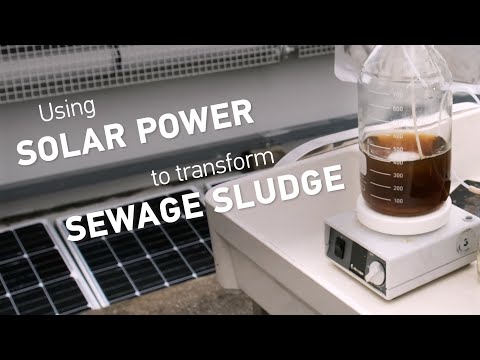
This makes the entire sludge recycling process entirely carbon-free, and actually carbon negative as it avoids carbon emissions from the sludge’s normal processing, and replaces other fossil-fuel-based sources for acetic acid, hydrogen, and animal feed.
Hydrogen can be used as a source of clean energy, and acetic acid is a key ingredient for food and pharmaceutical industries.

출처: Nature Water
고효율
This method has been demonstrated to recover 91.4% of the organic carbon in sewage sludge and convert 63% of the organic carbon into single-cell protein.
This is much higher than traditional anaerobic digestion, which typically recovers and converts around 50% of organic materials in sewage sludge.
Overall, this reduces carbon emissions by 99.5% and energy use by 99.3% compared to traditional methods.
“우리는 제안한 방법이 폐기물을 지속 가능하게 관리하고, 슬러지를 폐기물이 아닌 청정 에너지와 지속 가능한 식량 생산을 지원하는 귀중한 자원으로 전환하는 가능성을 보여주길 바랍니다.”
In addition to this high efficiency, it also purifies the sludge from heavy metals, which tend to pollute landfills in the usual methods to deal with it.
This new method indicates that a revolution in how wastewater is dealt with in the world is possible, removing heavy metals (maybe for later recycling?) and producing useful acetic acid, hydrogen, and animal feed all at once.
결론
A hydrogen economy will likely be one with a complex mesh of various hydrogen sources.
Most likely, one will be advanced catalysts performing water electrolysis into hydrogen, without requiring expensive rare metals. It would bring the cost of hydrogen low enough to make it an economically viable competitor to fossil fuels and other green alternatives.
Another likely source is to utilize better the massive millions of tons of waste products created by farming, wastewater, and other human activities. As these need processing anyway, it is by far better that we start processing them in such a way that pollutants (like heavy metals) are removed and new useful products are created.
And if this is done by being solely solar-powered, the better.
텅스텐 촉매 기업
Tungsten is emerging progressively as not only a super resistant metal, used in heavy industry and the defense sector, but also as a power catalyst useful for the chemical industry and to generate hydrogen.
It might even become a powerful high-temperature superconductor when woven in the right molecular configuration.
You can read a technical and investing overview about this resource in “Tungsten – The Secret High-Tech Metal”.
It is also a metal whose supply chain is almost entirely controlled by China, with one exception, Almonty Industries (ALM ).
Almonty Industries
AII.TO 가격 차트
Almonty is a tungsten miner that is currently mostly producing from a mine in Portugal, in operation for the last 125 years.
The company has been working on expanding the Portuguese mine and owns undeveloped deposits in Spain.

출처: Almonty
The company’s most important project is the ongoing development of a new mine in Sangdong, South Korea. The mine contains more inferred resources than all of its other deposits combined.

출처: Almonty
As one of the only active and producing tungsten miners in Western countries, Almonty is a key strategic supplier for the defense industry. So, it is an important company for reducing dependence on Chinese supply.
The Sangdong mine’s location makes it a perfect supplier to the defense industry, with South Kore,a new giant in mass production of “low techs” military gear like tanks, artillery, and ammunition (compared to less tungsten-demanding fighter jets, aircraft carriers, etc.).
중국이 카자흐스탄에 대규모 텅스텐 광산을 열 준비를 하는 가운데, Almonty Korea Tungsten Project의 상동 광산이 몇 달 안에 가동되면 Almonty는 “텅스텐 확보를 둘러싼 정치 구도를 크게 바꿀” 준비가 되어 있습니다. 생산이 시작되면 상동 광산은 세계 최대 규모의 텅스텐 광산 중 하나가 되며, 중국 외 공급량의 30%를 차지하게 됩니다.
Almonty should start producing tungsten from the Korean mine in early to mid-2025.
Because of its strategic position as essentially the sole large supplier in the West, Almonty was offered a guaranteed price by Plansee. Plansee is a high-performance metal manufacturer and one of Almonty’s larger clients, as well as the owner of 15% of the company.
The minimum guaranteed price was $235/MTU (metric ton unit), with no upper threshold. As Sangdong Mine is aiming for cash costs of $110/mtu, this should virtually ensure a high-profit margin for the project.
With a lucky, almost perfect timing between the upcoming opening of Sangdong and a new trade war between Trump’s America and China, the stock price has reacted strongly and rose by 40% in just 2 days following the announcement of tungsten export restriction from China.
As tungsten becomes more and more important for high-tech applications, as well as geopolitical tensions, stay high, secure, non-Chinese tungsten supply is likely to come to generate a stable premium, with Almonty one of the strongest beneficiaries.
연구 참고:
1. Christean Nickel et al. (2025) Self-optimizing Cobalt Tungsten Oxide Electrocatalysts toward Enhanced Oxygen Evolution in Alkaline Media. Angewandte Chemie. 05 2025년 2월 https://doi.org/10.1002/anie.202424074
2. Hu Zhao, et al. (2024) Solar-driven sewage sludge electroreforming coupled with biological funnelling to cogenerate green food and hydrogen. Nature Water. Volume 2, pages1102–1115. https://doi.org/10.1038/s44221-024-00329-z



