
메가프로젝트
Hyper-Kamiokande: 일본의 거대한 중성미자 검출기

 Securities.io를 Google의 선호 소스에 추가

가장 포착하기 어려운 입자를 엿보다
As fundamental physics advances, we are beginning to better understand the subatomic particles that make up our universe.
그럼에도 불구하고, 특히 아인슈타인의 상대성 이론과 양자 물리학을 하나로 묶는 통합 물리 이론과 같은 몇몇 질문은 아직 답을 찾지 못했습니다. 반물질과 중력의 정확한 본질이 아마도 빠진 핵심 조각일 것입니다.
이들을 연구하려면, 중성미자라는 매우 포착하기 어려운 입자에 대한 더 깊은 이해가 필요합니다. 이는 일련의 새로운 중성미자 실험 덕분에 곧 달성될 수 있습니다.
우리는 이전에 두 가지를 다루었습니다: 장강 지하 중성미자 관측소 (JUNO)와 심층 지하 중성미자 실험 (DUNE).
또 다른 중요한 중성미자 메가프로젝트는 일본의 Hyper‑Kamiokande이며, 이는 이전 실험인 Super‑Kamiokande의 후속이자 규모를 확대한 버전입니다.

중성미자란?
Neutrinos are electrically neutral particles with an extremely small mass, so small that it had long been thought to be null.
현재 우리는 중성미자가 왜 질량을 가지고 있는지 알지 못합니다, 다른 입자와는 다른 방식으로 작용하는 것처럼 보이기 때문입니다.
중성미자를 독특하게 만드는 점은 이들이 본질적으로 “유령” 입자이며, 다른 물질과 거의 상호작용하지 않는다는 것입니다. 이는 중성미자가 우주에서 4가지 기본 힘 중 중력과 약한 상호작용(weak interaction)만과 상호작용하기 때문입니다.
약한 상호작용은 매우 짧은 범위를 가지고, 중력은 저질량 중성미자에 거의 영향을 주지 않기 때문에, 중성미자는 물질을 통과하면서 거의 상호작용하거나 감속되지 않습니다. 결과적으로 중성미자는 거의 빛의 속도에 가깝게 이동합니다.

중성미자는 더 작은 구성 요소로 나눌 수 없는 기본 입자이며, 전자 중성미자, 뮤온 중성미자, 타우 중성미자라는 3가지 종류가 있습니다. 더욱 복잡하게도, 중성미자는 이 3가지 종류 사이를 정기적으로 전환하는 것으로 보입니다.
The transition between all 3 variants of neutrinos is linked to the mass of each neutrino’s type and contains answers about the fundamental nature of matter and the Universe itself.
태양 중성미자, 대기 중성미자, 원자로와 가속기에서 발생하는 중성미자를 이용한 진동 실험은 입자 물리학 표준 모델을 넘어서는 물리학에 대한 최초의 증거를 제공했습니다.
또한 4번째 종류의 중성미자, 즉 스테릴 중성미자가 존재할 가능성도 있습니다, 이는 중력만을 통해 물질과 상호작용하므로 다른 종류보다 탐지하기가 더욱 어렵습니다.

그리고 반중성미자, 즉 반물질 버전도 존재하는데, 이는 아직 덜 이해되고 있으며 Hyper‑Kamiokande의 중요한 연구 대상이 될 것입니다.
대부분의 중성미자는 핵융합이 일어나는 별 내부부터 지구 중심부의 방사성 붕괴까지, 다양한 핵반응에 의해 생성됩니다.
그 포착이 어려움에도 불구하고, 중성미자는 우주에서 가장 풍부한 입자라고 여겨집니다. 매초 약 1천조(1015)개의 중성미자가 우리 몸을 통과합니다.
(Fermilab이 만든 전용 웹사이트 “all things neutrinos”에서 중성미자에 대해 더 알아볼 수 있습니다.
Hyper‑Kamiokande 설계
Kamiokande → Super‑K → Hyper‑K
Hyper‑Kamiokande is the heir to Kamiokande and Super‑Kamiokande, the previous smaller versions of neutrino detectors built on the same research site in Japan, respectively in 1983 and 1996.
Kamiokande는 초신성 폭발과 태양으로부터 오는 중성미자를 최초로 탐지한 관측소이며, 이를 통해 중성미자 천문학 분야가 열렸습니다.
Super‑Kamiokande는 중성미자 진동을 발견하여 중성미자가 질량을 가지고 있음을 증명했습니다.
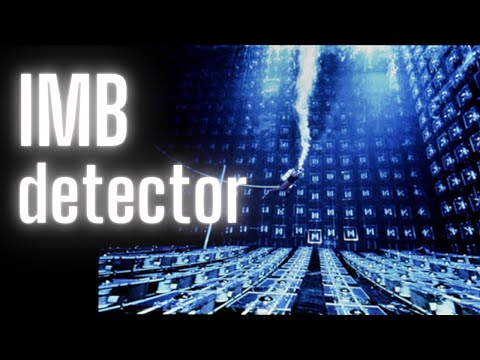
Hyper‑Kamiokande 검출기의 핵심은 높이 71 m, 직경 68 m인 원통형 물탱크입니다. 이는 세계에서 가장 큰 지하 물탱크가 될 것입니다.
각 단계마다 규모와 질량이 증가하면서 중성미자 탐지 능력이 향상되었습니다. 예를 들어 Kamiokande는 4,500 톤의 물을 사용했고, Super‑Kamiokande는 50,000 톤, Hyper‑Kamiokande는 260,000 톤을 사용할 예정입니다.

출처: Hyper‑Kamiokande
물탱크 벽면에는 20,000개의 초고감도 광센서와 1,000개의 복합 눈 광센서가 설치되어 물에서 발생하는 매우 약한 체레노프 빛을 감지합니다. 이는 Super‑Kamiokande보다 약 4배, Kamiokande보다 40배 많은 수치입니다.
광전증배관(PMT)은 초고성능 카메라의 픽셀과 같습니다. 이 덕분에 Hyper‑Kamiokande는 단일 광자도 포착할 수 있는 거대한 카메라가 되었습니다. 달 표면에 손전등을 비추는 빛도 감지할 정도로 민감합니다.
These results were achieved thanks to an improved photosensor design, which can withstand twice the water pressure and has half the residual background radioactive activity of previous versions.
워터 체레노프: 트랙을 빛으로 변환
The key concept of the Kamiokande observatory series is the “water Cherenkov detector”. It detects a faint bluish light emitted by charged particles traveling through water faster than the speed of light in water (which is lower than in the air or a vacuum).
중성미자가 물 속 원자와 충돌하면, 전하를 띤 입자와 체레노프 복사가 원뿔 형태로 생성됩니다.
빛 신호의 타이밍과 강도를 이용해 원래 입자의 특성을 재구성합니다.
지하에 건설
Hyper‑Kamiokande는 다른 입자들의 간섭을 줄이기 위해 산 아래에 건설됩니다. 우주선, 방사능 및 기타 간섭은 중성미자가 물 분자를 때리는 신호와 유사한 신호를 만들 수 있습니다.
깊은 암반층 아래에 위치하면 이러한 다른 에너지 원들의 영향은 무시할 수 있을 정도로 감소하고, 오직 포착하기 어려운 중성미자만이 가능한 원인이 됩니다.

출처: Hyper‑Kamiokande
대량의 물을 사용하는 이유는 중성미자가 물질과 매우 드물게 상호작용하기 때문입니다. “반응 질량”이 클수록 중성미자와의 상호작용이 발생하고 탐지될 가능성이 높아집니다.
통과하는 중성미자와의 반응 가능성을 더욱 높이기 위해, 가돌리늄 황산옥탄수화물 형태의 가용성 가돌리늄을 물에 0.01% 무게 비율로 첨가합니다.

출처: Hyper‑Kamiokande
중성미자가 물과 상호작용하면 중성자를 생성할 수 있습니다. 가돌리늄 원자는 큰 중성자 포획 단면적을 가지고 있어 이 중성자를 포획하고 감마선을 방출하여 탐지할 수 있게 합니다.

출처: Hyper‑Kamiokande
Gadolinium exists naturally in Japanese soil at a concentration of about 3 to 7 ppm, so the project is not considered to create a risk of pollution from water leaks.
J‑PARC 빔 + 자연 소스
In addition to natural neutrinos such as atmospheric neutrinos and solar neutrinos, a high-intensity and high-quality neutrino beam from the J‑PARC particle accelerator in Tokai will be used.
J‑PARC 빔 파워가 증가함에 따라 Hyper‑Kamiokande는 이전 실험보다 20배 많은 중성미자를 관측할 것으로 기대됩니다. Hyper‑Kamiokande와 J‑PARC는 295 km(183 마일) 떨어져 있어, 한 종류의 중성미자에서 다른 종류로 전환되는 현상을 연구하기에 충분한 거리입니다.

출처: Hyper‑Kamiokande
각 Hyper‑Kamiokande 검출기는 “내부 검출기(Inner Detector)”와 “외부 검출기(Outer Detector)”로 구분되며, 광학적으로 서로 분리되어 있습니다.

출처: Hyper‑Kamiokande
내부 검출기는 주요 검출기이며, 외부 검출기는 핵자 붕괴와 중성미자 측정에서 배경을 이루는 우주선 뮤온을 차단하는 역할을 합니다. 산 위에서 이미 크게 필터링된 후, 검출기에 도달하는 우주선 뮤온의 99.9% 이상이 제거됩니다.
(Hyper‑Kamiokande 설계에 대해 더 배우고 싶다면, 이 282페이지 분량의 공식 설계 보고서를 참고할 수 있습니다.)
스크롤하려면 스와이프 →
| 검출기 | 매질 | 질량 / 크기 | 핵심 하드웨어 | 주요 목표 | 타임라인 |
|---|---|---|---|---|---|
| Kamiokande | 워터 체레노프 | ~4,500 t; 16 m H × 15.6 m Ø | ~1,000 PMT | 태양 및 SN1987A 중성미자 | 1983–1995 |
| Super‑Kamiokande | 워터 체레노프 | ~50,000 t; 41.4 m H × 39.3 m Ø | ~13k PMT; **SK‑Gd** 0.01–0.03% | 중성미자 진동; SRN | 1996–현재 |
| Hyper‑Kamiokande | 워터 체레노프 | ~260,000 t; ~71 m H × 68 m Ø | 신형 초고감도 PMT; >99.9% 뮤온 차단 | CPV, 양성자 붕괴, 태양/초신성, DSNB | 운용 목표 2027; 데이터 수집 2027–28 |
Notes: Mass/size & PMTs and muon-veto from Hyper‑K/SK pages; SK‑Gd figures from SK‑Gd docs.
Hyper‑Kamiokande 일정
The project was approved in 2020, and excavation of the tunnel was started in 2021, together with the mass production of photomultiplier tubes.
The detector’s main cave excavation was finished in 2025년 6월.

출처: Hyper‑Kamiokande
그 이후로 관측소 자체의 건설이 시작되었으며, 최초 관측은 2028년에 기대됩니다.
It should be noted that while complex and very powerful, this design is ultimately now well understood, and is being built relatively quickly when compared to other fundamental physics megaprojects and next-generation telescopes.
Hyper‑Kamiokande의 목표
The overarching goal of Hyper‑Kamiokande is to elucidate the history of the evolution of the Universe and the Grand Unified Theory of physics, which unified all fundamental forces of the Universe into one common equation, a situation that is thought to have briefly existed right 0.00000000001 seconds after the Big Bang.

출처: Hyper‑Kamiokande
태양 및 초신성 중성미자 — 그리고 암흑 물질 탐색
Thanks to its greater mass and efficiency, Hyper‑Kamiokande will be able to detect a lot more neutrinos coming from our Sun and distant exploding stars.
특수한 종류의 중성미자를 관측함으로써, 태양의 핵융합 반응을 더 잘 이해하고 고에너지 HEP 중성미자 흐름을 최초로 관측할 수 있게 됩니다.
초신성은 하늘에서 또 다른 큰 중성미자 원천이며, 폭발 시 거대한 폭발을 일으킵니다. 1987년 2월 23일, Kamiokande는 대마젤란 은하에서 발생한 초신성 폭발로부터 중성미자를 관측했습니다.

출처: Shio’s HP
불행히도, Super‑Kamiokande 실험 기간 동안 초신성 폭발은 발생하지 않았습니다.
탐지 범위가 확대된 덕분에 Hyper‑Kamiokande는 초신성 폭발을 포착할 가능성이 훨씬 높아졌습니다. 우리 은하(10 kpc)에서 초신성이 발생하면 약 50,000개의 중성미자를 탐지할 수 있습니다.
이는 과학자들에게 초신성 폭발의 상세 메커니즘뿐 아니라 중성미자의 본질을 더 밝히는 실마리를 제공할 것입니다.
Hyper‑K와 DUNE은 초신성 중성미자에 대한 감도 면에서 거의 완벽하게 보완관계에 있습니다. DUNE은 νe (아르곤과의 산란을 통해) 를, Hyper‑K는 ν̅e (역베타 붕괴를 통해) 를 탐지합니다.
Hyper‑Kamiokande는 매우 먼 초신성 폭발들로부터 누적된 중성미자 흐름인 확산 초신성 중성미자 배경(DSNB)까지도 탐지할 가능성이 있습니다.
이러한 특정 복사는 검출기에 가돌리늄을 첨가함으로써 특히 감지됩니다(역베타 붕괴, 단순한 뮤온 붕괴 중성미자 대신).
Lastly, dark matter could also be responsible for the production of neutrinos. So if such a neutrino source is detected at a place with high dark matter concentration, like the center of the galaxy, it could help elucidate the nature of dark matter.
양성자 붕괴 탐색
The occasional decay of protons into lighter subatomic particles, such as a neutral pion and a positron, is something physicists have tried to prove the existence of and measure since the construction of the original Kamiokande.
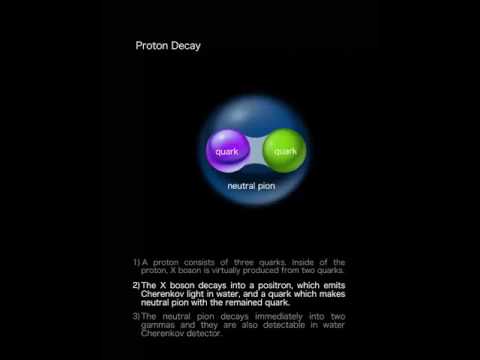
특히 Hyper‑Kamiokande는 수소에서 중성자를 포획할 때 발생하는 2.2 MeV 감마선을 탐지할 수 있으며, 이는 중성미자에 의해 발생하는 사건과 뚜렷이 구분됩니다.
검출기가 양성자 붕괴를 측정한다면, 이는 붕괴가 실제로 일어난다는 증명일 뿐 아니라, Super‑Kamiokande에서 탐지되지 않았을 때보다 상향 조정된 붕괴율을 추정하고, 붕괴 메커니즘을 이해하는 데 도움이 됩니다.
If still nothing is detected, this would force physicists to find out why protons decay even less than previously thought, or maybe not at all.
No one knows the answer to when proton decay can be observed or whether it ever really breaks down in the first place. However, we cannot move forward without actually conducting the experiment.
I believe that protons decay. We hope that readers will look forward to the day when proton decay is discovered.
(MCLOUD.BO )Dr. Masato Shiozawa, the co‑spokesperson of Hyper‑Kamiokande.
CP 위반: 물질이 승리한 이유
At the origin of the Universe, physicists think that the same amount of matter and antimatter was created.
중성미자 진동은 반중성미자 진동과 다를 수 있으며, 이는 CP 위반, 즉 전하 복합(Charge conjugation)과-Parity (CP) 대칭의 붕괴라는 가설적 현상으로 알려져 있습니다.

출처: Hyper‑Kamiokande
CP 위반은 이미 쿼크(양성자와 중성자를 구성하는 입자)에서 확인되었습니다. 그러나 이는 현재 우주를 만드는 데 필요한 차이의 1조분의 1에 불과합니다.
J‑PARC 입자 가속기에서 생성된 중성미자와 반중성미자가 이 실험의 핵심이 될 것입니다.
Hyper‑Kamiokande는 Super‑Kamiokande에 비해 J‑PARC 빔 강도를 2.5배로 증가시켜 데이터 부족으로 인한 오류를 줄이고 측정 횟수를 늘려 신뢰성을 향상시킬 계획입니다.
It is expected to be possible to determine whether the CP symmetry is broken or not for neutrinos in 10 years, with results in the 2030s.
결론
Neutrino observatories like Hyper‑Kamiokande, DUNE, and JUNO are likely going to be very important science experiments to finally solve questions regarding physics that have been unanswered for decades, and have blocked the development of further progress in theoretical physics.
이것이 일상 생활과는 거리가 멀게 들릴 수 있지만, 우리의 최첨단 기술 중 다수는 중성미자에 대한 더 나은 이해 없이는 발전할 수 없습니다.
예를 들어, Microsoft가 최근 만든 양자 컴퓨팅 칩 (Majorana‑1)(MSFT )
이 칩은 자체 반입자이자 메이저라나 입자를 이용해 새로운 물질 상태(위상 전도체)를 실제로 창조했습니다.
마찬가지로, 태양의 핵융합 반응을 더 잘 이해하면 인공 핵융합을 구현하는 데 도움이 될 수 있습니다.
So a better understanding of neutrinos, antimatter, or dark matter is not just a giant science project, but can have very direct applications in the development of new world‑changing technologies like quantum computing or fusion power plants.
중성미자 과학에 투자하기
1. Microsoft
MSFT 가격 차트
Microsoft는 운영 체제에서 사실상 독점적인 지위를 차지하고 있으며, Office365, Azure 클라우드, LinkedIn, Xbox와 세계 최대 규모의 비디오 게임 스튜디오, 광고, 프로그래밍 도구(GitHub) 등 B2B 소프트웨어 분야에서도 매우 강력한 입지를 가지고 있는 세계 최대 규모의 기술 기업 중 하나입니다.
이 회사는 특히 모든 제품에 Copilot AI를 배포하면서 AI 분야에서도 활발히 활동하고 있습니다. Microsoft AI는 처음에 OpenAI와의 협업을 통해 시작되었으며, 현재는 자체적으로 진행하고 있습니다.

출처: Microsoft
Microsoft는 또한 Majorana‑1 칩 발표와 같은 놀라운 소식으로 양자 컴퓨팅 분야에서도 활발히 활동하고 있습니다.
절대 영도에 가깝게 냉각하고 자기장을 조절하면, 이 장치는 위상 초전도성 나노와이어를 형성하며, 와이어 끝에 소위 메이저라나 제로 모드(MZM)를 포함합니다.

출처: Microsoft
(Microsoft에 대한 모든 사업 활동 및 투자 기회는 전용 투자 보고서에서 자세히 읽을 수 있습니다.)(.)
2. Neutrino Energy
While rich in potential future applications, neutrino science seems far from being directly used for commercial applications.
This could be changing, according to a very ambitious German private startup, Neutrino Energy.
The company is exploring the very novel concept of neutrinovoltaics, or the generation of electricity from the constant flux of neutrinos around us. How this works is by using a layer of graphene, a 2D material made of carbon (follow the link for a complete explanation of 2D materials like graphene or goldene).
This method aims to convert the constant motion of graphene atoms, influenced by surrounding radiation and particles like neutrinos, into usable electricity. While promising in theory, the process is still unproven and remains highly experimental.. A similar phenomenon is happening to graphene, with neutrinos “pushing” the atom nuclei, as with argon atoms in the DUNE neutrino detector.
The company has been announcing its upcoming first prototype, called the Powercube, which is supposed to demonstrate the technology developed with the assistance of AI.
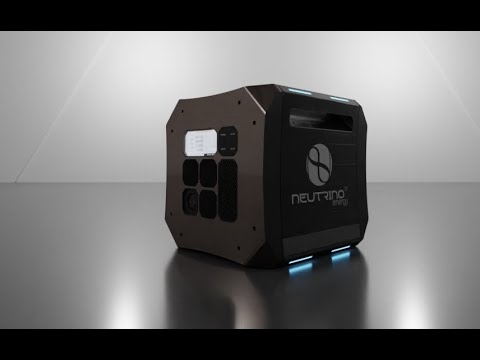
The company has also been working with the Centre for Materials for Electronics Technology (CMET) in India, aiming “to create a self‑charging electric vehicle powered by neutrinovoltaic technology”.

It is hard to tell how close to any commercialization the concept is, as it seems that, for now, it is just that, a concept with little reveal about the potential power output or economics.
It is also so extraordinary in its claim of a fuel‑less infinite source of energy that a heavy dose of skepticism is in order, especially considering the very low level of interaction of neutrinos and other forms of matter.
But this is definitely the closest to a “neutrino company” currently on the market, with the risk of a deceptive presentation of the technology’s potential to be kept in mind by potential investors.



