
지속가능성
화재 안전이 그 어느 때보다 중요해졌습니다 – 우리는 무엇을 하고 있나요?

 Securities.io를 Google의 선호 소스에 추가

불 위험을 줄이기 위한 난연제
With wildfires currently burning down entire neighborhoods in Los Angeles, or quite recently in Hawaii, it is clear why any technology helping with preventing or slowing fire should be pursued.
There are many angles from which we could tackle this issue. From better use of data to different construction materials, or different management of water and forested areas.
However, we are still going to keep using a lot of flammable materials in our daily life, simply because too many useful products happen to be flammable.
Another possibility is using fire retardants, chemicals that reduce the risks of catching fire and the speed at which a fire goes out of control. This can make a radical difference, as a slower fire will be more likely to be extinguished early or give more time for the fire department to arrive and bring the right equipment.
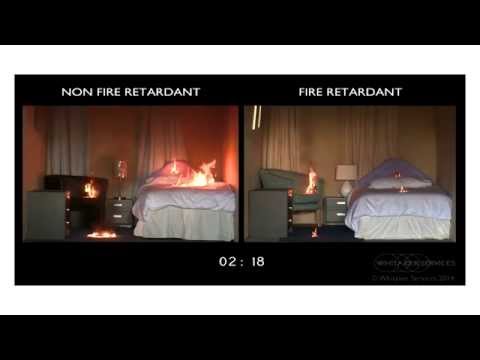
An issue is that many flame retardant chemicals are somewhat toxic, making them unpractical for many applications. One example is anything touching the human skin frequently, like cotton fabric. This could change thanks to the discovery of eight researchers at Texas A&M University, who have developed a new one-step flame retardant for cotton textiles.
They recently published their results in ACS Applied Polymer Materials, under the title “Evaporation Induced Flame Retardant Polyelectrolyte Complex for Cotton1”.
왜 면인가?
Cotton is the most used textile globally, thanks to its excellent properties for making soft, comfortable, and breathable fabrics. It is used in clothing and upholstery and is a major contributor to flammable materials in homes (sofas, closets, towels, tablecloths, etc.), including those in close proximity to fire hazards (cooking areas, candles, cigarettes, etc.).
It is mostly composed of α-cellulose, an extremely flammable material. This makes anything made of cotton burn very quickly and completely.
Another reason to focus on cotton is that it would immediately open a massive market for any innovation targeting this material. And it still could likely be expanded to other materials later on.
난연제는 어떻게 작동하나요
Most cotton flame retardants historically used were halogenated compounds that are now phased out because of their toxicity to humans. Alternative molecules have been explored by the chemical industry for many years, including phosphorus-, nitrogen-, silicon-, and boron-based chemistries.
The issue so far to find a good replacement has been one of cost. These alternative compounds need treatment in several steps, which cost more money as a result.
The way flame retardants work is by creating a char layer on top of the material when it burns, which blocks the expansion of the fire further. Most commonly, it is done by combining an acid source and a carbon source.
Sometimes, a “blowing agent” is added, which decomposes from heat into nonflammable gases that dilute the flammable gases and weaken the flames.
원스텝 난연제
The researchers looked into a class of chemicals called polyelectrolytes: polyethylenimine (PEI) as the blowing agent and sodium hexametaphosphate (PSP) as the acid source. In the case of cotton, the flammable material itself is the source of carbon.

This mixture is nontoxic and would be ideal for mass production on all cotton fabrics. But so far, only 2-step processes to apply and bound polyelectrolytes to cotton were known.
The researchers discovered they could use ammonia (NH3) as a volatile base to bind PEI and PSP to the cotton when the ammonia evaporates. They found that they could apply the whole mixture to cotton and evaporate the ammonia in only one step.
올바른 방법 찾기
Various ratios of PEI-to-PSP were explored to find the optimal composition to reduce cotton’s flammability.
The resulting cotton fibers were examined under an electron microscope (Scanning Electron Microscope – SEM), allowing us to measure the fire retardant absorption by the cotton fibers.

Another factor measured was the durability of the treatment against rinsing. As cotton fabrics are likely to be cleaned frequently, any flame retardant that does not handle water exposure and rinsing will have little usefulness in real-life conditions.
“This technology can be optimized to quickly, easily, and safely flame retard many flammable materials, offering vast protection in everyday life, saving money and lives of the general population.”
Maya D. Montemayor – Graduate student in the Department of Chemistry at Texas A&M.
For some of the ratios used, the material gets partially washed off the first rinse, but then the rest of the properly bonded flame retardant stays attached to the cotton fibers.

극도로 감소된 인화성
The treated cotton releases a lot less heat than the untreated (neat) cotton when measured in energy per gram of cotton (W/g). The temperature of the combustion was also lowered.

When performing a so-called “vertical flame” test, the researchers also observed that the acid in the mix was responsible for the bounding to the cotton, protecting the flame retardant from washing off when the fabric was rinsed.

앞으로 나아가기
These initial results are a big deal for the cotton industry and the flame retardant-producing companies, as they could open the way to a cheaper and easier generalized treatment for all cotton products.
The researchers are now evaluating with industrial partners how this process could be expanded beyond cotton to any carbon-rich material, like wood, fabric, foam, and other textiles.
“This cutting-edge research offers Texas A&M recognition as one of the leaders of this technology and the opportunity for further development with external companies.
TEES is licensing this and similar technologies to companies for various applications.”
Dr. Jaime Grunlan,- Leland T. Jordan ’29 Chair Professor in the J. Mike Walker ’66 Department of Mechanical Engineering at Texas A&M.
불 위험에 대해 할 수 있는 다른 일들
화재를 더 효과적으로 통제하기 위한 신기술은 여러 방향에서 개발할 수 있습니다. 예를 들어, 앞서 다룬 방법에는 다음과 같은 것들이 있습니다.
- AI 예측: 위성 이미지와 정확한 기상 예측을 활용하면 산불 발생 위험과 심각성, 그리고 산불을 통제할 방법을 더 정확히 예측할 수 있습니다.
- 산림 관리 시스템: 더 우수하고 추적 가능한 산림 관리 도구는 산림의 건강과 생산성을 더 정확히 평가하고 관리 방법을 개선하는 데 도움이 됩니다. 이를 통해 고사목과 그 밖의 화재 위험 요소를 줄일 수 있습니다.
- 대량 목재 건축: 목재 건축이 화재 위험을 줄이는 데 도움이 된다는 말은 이상하게 들릴 수 있습니다. 그러나 매스팀버는 목재를 매우 조밀하게 결합해 강철만큼 튼튼하면서도 내화성을 갖춘 보를 만드는 신기술입니다. 매스팀버는 자연스럽게 탄화층을 형성하며, 난연제도 이와 같은 원리로 가연성을 낮춥니다. PEI-PSP 난연제를 사용하면 성능을 더욱 개선할 수 있을 것입니다.
- 열 활성화 하이드로겔: 산불 확산을 막기 위해 일반적으로 쓰이는 폼 대신 물을 두 배 더 오래 유지하는 새로운 하이드로젤을 사용할 수 있습니다. 이는 산불이 닥치기 전에 주택을 보호하는 데 큰 차이를 만들 수 있습니다.
- 드론: 소방 드론은 소방관이 진입하기에 너무 위험한 곳까지 갈 수 있어 소방 장비에 유용한 수단을 더해 줄 수 있습니다. 이러한 드론을 생산하는 기업 텍스트론에 관한 자세한 내용은 “2025’s Top Drone Companies Leading the Aerial Revolution”.
난연제에 투자하기
Flame retardants are an often ignored, but very important product from the chemical industry that save countless lives daily.
It is one but many of the specialty chemicals part of modern life, making up a $8.63B market in 2022 and expected to grow 7.1% CAGR until 2030.

You can invest in chemical industry-related companies through many brokers, and you can find here, on securities.io, our recommendations for the best brokers in the USA, Canada, Australia, the UK, as well as many other countries.
If you are not interested in picking specific companies, you can also look into ETFs like the iShares STOXX Europe 600 Chemicals UCITS ETF (EXV7) or the Fidelity Select Chemicals Portfolio (FSCHX) which will provide a more diversified exposure to capitalize on the chemical industry.
난연제 기업
ICL 가격 차트
ICL is a global chemical company based in Israel, with a strong position in fire retardants, notably a #1 position in solutions for electronics, including EVs and AI, and construction, using either bromine or phosphorous.
It is also active in fertilizers, especially phosphate and potash, as well as phosphate for industrial products like battery materials.

출처: ICL
The company is overall a leader in the industries it occupies, with a 33% market share in industrial products and 20% in phosphate solutions. Overall, its sales are diversified over the globe.
The largest part of the company’s EBITDA is from sales of potash and phosphate solutions.

출처: ICL
Fire retardant is only a part of the company’s activity, and it is also investing actively in new technology. It is notably financing startups and doing its own R&D in next-generation fertilizers, including:
- Photocatalytic nitrogen fixation at proximity to the plant.
- On-farm electrochemical production of ammonia or nitrates.
- Biostimulants to improve fertilizers’ bioavailability.
- Improvement of phosphorus availability through plant extracts, microorganisms (PSB – Phosphorus Solubilizing Bacteria), and chemicals.
As a low-cost bromine and potash producer, the company is well-positioned to handle even low fertilizer prices, while betting on new innovative solutions to create growth in the future.
It could also benefit from a growing demand for fire retardants, even before one-step treatments like the one discussed in this article come onto the market.
연구 참고:
1. Montemayor, M. D., Rodriguez-Melendez, D., Smith, D. L., Vest, N. A., Palen, B., Chang, E., Moran, A. V., & Grunlan, J. C. (2024). Evaporation induced flame retardant polyelectrolyte complex for cotton. ACS Applied Polymer Materials. https://doi.org/10.1021/acsapm.4c02937



