
Render Token Nyheter
Render Token (RNDR)-nettverkets rolle i rendering av metaverset på Solana


Som den neste store kryptovaluta-/blockchain-trenden — etter DeFi i 2020 og NFT-er i 2021 — forventes metaverset å bli det heteste temaet i bransjen i 2022. Faktisk begynte det allerede å ta av sent i 2021 takket være Facebooks store interesse for konseptet og beslutningen om å omdøpe seg til Meta.
Imidlertid er blockchain‑industrien nå svært opptatt av metaverset og dets potensial til å revolusjonere internett, innholdsproduksjon, kommunikasjon, inntektsgenerering fra innhold og mer. Metaverset vil gi verden et miljø der kryptobransjen kan blomstre og oppnå masseadopsjon, noe som forklarer hvorfor alle ser ut til å fokusere på det akkurat nå.
Et eksempel er OTOY, hvis administrerende direktør og grunnlegger, Jules Urbach, har som spesifikt mål å demokratisere innholdsproduksjon — spesielt når det gjelder digitale eiendeler. For å oppnå dette målet planlegger Urbach og OTOY å bruke moderne teknologier for å oppfylle løftet om et åpent skybasert metavers, og den beste måten å gjøre det på, etter hans mening, er gjennom Render Network og dets Render Token.
Rendering av nettverket på Solana
According to its website, the Render Network is the leading provider of decentralized GPU-based rendering solutions. As such, it is a leader in revolutionizing the digital creation process. The project’s goal is to create a much more efficient, powerful, and widely-scalable rendering network than anyone has seen before, and to do it, Urbach announced Render Network’s integration with the Solana blockchain.
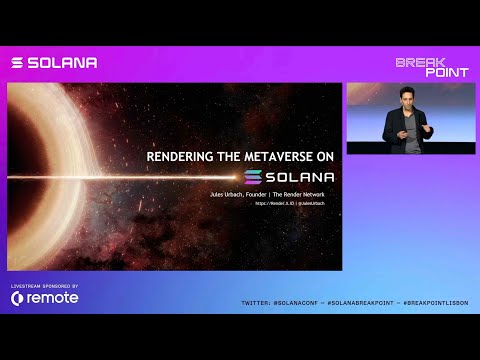
The announcement was made during the inaugural Solana Breakpoint Conference in Lisbon, Portugal.
Urbach started the presentation by explaining what Render is and how it started, noting that it was based on GPU rendering on the cloud. Explaining the mission of democratizing content creation, he proceeded to display several videos rendered on the GPU on the blockchain, listing a number of major companies that all use render network to create their content, such as Netflix, HBO, Disney, and more.
Render makes it possible with rapid delivery of high‑quality frames. Of course, today these are offline renders, but in the future the company will target the same quality of real‑time graphics, rendered holographically, in 3D, and in real time.
One limitation here is that doing so requires a lot of computing power. But, the current crypto industry has already presented the solution that will allow Render to bypass this issue, and that solution is the metaverse itself.
Urbach noted that the company is taking the cost of a dollar of rendering on Amazon, and paying out a dollar, or half a dollar, or even a quarter for the same amount of work on the Render Network. On top of that, the network also has plugins for every single 3D tool. In other words, there is no software that anyone needs to learn in order to use Render.
Whether users know PhotoShop, or Blender, or Unity, or anything else — there is already a plugin for that that connects directly to the Render Network. Urbach noted that these jobs were done on Amazon four years ago and that they now run on the decentralized cloud. He also stated that the network already has over 10,000 users, with the number growing up fast. Not only that, but he also mentioned that there were already over 1 million RNDR tokens spent on jobs, with this amount growing fast as well. He predicted that by november 2022, the amount will likely grow by 10 times.
Hva har Render Network gjort så langt?
Moving on with his presentation, Urbach listed some of the things that Render has already achieved since its launch. Its very first commercial job, according to him, was Jonh Knoll, the head of ILM. He was the first person to praise the product and provide encouragement that led Render to where it is now.
Render has already started collaborating with many others, and it also adopted a lot of 3rd-party software — things that the project itself is not creating.
Finally, he came to the topic of integration with Solana, stating that the project did start on Ethereum Layer 1, but it quickly decided to leave due to excessively high fees. It first switched to Matic, and it kind of liked it, but there were still some problems that could not be bypassed or solved. Solana, on the other hand, does not suffer from same issues, it has a fast chain, low fees, and more, all of which makes it uniquely suitable for a project of this kind.
In fact, Urbach noted that the team inspected every blockchain, network, and system that it could get its hands to, and nothing was even close to the possibilities found on Solana. It is the only project that could deliver what they needed, and it can support the metaverse. Not only does it have impressive speeds, but it delivers them alongside top-notch security, which makes it the only blockchain to not sacrifice one for the other, and that is what impressed Render so much.
Render feels that Solana is the only blockchain that can provide enough security and speed for rendering to be done in real-time, which is why they chose this blockchain to finally settle.
In addition to speed and security, fee payments on Solana are trivial, and more importantly, the project wanted access to the Solana ecosystem. Metaplex, for example, will allow moving anything that is done on Render Network to Solana, and then to Metaplex with a single click.
Metaplex solves a number of issues that artists face every day when creating NFTs. Right now, there are thousands of them on Render, and they made over $700 million in NFT sales in 2021 alone. Many of them wish to create things that simply cannot be done on OpenSea and other NFT marketplaces, such as being able to create 3D metaverses that can be streamed at, offer interactivity, be able to update streams live, and more, none of which can be done on the likes of OpenSea and similar solutions.
Metaplex removes all of those problems. It can add live streaming to NFTs, it can support custom stores, it has logic nodes, it can support web-like integrations, not only between different art pieces, but also services, including rendering, AI, and alike. It can create payment flows, which is also highly necessary, and something that metaverse will not be able to function without.
In other words, Metaplex is the only place that allows all the different pieces necessary to run a real, successful metaverse, to come together and not suffer a single currently known point of failure.
Hva kommer videre?
After spending so much time in developing this idea, testing different chains and solutions, and seeing the way in which the sector is moving towards, Urbach revealed that the development seems to be going towards streaming. This is why it is crucial for the project to be able to deliver high-quality frames, as seen in movies and TV shows, as a stream for AR and VR.
Developers will be able to use the network by compiling all the code they want, create complex pieces of code, using the network’s own compilers, decentralize rendering, and more. In fact, the project has also been working on GPU compiling technologies, which will allow for the creation of a really secure code through Rust, as the best currently available alternative to C++, which cannot offer the same level of security and quality of code.
In the end, entire Solana and Rust communities will be able to leverage it — with or without Render — but is something that is so fundamentally important that the project could not allow itself to skip it.
He also noted that Apple devices, specifically iPhones and iPads, have a huge potential for rendering due to excessive amounts of power that they received with newer models.
At this point, Urbach also displayed a number of videos showing the potential of Render to make beautiful, high-quality streams, showing the capability to harness the power of the Render Network to blend it with reality on the phone in real-time. However, all of this is only possible thanks to the Render Network.
Konklusjon
Many of the things modern technology can achieve today looked like science fiction only a few short years ago, and the speed at which things are developing even further is jaw‑dropping. Not only that, but projects like Render Network make it all extremely easy, available to anyone with even simple tools and devices at their disposal, and with very little knowledge of different software required. Plus, it is all available in a single place, and on top of blockchain technology, which truly allows for decentralization and commercialization of content creation, which means that Render Network is well on its way to achieving its mission.
For å lære mer, besøk vår Investering i Render Token-guide eller vår Hvordan kjøpe Render Token-guide.



