
Robotik
Framväxten av svamprobotar: Svampdrivna robotar är här

 Lägg till Securities.io bland dina föredragna källor på Google

Behovet av mjuka robotar
When making robotic systems out of controlled environments like factory floors, they need to have a “soft” touch, with precise control over their movement.
Detta kräver mycket känsliga sensorer, särskilt beröringssensorer. Detta är något som ofta kräver mycket komplexa och sköra elektroniska enheter, något som är knepigt att hålla pålitligt under år av användning i svåra miljöer. Det använder också ofta sällsynta eller förorenande metaller som sällsynta jordartsmetaller, vilket ökar kostnaderna för sådana robotar.
Samtidigt är detta något biologiska system gör konstant medan de bara använder grundläggande komponenter som sockerarter och proteiner.
Under de senaste åren har en växande trend uppstått att titta tillbaka på biologin för att förbättra robotar. En del av detta innebär att replikera metall- och plastdesign från livet, en metod som kallas biomimik. Vi utforskade detta i artiklar som “Hur robotik kan ta inspiration från naturen.”
En annan trend är mjukrobotik, med aktuatorer, rörliga och kontaktdelar gjorda av flexibla material, ibland 3D‑printade, som vi beskrev i “Mjuk‑robotik för att dra nytta av skum‑fluidik“, “Händer som en människa: Ny additiv tillverkning hjälper mjuk‑robotik att bli verklig” och “Magnetiska gelkapslar kan driva både robotik och medicin framåt.”
Men vad händer om vi istället för att replikera biologiska förmågor med artificiellt material använder faktiska biologiska vävnader och integrerar dem med de robotiska systemen?
Detta är vad forskare vid Cornell University (USA) och University of Florence (Italien) har uppnått. I en artikel publicerad i Science Robotics, med titeln “Sensorimotorisk kontroll av robotar medierad av elektrofysiologiska mätningar av svampmycel“, beskriver de hur de använde svampar för att skapa robotikbaserade biosensorer.
Svampens bioelektriska signaler
This might come as a surprise to many, but fungi are actually extremely complex organisms. Their mycelium (the invisible microscopic filaments part of the fungus) can carry electric signals, and create them in response to stimuli.
For example, light can cause such electric discharge in the mycelium, and chemical signals can do it as well. So it makes a good candidate for creating biosensors usable in artificial machines like robots.
Att hålla en biorobot vid liv
Previous research had already looked to integrate into robots using biological tissues, like for example lab-grown muscles (see “Muskelförsedda aktuatorer kan maximera potentialen för robotiska lösningar”).
This is, however, a little tricky in practice, as most tissues are difficult to keep alive in a robot frame. They need the right temperature, moisture, and nutrient supply and might be vulnerable to contaminations/infections, all issues not present in “normal” robots.
And if the muscle tissues become unhealthy for any of these reasons, the robot will quickly lose functions.
In contrast, fungal mycelia are particularly robust, having evolved to be on their own in outdoor environments and compete against other mushrooms, mold, bacteria, and viruses without additional protection (contrary to muscle tissues, which rely on the rest of the organism like its immune system for protection).
Mycelia is also especially adept at perceiving its external environment through light, pressure/touch, and chemical sensing.
Combined with its tendency to create bioelectrical signals in response to stimuli, it creates perfect biosensors whose signals can be read and “decoded” by an electronic chip, while being tough enough to survive in a robot.
Hur svamprobotar fungerar
What the researchers did was grow the mycelia inside the electronic of the robot. And then train the algorithm of the robot to interpret correctly the signal from the mycelia in response to stimuli.
The system created by the researchers can block out vibration and electromagnetic interference that could muddy the mycelium’s signal.
This was a new step in building biorobots, and an important one, as it allows for stable, long-term electrophysiological recordings during untethered, mobile operations.
This creates a biohybrid machine, able to react to light signals. In the future, they are planning to also have it reactive to chemical signals.
This creates interesting potential like for example a robot that could sense soil chemistry in row crops, and decide if and how much fertilizer is needed. In that example, this would bring one step further the progress made by robotics in agriculture, as we discussed in “Investerare bör ta notis: Robotik tar över jordbruket”.
Similarly, we could have the mycelium detecting pathogens.
Ett tvärvetenskapligt fält
As it is a new field of science, without much-standardized procedures or products, this type of robot can be a little more complex to develop than traditional ones.
“Du måste ha en bakgrund inom maskinteknik, elektronik, lite mykologi, lite neurobiologi, någon form av signalbehandling. Alla dessa områden samverkar för att bygga detta slags system.”
Anand Mishra – research associate in the Organic Robotics Lab led by Rob Shepherd.
In this research, Anan Mishra collaborated with Bruce Johnson, a senior research associate in neurobiology and behavior, on how to record the mycelia membrane electrical signal. And with Kathie Hodge, associate professor of plant-microbe biology, on how to grow clean mycelia cultures and avoid contamination when inserting electrodes, as mycelia can struggle with contamination, even if it is more robust than most other bio-robotic options.
First Prototypes
Two biohybrid robots were built: a soft robot shaped like a spider and a wheeled bot.

Källa: Cornell University
Each could react by walking and rolling in response to natural continuous spikes in the mycelia’s signal. They also would react to changes in the environment, like ultraviolet light, changing the movement of the robot.
Investering i bio- och mjukrobotik
Soft and bio-robots are likely to be a growing part of the growing robotics market, as robots are progressively exiting the factory floors to help with patient care in hospitals, move goods in warehouses, or pick fruits in fields and orchards.
You can invest in robotic-related companies through many brokers, and you can find here, on securities.io, our recommendations for the best brokers in USA, Kanada, Australien, Storbritannien, såväl som många andra länder.
If you are not interested in picking specific robotic companies, you can also look into robotic ETFs like GlobalX Robotics & Artificial Intelligence ETF (BOTZ), iShares Automation & Robotics UCITS ETF (RBOT), or Global Robotics & Automation Index ETF (ROBO), or check other in our article “5 bästa robotik‑ och artificiell intelligens‑ETF:erna att investera i” which will provide more diversified exposure to capitalize on the growing robotic industry.
Or you can also check our article about the “10 bästa robotikföretagen“.
Robotföretag
1. Soft Robotics
This company is privately listed and in 2018, ABB Technological Ventures struck a partnership with Soft Robotics to speed up the development of microfluidic computation and soft gripper for robots.
Soft Robotics is focused on developing mGripAI, a robot with a soft grip for the food processing industry, combined with a full 3D vision and AI system and using ABB’s IRB360 FlexPicker gripping system.

Källa: Soft Robotics
The company’s approach could potentially integrate foam fluidics as well, considering its experience in applying to real-world applications microfluidic technology.
You can also see mGripAI in action in this video.
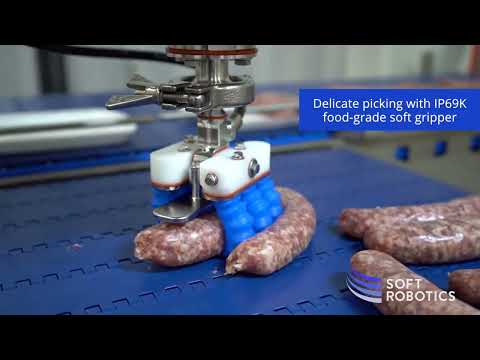
For now, the main application of soft actuators and grips is in industrial processes, especially in the food industry.
Further down the road, progress in AI, machine vision, battery tech, and soft robotics should allow for the creation of robots able to assist nurses, shopkeepers, cleaners, and other tasks that are currently reliant almost 100% on human labor.
In any case, we can easily see how useful it could be to have mycelium-based chemical sensors to detect harmful compounds, spoiled food, or other chemical signals that could be detected while touching things with the FlexPicker gripping system.
2. Boston Dynamics
Developed like a headless yellow dog, Spot, by Boston Dynamics, can climb uphill and navigate stairs. The device came for US$74,500. It served many purposes, from inspecting factories, construction sites, and hazardous environments, it could climb stairs and even navigate them.
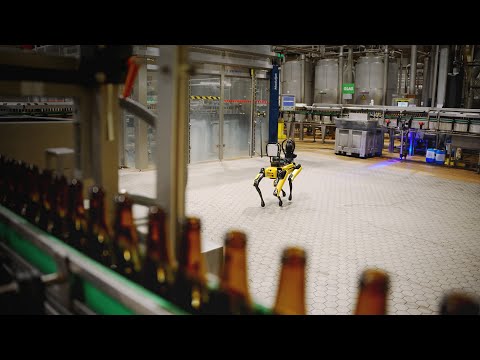
The Spot is now capable of operating 24X7, without interventions. It can charge itself autonomously and plan around new obstacles dynamically. According to official numbers, Spot robots have reached more than 1,000 customers to date.
Spot caters to a range of industries, including manufacturing, energy and natural resources, construction, academia and education, and government.
Chemical and/or light sensors based on mycelium could be a great addition to such an ultra-mobile platform.
After Hyundai closed its deal to take over Boston Dynamics, it owned an 80 percent stake in the company. SoftBank, through one of its affiliates, held control over the rest 20 percent.
Boston Dynamics also gained massive internet fame for the radical progress it made with its humanoid Robot Atlas.

Källa: Boston Dynamics
Hyundai has always been first a technology company mixed with a typical South Korean style of industrial conglomerate structure (chaebols).
This makes it a prime candidate to embrace automation and robotics, especially in the context of South Koreas demografiska kollaps (mindre än 0,78 födsel per kvinna). This population decline will only be manageable by automatizing plenty of tasks currently done by humans, and multitasking polyvalent robots like the ones from Boston Dynamics might hold the key to achieving it.
This also matches Hyundai’s vision of the future and corporate strategy, with forecasts for “automatiseringsgraden kommer att öka med 78 % och produktiviteten per person med 38 %”.



