
Aerospace
Why Swarm Intelligence Matters for Autonomous Spacecraft

 Add Securities.io to your preferred sources on Google

Until recently, the dominant method to manufacture a moving machine, be it an aircraft, a spacecraft, or a submarine, was to design it alongside well-established mechanical systems. More recently, the idea of “bionics” emerged, where artificial designs imitate biological ones, especially for characteristics like morphology and locomotion. This can take the form of imitating dragonflies to create microdrones, human hands for robots, or building underwater vehicles shaped like sea creatures.

This approach helps leverage the billions of years of evolutionary process that have optimized shapes and structures for specific conditions, usually with a strong trend of energy-efficiency and resilience that artificial engineered designs struggle to match.
A new scientific paper is looking to push this idea further, written by researchers at Peking University and the China Academy of Aerospace System and Innovation. The study argues that a new concept called Extensive Bionic Intelligence (EBI) could empower further artificial systems by transplanting evolutionary mechanisms refined over billions of years, especially for aerospace applications.
It was published in the Chinese Journal of Aeronautics1 under the title “Thoughts on extensive bionics intelligence in aerospace field”.
Bionics Vs Extensive Bionics
A reason why complex systems are slowly taking more and more inspiration from biological systems is that, as their complexity increases, their design faces the same problems as biological organisms:
- A complex mesh of different components needs to work together smoothly.
- Changing conditions and environments require quick adaptation.
- “Macroscopic cross-level emergence of sophisticated functions absent in individual components, evolving orderly within dynamic environments.”
Which is why the concept of bionics emerged:
“Bionics is to take a specific organism as an object and imitate its distinctive features, for achieving high consistency between artificial systems and natural organisms in physical attributes, motion characteristics, and application scenarios. The pursuit of the ultimate similarity between the artificial object and the natural organism is at the fundamental idea of bionics. “
This can create very interesting animal-like designs, like, for example, the manta-like design of an underwater drone from Northrop Grumman (NOC ) (follow the link for our report on that company).

However, this approach is also limited as it can solely imitate real-life organisms. It cannot iterate on a design by much, and will ultimately be constrained by the design that made sense for fragile biological structure, and not what could be life-inspired designs, taking into account artificial material advantages.
Which is why the new approach of “extensive-bionic” is now being considered. It does not just imitate the end result (living organisms) but also the processes that have created them, which might or might not yield similar outcomes when applied to artificial systems.
“The extensive-bionic breaks free from the stereotypical “one-to-one correspondence” mindset (for example, designing robotic fish solely by mimicking swimming creatures or drones by copying flying animals). It explores various biological patterns in nature, including morphological patterns, structural patterns, behavioral patterns, reasoning patterns, organizational patterns, and swarm patterns, and then abstracts universal methodologies applied to artificial systems. ”

Source: Chinese Journal of Aeronautics
Applying Extensive Bionics
Overall, Extensive Bionic Intelligence (EBI) is looking to integrate many scientific fields into a new school of engineering and design:
- Biological evolution (the emergence of intelligence in nature),
- The material foundations and information processing mechanisms of neuroscience (the neural foundation of intelligence)
- Cognitive science (the fundamental manifestations of intelligence),
- Psychology (the advanced manifestations of intelligence) integrates multidisciplinary theories to form a theoretical and technological framework for intelligent science.
This is expected to be especially relevant to bio-inspired systems and swarm intelligence, particularly the future development of autonomous and intelligent spacecraft and aerospace systems.
“More complex organisms also provide valuable paradigms. For instance, the distributed neural network and flexible cognition of octopuses demonstrate decentralized intelligence and adaptive problem-solving capabilities, offering new insights into designing highly autonomous unmanned systems.”
EBI can also bring the added value of integrating more than one design at once, making it more able to create a drone or robotic “ecosystem” than the one-to-one imitation of classical bionics.
It will facilitate cross-disciplinary integration of multiple systems and objectives, moving away from the previous simpler bionic approach that has so far yielded only mixed results when it comes to fielding functional tools.
“EBI technology breaks the species isolation phenomenon in biological learning processes, abandoning simplistic and crude transfer approaches of “imitating fish underwater”, “replicating birds in flight”, and “mimicking wolves on land.”

Source: Chinese Journal of Aeronautics
The researchers give a series of examples where that approach could be successful, including for swarm intelligence:
- Bird flocking behavior for multi-UAV coordination(broad imitation scope).
- Fish schooling algorithm to optimize the satellite formations control(species boundary transcendence).
- Unmanned swarm system exploration (cross-disciplinary integration empowerment).
- Mimicking the principles of human neural systems to simulate human-like cognitive agents with thinking and learning capabilities. (focusing on the intelligence concept)
Extensive Bionic Intelligence For Aerospace
EBI For Environmental Perception
Biological organisms utilize polarization vision for navigation, predator avoidance, hunting, and communication. They also created many forms of vision and senses that can be applied to artificial designs:
- The US Air Force Research Laboratory has applied compound eye systems to short-range air-to-air missiles, enabling rapid target locking by seekers.
- The CurvACE curved artificial compound eye system was deployed on drones for short-distance odometry, target tracking, and visual stabilization experiments.
- Wide-field spatial X-ray astronomical detection through lobster-eye X-ray focusing imaging technology by the National Astronomical Observatories of the Chinese Academy of Sciences (NAOC).
- Imitating with an artificial neural network animals’ asynchronous spike sequences to report light changes to the brain, helping in the capture of high-speed dynamics.
EBI For Integrated Computing
Research from Tsinghua University used memristor array-based convolutional networks to achieve two orders of magnitude higher energy efficiency than Graphics Processing Units (GPUs) when processing Convolutional Neural Networks (CNNs).
Similarly, neuromorphic computing like Zhejiang University’s Darwin III neuromorphic chip can support over 2 million neurons and 100 million synapses on a single chip, getting close to the number of neurons in simple animals.
This imitation of an animal’s neurology can go down to the transistor level, with silicon nanowire neuromorphic transistors that mimic neuronal plasticity through ion-doped sol-gel silicate films.
EBI For Individual Decision-Making
In general, autonomous decision-making falls under constraints of computing, storage, and resource limitations more than centralized intelligence that can access supercomputers or cloud computing.
EBI can use genetic algorithms, particle swarm optimization, grey wolf optimizer, and artificial fish swarm algorithms for deciding movements, direction, actions, etc., of robots and drones.
This fits the shift from centrally controlled aerospace assets to autonomous systems that must make useful decisions with limited power, bandwidth, compute, and human oversight.
A bio-inspired dopamine model for autonomous decision-making in robots could even be developed, where dopamine regulates motivation and reward, like in human brains.
EBI For Cooperative Control
So-called “swarm intelligence” relies on the emergence of intelligent and complex group behavior and coordination, despite the limited intelligence of the individual components. Fish schools, bird flocks, and bee swarms display such capacity.
Such bio-inspired cooperative control that lacks fixed central nodes can enable spacecraft swarms to operate without rigid communication topologies, enhancing resilience to unexpected scenarios such as the absence or failure of individuals.
EBI For Adversarial Game Theory
As one application of artificial swarms and bionics is in telecommunication and defense applications, the ability to either attack or resist attacks is an important one.
This makes biological group behaviors like wolf packs cooperatively hunting or fish schools evading encirclement especially interesting. This can also promote the efficiency of the group at the individual cost of components of a swarm, like for example sacrificing one evader to ensure the escape of others, similar to a strong predator hunting the weaker individuals within the prey group.
EBI, AI & Space Techs
Making Space Techs Adaptive
The quick development of artificial intelligence makes extensive bionic intelligence even more important for aerospace applications. The quickly increasing importance of space technologies, thanks to reusable launchers, is also making it crucial to increase the autonomy of spacecraft.
“The four key capabilities of ‘access to space, utilization of space, development of space, and exploration of space’ impose higher demands on new aerospace systems, including space transportation systems, space infrastructure, space manufacturing, deep-space exploration systems, and development systems.”
Ideally, such bio-inspired AI aerospace systems would integrate several abilities:
- An integrated system of perception, memory, reasoning, and decision-making using EBI.
- Swarm intelligence creates complex global behaviors from simple local rules and keeps them stable and predictable.
- Dynamic restructuring of neuronal connectivity to adapt to new scenarios and adapt beyond the confines of initial training datasets.

Source: Chinese Journal of Aeronautics
Accelerating EBI Development
The researchers argue that to speed up the development and adoption of Extensive Bionic Intelligence, a few steps need to be taken.
The first is the creation of a complete bio-intelligence database. It will be essential to process and categorize large volumes of biological observation data, progressively refining bio-intelligence databases. This way, standardizing heterogeneous biological data will ensure its usability for computational modeling and physical prototype designing.
Once this comprehensive biological intelligence database is created, it will be possible to quickly select the most task-aligned imitation targets from it. This will still need to match human goals as well, which might not be simple.
“The main technical difficulty is to establish precise mapping mechanisms that align complex biological advantages with mission-specific engineering tasks, while avoiding oversimplification or loss of functional essence.”
Then, rapid evolutionary mechanisms will need to be established to achieve agile training for novel environments and problems. It will also need to integrate extensive bionic perception and control technologies.
Once all these steps have been taken, the field of EBI should be able to contribute to deep-space autonomous exploration, extraterrestrial multi-robot coordination, and satellite software-defined systems, driving leapfrog improvements in the intelligence of aerospace unmanned systems.
Investing In Unmanned Intelligence
Kratos Defense & Security Solutions
KTOS Price Chart
Started with a focus on defense telecommunications infrastructure and networks, Kratos has performed since 2004 a series of acquisitions of small or medium-sized electronics and defense companies.
This led it to become an important supplier of aerospace telecom solutions.

Source: Kratos Space
Kratos is also expanding quickly in the drone and missiles segments, especially the “cheap and good enough” ammunition category, an important one as production of expensive weapon systems in both attack and defense roles is struggling to keep up with consumption in conflicts like Ukraine and Iran.
As such, Kratos is a provider of subsonic and supersonic missile engines like the GEK-series turbojets and Zeus solid rocket motors.
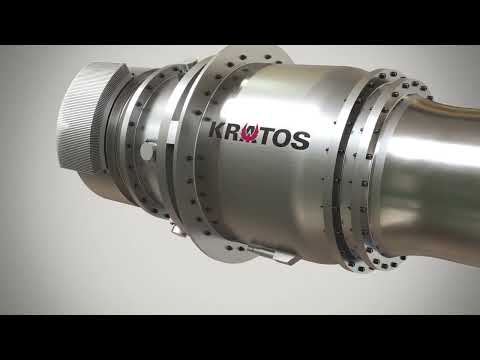
It also produces the XQ-58 Valkyrie Uncrewed Tactical Aircraft (UTA) as well as drone aerial targets to test weapons.
On the ground, it is creating remote-controlled and self-driving trucks and ground logistics systems, high-energy lasers, lightweight, electromagnetic interference–shielded mobile platforms C5ISR systems (Command, Control, Communications, Computers, Cyber, Intelligence, Surveillance, and Reconnaissance), and the Sentinel Weapon System, a land-based intercontinental ballistic missile (ICBM) system under development

Companies like Kratos are small enough to stay agile, but large enough to have the ability to deploy new concepts like Extensive Bionic Intelligence to its autonomous drones and other weapons. As such, it will likely be able to capitalize on parallel advances in edge AI, sensor fusion, decentralized coordination, and multi-agent mission planning.
(You can also read our full investment report on Kratos for more information)
Latest Kratos Defense & Security Solutions (KTOS) Stock News and Developments
Study Referenced
1. Junzhi Yu, et al. Thoughts on extensive bionics intelligence in aerospace field. Chinese Journal of Aeronautics. 13 March 2026, 104161. https://doi.org/10.1016/j.cja.2026.104161



