
Aerospace
Kratos Defense (KOTS): Updating The US Military For The Drone Era

 Add Securities.io to your preferred sources on Google
Securities.io may receive compensation when you use links to products we review. This does not influence our editorial evaluations. We are not a registered investment adviser; this is not investment advice. Read our affiliate disclosure.

For decades, the landscape of military equipment stayed relatively unchanged. New weapon systems would be developed, but most would be articulated around the same concept of combined warfare, dominated by tanks, jet aircraft, and the associated aircraft carriers.
However, the war in Ukraine and now Iran have shown that new technologies are quickly changing what weapon systems are cost-efficient enough to sustain a prolonged conflict. Most of the bombing is now done not by aircraft or even by artillery, but by more nimble, cheaper drones, loitering munitions, and low-cost missile systems.
Similarly, expensive platforms like aircraft carriers now have to stay hundreds of miles away from the enemy coast to stay safe from cheap missiles.
Behind this change is the radical decrease in cost and abundance of precision electronics and space technology, making the modern battlefield more connected, more transparent, and more lethal than ever.
This is why investors in the defense sector should consider not just the largest companies, like Lockheed Martin (LMT ), L3 Harris (LHX ), or Northrop Grumman (NOC ).
They should also consider smaller and more innovative companies like drone maker Red Cat (RCAT ), electronic producer Teledyne (TDY ).
Another such company is Kratos Defense & Security Solutions (KTOS ), a defense contractor specializing in most of the military equipment at the very edge of technological innovations: unmanned systems, satellite communications, cyber security, microwave electronics, missile defense, and hypersonic systems.
KTOS Price Chart
Kratos Defense Overview
Kratos’ History
Kratos origins start with “Wireless Facilities Incorporated”, a company building and supporting the telecommunications infrastructure and networks, founded in 1994. By the end of its first decade of existence, the company was developing a strong focus on military and government contracts, moving away from the commercial wireless market with tightening margins.
It was renamed to Kratos Defense & Security Solutions in 2007.
In the years between 2004 and 2011, the company started a series of acquisitions of small or medium-sized electronics and defense companies, expanding its presence in military & government telecom and information systems.
In 2011, Kratos merged with Integral Systems, a manufacturer of satellite ground systems, now forming Kratos Space (see below).

Source: Kratos Space
The company then acquired a series of turbine and rocket engine companies producing cheaper models than the ones usually mounted on missiles like the Tomahawks, for example. This includes Florida Turbine Technologies, Technical Directions Inc, and Prometheus Propulsion & Explosive Systems.
“The projected market for advanced turbojet and turbofan engines in our class alone is easily in the many thousands over the next five years given the projected number of extended-range and low-cost cruise missile systems and next generation unmanned weapons systems to be acquired.”
Kratos By The Numbers
Kratos is a 2,800+ employee company, operating 20 distinct manufacturing and operational facilities, with a total 550,000 square feet footprint.
Most of the company operations are US-based, notably in Oklahoma, Michigan, California, Pennsylvania, and Indiana. It is also present through subsidiary and local offices in Europe (especially France, the UK, Germany, and Norway), Israel, Canada, Japan, India, Indonesia, and Australia.
Kratos generated $1.34B in revenues in 2025, for an operating income of $25.6M, and net income of $22M.
The comparatively small net income is directly linked to the company’s rapid expansion in manufacturing capacity, coming with large expenditure in fixed capital and building inventory ahead of any government contract, financed by the company itself.
A Different Business Model
Maintaining enough ammunition stockpile has been an ongoing issue for the US and NATO military since the beginning of the war in Ukraine, a situation that is only getting more tense.
Similarly, many major weapons programs have been suffering considerable delays, overcosts, technical issues, or outright cancellation, like the F-35 fighter planes or the Zumwalt-class destroyers.
“We as a country are out of time; we must field what we have available now, in large quantities, to address the immediate and growing threat. The time for PowerPoints and dreams of a maybe, someday, perfect future system is over. Kratos has the right products, able to be produced affordably in mass, now.”
In comparison to massive and expensive designs, Kratos is focusing on two categories of weapon systems:
- Advanced unique capability filling a specific niche and military need, for example, hypersonic missiles or highly connected environments.
- Cheap and “good enough” ammunition, especially drones and missiles.
This focus on delivering the goods required by the US military and its allies is also reflected in the company’s management of its capital. While most large defense companies are focused on the short-term returns to their shareholders, Kratos is concentrating on being ready to respond to increased demand.
“Since our Company’s inception, we have not had an established plan to buy back Kratos stock or pay dividends; we have instead consistently reinvested our capital in property, plant, equipment, and investments in non-recurring engineering and other initiatives, with the objective of being first-to-market with relevant, low-cost systems for the warfighter, which approach is now recognized as the “must have” business model to be successful in today’s environment.”
Kratos Segments & Products
The company is divided into 6 major segments, each fulfilling a specific niche for the US military:
- Hypersonics
- Propulsion & power (turbojets and rocket motors).
- Unmanned systems (drones).
- Weapon systems (fully assembled weapons).
- Space (satellite telecoms)
- Microwave & Digital Solutions (telecom, electronic warfare).
Hypersonics
By far the most advanced technology at Kratos, hypersonic missiles are missiles traveling at speeds higher than Mach 5, or 5x the speed of sound. Kratos leads hypersonic flight testing up to Mach 20, offering unparalleled test environments for this new category of weapon.
More importantly, this is a domain where the USA is lagging behind both Russia and China.
This segment includes two prototypes, the Erinyes Hypersonic Flyer and the Dark Fury Hypersonic Flyer. Erinyes is designed for long-range missions, while the Dark Fury is focused on extreme velocity and accuracy, optimizing rapid strike capabilities.
To grow its capacity in this field, Kratos opened in January 2026 a 55,000 square feet hypersonic system manufacturing facility in Maryland, as well as a new hypersonic test facility in Odon, Indiana. The Indiana test site will fill a gap in the capacity of aerothermal testing for materials used on hypersonic systems.
“The new facility enables us to increase production capacity, streamline payload integration processes, and respond even more rapidly to the growing demand for affordable hypersonic flight testing. The Princess Anne facility will play a crucial role in supporting our $1.4 billion MACH-TB 2.0 contract and other critical programs, enabling increased test cadence and more affordable flight test opportunities for hypersonic technologies.”
Dave Carter – President of Kratos Defense & Rocket Support Services Division.
The company also produces a wide array of ballistic test vehicles, using surplus military and commercial rockets for “diverse trajectory needs in scientific tests, ensuring seamless integration of experiments, reducing costs and accelerating development.”

Source: Kratos Defense
Propulsion & Power
In addition to hypersonic, Kratos is a provider of subsonic and supersonic missile engines. This includes the GEK-series turbojets and Zeus solid rocket motors.
These missile engines were developed according to Kratos’ vertically integrated development model and internal funding to rapidly prototype, test, and scale propulsion solutions.
The turbojet & turbofan engines were developed in partnership with GE Aerospace (GE ). This alliance covers the Spartan engines, focused on low-cost, high-volume production to support the affordable mass strategy, and the GEK engine family, focused on highly adaptable turbofan engines for cruise missiles, collaborative combat-type aircraft, and other unmanned aerial vehicles.
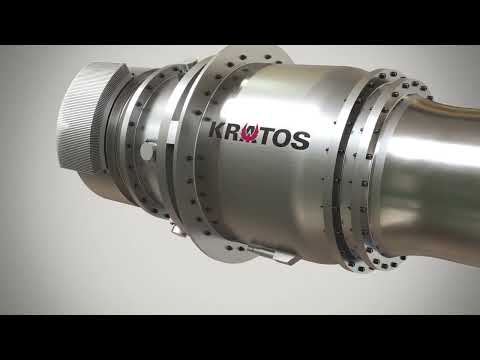
Recently, the GEK1500 engine has been awarded a design project for future collaborative combat aircraft (CCAs), a concept of drones becoming an integral part of the US Air Force, where the fighter jets like the F-35 become more of a command “mothership” for a flight of drones.
“Lessons learned from recent GEK800 altitude testing are directly informing GEK1500 —improving thrust, power generation, and lifecycle cost — so we can meet CCA requirements without compromising affordability or schedule.”
Steve “Doogie” Russell – Vice President and General Manager of Edison Works at GE Aerospace.
This segment of the company is important not just as a profit center, but also as a supplier and expertise center for the other departments, like weapon systems and drones.
Unmanned Systems
With its experience in missiles, jet engines, and telecommunications, the move into drone manufacturing is a natural one for Kratos.
The core of the future offering of Kratos in this field will be Uncrewed Tactical Aircraft (UTA).
First flying in 2019, the XQ-58 Valkyrie is a dynamic multi-mission collaborative combat-type aircraft, Autonomous Collaborative Platform (ACP), and Tactical UAS.
It is capable of reaching up to 3,000 nautical miles of range, while retaining speed capability of .85 Mach, an altitude up to 45,000 feet (approximately 13,716 meters), and maneuvering at over 6G.
It will be able to use both long and short runways as it can come in two versions: either Rocket Assisted Takeoff (RATO) or Conventional Takeoff and Landing (CTOL). Basic models can even be launched via a rocket-assisted trailer without a runway (relying on parachute landing).

The Valkyrie could also be deployed in NATO armies, as illustrated by Airbus preparing two Valkyries for first flight with European mission systems, combining them with the European Multiplatform Autonomous Reconfigurable and Secure (MARS) system.
“By combining the Kratos Valkyrie with our MARS mission system, we are offering the German customer exactly what Germany and Europe urgently need in the current geopolitical situation: a proven flying uncrewed combat aircraft with a sovereign European mission system that does not have to be developed from scratch in a time-consuming and costly manner.”
Marco Gumbrecht, Head of Key Account Germany at Airbus Defence and Space.
Meanwhile, Kratos also provides drone aerial targets to test weapons and train soldiers against real target simulating potential enemy aircraft and missiles.
Kratos “prebuilds” batches of these drones without waiting for government contracts to accelerate delivery timelines and lower costs. This is a strong departure from the traditional contract-only or cost-plus contract, which are safer from a financial point of view, but are also accused of inflating prices and delaying weapon deliveries significantly.
Kratos is also developing remote-controlled and self-driving trucks and ground logistics systems. While this has obvious military applications, this could as well be a good fit for a civilian branch, as the system is developed with a retrocompatiblility with the existing trucking fleets in mind (vehicle-agnostic retrofit kits).
“Multi-mode control supports teleoperation, path-following, and waypoint navigation, including multi-vehicle formations in GPS-denied environments. Retrofit kits also convert standard platforms into uncrewed, threat-representative targets, providing dynamic behaviors that further prepare warfighters for real-world engagements.”
Weapon Systems
This segment provides the military with fully ready-to-use weapons, comprising three main components for Kratos: strategic weapons, radars, and strategic missiles.
Here, the company collaborates with other defense giants to provide the final product, bringing its own unique expertise to the final system.
For example, Kratos is a strategic supplier to Northrop Grumman for the Sentinel Weapon System, a land-based intercontinental ballistic missile (ICBM) system under development, with deployment expected in the early 2030s.
This also includes integrating C5ISR systems (Command, Control, Communications, Computers, Cyber, Intelligence, Surveillance, and Reconnaissance) into lightweight, electromagnetic interference–shielded mobile platforms.
Or the production of high-energy lasers, like the 25+ kW HELEX laser beam. Such a system could become essential in future anti-drone technology, as it can strike threats while promising virtually limitless “ammo”, as long as it is connected to a powerful enough energy source.
For radar, Kratos provides specialty enclosure systems that protect radar electronics and operations control equipment from electromagnetic interference (EMI). It also manufactures pedestal and mobility platform assemblies for ground-based radar systems (electrical wiring, drive motors, leveling jacks, azimuth bearings, and other mechanical systems).
Space
A long-term expert in ground-based infrastructure for satellite telecommunications, Kratos remains an important player in this sector, even if companies like SpaceX (SPCX ) may increasingly become serious competitors.
As a demonstration of Kratos’ persistent relevance, it recently won in April 2026 a $446.8M space systems command contract with the U.S. Space Force for a resilient missile warning and missile tracking Ground Management & Integration (GMI).
This is part of the medium Earth orbit Resilient Missile Warning and Tracking (MWT) program.
“Kratos will serve as the system integrator, leading a team including Northrop Grumman, Auria, ASRC Federal Systems Solutions and Rise8, to establish fully operational primary and backup mission operations capabilities.”
Besides managing the US fleet of military telecommunications, the space department includes KnownSpace RF intelligence services, which monitor space telecommunications, radio frequency monitoring and management, Earth observations, and cybersecurity.

Source: Kratos Space
Microwave & Digital Solutions
This segment produces various electronics components: attenuators, switches, phase shifters, in-phase and quadrature (IQ) vector modulators, solid state power amplifiers (SSPAs), low noise amplifiers (LNAs), frequency sources, and frequency converters.
These systems are used in electronic warfare, radars, drones, smart munitions, etc.
So this is both a department able to provide key components to other defense companies (for example, Raytheon (RTX ) missile programs) and a key provider of important electronic components to all the other segments of Kratos.
Here too, the company’s focus is on high-volume, low-cost manufacturing, with rapid scalability and off-the-shelf components preferred to the bespoke, high-cost systems generally favored by its competitors, a method the company calls “Design-for-Manufacturability”.
Kratos’ Future
Since at least 2019, Kratos’ management has correctly recognized that the key missing capacity in the US defense industry is not technology, but the ability to mass-produce a cheaper design than the high-cost, high-performance, high-margin model favored by the largest defense contractors.
This assessment was especially prescient in the field of drones and missile ammunition. By acquiring early, smaller companies that had developed cheap rocket engines and combining them with its vertically integrated avionics, electronics, and remote control system, this strategic position is turning Kratos into a vital tool for the US military.
The company will likely prove essential for the USA to adapt quickly to the emergence of drones and cheap missiles as a major strategic problem, as illustrated by the ongoing depletion of traditional ammunition in just a few weeks of war with Iran.
Kratos will also likely become even more than today a key partners for companies like Raytheon, GE Aerospace, and Northrop Grumman to innovate in these fields and keep up with a very quickly evolving military landscape.
Lastly, the progress made in hypersonic should help close an important gap in capacity where the USA is actually lagging, and has been struggling to catch up for several years by now.
Latest Kratos Defense & Security Solutions (KTOS) Developments



