
Aerospace
AeroVironment (AVAV): The Western Drone And Loitering Munitions Company

 Add Securities.io to your preferred sources on Google

Since we initially wrote our article “Top 10 Aerospace and Defense Stocks“ in 2023, international geopolitics have kept taking a turn for the worse.
The war in Ukraine is still ongoing and, if anything, escalating, and the Middle East is ablaze with the USA and its allies fighting Iran and its own allies over the region’s energy resources, which are increasingly either stuck with closed sea lanes or set on fire with missile strikes.
“This may be the most dangerous time the world has seen in decades.”
Overall, markets have so far ignored these mounting risks, preferring to focus on the AI boom. Some of the leading defense ETFs have barely gone up since 2019, pre-Ukraine war.
So while markets’ attention has still been focused somewhere else, this is starting to be reflected in the recent surge in price in major defense ETFs.
ITA Price Chart
Unmanned Warfare
The armed conflicts in Israel-Palestine, the Caucasus Mountains, the Red Sea, and Ukraine have demonstrated very quickly changing methods of warfare. Drones, both flying and on tracks, are increasingly taking over the role previously given to traditional weapons like artillery, tanks, warplanes, etc.
The most important element is how cheap they can be for the damage they can inflict. A drone costing thousands of dollars can disable a multi-million dollar tank, with the drone operator safely dozens of miles away. This cost asymmetry favored the drone-heavy forces and strategies.
For example, the 2024 attacks by Iranian drones on Israel are estimated to have cost Iran around $50M-$100M. And consumed $1B to $1.5B worth of air defense systems. This pattern has continued for two years now, with no end in sight.
Drones are also making the battlefields more “transparent” than ever before, with instant live-feed videos of friends and foes instantly accessible by all levels of the command structure. In that context, camouflage, surprise attacks, or infiltration behind enemy lines become increasingly risky and borderline impossible.
Initially mostly relying on slightly civilian models, the ongoing wars are increasingly using more sophisticated and more capable drones and loitering ammunition (flying ammunition able to stay flying over an area for up to several hours before finding a target).
This might progressively shift the military budget from large, expensive centerpieces like fighter jets, tanks, and aircraft carriers toward more decentralized, small weapons. Therefore, innovative drone makers, or defense companies able to counter drones cost-effectively, might become the new defense giants of tomorrow.
In this context, companies with a solid head start in providing the military with low-cost drones will likely prove a good investment. One of them is AeroVironment (AVAV ), one of the rare independent drone companies whose weapons are all already fielded by the US military.
AVAV Price Chart
AeroVironment Overview
AeroVironment’s History
AeroVironment was founded in the 1970s to solve engineering problems regarding aerodynamics, notably winning in 1979 the largest prize in aviation history with its human-powered Gossamer Albatross that successfully crossed the English Channel. The company later created the Solar Challenger, which flew 163 miles across Europe entirely on solar energy.
In the 1990s, the company moved toward partnership with NASA, notably working on several prototypes and space probes for long-endurance high-altitude flight.
In the 2000s, this experience with government contracts led to the development of small uncrewed aircraft systems (sUAS) like the Raven, Puma, and Wasp for the US military.
In 2007, the company started to trade on the public market on the NASDAQ under its current ticker symbol.
In 2011, AeroVironment pioneered a new weapon class with the Switchblade loitering munition system, a tube-launched, precision-strike “kamikaze drone”. The latest version of this drone can hit larger, hardened targets at standoff distances of 40 km. Switchblade is still today a cornerstone of the US Army’s attack drones.

Source: AeroVironment
In 2021, the company provided the rotor design and minor systems engineering for NASA’s Ingenuity Mars Helicopter, a design previously thought to be impossible in the rarefied atmosphere of the red planet.
During the 2010s and 2020s, AeroVironment expanded its technological capacity and drone catalog through a series of mergers and acquisitions, notably Arcturus UAV (medium drones), Telerob (ground robotics), and Tomahawk Robotics (common control systems).
But it was in 2025 that the company moved to become a large defense contractor, with the $4.1 billion merger with BlueHalo in an all-stock transaction. BlueHalo brought to the company complementary defense-related activities, like space communications, directed energy weapons, maritime drones, and AI tools. (see more info below).
AeroVironment By The Numbers
The now larger company employs 4,000+ employees working in 18 global manufacturing locations. In total, more than 60,000 weapons units (up from 35,000 units in 2024) have been fielded by the company in its history, with 4,000,000 flight hours.
While Switchblade is the most recognizable drone of the company, it offers in total 15 to 20 distinct drone models, organized in four product families:
- Small Unmanned Aircraft Systems (SUAS).
- Medium UAS.
- Loitering Munitions (one-way attack drones).
- Specialized space/sub-surface models.

Source: AeroVironment
The company’s $2B in revenues is split between AxS (Autonomous Systems) and SCDE (Space, Cyber, & Directed Energy), with roughly a 2/3rd-1/3rd split in revenue in favor of autonomous systems. The AxS segment grew at a 22% CAGR in the past 5 years before 2026, and the SCDE segment grew at a 12% CAGR in the same period.

Source: AeroVironment
Most of the sales come from US domestic sales, mostly to the US military, with international sales linked to US close allies. Product sales make up almost 3/4th of total revenues, with the rest being services like maintenance and software.

Source: AeroVironment
The growth in sales has followed the quick adoption of drones by the US military, which is still following the process already further advanced in the military of adversaries like Russia and Iran. This has grown the total addressable market (TAM) from $12B in 2024 to $72B in 2026, or a 6x increase.
AeroVironment is spending a lot on “IRAD” (Internal Research and Development), up to 7-9% of revenues, or a much higher level than most defense -tech peers, giving it a marked development advantage for new weapon platforms.
AeroVironment Highlights
AeroVironment’s Drones
With many drone models, it can be hard to grasp which are the most important ones for the company and the US military.
To begin, none is more iconic for AeroVironment than the Switchblade, in many ways the precursor to today’s proliferating one-way attack drones increasingly complementing or even replacing artillery and aviation strike in many armies around the globe, including among the U.S. ‘ enemies.
This is also AeroVironment’s fastest-growing cash cow, driven by a massive $990M U.S. Army contract and the Switchblade selection for the Low-Altitude Stalking and Strike Ordnance (LASSO) Program.
“The Army’s trust in the Switchblade family has been earned through years of real-world use by soldiers who rely on these systems every day. That trust reflects a clear operational need for precision, speed, and adaptability at the tactical edge—capabilities the Switchblade family is designed to deliver as missions and threats continue to change.”
Jimmy Jenkins, Executive Vice President of Precision Strike and Defense Systems at AV.
Another important model is the RQ-11B Raven. With 20,000units delivered globally, it remains the primary, ubiquitous eye-in-the-sky for U.S. and allied infantry battalions. It weighs 1.9 kg (4.2 lb), has a flight endurance of 60–90 minutes, and an effective operational radius of approximately 10 km (6.2 miles).
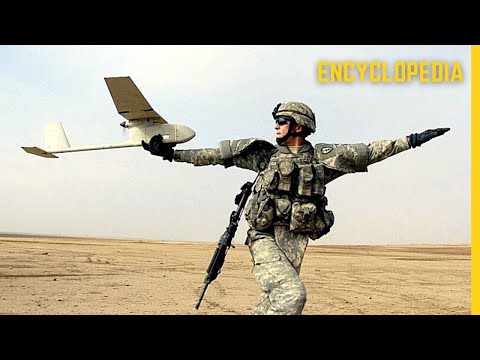
Another important model for the company is the Puma 3 AE, another small UAS that is often bundled into weapon package sales to foreign allies, for example, $874M in 2025 for AeroVironment providing various drones to international militaries. It is larger than the Raven, weighing 15.4 lb and offering 3 hours of flight endurance, with control reaching up to ~60 km (~37 mi). It also exists in a “LE” version with double the endurance and more payload capacity for more sensors.
In terms of technical achievements, a few other drones should be mentioned:
- The Sunglider(High-Altitude Pseudo-Satellite), a solar-powered solar glider able to stay airborne for months at a time in the stratosphere (65,000 feet).
- The JUMP 20and Jump 20-X, a reconnaissance drone able to stay up over 14 hours of flight endurance, with a range of up to 185 km, and with a heavy-duty payload capacity that allows it to carry advanced, multi-sensor imaging turrets without requiring a runway.
- The P550, a long-range e-VTOL (electric vertical take-off and landing) with a 15-pound payload capacity and “hot-swappable” bays, allowing soldiers to rapidly switch out heavy cameras, electronic warfare gear, or lasers in the field

Source: AeroVironment
AeroVironment + BlueHao
While still primarily a drone-focused company, the 2025 merger with BlueHalo brought to AeroVironment a much larger breadth of technology. Most notably, it also expanded the company out of “Air” and into all the other major “warfighting domains” determined by the US military: land, sea, space, and cyber.
On land, AeroVironment notably can produce the LOCUST X3, a third-generation 20–35+ kW Directed Energy Laser Weapon System. This is a type of solution considered a solid option to handle the increasingly dangerous and numerous swarm of drones threatening the lives of soldiers, as they only consume energy instead of expensive missiles or ammunition, and can run as long as the energy supply is steady, making it perfect for defending military bases against drones.
“The unmanned aircraft threat is not terrifying because every drone is sophisticated. It is terrifying because so many are not. Commercially available drones are cheap, accessible, adaptable, and increasingly lethal in the hands of hostile actors. They do not require deep pockets, years of training, or a traditional defense industrial base to acquire and employ.”
Aaron Westman, Senior Director of Business Development at AV.
For the land domain, the company can also provide soldiers with “Gallium”, a ruggedized handheld radio, the TEL640 Multi-Domain, a heavy-duty, truck-based command center, and the TOM 50 RE land robot weighing only 10kg so it can be carried by a soldier before being used for reconnaissance missions.
At sea, AeroVironment is deploying Unmanned Underwater Vehicles (UUVs)/Remotely Operated Vehicles (ROVs) and submarine-launched aerial reconnaissance drones. This includes the Wraith launched in January 2026, a heavy-duty underwater drone able to plunge as deep as 3280 feet and generate 80 lbs of forward thrust, as well as the Defender for even deeper missions, the Ally for inspection of ships tasks, and the Pro 5, the company’s smallest, lightest footprint underwater drone, optimized purely for maximum speed and rapid deployment.
In space, AeroVironment inherits BlueHalo expertise in laser technology. This covers long-haul laser communications for high-bandwidth, secure optical terminals for multi-orbit, high-speed data transfer between satellites, notably landing a $240M contract in 2025. It can also provide Command & Data Handling (C&DH) to control space assets, and phased-array antenna infrastructure for ground-based antennas.
In cyber and software capacities, AeroVironment is looking for software and AI capabilities complementary to its existing expertise in drone warfare. This includes the Titan MS C-UAS, an AI-powered, multi-sensor solution for the detection and destruction of drone threats, and the HALO Shield, a system aiming to manage complex mixed threats from combined drone swarms, advanced UAS, and subsonic cruise missiles, an environment the recent bombing of US bases by Iran makes extra realistic.
Other software tools are of a more offensive nature or focused on data, like AV_Halo INSTINCT, a swarm control software, GeoPoint for rapid, automated image/ video geolocation and reporting, and SPOTR-Edge for the detection, classification, localization, and tracking of objects including people, vehicles, and maritime vessels, either by day or night.
AeroVironment’s Future
Moving Early To Be Ready On Time
AeroVironment’s move into drone technology as early as the beginning of the 2010s illustrates the company’s forward-thinking approach to technology and weapon systems.
In the same way, the company’s R&D efforts for 2027 are planned for many technologies that are only now becoming strategically central to the US military, like direct energy, electronic warfare (EW), land drones (UGV), etc.

Source: AeroVironment
Overall, AeroVironment has demonstrated a strong ability to reduce time to market and provide superior products compared to larger, but also slower and more bureaucratic competitors preferring “gold-plated” expensive larger weapon platforms (for example, the F-35 fighter jets), defying the structural trend for swarms of small, cheap systems instead.
Manufacturing At Scale
Producing enough volume of cheap ammunition has been a critical issue for the US military and overall Western countries since the beginning of the war in Ukraine, which has consumed unexpected masses of artillery shells, interceptor missiles, and vehicles. Similarly, Iranian drones and missiles have been hitting many targets in the Middle East, and US inventories of stand-off weapons like cruise missiles are running low by all accounts.
Another issue is the risk of critical components or resources being made in China, which the Pentagon considers an unacceptable supply chain risk.
To meet growing demand and new contracts, AeroVironment has been investing $65M in capex in new factories or expanding existing facilities across the USA and in Germany, with ~$130M more of similar capex planned for 2027.

Source: AeroVironment
The company is also open to radical new ideas on how to solve manufacturing and production bottlenecks. For example, it launched in July 2026 a 46,000‑square‑foot bio-manufacturing facility in Xenia, Ohio. The idea is to explore how biology-based solutions could help some military-relevant problems. For example, a bacterial system capable of bio‑cementation of loose aggregate for advanced construction, or a protein that selectively binds to individual rare earth elements to reduce dependency on China for rare earth refining.
“China currently accounts for an estimated 70% of global production of rare earth elements such as neodymium, dysprosium, and ytterbium. These are the very materials AV is working to produce at scale, helping reduce America’s dependence on foreign sources and strengthen the resilience of domestic supply chains. ”
Integrated Drone Platform
Ultimately, drones will no longer be seen as this big novelty or hard-to-deal-with threat, but as an integral part of the military, in the same way the tank, the airplane, and the satellite did before.
The first step will be integrating all types and dimensions of drones into a unified system. Not only will this make controlling drones simpler, but it will also make them even more efficient and useful, especially as AI and autonomous decision-making make progress.
For example, a high-altitude reconnaissance drone can detect a target, a ground vehicle can carry an attack drone closer to the front line and save it range or charge its battery, and then the strike can be done, with signal relayed by yet another drone flying in the back.

Source: AeroVironment
Counter-drone effort will also need such a platform to avoid friendly fire and coordinate the effort of anti-drone drones, itself likely one of the solutions to fight cheap drones: use even cheaper or more reusable drones.
The anti-drone segment, or “counter UAS,” is expected to grow 20% CAGR up to 2030. The associated space-based telecom systems are also a quickly growing market, expected to grow 12% CAGR to 2030.

Source: AeroVironment
Many new Pentagon programs are coming in the next few years to procure these technologies for the military in either new capacities or in larger numbers. In total, these programs represent a $37B opportunity in the next 4 years, without counting regular spending and potential exceptional accelerated procurements.

Source: AeroVironment
Conclusion
Overall, the investment case for AeroVironment is that it is the right company in the right place.
The strong positioning in drones of all kinds, as well as key counter-drone technologies, is ideal as geopolitical tensions explode and the aircraft-centric way of warfare that has dominated the past decades make way for a much bigger role for unmanned systems and smaller, cheaper, more sensor- and AI-focused weapon platforms.
This could greatly benefit the company as the Pentagon integrates the lessons of the ongoing conflict in Ukraine and with Iran into doctrine.
This is not to say that any drone procurement will necessarily benefit AeroVironment. A growing trend of new startups like Anduril is to bring Silicon Valley’s speed and cost-cutting to the slow environment of the defense industry, which is a serious threat.
A threat that the company is, however, likely in a better position to tackle than many older and more established giant defense conglomerates.
(You can also read more on other drone companies in our article “Top 10 Drones And Drone Warfare Stocks”)
Latest AeroVironment (AVAV) Stock News and Developments



