

Investing in Stocks
Top Robotic Stocks Positioned for Growth in 2026

Securities.io maintains rigorous editorial standards and may receive compensation from reviewed links. We are not a registered investment adviser and this is not investment advice. Please view our affiliate disclosure.

How Manufacturing Shifted From Human Labor to Robotics
For most of history, manufacturing was done by human hands, transforming raw materials into useful items. With industrialization, this started to change, as machines started to be used for the mass production of standardized goods instead.
Progressively, increasingly complex manufacturing methods developed, up to industrial robots able to perform several different tasks without human intervention, for example, forming the bulk of assembly work for car manufacturing.
TL;DR
- Robotics is entering a major growth phase driven by AI, sensors, AMRs, and autonomous systems.
- Intuitive Surgical leads robotic surgery with proven clinical advantages.
- Teradyne controls leading AMR and cobot brands poised for factory automation growth.
- Oceaneering dominates subsea robotics and is expanding into aerospace, nuclear, and defense.
But these early robotic solutions had several key limitations: they were big, heavy, fixed in one spot, inflexible, and expensive.
A new generation of robots is the exact opposite:
- Thanks to much more precise and smaller actuators and electric motors, they are able to perform very precise tasks.
- Using machine vision, they can interact autonomously with their environment.
- Powered by ever-advancing AI, they can understand changing conditions and variable situations and still perform their tasks well and safely.
- With battery density growing quickly and hydrogen, they can move and work for hours between recharges.
Altogether, these improvements radically change what robots can do. They are now being used to perform surgery, run warehouses, and might soon become home and medical assistants, humanoid factory workers, and so many other tasks.
This will massively grow the robotic market, from its current $33.9B in 2024 to $60.5B in 2030, and represents a massive opportunity for investors, as these robots will be able to capture a massive market currently employing expensive human labor.
So the stock of the leading companies in robotic development today is likely to become a successful investment as well.
Swipe to scroll →
| Company (Ticker) | Robotic Segment | Tech Edge | Key Risk |
|---|---|---|---|
| Intuitive Surgical (NASDAQ: ISRG) | Medical (Surgery) | Da Vinci robots | Slow regulatory approval |
| Teradyne (NASDAQ: TER) | Logistics & Manufacturing | Autonomous mobile robots | Chinese competition |
| Oceaneering (NYSE: OII) | Offshore / Undersea | Offshore sector expertise | Niche solution – potential lack of scale |
Top 3 Robotic Stocks Set to Boom in 2026
1. Intuitive Surgical (ISRG): Leader in Robotic Surgery
Intuitive Surgical, Inc. (ISRG +0.84%)
At first, it might seem counterintuitive that surgery has been one of the first fields beyond manufacturing to be taken over by robotics. After all, few things are as complex and fragile as a human body.
But for this very reason, robotic arms provide a unique advantage compared to human actions:
- A robot stays as precise and steady after 8 hours as it does during the first minute.
- A robotic arm can perform complex movements that a human arm cannot.
- Possibility to zoom in and out at will, with a high-definition camera showing all the required information.
- Multiple cameras can help monitor other organs or give multiple points of view during the surgery.
- A robot surgeon can hold many tools at the same time, including very tiny surgical instruments, and switch between them effortlessly.
- Smaller incisions reduce the recovery time and the risks of possible post-surgery complications (infection, scar tissue, etc.).
It is to capitalize on these unique advantages of Robotic Assisted Surgeries (RAS) that Intuitive Surgical, a pioneer in the field, developed the Da Vinci robot in the late 1990s.
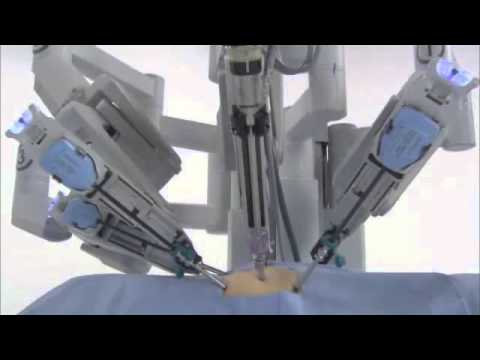
By 2006, the company had 500 da Vinci Systems installed in hospitals worldwide. In 2024, the company grew to 10,670+ systems installed in hospitals all over the world, of which 1,790+ were sold in 2024 only.
A key to the adoption is the proven superior outcome for the patients, with less risk, fewer complications, and overall better results.

Source: Intuitive Surgical
The company has quickly expanded its authorized applications around the world, but more clinical studies and demonstrations are needed to make them the go-to option for all surgeries.

Source: Intuitive Surgical
Da Vinci and the company’s other surgical robots for niche roles (lung biopsy, orthopedic, etc.) still require a human operator.
While in the very long run, AI using the millions of recorded surgeries performed by Da Vinci robots might replace surgeons, the conservatism of the medical industry, regulations, and patients’ worries of the absence of human decision-making will likely keep the current method ongoing for a decade.
2. Teradyne (TER): Logistics & Manufacturing Robotics
Teradyne, Inc. (TER -3.67%)
Teradyne is a company that was initially founded on its technology of semiconductor testing (antennas, chips, memory, robots, etc.).
This activity is important for many economic sectors, from defense to tech, automotive, telecom, etc. It is boosted by the joint trends of verticalization (tech giant developing their own hardware), electrification, and AI.
Since then, the company has added a strong robotic segment to its activities with the acquisition of MiR in 2018 and AutoGuide in 2019. This activity is split between autonomous mobile robots and collaborative robots, with 16% of total sales and growing quickly.

Source: Teradyne
Autonomous mobile robots are designed to move payloads from 250 kg (551 lbs) up to 1,350 kg (2,976 lbs), depending on the model.

Source: Teradyne
Collaborative robots (Cobots) are cost-effective, simple-to-deploy robots designed to automate repetitive and dangerous work, for example, machine tending, packaging and palletizing, assembly, gluing, soldering, polishing, screw and nut driving, etc.
The lower cost and ease of deployment lead to an average payback time on the investment of 12-18 months.

Source: Teradyne
Between semiconductor testing and robotic platforms, both sides of the company activities are going to benefit from the rapid expansion of robots into the real world and into more tasks.
3. Oceaneering (OII): Offshore & Subsea Robotics
Oceaneering International, Inc. (OII -2.17%)
One application of robots is to deploy them where it is generally unsafe for humans to do so. With the increased capacity and autonomy of the new generation of robots, this will likely become even more true.
Offshore and underwater work environments are notoriously dangerous, with, for example, oil rigs famous for being some of the world’s most dangerous work sites.
Oceaneering is an expert in remotely operated vehicles, undersea robots, and subsea hardware, employing 12,000 people and working in 50 countries.

Source: Oceaneering
It is the world’s leader in subsea robotic services, with more than 400,000 km surveyed (250,000 miles) over 420,000 dive hours.

Source: Oceaneering
The company is mostly servicing the energy industry (oil and offshore wind) and the defense & aerospace sector. Robotic and offshore projects make more than half of total revenues, with more than half of revenues coming from outside the USA.

Source: Oceaneering
Built from the profitable niche of ocean-going robots and components, the company is rapidly expanding in other areas where its technology could be useful, like aerospace, nuclear energy, logistics, and transportation.
So Oceaneering offers its services and technology for other fields, like:
- Offshore wind technologies
- Components for nuclear power plants(including SMRs) and carbon capture
- Submarine rescue solutions
- And even space suits for astronauts, aerospace hardware.
Lastly, the company is also expanding into other fields related to robotics, like autonomous bus/shuttle (driverless automated guided vehicle -AGV) and material handling and logistics robots.
Thanks to its long experience in working in hazardous offshore conditions, Oceaneering is in a good position to deploy autonomous robots in both more mundane conditions and in equally demanding fields like nuclear energy or space.
Investor Takeaways
- AI-driven robotics is becoming a multi-industry megatrend with accelerating revenue growth.
- Intuitive, Teradyne, and Oceaneering each dominate a niche with high barriers to entry.
- These stocks offer exposure to medical automation, factory robotics, and subsea autonomy.
- Regulatory cycles and competition are risks but long-term adoption trends remain strong.



