
Aerospace
NASA Unveils Artemis III Crew: Inside the New 2027 Flight Plan

 Add Securities.io to your preferred sources on Google
Securities.io may receive compensation when you use links to products we review. This does not influence our editorial evaluations. We are not a registered investment adviser; this is not investment advice. Read our affiliate disclosure.

On April 1st, the Artemis II mission is launching with 4 astronauts to orbit the Moon for 10 days. It follows the Artemis I mission, which tested the SLS (Space Launch System) launcher and the Orion spacecraft, so it is safe to perform a manned flight.
Artemis II is part of a larger program organizing not just the return of humankind to the Moon’s surface, but the establishment of a permanent Moon base with US astronauts (and US allies), trying to get ahead of similar plans by China & Russia in what is forming a new space race to the Moon and Mars.
The program has recently been overhauled from its initial design. Initially, Artemis III should have been the actual Moon landing, but this has been postponed to the Artemis IV mission instead.
On June 9th, 2026, NASA revealed the crew members for Artemis III, as well as confirmed the launch date of 2027.
“The mission will undertake a series of challenging tests in Earth orbit in 2027, essential for Artemis IV, the first planned crewed mission to the lunar South Pole in 2028.”
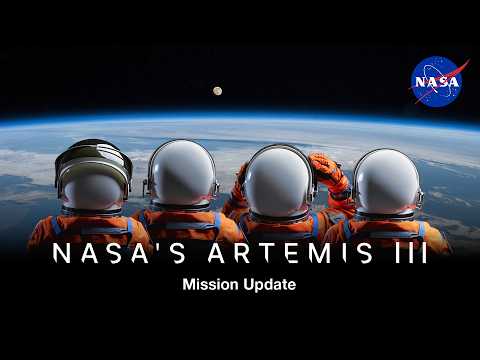
So what is the new plan for Artemis III, and how does it fit with the greater program of space exploration from NASA?
Reforged Artemis Program
The New Artemis
The decision to redesign the Artemis program came as NASA felt the need to test further some key technologies before trying an actual Moon landing. This concerns the testing of docking operations with commercial lunar landers.
“Artemis III will demonstrate the power of American innovation and international partnership as we test complex rendezvous and docking operations and advance the technologies that will one day carry us deeper into the solar system.”
So NASA added a new Artemis mission in 2027, turning this new mission into the new Artemis III.
This is not so much a delay as a stepping stone to make sure that the very ambitious next steps will go smoothly: first Moon landing in more than 50 years, exploration of the Moon’s South pole, Moon base with a permanent human presence, exploitation of local resources to create fuel, air, and building materials, etc.
“The Artemis III astronauts, alongside ESA and our international partners, and the tens of thousands of the best and brightest across the agency and industry, are ushering in a new Golden Age of exploration carrying forward the hopes and dreams of the next generation just as the Apollo astronauts did for so many of us.”
This new plan also entirely canceled the initially planned Lunar Gateway space station, with some of its components reused into a nuclear-propelled Martian robotic mission instead (SR-1 Freedom).
More Time For Testing Landers
Another reason to postpone the landing was that simply some key elements of the initial plans have been too slow to materialize, notably reliable launches of SpaceX (SPCX ) Starship, which will also need to test refueling in Earth’s orbit.
SpaceX plans to use a modified Starship as a lander. Its competitor, Blue Origin, is also working on its own lander. For now, NASA is looking to use both landers and wants to maintain redundancy in case a problem occurs with one of the two systems.
Blue Origin is developing a crewed lunar version of the company’s Blue Origin lander, while SpaceX is developing a crewed lunar lander version of the company’s Starship, with both companies building test articles for Artemis III. NASA is supporting both lander providers hands-on throughout design, development, testing, and evaluation, including sharing agency expertise and capabilities gained from previous missions.”
A key test during Artemis III will be to check that all goes well in the docking between Orion (the spacecraft carrying astronauts) and the landers, all in low-Earth orbit, making it easier to fix any eventual problem during the test.
Blue Moon will launch first, followed by Orion carrying the four astronauts. The spacecraft will remain docked for approximately two days while the crew conducts tests and technology demonstrations.
After Blue Moon departs, Starship will attempt its own docking manoeuvre with Orion before returning to Earth.
“This highly choreographed mission includes a dramatic multi-launch campaign of the world’s most powerful rockets, testing integrated hardware between Orion and the landers, including system interfaces, software, propulsion, and communications.”
In total, the Artemis III crew is expected to remain in space for about two weeks, with the exact mission length to be determined in real-time based on launch, rendezvous, and docked operations.
Artemis III’s Crew
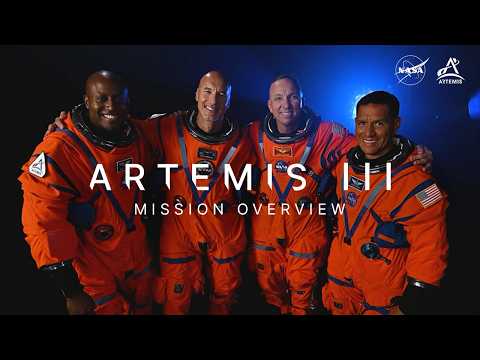
The announcement about the Artemis III schedule and procedure also came with the unveiling of who will be the four astronauts for this mission:
- NASA astronaut Randy Bresnik, commander
- ESA (European Space Agency) astronaut Luca Parmitano, pilot
- NASA astronaut Andre Douglas, mission specialist
- NASA astronaut Frank Rubio, mission specialist

Source: NASA
This will be the first time an ESA astronaut has been assigned an Artemis mission, a salient point for a program that is deeply international, even if it is led by NASA and American companies like SpaceX and Blue Origin.
”ESA’s European Service Module will once again provide the critical capabilities that power Orion, demonstrating Europe’s enduring role at the very heart of the Artemis program. The news out of Houston today is a powerful recognition of ESA’s role in enabling humanity’s return to the Moon.”
Josef Aschbacher, ESA’s director general.
The ESA astronauts will include the Italian Luca Parmitano, on his 3rd spaceflight after the Italian Space Agency’s (ASI) first long-duration mission to the ISS in 2013 and another mission in 2019 where he was the commander. He was previously a member of the Italian Air Force and a test pilot with more than 2,000 flight hours across 40 types of aircraft.
The mission commander will be Randy “Komrade” Bresnik, A retired U.S. Marine colonel who has logged more than 7,000 hours in 95 types of aircraft (he was deployed to Kuwait to fly combat missions in support of Operation Iraqi Freedom), as well as 3,600 hours in spacecraft and 32 hours of Spacewalk experience over the course of 5 EVAs (Extravehicular Activity). Since 2018, Randy Bresnik has served as assistant to the chief of the Astronaut Office for exploration, overseeing the development and testing of the spacecraft and systems that will operate during Artemis missions.
Andre Douglas will be the mission specialist. An expert in spaceflight, he will be in charge of testing the docking procedure of Orion with both Blue Origin’s and SpaceX’s landers. This will be his first spaceflight, even if he previously served as a backup and closeout crew member for the agency’s Artemis II mission. He previously worked on maritime robotics, planetary defense, and space exploration missions.
Frank Rubio will be making its second spaceflight with Artemis III, after breaking the record for the longest single-duration spaceflight by an American astronaut with 371 days in orbit in 2022-2023. He has served for more than 28 years in the U.S. Army as an aviator, a physician, and an astronaut
Serving as a backup crew member will be Robert Hines, training alongside the main four-member crew. If one of them were unable to join the mission, he would be ready to replace them. Hines is a colonel in the U.S. Air Force with more than 27 years of service as an instructor pilot, fighter pilot, and test pilot, accumulating 4,000 hours of flight time in 50 different types of aircraft, and has flown 76 combat missions in 3 different aircraft types. He previously served as pilot of NASA’s SpaceX Crew-4 mission to the International Space Station.

What’s Next?
Artemis & Beyond
If all goes well during 2027’s Artemis III, the mission will have tested the readiness of both Jeff Bezos’ and Elon Musk’s landers.
It is yet to be seen if the timeline will work. Starship is finishing its test, and SpaceX recently conducted a test flight of an upgraded Starship vehicle designed to support future lunar missions.
Meanwhile, Blue Origin suffered a serious setback with the explosion of its New Glenn rocket at its only launch pad, obliterating the infrastructure in what is almost the largest non-nuclear explosion in history.
Later on, NASA wants to alternate and cycle missions between SpaceX and Blue Origin so that the contracts to go to the Moon stay competitive and to reduce the risk of being tied to one sole supplier.
Still, if Artemis validates the landers, this opens the way for an actual lunar landing with Artemis IV. Two astronauts will stay on the Moon for a week-long mission before coming back.
The targeted date for Artemis IV is still early 2028, reflecting NASA’s hopes and ambitions that all the required tools will be tested and ready for that date. As China is also looking to go back to the Moon soon by 2030, losing this “race” would be a blow to the American space program.
Building A Lunar Base
Following will be Artemis V and other, later missions, which will build the basic blocks for a lunar base. It will start with four tons of payload delivered to test what works on the lunar surface, in part through the CLPS (Commercial Lunar Payload Services) initiative.
This will be followed by Intuitive Machines’ (LUNR ) Nova-C Trinity lander, which will deliver science investigations and technology demonstrations (see more below about Intuitive Machines).
And then will come the MoonFall drones to the lunar South Pole to help explore and map challenging terrain, and VIPER (Volatiles Investigating Polar Exploration Rover), designed to help scientists better understand the location of water ice and other volatiles near the lunar South Pole.
The base will be powered by the Fission Surface Power nuclear reactor project. NASA is working with the Department of Energy (DOE) and industry to design this fission power system that would provide at least 40 kW of power from four 10 kW units. This could also become the building block of future power supply for Martian bases.
It will also include two types of vehicles on the Moon’s surface: the lunar terrain vehicle (LTV – unpressurized ) and the pressurized rover. The pressurized vehicles will work as a mobile base, allowing the astronauts to move from the base camp for much longer periods of time.

Source: Space.com
Lastly, an initial orbital relay constellation similar to Earth’s Starlink, followed by an additional provider-developed constellation to expand communications and navigation capabilities.
Investing In Lunar Colonization
Intuitive Machines
LUNR Price Chart
Building offworld bases or even colonies is going to require a strong expertise in building large space probes and making them arrive in the right place intact.
Today, we are getting closer to the point where private companies could start sending automated or manned missions to mine asteroids, especially near-Earth objects.
Founded in 2013 in Houston, Texas, Intuitive Machines is, for now, a very “Moon-focused” company, as indicated by its stock ticker LUNR, and has already been selected for 4 NASA lunar missions, and employs 400+ people.

Source: Intuitive Machines
It was the first commercial company to successfully land and transmit scientific data from the Moon. The company is working on many projects that will form the base of a lunar infrastructure for exploration and settlement.
The first one is the “data transmission service”, with the technology being tested, and ultimately looking to end with a lunar data transmission constellation around the Moon’s orbit.

Source: Intuitive Machines
The second part is the “Infrastructure as a Service”. It should include an LTV capable of autonomous operations, the telecommunication service, and GPS localization services.
The last segment is the delivery of material to the lunar surface. The next step will be with the Nova-D lander, able to deliver 1,500-2,500 kg of material to the Moon. This payload capacity and size will be the one required for delivery of the Lunar Terrain Vehicle (LTV), as well as the 40kW Fission Surface Power nuclear reactor expected to power the Moon base.

Source: Intuitive Machines
The company has landed many valuable contracts with NASA, for example, the Near Space Network contract, with a maximum potential value of $4.82B. Besides NASA, the company is trying to diversify its client base, having been selected in April 2025 for a grant of up to $10M by the Texas Space Commission.
As the company reaches a positive free cash flow point in Q1 2025 and positive EBIDTA in Q1 2026, it is now becoming a lot safer for investors, moving away from a cash-burning startup to an established services provider to the growing space economy.
Intuitive is also expanding quickly through acquisitions, notably with the Lanteris, the company formerly known as Maxar Space Systems, as well as the acquisitions of Goonhilly Earth Station Ltd and COMSAT. Lanteris is a leading manufacturer of commercial GEO satellites and is building the Power and Propulsion Element for NASA’s SR-1 Freedom nuclear spacecraft.
Intuitive Machines could form the building block of further deep space exploration, especially as it becomes a trusted partner of NASA on par with SpaceX or Rocket Lab (RKLB ).
(You can read more about Intuitive Machines in our investment report dedicated to the company. These space infrastructures will be the foundation of the new space-based economy.
Latest Intuitive Machines(LUNR) Stock News and Developments



