Spotlights
Caterpillar (CAT): AI, Autonomy & the Future of Heavy Industry

Securities.io maintains rigorous editorial standards and may receive compensation from reviewed links. We are not a registered investment adviser and this is not investment advice. Please view our affiliate disclosure.

Summary:
Caterpillar sits at the center of global construction, mining, energy, and rail infrastructure. With accelerating adoption of AI, autonomy, electrification, and digital services, CAT is evolving from a machinery manufacturer into a high-tech industrial platform. Structural tailwinds in commodities, energy demand, data center buildouts, and reshoring initiatives support a durable long-term demand cycle for equipment plus recurring services.
How Caterpillar Builds the Physical Economy
When investors and the public at large think of technology, the first thing that comes to mind is AI, software, data centers, social media, cybersecurity, and other digital & virtual innovations.
But in actuality, a lot of the world runs on physical activity: mining, construction, energy & water infrastructure, etc.
In order to make chips, copper and rare earth mining and aluminum smelting are required; for EVs, lithium needs to be extracted and purified, and data centers run only thanks to massive energy production and a complex infrastructure requiring earthwork, pylons, cranes, etc.
Almost all of these activities are supported by massive machines that dig, crush, and move millions of tons of materials every day.
Until now, most of this work was done with human controllers and powered by fossil fuels, moving the excavators, bulldozers, cranes, trucks, and other heavy equipment required. This is quickly changing, with the leading firms in the sector quickly digitalizing and electrifying.
And none has been more active in pushing this transition than Caterpillar, the global leader in heavy machinery.
Caterpillar Inc. (CAT -1.13%)
Caterpillar Overview
Caterpillar History
The company was founded from the merger in 1925 of Holt Manufacturing Company and the C. L. Best Tractor Company. This makes it just over a century old and gives it roots in steam tractors and other steel plate-tracked vehicles, including the first tanks used in WWI.

After the foundation of Caterpillar from the merger, the company progressively shifted from military equipment and tractors to diesel engines and heavy construction machinery, and then generators (although it still produces some military equipment, mostly for engineering purposes, see below). The company adopted its iconic yellow color in 1931.

After a slowdown in sales post-WW1, the company restarted growth, with notably strong growth in the 1970s, where sales surpassed $3B in 1973 and reached nearly $5B by 1975.
For a long time a US-centric company, although exporting its goods, Caterpillar started expanding overseas with manufacturing in Brazil since the 1960s. It then added a factory in Mexico in 1988, its first Russian facility near St. Petersburg in 2000, and another facility was finished in Suzhou, China, in 2009.
Since the 1990s, Caterpillar has also performed a long series of acquisitions to consolidate its position in all of its key markets, leading to a total of 17 brands inside the group.
This includes notable moves like the acquisition of MWM GmbH in Germany (sustainable natural gas and alternative-fuel engines), Kemper Valve and Fittings (oil & gas well servicing), Earthmoving Equipment Division in India, Progress Rail (train electro-motive diesel), and Shandong Engineering Machinery in China.

Business Overview
The company is structured around 3 main segments: construction, resources (mining, logging), and energy & transport.
Swipe to scroll →
| Segment | What CAT Sells | Key Demand Drivers | Tech/AI Upside | Durability / Cyclicality | Investor Watchlist |
|---|---|---|---|---|---|
| Construction | Excavators, dozers, loaders, road & paving, quarry/waste, attachments + services | Infrastructure spend, housing, commercial builds, roads/bridges, municipal projects | Jobsite autonomy, operator assist, connected fleet analytics, predictive maintenance, digital twins | Medium-high cyclicality, improves with services/parts + replacement cycle | Backlog, dealer inventory, service attach, infrastructure policy tailwinds |
| Resources | Mining trucks & shovels, underground, drills, loading systems, rail solutions + autonomy | Mining capex, commodity cycles, electrification of mines, safety/efficiency mandates | Highest: autonomous haulage, fleet orchestration, sensor fusion, remote ops centers | High cyclicality, but autonomy + productivity ROI can sustain spend in down cycles | Autonomy deployments, mining electrification pilots, commodity capex guidance |
| Energy & Transportation | Engines, generator sets, gas turbines, compression; locomotives/rail services (Progress Rail) | Data center power demand, grid reliability, O&G/industrial demand, rail replacement cycle | Microgrids, monitoring/controls, hybridization; hydrogen/alt-fuel rail demonstrations | More durable (service intensity + critical uptime), still macro-sensitive | Data center backup orders, margin mix (service vs. equipment), turbine demand, rail wins |
The company has more than 113,000 employees, is directly present in 24 countries (140 locations), with more than 4 million Caterpillar equipment units operating worldwide.
In 2024, it generated $65B in sales, with $9.2B in net income and $8.8B in free cash flow, with energy the largest source of revenues, closely followed by construction.
The company generates approximately half of its sales in the US (47%) and half in the rest of the world (53%).

While diesel engines and manually operating machinery have been, and still are, the core of the company, it is evolving quickly into a tech company.
Remote control and AI are changing how Caterpillar machinery is operated. And electrification pilot tests in partnership with mining leaders like Rio Tinto (RIO -2.92%) are ongoing.
Caterpillar Segments
Construction
Likely the best known segment of the company, Caterpillar’s excavators, bulldozers, and other specialized construction equipment can be seen all over the world in a myriad of construction projects.
Among the most remarkable construction projects enabled by Caterpillar can be mentioned the U.S.’s Hoover Dam and Golden Gate Bridge, as well as the Three Gorges Dam in China.
Construction covers not only general construction, but also waste management, quarry, road construction equipment, and landscaping, with more than 300 different models on offer.

The sector benefits from underlying growth trends, with an expected +25% global construction spend in the coming decade.

The segment is evolving into not only sales of equipment, but a full suite of services, IT systems, and maintenance offerings, providing extra safety and efficiency to the company’s customers.

Resources
The Resources segment is mostly composed of mining and rail, but also heavy construction and quarries.

The Resources segment is where Caterpillar’s self-driving program is the most advanced, with already 690 autonomous trucks operating worldwide.
This is in part because mining operations are more standardized and stable, helping automation (for example, a regular route for a truck to extract crushed rocks) and safety with self-driving vehicles weighing tens or hundreds of tons. This fleet is targeted to grow by 3x by 2030.
The resource segment is benefiting from the aging of the global and US fleet of machinery, with 60% of mining & quarry fleets more than 10 years old, and the 30,000+ fleet of US locomotives aging further.
In addition to the replacement of existing equipment, a commodity boom is going to be driving major growth in capex spending in the mining sector, for both new equipment and digital solutions & autonomous vehicles.

Energy & Transportation Segment
Energy
Caterpillar was one of the early adopters of the diesel engine, and built in parallel to its machinery an energy generation business based on this technology. One of Caterpillar’s generator sets even helped power the Apollo 11 mission to the moon.
The company quickly became the world’s largest manufacturer of diesel engines by 1937, a position it still retains to this day.
It later added gas turbines to its offer, with a broad portfolio going up to 10 MW for engines and 39 MW for turbines.
This is a rather diversified segment in respect of the industries it serves, with a split over direct energy generation and providing generators for industries like oil & gas, transportation, or manufacturing. The sector has grown by 30% since 2019, even with the pandemic-driven slump in sales in 2020.

The company expects this segment to be its main growth engine, with targets for 2030 of 2x sales in power generation and 2.5x in gas turbines.
Caterpillar does not see the growth of renewable energy as a threat, at least not until 2035, due to the combination of a growing energy demand (+40 exajoules worldwide by 2035, or 8x the energy needed to power all US households each year) and the need for backstop production to compensate for renewables’ intermittency.
The need for backup (and primary) energy generators for data centers is also playing in favor of Caterpillar’s energy segment.

Transportation
In 2006, Caterpillar acquired Progress Rail Services, which then acquired Electro-Motive Diesel in 2010 (one of the world’s original and largest manufacturers of diesel electric locomotives) and ECM S.p.A. in 2018 (railway signaling).
The segment is producing locomotive and train engines, capitalizing on Caterpillar experience and synergies in this field, and is the largest supplier of rail infrastructure products and services in the United States, and provides maintenance of freight cars and other rail technologies.
Caterpillar Defense
While this segment has not been the main focus of the company compared to its larger markets of construction, energy, rail, and resource, the expertise in diesel engines and tracked vehicles gives it an advantage in niche defense products.
For example, Caterpillar produces demining vehicles (essentially armored bulldozers) and trench-digging and earthwork military vehicles.
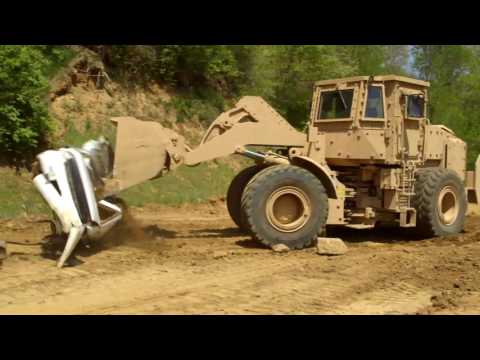
It also sells to the military power generation solution to provide energy to military bases, hospitals, radar sites, embassies, data centers, etc.
Lastly, it also powers powertrains for land vehicles and ships, including submarines.

Caterpillar Innovation: AI, Autonomy & Electrification
Digital & AI
Along with its partner Nvidia, Caterpillar was presenting its IT innovation at the CES 2026. The company is also upping its investment in IT by 2.5x for 2025–2030 vs 2019–2024.

Half of Caterpillar’s equipment is connected, with 500,000 “tech-enabled” machines.
At CES 2026, Caterpillar also presented other innovations, part of the greater trend of this year’s CES around Physical AI (follow the link for more explanation on this topic).
“For a century, Caterpillar has built the industrial machines that shaped the world. In the age of AI, NVIDIA and Caterpillar are partnering across the full spectrum — from autonomous construction fleets to the AI data centers powering the next industrial revolution.”
Jensen Huang, founder and CEO of NVIDIA
This includes:
- CAT AI Assistant, designed to be a proactive, voice-activated partner, allowing operators to ask for information on machine settings, troubleshooting, and maintenance.
- Edge Computing and Digital Twins, for remote and unconnected computing.
- Autonomy at Scale for construction and mining machines equipped with AI-driven recommendations, capable of processing billions of data points in milliseconds to navigate complex, variable jobsite conditions.
- Condition Monitoring, a suite of technologies that Caterpillar dealers use to detect and identify issues and recommend service or maintenance based on data from the machine itself.
Sustainability
Until recently, sustainability efforts at Caterpillar have been centered on alternative fuels, longer life of the machine fleet, and modular drivetrains, reducing resource consumption, carbon emissions, and improving efficiency.

This is changing rapidly, with efforts to electrify the company’s vehicles. For example, it has started to use the first Caterpillar battery-electric haul trucks in the Pilbara jointly with BHP, replacing diesel trucks. (BHP -3.09%)
“These trials will help us understand how all the pieces of the puzzle fit together: the battery technologies, generation and charging infrastructure, power management, as well as the supply chains to potentially deliver this at scale.”
Tim Day – BHP Western Australia Iron Ore Asset President
Besides battery-powered systems, Caterpillar is pushing for further autonomy in resource production with its groundbreaking dynamic energy transfer solution in 2024 for battery and diesel-electric mining equipment.
It uses an electrified rail system to transmit the energy to the truck while it is working, virtually eliminating downtime for recharging batteries. It is compatible with both battery and diesel-electric powertrains. The system has been tested and will be commercially available by the end of 2026.
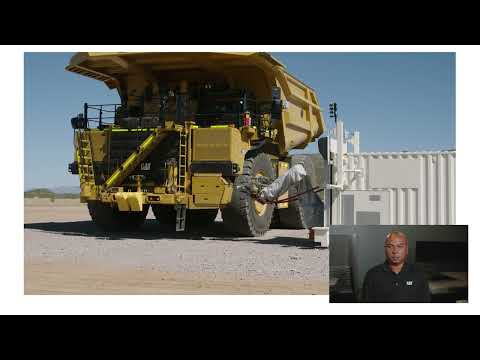
It can be combined with the Automated Energy Transfer System (AETS) that uses robotics, robust vision systems, and controls to fully automate the connection between a battery electric machine and a two- to six-megawatt stationary charger, all fitting inside mobile containers.
Other segments of the company are adopting green solutions, like the rail segment developing a demonstration model of a locomotive powered by hydrogen fuel cell, together with BNSF Railway Company (BNSF – wholly-owned subsidiary of Berkshire Hathaway (BRK-A -0.13%)), and Chevron (CVX +0.17%), using alternative fuel, developing hybrid rail powertrain, etc.
Lastly, Solar Turbines, the turbine subsidiary of Caterpillar, is also developing solutions to utilize green fuels like hydrogen and synthetic gas, and has developed SoLoNOx, an advanced combustion system that provides the most cost-effective and sustainable approach to reduce NOx emissions.
Investment Outlook: Is Caterpillar a Buy for the Next Decade?
Caterpillar is central to activities around construction, logistics, resource extraction, power generation, and the US rail network.
As such, it could be a great beneficiary if the upcoming decade is marked by the rebuilding of US domestic industries, a boom in commodities, and overall an economic environment similar to the 1970s stagflation.
In addition, the importance of rail transportation to heavy industries could make this segment another growth center for Caterpillar, as the US tries to bring back its industries and supply chains closer to home, in a context of rising tensions with Russia and China, but also the EU.
Lastly, the currently small but strategically important activity in defense could allow Caterpillar to grow this activity as well, especially with plans to grow the US military budget to $1.5T and the request by the US president to produce more weapons quickly.
For investors, the company has a strong focus on sustainable growth and financial stability, with 32 consecutive years of rising dividends and regular share repurchases, for a total of 99% of free cash flow generated in 2019-2024 by the machinery, power & energy segment returned to shareholders.
So combined with structural trends supporting all the company’s segments, this could make the stock an option for both defensive and growth-focused portfolios.
Investor Takeaway:
Caterpillar offers investors rare “physical economy” exposure to industrial automation, autonomous mining fleets, power generation for data centers, and rail infrastructure through a cash-generative leader with long-term shareholder returns. Key catalysts are service/software attach rates, autonomy scaling in mining, and electrification adoption; key risks include commodity capex cycles, geopolitics, and a construction downturn.
Latest Caterpillar (CAT) Stock News and Developments
Best Dividend Aristocrats As Of March 20, 2026
seekingalpha.com
•
March 21, 2026
Caterpillar vs. Komatsu: Which Equipment Stock Has the Edge Now?
zacks.com
•
March 20, 2026
Goldman Sachs Large Cap Value Fund: Q4 2025 Portfolio Attribution And Review
seekingalpha.com
•
March 20, 2026
Coastline Trust Co Increases Stake in Caterpillar Inc. $CAT
defenseworld.net
•
March 20, 2026
Centaurus Financial Inc. Sells 1,035 Shares of Caterpillar Inc. $CAT
defenseworld.net
•
March 20, 2026
Oil Spike Sends Indexes Lower, but the Selloff Stays Shallow
fool.com
•
March 19, 2026