

Spotlights
IBM: From Mainframes to AI and Quantum Computing

Securities.io maintains rigorous editorial standards and may receive compensation from reviewed links. We are not a registered investment adviser and this is not investment advice. Please view our affiliate disclosure.

The International Business Machine
Computers have taken over most business activities in recent decades. But some forms of automated data collection and encoding are much older. For example, punched cards were used at the beginning of the 20th century to input data into the early ancestors of electronic computers.

Later on, vacuum tubes, and then more modern electronics, kept increasing the ease of use and the computing power available to researchers, administrators, and businesses.
More importantly, this increase in capacity follows an exponential law, with each step growing by an order of magnitude greater than the previous one, instead of just a linear progression.

Source: Medium
As a result, computers are not only getting better but are also constantly becoming able to do more tasks that were previously out of reach and confined to the human brain. More recently, computers have been able to achieve tasks impossible for humans, like screening millions of material types to produce better battery materials, or designing from scratch new types of proteins.
From the original punchcard “computers” to the 1960s-1970s first transistors, to today’s exploration of quantum computing and AI, one company has been instrumental to progress in computing capability and its commercialization: the International Business Machines Corporation, better known as IBM.
International Business Machines Corporation (IBM +2.17%)
IBM at a Glance: Revenue, FCF, Workforce
IBM is a company that has been instrumental in the history of computer science (see the history section below). It has today more than 300,000 employees and 19 research facilities on 6 continents.
The company has generated $63B in revenues in 2024, of which $12.7B was free cash flow, with the highest free cash flow margin in the history of the company in 2024.
IBM used to make most of its money by selling “mainframes” to large businesses, room-size computers used by corporations during the Cold War Era.
Today, the equivalent is the company’s hybrid cloud, a type of cloud computing mixing together private cloud infrastructure (like on-premises data centers) with one or more public cloud services. No less than 93% of Fortune 500 companies are using IBM’s hybrid cloud product and solution, and 73% of companies use hybrid cloud.
IBM is also active in building the next pages of computing technology, with a strong presence in neuromorphic chips, AI, and quantum computing.
IBM History: From Tabulators to Mainframes
From 1914 to 1924, Thomas Watson Sr. grew the Computing-Tabulating-Recording Company (C-T-R) into a US$11 million company, and rebranded it as the International Business Machine.

Source: IBM
At the time, the company was still selling meat slicers, coffee grinders, and scales, along with more high-tech tabulating machines. The tabulating machines, ancestors of modern computers, were used to help run railroads, handle accounting at department stores, and keep track of production and inventories in factories.
In the subsequent decades, IBM would expand into Australia, Brazil, and China, turning it truly into the international company implied by its name.
“You cannot be a success in any business without believing that it is the greatest business in the world.”
This international push would see international sales grow from $50M / year in 1949 to more than $2.5B in 1970, overtaking US operations in 1975.
The company’s first electronic computer, the 701, was about 25x-50x faster than its predecessors. It would lead to the first modern mainframe, the IBM System/360, which hit the market in 1964. By 1989, products based on the System/360’s architecture and its extensions accounted for more than half of IBM’s total revenue.

Source: IBM
Today, IBM mainframes are still important, with 45 of the top 50 banks, 4 of the top 5 airlines, 7 of the top 10 global retailers, and 67 of the Fortune 100 companies leveraging the mainframe as their core platform.
Company Culture
The company’s favored recruiting method was to hire top graduates from leading universities as salespersons, claiming that “the key to sales is knowledge”.
This would be accompanied by customer training courses, a global education system for employees and their families, partnerships with universities, virtual classrooms, etc.
“The smart company can never expect to be more highly regarded than the salesmen in the field.”
This is also when the company culture of a customer-focused approach, even more than a technical focus, was born.
In 1949, the company ran a series of now-famous ads in most newspapers across America, stating simply “IBM means service.”
It began to present awards of the same name each year to top performers in customer service.
What IBM Sells Today: Hybrid Cloud, Red Hat, Consulting
IBM operates as an umbrella corporation for many interconnected divisions, mostly focused on integrating multiple IT technologies together, from hybrid cloud to open source AI, enterprise software, and specialized consulting.

Source: IBM
Hybrid Cloud
Connected computers in large enterprises used to rely on large mainframes handled in-house, in large part due to the need to keep confidential data safe and the limited connectivity of individual working stations.
As the Internet progressed, a move to cloud computing took place, allowing for multiple offices to collaborate better and utilize the same common IT infrastructure, making the fortune of companies like Oracle (ORCL +6%) and Amazon’s AWS (AMZN +3.64%).
Paradoxically, this has ultimately led to an increase in the complexity of IT infrastructures, with multiple clouds, legacy in-house systems, and many IT layers interacting with each other poorly.
Instead, IBM pushes for hybrid cloud, or “hybrid by design”, an approach aiming for a “Great Reset” creating a coherent cloud infrastructure integrating together open source software (Red Hat, Linux), IBM AIs, in-house infrastructure, and large cloud providers (Azure, AWS, etc.).
Red Hat
Red Hat was the independent provider of Red Hat Enterprise Linux, which is the de facto standard for hybrid cloud.
It was acquired by IBM in 2018 for $34B. Since the acquisition, Red Hat has more than doubled its revenues (to $6.5B).
This acquisition illustrated IBM’s commitment to open source systems, and after initial concerns, improved its reputation with the developer community as the company left Red Hat’s original ethos of open source development intact.
It was followed by a series of other acquisitions focused on open source software, AI, and quantum computing.

Source: IBM
The open source focus is looking to capitalize on the expectation that, the way Linux is dominating server software, Red Hat and other open source solutions will also win the market for hybrid cloud and in-house AI, especially if boosted by IBM’s sales network and investment capabilities.
Smaller AI models like the Chinese DeepSeek have proven to be able to go toe-to-toe with larger AI businesses. It seems that IBM’s Granite AI is performing the same way, with similar results for a small fraction of the costs.

Source: IBM
Consulting
IBM has long been a giant in IT consulting, guiding the IT teams of its enterprise clients in implementing innovative solutions and architectures.
Today, adoption of AI is the most pressing matter, and IBM can offer more than 75,000 consultants with Generative AI skill certifications.

Source: IBM
IBM counts 100% of the top banks, automotive, telecom, media and entertainment, consumer/ retail, and healthcare and life sciences companies as its consulting clients.
This activity is divided roughly into two, between strategy and operations, with the first focused on the adoption of new technologies, and the second on optimization of current activity & cybersecurity.

Source: IBM
IBM R&D: AI, Neuromorphic, Quantum & Photonics
An Impressive Track Record
IBM Research has long harnessed a thinking culture to create dozens of life-changing technologies, from DRAM, the relational database, and the scanning tunneling microscope, to Watson and a fully functioning cloud-based quantum computer.
In its long history, IBM has played a foundational role in creating the Social Security Administration, as well as NASA’s Mercury & Apollo missions, and the Space Shuttle program.
IBM’s scientists and engineers have won six Nobel Prizes, six Turing Awards, 19 Medals of Technology, five National Medals of Science, and three Kavli Prizes. As of 2021, IBM scientists had also published the most patents for 28 consecutive years.
The company is still pursuing this science-first approach, having progressively risen its R&D expenditure from 9% of revenues in 2020 to 12% in 2024, and expects it will rise to the “mid-teens” percentage in the upcoming years.
AI
IBM has been an early mover in AI, notably with its at the time groundbreaking Watson enterprise AI, which successfully won the Jeopardy against human opponents in 2011.
The modernized WatsonX released in 2023 has already been adopted by Dell, Vodafone, Lockheed Martin, Fiserv, and other companies for using proprietary data to train their own AI.

Source: IBM
WatsonX is a large revenue driver for IBM, thanks to the multiplying effect of consulting, generating 5-6 dollars for each one generated by WatsonX’s sales.
IBM’s business in generative AI, which includes LLMs (Large Language Models, image & video generation, etc.), has been growing quickly, reaching $5B by the end of 2024.

Source: IBM
Neuromorphic Chips
Modern AIs are built on the back of GPUs (Graphics Processing Units), a type of hardware initially designed for calculating video game graphics. While much more efficient than CPUs, this is likely not the most efficient hardware design for running neural networks.
Such a design is neuromorphic chips, or Neural Network Processors (NNPs), a field where IBM is leading.
These chips are not only more powerful, but they are also several orders of magnitude less energy-intensive, an important element as energy supply might soon become a bigger constraint to AI development than hardware availability.

Source: IBM
This higher efficiency will also be very important for AI applications in robotics, drones, and edge computing (including self-driving vehicles), where energy-efficient and compact hardware are even more important than in AI data centers.
(You can learn more about AI hardware in our dedicated report, covering GPUs, neuromorphic chips, TPUs, FPGAs, and XPUs)
Quantum
Quantum computing, relying on fundamentally different principles than “normal” computing, has the potential to solve some problems that other electronics systems could not address.
When mature, this technology could represent a $500B market.

Source: IBM
In early 2025, IBM already reached $1B in quantum computing sales, having deployed 75+ quantum computing systems since 2016, showing that the field is entering the early stage of commercialization.

Source: IBM
This was done for clients like Wells Fargo, Bosch, Moderna, Boeing, and HSBC.
Today, we have 13 utility-scale quantum computers (100+ qubits) operational in Poughkeepsie, NY; our European data center; and in client locations around the world.
A strong focus on IBM is to push for the adoption of its open source Qiskit standard as the default quantum software platform. With Qiskit adopted by 74% full-stack development platforms, this seems to be working.

Source: IBM
This is not to say that it is not working on quantum hardware as well, with its Heron superconducting quantum chip performance ranked among the best in the world.

Source: IBM
Photonics
Another innovative way to perform computing beyond electronics is to use light instead of electricity to encode and carry the data. Today, this is mostly only done for the connection between electronic computers through optical fibers.
Photonics is the field that looks to use light for computation.
IBM’s silicon photonics technology could speed data center training by as much as 5x.
“By using optical waveguide technology, IBM has put as many as 6× more optical fibers at the edge of a silicon photonics chip compared to what was possible before.
That will translate into as much as 80× improvement in bandwidth between chips.”
John Knickerbocker – IBM Researcher
This method of networking chips brings optical connections onto circuit boards and all the way to chips, resulting in a more than 80% reduction in energy consumption compared with electrical connections.
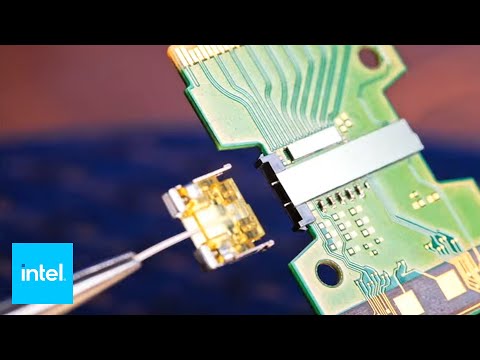
Together with neuromorphic chips, it is easy to imagine that IBM will be important in the future of AI hardware to keep the AI industry’s energy consumption under control.
“If you have if you have 10,000 accelerators in a data center, you need to be able to talk to accelerators which are a few meters apart, not just a few inches apart.
The IBM technology can achieve 100 meters at high bandwidth.”
Mukesh Khare – IBM VP
IBM was also instrumental for some of the early applications of photonics, notably the SKAO (Square Kilometre Array Observatory) radiotelescope’s optical beamformer.
IBM Financials: Growth, Margins & Returns
IBM has financially performed strongly and consistently over the past years, with a sustainable revenue growth of 5%+, driven by 10% growth from software sales and even stronger growth in consulting (14% in hybrid cloud, 23% in AI).
Margins have improved with 2-3% growth of free cash flow above revenue growth.
The overall growth is supported by the strong synergies between each of the company’s activities and the strong relations with its large enterprise clients.

Source: IBM
This has, in turn, benefited the company’s shareholders, with returns above the S&P500 and S&P Tech Index.

Source: IBM
Conclusion
IBM used to be one of the least discussed companies by investors among the large US tech companies.
In large part, this was due to its focus on open source standards, mainframe, a pure B2B focus, and a relative period of stagnation in the 2010s. It can also be argued that IBM could have done better in capturing the nascent market of cloud computing as a service, leaving it instead to Microsoft (MSFT +3.12%), Google (GOOGL +5.14%), and Amazon (AMZN +3.64%).
Still, IBM is as much as before an innovation powerhouse, leading in advanced computing techniques like quantum computing and photonics.
It is also doing well in AI, with an approach focused on specialized, enterprise-grade models instead of generalist LLMs like ChatGPT or Gemini.
Lastly, IBM’s deep connection with all the major corporations, through WatsonX, its consulting branch, and its hybrid cloud services, means the company has a very strong competitive position in its niche.
It is also a powerful champion of open source, at a time when closed AI models are criticized, and privacy concerns & the worry about tech companies’ power are mounting.
Clearly, markets are starting to realize IBM is far from just a legacy tech company, with its stock having rallied strongly since 2023 and up more than 100% in the past 5 years. If quantum computing or AI services continue to grow at their current rate, further growth should be expected.
Latest IBM (IBM) Stock News and Developments
IBM (IBM) Rises Yet Lags Behind Market: Some Facts Worth Knowing
zacks.com
•
March 31, 2026
AI & Quantum Opportunities After Tech Sell-Off: 2 Stocks for April
zacks.com
•
March 31, 2026
April Dogs Of The Dow: One To Buy
seekingalpha.com
•
March 31, 2026
IBM Consulting Rebounds Slightly: Is AI Enough to Fuel Durable Growth?
zacks.com
•
March 31, 2026
4 Cloud Computing Stocks to Buy Amid Heightened Market Volatility
zacks.com
•
March 31, 2026
International Business Machines Corporation (IBM) is Attracting Investor Attention: Here is What You Should Know
zacks.com
•
March 31, 2026



