Sustainability
A Sun that Never Sets – Reflect Orbital’s Big Plans for Upending Solar Energy

Securities.io maintains rigorous editorial standards and may receive compensation from reviewed links. We are not a registered investment adviser and this is not investment advice. Please view our affiliate disclosure.

Solar Rising
Solar energy is becoming one of the world’s major power sources due to its natural abundance, “fuel-free” nature, and no carbon emission when operating (but some during production if the panels are not made with green energy).
A major reason for this progress has been the improvement in photovoltaic technologies, with the quickly rising efficiency of solar panels. And there is more to come, with bifacial panels, perovskite, thin-film cadmium telluride, or quantum dots all candidates to improve solar panels further.

Source: Clean Energy Review
This is something we discussed in further detail in “The Solar Age – A Bright Future To Mankind.” In parallel to improved efficiency, production costs also declined steeply, creating the perfect environment for making solar competitive against fossil fuels.

Source: News Channel 3
Still, solar power suffers from one key weakness. It cannot produce power at night. Or, for that matter, it produces very little on cloudy days.
This means that solar power can only work as mankind’s main power source in tandem with solutions to alleviate this problem.
Currently, the two main options considered are massive battery packs to store power for the evening and sunless days and long-distance power transmission lines to carry energy from sunny areas and throughout time zones.
The problem is that both options are rather expensive and resource-intensive.
This is why another possibility is being discussed: Capturing the solar energy where it shines 24/7 and is never affected by the weather, directly from Earth’s orbit.
Orbital Solar
What makes today and in the near future space solar concepts potentially viable is the crash in costs to launch material into orbit. This was mostly driven by the invention of reusable rockets by Elon Musk’s SpaceX, which has divided cost by 10x already and might do so again in the near future.

Source: Ark Invest
Power Satellites
For a long time, the main strategy envisioned was to install photovoltaic panels in large arrays of satellites and beam back power to the surface with microwaves (which are not absorbed by clouds).

Source: ESA – European Space Agency
The issue with that strategy is that it is rather complex compared to ground-based solar:
- Ground-based: collect sunlight -> convert DC to AC -> send power into the grid.
- Space-based: collect sunlight -> convert microwaves -> convert microwave back to electricity -> convert DC to AC -> send power into the grid.
These many more steps require more equipment and, therefore, more weight to send into orbit. It also means that some energy is lost at every conversion step between sunlight, power, and microwaves.
So, while the sunlight is stronger and uninterrupted in orbit, the additional loss and equipment cost might make orbital solar not that much cheaper than ground-based one, even if it is more reliable.
Selling Sunlight?
Another approach is being considered by a startup called Reflect Orbital.
The idea is to skip the step of bringing solar panels and microwave transmitters into orbit. And instead, just put into orbit a giant mirror reflecting the sunlight down to Earth.

Source: Reflect Orbital
Such a method was already tested by the Russian space program in 1990, so we know it works technically. Short funding in post-Soviet Union Russia, still expensive solar farms, and the cost of orbital launch back then made it not commercially viable at the time.
This concept has a few key advantages against “traditional” orbital solar designs:
- Power satellites will necessarily degrade over time. And contrary to solar panels on Earth, there is for now no realistic path to recycling, meaning that expensive and complex machinery are fully wasted at the end of their useful life.
- Space mirrors can be made of simple, thin metallic foil, which is way lighter than photovoltaic solar panels. This would reduce the launch costs drastically.
The way it would work in practice is that Reflect Orbital would “sell sunlight” to ground-based solar farms so they can keep producing after dark when electricity prices are the highest.
The company has already done a demo of the concept using a hot air balloon, partially as a marketing move to illustrate the concept more than a true prototype, which would require an actual satellite in orbit.

How Serious Is It?
Team
The Co-Founder and CEO of the company is Ben Novak. As a college freshman, he led SpaceX projects validating Crew Dragon propulsion components and worked again at SpaceX later on.
The CTO is Tristan Semmelhack, who was the youngest engineer at Zipline, the world’s leading drone delivery company.
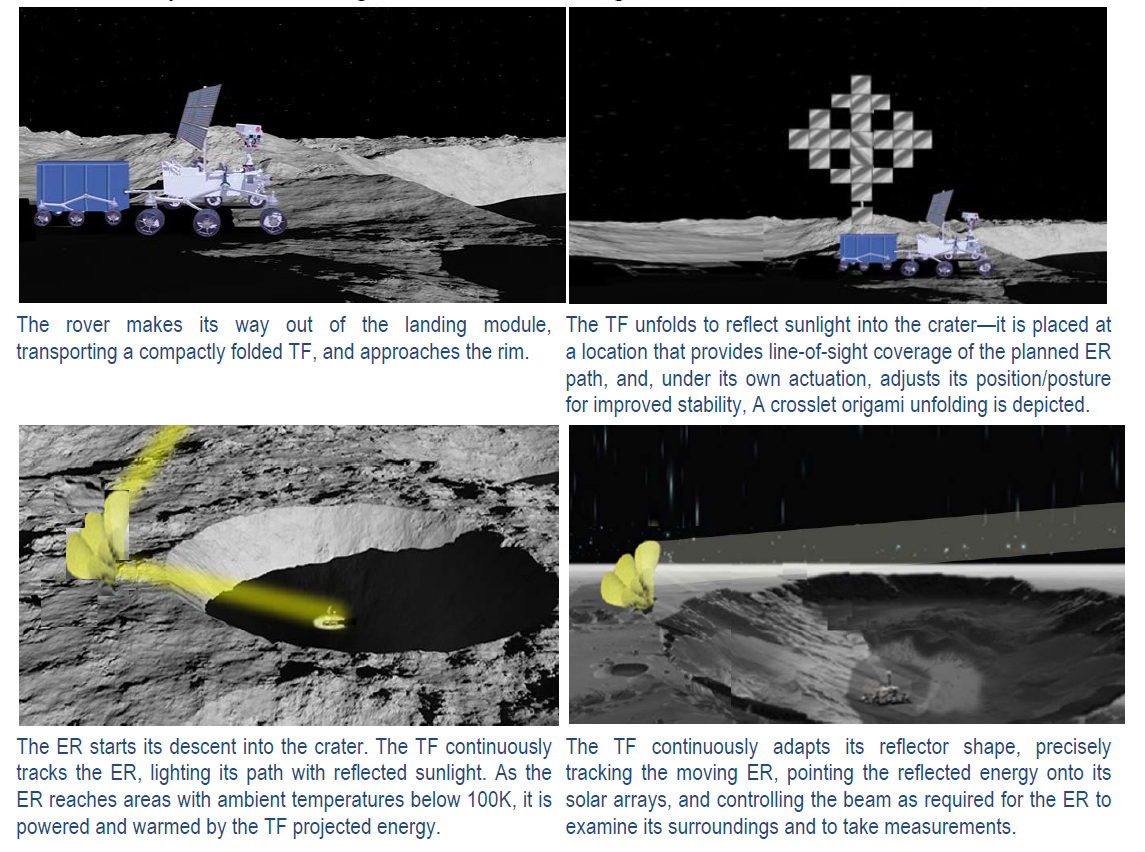
Maybe more crucial for the potential success of the future prototype is Robert Salazar, the Heliostat Design Engineer. He worked on the design of the Starshade’s Optical Shield at NASA’s Jet Propulsion Laboratory; Robert went on to design ultralight deployable heliostats for the Transformers for Lunar Extreme Environments project.

Source: NASA
So, overall, the team seems to have some serious technical credentials when it comes to space projects and space mirrors. This is not just a marketing team with a crazy idea.
And we can assume Novak’s experience at SpaceX could help secure access to the company launchers in the future.
Technical Feasibility
As we said before, this technology was already tested in the 1990s, so we know it can work. It can reuse a lot of research done over the years about solar sails, inflatable antennas, and origami folding for maximizing the efficiency of the launch of solar panels and reflective foil.
In general, making ultra-light reflective surfaces for space is relatively easy, at least as far as space equipment can ever be called easy. From the ground, the reflectors would look like “mini-suns.”

Source: University Of Glasgow
In a study from 2022 titled “Enhancing solar energy generation and usage: Orbiting solar reflectors as an alternative to energy storage,” the reflectors were assumed to be made of a constellation of thirty 1-km diameter sized reflectors, with each reflector having a 20-year lifetime and weighing approximately 7860 kg.
The procurement cost would be $375/kg, or $3M per reflector and $90M for the whole constellation. This would be enough to generate additional illumination worth 100 MWh in power generation.
Economic Viability
In the same study, the scientists then used a launch cost of $1400 per kg or the cost for the Falcon Heavy satellite launch in 2018. It is worth noting that by 2023, this launch cost has already fallen below the $1,000 threshold, and that is before the arrival of SpaceX Starship, which is much larger and, in theory, much cheaper as well.
In this analysis, the researchers calculate that in the current conditions, the project would not manage to generate money. They even calculated the launch costs required for orbital mirrors to reach breakeven in different market conditions:
Market condition 1 has relatively stable prices of electricity throughout the day, with India used as an example. In this case, launch costs for breakeven have to be $257/kg.

Source: Applied Energy (LC = Launch Cost, PC = Procurement Cost)
Market condition 2 has extreme price variation between moments of the day, with California used as an example. In this case, launch costs for breakeven need to be “only” $558/kg.

Source: Applied Energy (LC = Launch Cost, PC = Procurement Cost)
Potential Applications
First Marketing Demonstration
The company is discussing on its webpage the potential to “reserve a spot of light” for 4 min over 5 km, with limited availability starting in Q4 2025.
This would be achieved with satellites that will weigh only 35 pounds (16 kilograms) each and will be fitted with Mylar mirrors 33 feet by 33 feet (9.9 by 9.9 meters) in size that deploy in orbit.
In most cases, it would anyway be more of a demonstration and promotional tool than one targeting power generation, with a strong case that such an application could indeed go viral, with the possibility to ask for sunlight at night at the click of a smartphone app.
Solar Power Generation
The first and most obvious application would be sending light to large-scale solar farms, especially in the electricity market with very high power peak prices in the evening. Any space solar company will need to carefully select its market while keeping in mind the growing competition for constantly cheaper battery packs.
Another practical consideration will be choosing the right orbit, with as many customers as possible on the way of the satellites and their possible target for reflection.
Another possible use case would be to increase the solar intensity hitting solar farms in Nordic latitudes. For example, solar farms in Canada or Scandinavia could benefit from extra light to reach their maximum capacity, especially in winter when power demand is high and the sun’s intensity is at its lowest.
Artificial City Light
Another consideration could be providing city light to large urban centers.
However, this might just not really be competitive with simpler-to-operate light poles with integrated solar cells and batteries.
Farming
Another activity that requires light is farming through plant photosynthesis. Orbital lighting could maybe provide extra light for large-scale farming operations that currently use LED lights in their greenhouses.
This would only work for the largest farms but could make sense for some regions with massive greenhouse installations, like, for example, the Netherlands or the South of Spain.
Another option could be to illuminate Nordic regions in winter, where the growth season is very short. This might also be, in general, an option for the satellite to sell the reflected light in areas without sufficient demand from solar farms.
Orbital Mirrors Limitations
Beyond just technical and economic considerations, orbital mirrors also have their critics.
One problem they could cause is even more light pollution that we experience today. Especially if it becomes a mass-adopted solution to handle peak electricity consumption all over the world. In the long run, this could make ground-based astronomy entirely impossible.
Another potential issue is the disturbance of natural ecosystems. We already know that light pollution from city lights can disturb nocturnal animals, migratory patterns, and insect populations. So, Reflect Orbital space mirrors could potentially make it worse.
Investing In Solar Power
Solar energy production is constantly growing at a double-digit rate and will be a key driver to decarbonize the economy. It has still also a very long way to go, with the immense majority of our global electricity production and even more total energy coming from fossil fuels.
Over the years, it is a sector that has evolved to reward the largest companies, with economies of scale a key factor in managing to generate profit in a very competitive environment. With of course new technologies a potential disrupter of established polysilicon panel manufacturers.
Solar mirrors could also make solar even more attractive by not only solving the issue of peak prices in the evenings but also improving the production of existing solar parks, making them more profitable by increasing the number of hours where they produce.
You can invest in solar companies through many brokers, and you can find here, on securities.io, our recommendations for the best brokers in the USA, Canada, Australia, the UK, as well as many other countries.
If you are not interested in picking specific solar companies, you can also look into ETFs like Global X Solar ETF (RAYS), Invesco Solar ETF (TAN), or Global X China Clean Energy ETF (2809.HK) which will provide a more diversified exposure to capitalize on the solar and clean energy industry.
You can also read our article about the “Top 10 Solar Power Stocks to Invest In”.
Solar & Space Companies
1. Rocket Lab
Rocket Lab USA, Inc. (RKLB -1.09%)
Rocket Lab is one of the most serious contenders in the reusable rocket market. The company has initially focused on small rockets, with the Electron launch system (320 kg of payload), which is progressively being turned into a partially reusable rocket. So far, Electron has deployed 177 satellites in 44 launches.
Later on, Rocket Lab is looking at creating a medium-sized reusable rocket, the Neutron, comparable to Falcon 9 (8,000 kg to LEO in fully reusable mode, 1,500 kg to Mars or Venus). The Neutron will be powered by a methane-burning rocket engine (like Starship), which seems to become the trend for the next generation of rockets.
The company is remarkable for its fully vertically integrated satellite manufacturing process, allowing it to optimize costs and design speed. This resulted in multiple contracts with NASA & the US government, including a $515M military satellite contract. And a civilian $143m contract for Globalstar.
Rocket Lab is also a major manufacturer of solar panels for satellites after its 2022 acquisitions of SolAero Technologies, with 1000+ satellites powered by these panels, and 4MW solar cells manufactured in total.

Source: Rocket Lab
For now, its launch system is reliant on outside suppliers, but a series of strategic acquisitions should change that, replicating in the launch system the vertical integration already achieved in satellite design and manufacturing.
The company is also looking at the possibility of a telecom LEO constellation to generate recurring revenues. It is also contributing to research on in-space manufacturing with Varda Space Industries and orbital debris inspection.
While SpaceX had Elon Musk’s business talent to develop its technology from scratch, Rocket Lab used a mix of R&D and acquisitions to vertically integrate the technology required. This has proven very successful in satellite manufacturing, and they are now looking to replicate this strategy for reusable rockets.
Considering the existing cash flow from satellite production & the Electron successes, Rocket Lab is a good candidate to catch up with SpaceX, at least until mass drivers and other infrastructures are built in a few decades.
2. JinkoSolar Holding Co., Ltd.
JinkoSolar Holding Co., Ltd. (JKS -3.55%)
Jinko is one of the largest solar panel manufacturers in the world, and it is based mostly in China. To avoid tariffs, the company is diversifying its manufacturing base, with silicon wafer manufacturing in Vietnam and solar cell manufacturing in Malaysia and the US.

Source: Jinko Solar
In any case, the company is not overly exposed to Western markets, with China, Asia Pacific (APAC), and emerging markets making the bulk of the company’s business.

Source: Jinko Solar
Jinko has delivered 230 GW of solar cells in the company’s history and 20 GW in Q1 2024, up from 14.5 GW just a year ago.
This makes Jinko the #1 in the photovoltaic industry.
Jinko’s most advanced solar cell, the N-type, achieves a remarkably high 25.8% energy efficiency. It also offers bifacial panels.
In 2023, the N-type took over most of Jinko’s sales, representing 80% of the whole shipments, with more capacity coming from the 56 GW production facility expected to reach full speed by the end of 2024 to make up 90% of delivery by year-end.
Total production capacity is expected to reach 120-130 GW or almost half of the company’s cumulative production in its entire history.
Looking to green the profile of its product, Jinko Solar also released NeoGreen, the first N-type solar panel produced entirely with renewable energy (instead of coal, commonly used in China).
Jinko’s ultra-aggressive growth in production capacity reflects the company’s confidence in its N-type technology and ambition to seize the export markets of Asia, Africa, and South America.
And the overall prospect of solar power taking over the world’s energy systems, including maybe solar mirrors, boosting profitability even further.