

Artificial Intelligence
AI Finds Massive Lithium Deposit in Quebec From Space

Securities.io maintains rigorous editorial standards and may receive compensation from reviewed links. We are not a registered investment adviser and this is not investment advice. Please view our affiliate disclosure.

AI Discovers Major Lithium Deposit in Quebec
As demand for resources grows due to new technologies, economic development, and a growing population, more advanced methods are being deployed to find new mineral deposits.
This need for more resources is especially acute for minerals that were not especially important a few decades ago. As a result, many potential deposits are still unknown or poorly estimated.
This is notably the case for lithium, which is used in batteries for electrification of transport and energy systems and has transformed from a minor commodity to a strategic resource in the past decade.
Today, most of the world’s lithium comes from the Lithium Triangle (Bolivia, Chile, Argentina) and Australia, with the raw material turned into battery-grade lithium mostly in China.
But new deposits are being found and considered for exploitation, for example, lithium-rich brines in Arkansas, geothermal pools, or new projects in the USA and Canada, slowly forming a pan-American lithium super corridor.
Already a country rich in mineral resources (oil, gas, uranium, gold, etc.), Canada has an especially strong potential, thanks to mining-friendly regulations, local expertise, and rich geology. We already covered previously how 6 new mining sites in Canada could be important for lithium production.
Another deposit, Q2 Metals Corp’s Cisco lithium project, has used space-based detection to evaluate its mineral resource and revealed a potential for more than 300 million tons of lithium-rich rock.
AI-powered space and seismic analysis has identified a potentially massive lithium-bearing formation at Q2 Metals’ Cisco project in Quebec. While still at the exploration stage, the discovery highlights Canada’s growing role in securing North America’s lithium supply using advanced, lower-impact exploration technologies.
Cisco Lithium Project in Quebec
Project Overview and Location
Developed by the company Q2 Metals Corp, listed in Canada and in the US OTC markets (QTWO.V / QUEXF), Cisco is located in the Eeyou Istchee James Bay region, in Quebec.

Source: Q2 Metals Corp
The 41,253 hectares (159 square miles) mineral claim is crossed by a highway and closed to railroad connections.

Source: Q2 Metals Corp
This will allow connection to Becancour (midway between Montreal and Quebec City), which is set to become a major lithium hub in North America.
Matagami is the endpoint of the CN rail line that connects to the ports in Montreal & Quebec City, as well as to Bécancour.
Becancour is a battery hub being developed that has attracted major investments by both the Federal & Provincial governments as well as Ford, General Motors, POSCO, EcoPro, and others.
The region is already mined for minerals or with projects in development in the so-called “greenstone Belt” by miners like Rio Tinto (RIO -2.92%), and Patriot Battery Metals (PMETF).
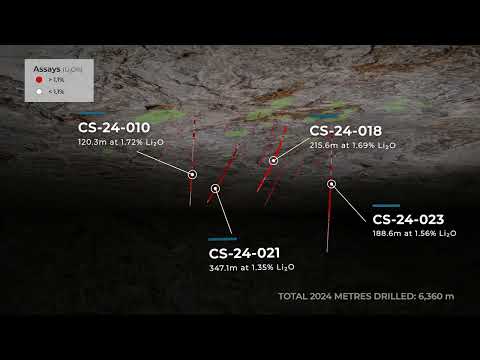
AI-Powered Space and Seismic Exploration Technology
In partnership with Fleet Space, a swarm of small satellites was coupled with ground sensors that record vibrations in bedrock and transmit readings directly to orbit.
Mineral Exploration faces immense pressure to shorten the time to target, de-risk drill programs, and optimise exploration budgets in capital-constrained environments.
ExoSphere by Fleet gets us from prospect to drill-ready targets faster, with more precision and reduced uncertainty.
Using ambient seismic noise tomography, these sensors can analyze the underground and image subsurface structure without explosives. The company then combined these data with gravity, magnetic, and geological data, using AI to make sense of all these disparate data, to draw a clear picture of the underground resources.

Source: Fleet Space
This way, the algorithms search rock properties that match signatures seen at known lithium deposits.
The software then ranks targets, flags structural trends that might host pegmatites, and packages results into maps and cross sections that geologists can interrogate.
From there, teams choose which anomalies to drill, knowing that ExoSphere can update its models within 48 hours as borehole data arrives.
In total, the Cisco deposit could contain as much as 300 million tons of lithium rock grading one percent lithium oxide, or 3 million tons of pure lithium, or around 6% of the entire Lithium Triangle for this deposit alone.
The AI-generated data also indicates that the region as a whole could have great lithium-mining potential, going beyond the limits of the Cisco project.
“With global mining leaders using ExoSphere’s real-time subsurface intelligence to refine drill targeting, we’re enabling faster, smarter, and more sustainable outcomes across the exploration and resource development cycle.
We’re proud to support Q2 as they advance a project that has the potential to meaningfully strengthen the resilience of the Americas’ lithium supply chain.”
Flavia Tata Nardini – CEO & Co-Founder of Fleet Space
Swipe to scroll →
| Exploration Method | Traditional Mineral Exploration | AI & Space-Based Exploration |
|---|---|---|
| Data Sources | Surface mapping, sampling, limited geophysics | Seismic sensors, satellites, gravity, magnetic & geological data |
| Time to Drill Targets | Months to years | Weeks to months |
| Capital Efficiency | High risk of dry or sub-optimal drilling | Reduced drilling risk through ranked AI targets |
| Environmental Impact | Extensive physical surveys and test drilling | Lower surface disturbance before drilling |
| Model Updating | Static interpretations | Continuous AI updates as new data arrives |
Why Quebec Is a Strategic Location for Low-Carbon Lithium Mining
An extra benefit is that Quebec is a relatively water-rich region, helping the mining activity not strain the local resources used by the region’s inhabitants.
This abundance of water also translates into abundant hydropower. This low-carbon and cheap electricity is already used by companies like Rio Tinto for processing bauxite ore into aluminum at a lower cost and lower carbon emissions.
As lithium is mostly mined as a “green mineral” for batteries and decarbonization, a low carbon emission profile could help make the lithium mining in the area more ecological and command a premium in many markets.
Cheap electricity might also be important for the mining itself, with not only the processing of the ore, but also mining vehicles (excavators, trucks, etc.), electrifying quickly.
One thing that could delay the project is, however, that it is located in the traditional territory of Eeyou Istchee, where Cree communities have long land-use histories and a stake in mining decisions.
Quebec’s permitting rules require environmental assessments and consultation with Indigenous governments before projects move. This adds time but helps build legitimacy when consultation works.
Usually, mining companies find a way to help the local community in exchange for agreements. And lithium mining is generally less damaging to the environment than the extraction of other minerals.
The Cisco lithium project underscores two converging investment themes: the strategic importance of domestic lithium supply chains and the accelerating role of AI in mineral exploration. While resource estimates remain preliminary, Quebec’s infrastructure, hydropower, and government support position projects like Cisco as potential long-term contributors to EV and battery supply resilience in North America.
Canada’s Role in the Future Global Lithium Supply Chain
Canada is shaping up to be an important lithium producer, on par with the major lithium producers in the world, and allowing North American battery and EV manufacturers to relocate closer to their supply chain.
This is especially true as the region can provide abundant hydropower and efficient transportation, and the local & federal governments have identified the lithium industry as a priority in its economic development.
This news also illustrates the growing utilization of space technology and AI to improve, quicken, and reduce the impact of mineral exploration.



