
Enerhiya
Cameco (CCJ) Spotlight: Ang Pundasyon ng Kanlurang Nuclear Renaissance

 Idagdag ang Securities.io sa mga gusto mong mapagkunan sa Google

Ang Pangangailangan ng Higit pang Enerhiya
As climate change becomes a growing concern in most countries, decarbonizing our energy supply is becoming more pressing. A lot is being done with renewables, but still not enough. The issue of renewables intermittency will still take a while to be solved with malakihang imbakan ng baterya para sa utility.
The problem is compounded by growing energy demand from AI and the electrification of everything, from transportation to industry and heating/cooling. This means that not only do we need to decarbonize power generation, but we likely need to at least double or triple electricity generation as well for gumana ang ating hinaharap na halo ng enerhiya.
Overall, we are likely to need all the possible low-carbon solutions we can deploy sooner rather than later. Part of this growing electricity production will need to be very stable baseload generation.
This demand will most likely need to be satisfied with nuclear power. And no other company in North America (or even the West at large) will be as instrumental in making it happen as Cameco.
CCJ Tsart ng Presyo
Paningin sa Industriya ng Nuclear
For a while, the incidents of Chernobyl and Fukushima were seen as proof nuclear energy was just too dangerous. Still, before them, there was a time when it seemed clear that the future was nuclear and that burning coal, oil, and gas would soon be as obsolete as the Netherlands’ picturesque windmills.

Pinagmulan: Nuclear Energy – Our World in Data
Nuclear power production stopped growing in the late 1990s post-Chernobyl and has stagnated globally since, with China’s growing production compensating for the declining European nuclear industry.
For many years, only China and Russia seemed willing to develop nuclear energy. Especially China, which is, as The Economist put it, “nagpapatayo ng mga nuclear reactor nang mas mabilis kaysa sa anumang ibang bansa”.
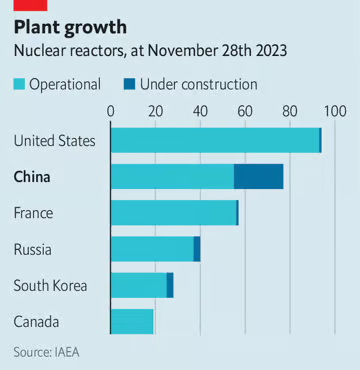
Pinagmulan: The Economist
The Ukraine war, a global energy crisis, and the realization that decarbonization with renewables only will take too long is quickly changing the perception of nuclear.
So today, nuclear energy is making a comeback globally, at a scale unimaginable a few years ago, with many news pointing at a change in policies throughout most of the world:
- Japan Pinapabilis ang Pagsisikap na I-restart ang Pinakamalaking Nuclear Plant sa Mundo
- Kalihim ng Enerhiya ng US na si Jennifer Granholm nanawagan ang triple ng US nuclear fleet
- Bagong nuclear isinama sa draft na plano ng enerhiya ng Korea
- France ibinababa ang mga target sa renewable, inuuna ang nuclear sa bagong energy bill
- UK nagbabalak magtayo ng bagong nuclear reactor sa Scotland
- India magtatayo ng 18 nuclear reactor na may kapasidad na 13.8GW pagsapit ng 2032
Mga Bagong Teknolohiya na Nagpapasigla sa Nuclear
All this talk about a nuclear renaissance was before the AI craze leading companies like Microsoft na sabik na i-lock in ang susunod na 20 taon ng produksyon ng enerhiya ng isang buong nuclear power plant para sa mga AI datacenter nito (MSFT ).
Not long after, tinanggihan ang Amazon na makakuha ng katulad na kasunduan (AMZN ), on the grounds that tech companies cannot be allowed to absorb all the nuclear power available:
We are on the cusp of a new phase in the energy transition, one that is characterized as much by soaring energy demand, due in large part to AI, as it is by rapid changes in the resource mix.
Co-location arrangements of the type presented here present an array of complicated, nuanced, and multifaceted issues, which collectively could have huge ramifications for both grid reliability and consumer costs.”
Another boost to nuclear energy is the emergence of new technology to make it a lot safer, especially:
- SMRs (Small Modular Reactor), including floating nuclear power plants
- 4th-generation nuclear reactors, including fast reactors, are able to burn 98% of nuclear waste.
Overall, China has been leading in this field, kapansin-pansin sa unang 4th generation nuclear power plant na inilunsad noong 2023. Western countries are now starting to pick up as well, as most likely to look at streamlining some regulations to bring the cost of new reactors down.
Another key factor in decreasing costs will be to build in series the new reactors, whether traditional design or SMRs, in order to achieve economy of scale instead of the one-of-a-kind designs that have been built so far.
Epekto ng Nuclear kay Trump?
With Trump elected president for a second time, it makes sense to look back at his position on energy. On the one hand, strong support for fossil fuel extraction is to be expected.
“You are looking at, overall, a ‘drill baby drill’ philosophy. You are going to see offshore lease sales, you are going to see pipelines move much quicker, you are going to see fracking on federal lands and a mindset that is focused on lowering energy costs for consumers,”
Dan Eberhart – CEO of Canary LLC, an oilfield services company.
However, it will also likely include nuclear energy. The overall goal is mapababa ang gastos ng enerhiya. His own campaign emphasized its 1st term activity in favor of nuclear energy:
- Bilyong dolyar sa loan guarantees upang mapadali ang konstruksyon ng Plant Vogtle units 3 at 4.
- Sinusuportahan ang Carbon Free Power Project sa Idaho National Laboratory.
- Pinahusay ang pro-nuclear Partnership for Transatlantic Energy Cooperation.
There is little reason to expect less about nuclear from a candidate who has been enthusiastically looking to reduce dependency on foreign powers, massive infrastructure spending, and a focus on re-industrialization.
So while Trump’s election might be bad news for renewables, it could be a good one for the nuclear industry.
Cameco
Cameco is the world’s second-largest uranium miner, with mines mainly producing in Canada. This puts it just behind Kazatomprom in Kazakhstan. Its main mines are Cigar Lake and McArthur River/Key Lake in the Province of Saskatchewan.

Pinagmulan: Cameco
As a result, Cameco will be at the center of supplying the raw materials required by existing and future nuclear power plants.
Mula noong 2022, ang Cameco ay nagmamay-ari rin ng 49% ng Westinghouse, the historical builder of most of the US nuclear power plant parks, and the designer of many European reactors as well. This means that Cameco could benefit from the renaissance of nuclear power in multiple time frames.
In the short term, deficits and risks over uranium supplies can boost the company’s immediate profit and mining profitability.
In the long term, Westinghouse could be a major beneficiary of a massive program to build more nuclear power plants, both in the USA and its allies, especially in Europe that patuloy na nagdurusa mula sa matinding krisis sa enerhiya na sumisira sa ekonomiya nito.
Kakulangan sa Suplay ng Uranium
Uranium has suffered as a commodity for a long time as a result of the end of the Cold War. Nuclear weapons were dismantled by both the USA and Russia and turned back into nuclear fuel.
In addition, the sudden interruption of adding new build reactors, followed by the closing of all Japanese nuclear reactors after Fukushima, did hurt demand growth.
As a result, uranium prices have mostly stagnated in the last decade, causing supply to decline accordingly.

Pinagmulan: Cameco
This creates an issue, as the long-term supply of uranium does not match the future demand, even without taking into account the recent push for more and quicker construction of new reactors.
Cameco estimates that a massive amount of uranium will be needed soon, and there are not many new sources to come online any time soon.

Pinagmulan: Cameco
Lastly, it should be noted that fuel is a very small portion of a nuclear power plant’s operating costs. So in case of shortages, paying more is not an issue, as long as fuel can be secured to keep the plant running. This is obviously an ideal situation for uranium miners.
Heopolitika ng Suplay ng Uranium
As almost half of the world’s uranium is coming from Kazakhstan (45%), this makes the Central Asian country suddenly very strategic, especially in the context of a potential global supply deficit.
Overall, Kazasthan has tried to strike a middle ground between the West and its much more powerful and locally very influential neighbors to the North (Russia) and the East (China).
There are, however, indications that the country might ultimately see most of its uranium supply mostly go to the Eurasian superpowers instead of the global market. For example, Kazatomprom recently hinted that it might stop exporting to the West altogether due to sanctions on Russia making exports difficult logistically:
“It is much easier for us to sell most, if not all, of our production to our Asian partners — I wouldn’t call [out] the specific country . . . They can eat up almost all of our production or our partners to the north.”
Meirzhan Yussupov – Kazatomprom’s CEO
In addition, already in 2022, Kazatomprom discreetly announced in a footnote that the ownership of the company holding a 49 percent stake in Budenovskoye, a giant deposit that Kazatomprom is developing, was transferred to entities including Rosatom’s subsidiary Uranium One.
Meanwhile, the Pinagbawalan ng US ang pag-import ng Russian uranium noong Mayo 2024, Niger (ang ika-7 na pinakamalaking prodyuser sa mundo) ay bawiin ang lisensya ng isang pangunahing uranium mine na pag-aari ng kumpanyang Pranses na Orano after a pro-Russian coup in the country, and Putin said Isinasaalang-alang ng Russia ang mga restriksyon sa pag-export ng uranium sa Setyembre 2024.
So let’s just say that the uranium supply news have been more than a little geopolitically charged lately, and unlikely to cool down any time soon.
This should benefit suppliers from much safer and more stable sources, especially the only one running at a large scale: Cameco.
Westinghouse
In 2022, nagpasya ang Cameco na bilhin ang mayor na kontrol sa Westinghouse, ang nangungunang tagapagtayo ng nuclear power plant sa US, together with a giant investment firm, Brookfield.
The company has a massive renewable/low carbon power generation division in the form of $19B Brookfield Renewable Partners (BEP.UN.TO ) (BEPC ) (BEP ). Brookfield Corporation (BN ) as a whole is a massive asset management company with almost a trillion dollars under management.
This means that Westinghouse is now going to be able to access a very deep pool of capital, something that is often an issue for nuclear reactor builders, as new projects require years of investment before bringing revenues.
While longer to materialize into revenues, once in construction, a new reactor generates revenues for Westinghouse from the 6th year after design and engineering studies and will keep doing so for the entirety of the construction project for a period more than 10 years long.

Pinagmulan: Cameco
Westinghouse’s horse-work is the tried and tested AP1000 reactor design (6 in operations and 6 in construction), using standard na CANDU ng kumpanya, one of the most common in the world.
It is also working on the AP300 small modular reactor, which is likely to be deployed sa Slovakia, Finland, and Sweden, and the microreactor e-Vinci, illustrating the company’s continuous innovations and how it is keeping up with the industry’s latest trends.

Pinagmulan: Westinghouse
Westinghouse is instrumental in a large part of the nuclear supply chain. Due to tight regulations, such parts and equipment will be required for any new power plant, traditional or SMR alike.
Overall, even if the supply issue around uranium gets solved and uranium prices crash, the ownership of Westinghouse should allow Cameco to benefit from the ongoing nuclear renaissance for several decades at least.
Konklusyon
Cameco is not the only uranium miner, nor is Westinghouse the only nuclear reactor builder. However, in both segments, the company is the leader of the Western world, only matched by foreign competitors like Kazatoprom or China’s nuclear reactor builders or domestically by smaller and younger companies.
As nuclear energy and uranium supply is increasingly the topic of great power competition, we can assume that large efforts will be made to secure the supply of the currently operating nuclear power plants. This should put Cameco’s uranium production at a premium for several years.
In the long run, the ownership of Westinghouse might be equally important for sustaining the stock market capitalization. As the world is rushing to electrify energy systems and decarbonize power production, the reliability of nuclear energy will put it in high demand; especially for activities requiring perfectly continuous supply like AI datacenters.
And maybe as a cherry on the cake, nuclear power will likely become one of the rare consensus points between all elements of the political spectrum in a time of deep divisions:
- The left can appreciate its low carbon emissions as an intermediary solution to climate emergency.
- The right can appreciate its technological prowess, geopolitical relevance, and role in re-industrialization.
- Technologists see it as a perfect solution to power AI systems.
So from Microsoft lobbyists to Trump supporters and climate activists, nuclear energy will likely find in the near future the economic and political support it needs to restart an aggressive growth cycle in the West, China, and the rest of the world.



