Megaprojects
Nusantara: Indonesia’s New $35B Smart Capital

Securities.io maintains rigorous editorial standards and may receive compensation from reviewed links. We are not a registered investment adviser and this is not investment advice. Please view our affiliate disclosure.

It is not uncommon for countries to want to relocate their capital in modern times, especially when there is a perception that the city currently used as the capital is poorly located, has too many problems, or concentrates already too much influence compared to the rest of the country.
For example, this is how Brazil’s capital is today, Brasilia, a city built from scratch to move Brazil’s capital from Rio de Janeiro to Brasília in 1960.
Egypt is also doing the same thing with the construction of the “New Administrative Capital“ to alleviate Cairo’s severe overpopulation, traffic congestion, and pollution.
Another such project is happening in one of the most populous countries in the world, Indonesia.
The most populous country in Southeast Asia, with 288 million people, is in large part centered around its current capital, Jakarta, inhabited by 10 million people, and located on the most populous Island of the country, Java Island (157 million people).

The new capital is to be located in a newly built city and a completely different island, created from scratch, called Nusantara.
Construction is ongoing, after delays due to Covid-19, and the city is expected to ultimately be its own regional capital with 1.9 million inhabitants, re-centering some of the administrative and economic activity of the country away from Jakarta and Java Island.

Why Indonesia is Moving Its Capital to Nusantara
History of Indonesia’s Capital Relocation Plans
The idea of moving the capital of Indonesia from Jakarta is an old one, as the topic has been discussed since just after the country’s independence, during the rule of the first president, Sukarno, who considered the recently inaugurated (1957) city of Palangka Raya instead. The key reason is Jakarta’s and Java’s environmental and overpopulation problems.
Java Island is an extremely fertile land, thanks to volcanic activity and a favorable climate, which has historically allowed for much denser population centers. But this also means that the 150+ million inhabitants are putting a lot of pressure on the island’s natural resources, including fresh water.
Jakarta itself was originally designed for 800,000 people, but the Greater Jakarta area (Jabodetabek) now reaches a population of nearly 42 million people, making it the world’s largest urban agglomeration, with many slums and unsanitary urban environments.
In addition, while Indonesia is quickly developing today, it has historically been a relatively poor country, with insufficient infrastructure, creating further issues.
The idea was revived in 2017, with a 10-year plan to transfer all government offices to a new capital city, which was announced in 2019.
Jakarta: The “Sinking City” and Water Crisis
A central problem in Jakarta is water.
First is a lack of access to piped water, with 60% of residents having no access to it. This results in massive illegal and uncontrolled groundwater extraction, depleting the underground water reserve of the city.
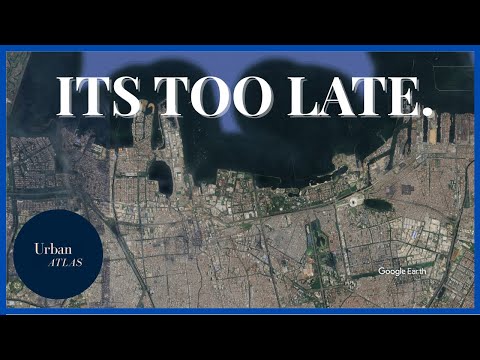
Not only is this situation not sustainable as underground reserves are depleting, but this also causes the ground to collapse under the city, causing Jakarta to be nicknamed “the Sinking City”, with a part of North Jakarta sinking by as much as 25 cm annually.
This had catastrophic consequences for the city, as 40% of the urban area now sits below sea level. This led to increasing damage from coastal tidal surges, combined with an increased monsoon intensity due to climate change.
The production of roughly 14,000 tons of waste daily by the city is overwhelming landfills and polluting waterways.
Lastly, regular catastrophic floodings from 13 major rivers in the vicinity are another issue, due to the tropical rain during monsoon and often poor drainage and trash blockage.
In the long run, it is possible that an entire section of the city will be lost to the sea.
Or maybe not, if the Great Sea Wall project, a multi-billion dollar massive infrastructure initiative designed to save the city and the region with 500–700 kilometers of dikes and seawalls. It might cost $40B-$80B and is expected to take multiple decades to be built.
Jakarta Air Pollution and Traffic Congestion Issues
The presence of up to 20 million motorized vehicles and nearby coal-fired power plants makes its air one of the world’s most polluted, if not the most polluted, as a lack of moisture in the atmosphere and other meteorological conditions make the atmospheric conditions even worse.
The same vehicles are also famous for causing endless congestion, with poor traffic estimated to cost the city up to economic losses estimated at roughly 2% of its GDP.
However, as long as the city is the country’s political, economic, and cultural centre, its population is expected to keep rising. And this is a trend difficult to break, even with the planned move of the capital to Nusantara
Nusantara Overview
Developing Nusantara: Site Selection and Construction
The need to reduce population pressure in Jakarta is why the main goal of Nusantara is to relocate part of the country’s political and cultural center out of Jakarta and Java Island entirely.
The name “Nusantara” is an Old Javanese term meaning “outer island” or “archipelago”, a term equivalent to the Malay Archipelago outside of Indonesia.
The site selection took many years, with a key requirement being relatively free from earthquakes, tsunamis, and volcanoes, as well as allowing for a maritime port.
Ultimately, the jungles of eastern Borneo have been chosen as the site for Nusantara. Borneo Island is sparsely populated and the world’s third-largest island.

The exact site is a hilly landscape of forests and oil palm plantations 30 kilometers (19 miles) inland from the Makassar Strait.
The project is managed by an agency known as the Nusantara Capital City Authority. It differs from other Indonesian cities as it is directly accountable to the central government.
The initial stage of development involves constructing government facilities and other buildings for the expected initial population of 500,000 people, according to the project website. At the end of 2025, its population was 147,000 people, mostly living in existing villages, with 1,700 to 4,100 civil servants ordered to move within 2026.

Nusantara Project Cost, Size, and Timeline
The project is expected to cost up to $35B, with a funding split expected to be 20% funded by the Indonesian state budget (APBN) and 80% intended to come from private and foreign investment. By mid-2025, the required investment had reached around 1/3rd of the total planned.
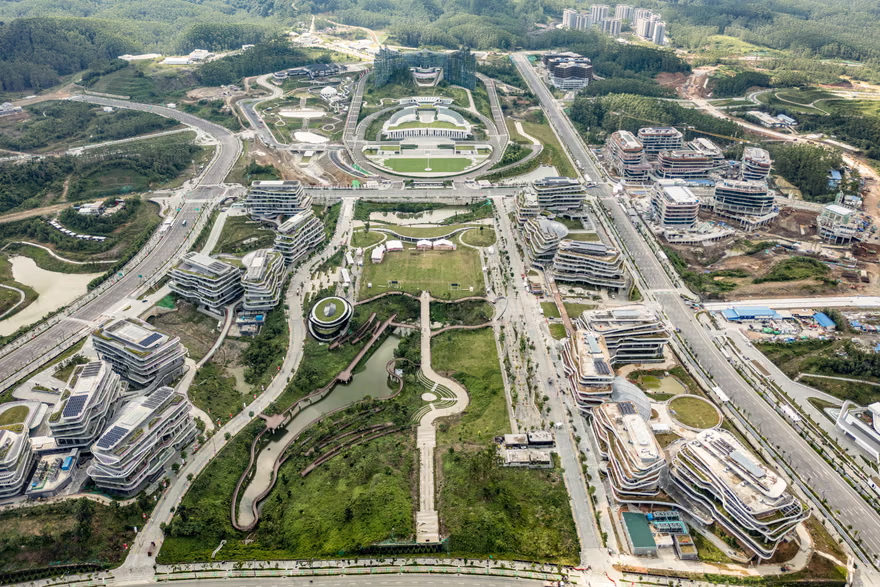
The new Indonesian capital will occupy 256,142 hectares, roughly 3x the size of Singapore. A city of 6 million people, which means that Nusantara will likely be relatively low in population density, matching its “green” ambitions (see below), with only a quarter of the whole surface to be developed, and the rest preserved as parks and natural reserves.
The stretch of land between the capital and the sea will also have many natural reserves to preserve its rich ecosystem of mangroves, proboscis monkeys, and Irrawaddy dolphins.

Between 150,000 and 200,000 workers have participated in phase 1 of the construction.
Water, the bane of Jakarta, will be managed with many brand-new infrastructures:
- The Sepaku Semoi Dam, providing a capacity of 2,500 liters per second, adds to the 3,000 liters per second of the Sepaku River Intake and reduces the risk of flooding.
- Water will be distributed with a 16-km main pipeline
- A 50 MW solar power plant has already been built, and more green energy infrastructure is planned.
The project was initially planned to be open by 2026, but it is now expected to be operational only by 2028, and fully finished by 2045 for the 100th anniversary of Indonesia’s independence. Today, it is mostly basic infrastructures and the presidential palace, key ministry offices, and infrastructure for initial relocation that are finished.
Nusantara’s Green Ambitions
Like many modern megaprojects, such as the Saudi “NEOM“, Nusantara has large green ambitions, looking to become a template and a model for other Indonesian cities and the world.
The dedication to space, in a country where cities are overcrowded and overpopulated, is a first element, with 75% of the city reserved for forests and open green areas. Overall, all residential areas are designed so that essential amenities and public transit are reachable within a 10-minute walk or cycle.
The city is expected to be entirely powered by renewable energy, using the untapped hydropower potential of Borneo Island and the powerful sunlight at the tropical latitudes, with already 104,000 tons of CO2 emissions saved annually by a 50 MW solar power plant. In total, up to 2GW of solar and wind capacity will be installed to service the city.
Another key part fitting both this green agenda and improved urbanism is a steep decline in the use of individual vehicles. The target is for 80% of transport to be supported by non-private means.
So the city is planned around dense, walkable areas, and will feature a citywide network of cycling paths, two rail lines for a metro system, a bus rapid transit system, and autonomous electric minibuses.
Nusantara: Indonesia’s AI-Powered Smart City
Starting from scratch, a new city is also a great way to change governance methods.
Nusantara will be a so-called smart city, with digital infrastructures like a 5G network and a 160 petabyte National Data Centre powering real-time city management.
Its Integrated Command and Control Centre (ICCC) will use AI-powered sensors and surveillance to monitor urban activities, manage traffic, and coordinate emergency responses.
Agentic AI and federated knowledge platforms will be deployed to let the infrastructure “learn” and optimize services like energy distribution automatically.
Residents will access all the city’s services (health, education, and administrative) through the IKN Smart City App, which includes a centralized digital identity for secure identification.
This infrastructure will be physically supported by a network of Multi-Utility Tunnels (MUT), where all essential utilities (power, fiber-optics, water) are housed in smart underground tunnels, equipped with sensors for real-time leak and fault detection.
The city will also have six economic clusters centered on new technology to make it not just an administrative city, but also an R&D and innovation center:
- Clean Technology Industry
- Integrated Pharmaceuticals
- Sustainable Agriculture
- Ecotourism and Health Tourism
- Chemicals and Downstream Products
- Low-Carbon Energy.
Nusantara Transportation: Roads, Rail, and Airports
Located so far from the current capital and the economic and demographic center of the country, the new capital will need good connections to the rest of the country.
Locally, this will include a 47 km (29 miles) toll road to connect the government central area with nearby Balikpapan. The road will also cross the river estuary and sea with a new bridge on Balang Island to the south.

A new intercity and regional rail system will connect Nusantara with Samarinda and Balikpapan, as part of the broader Trans Kalimantan Railway network that will connect the entire Indonesian side of Borneo Island with rail service.
The city will also be served with air connections by the nearby Aji Pangeran Tumenggung Pranoto International Airport located at Samarinda, Balikpapan’s Sultan Aji Muhammad Sulaiman Sepinggan Airport, and a new Nusantara International Airport (VVIP Airport).
The Future Of Nusantara and Indonesia
Progress and Criticisms
Like many such ambitious and mostly politically motivated projects, Nusantara has drawn its fair share of criticisms. Besides concern about the impact on the relatively pristine natural ecosystem of Borneo and the native population, skepticism about the realism of the plans drawn is partially warranted.
The Indonesian state does not have an unlimited budget to spare for this new capital, and many believe the same money could have been put to better use building public infrastructure in Jakarta instead. And of course, there is the potentially bad optics of the government “running away and abandoning” Jakarta and its inhabitants for a cleaner, less crowded, and overall nicer new city.
Covid-19 added further delays and disruption to the initial plans.
However, the Indonesian government still seems committed to the project, despite the delays, and has started to move key administrative personnel to the new city.
It is also a key project to balance out the economy and urbanism of Indonesia, a country made up of a few large and many small islands, but whose political, cultural, and economic direction has long been entirely dominated by Java Island.
And the test deployment of key technologies like green energies, autonomous vehicles, and smart city systems could be the template to make the rest of the country’s economic development more sustainable and benefit the everyday life of ordinary citizens.
What About Jakarta?
Still, this change might not change much for Jakarta, as the city concentrates a lot of the economic growth and dynamism of the country, leading to its population growing much faster than the expected relocations to Nusantara.
And this also does not solve the issue of sinking ground level, flooding, pollution, or congestion in Jakarta or Java Island at large.
So the end result of this project will probably be a little bit like in the case of Brazil. A separate administrative city working as the capital (Brazilia and Nusantara), but the former capital remains the country’s largest city by population and economic activity, with all the advantages and dysfunctions that come with it.
Investing In Nusantara
Caterpillar
Caterpillar Inc. (CAT -1.06%)
The Nusantara project is looking for investors for many of its key infrastructure projects developed with private partners, and even has a dedicated website for investing in land, real estate development, or commercial activity.
However, a project of this size will ultimately be first and foremost a construction and civil engineering project. One key partner of the Indonesian government in this task is Caterpillar, the heavy machinery company.
Caterpillar is using Nusantara as a proving ground for its Autonomous Construction Fleet, recently unveiled at the technology trade fair CES in Las Vegas.
The company integrates AI, machine learning, computer vision, edge computing, LiDAR, radar, GPS, and high-resolution cameras to give its construction equipment the ability to work autonomously. As the tech reaches level four of autonomy, it is just one step before fully autonomous operations.
This can help construction projects to be not only more efficient but also safer.
“Safety is really our litmus test for autonomous technology — taking jobs that are repetitive and hazardous and enabling a remote operation solution. By embedding autonomy into construction workflows, we’re reshaping the industry to achieve safer jobsites, better jobs and easy precision that redefines productivity for the modern jobsite,”
This is not a new development, as the company has introduced autonomous haulage in large, open-pit mines since 2013.
This is now expanding to a much wider range of the company’s machines, with tools used for building roads and other infrastructures like loaders, dozers, haul trucks, excavators, and soil compactors. This could prove a durable advantage for Caterpillar over less advanced competitors, with less capital.

The company is also a leader in building carbon-neutral heavy machinery, deployment of AI in construction sites (beyond “just” autonomy), and a giant in energy generation (large diesel engine and gas turbines) and rail transportation (locomotive, train engines, rail infrastructure).
(You can also read more about Caterpillar operations around the world in our investment report dedicated to the company.)
Latest CAT (CAT) Stock News and Developments
Caterpillar vs. Komatsu: Which Equipment Stock Has the Edge Now?
zacks.com
•
March 20, 2026
Goldman Sachs Large Cap Value Fund: Q4 2025 Portfolio Attribution And Review
seekingalpha.com
•
March 20, 2026
Coastline Trust Co Increases Stake in Caterpillar Inc. $CAT
defenseworld.net
•
March 20, 2026
Centaurus Financial Inc. Sells 1,035 Shares of Caterpillar Inc. $CAT
defenseworld.net
•
March 20, 2026
Oil Spike Sends Indexes Lower, but the Selloff Stays Shallow
fool.com
•
March 19, 2026
My Top 2 Megacap Stocks to Buy After GE Aerospace's Latest Pullback
fool.com
•
March 19, 2026