
Aerospace
Building Martian Habitats Might Be More Efficient With Bacteria

 Add Securities.io to your preferred sources on Google

The Moon was the target of the 1960s space race, and today it is once again the focus of attention of the new space race between the USA and China. But no matter how many Moon bases are built, or even if a complete industrial infrastructure for a space project is created on Earth’s satellite, it will stay an irradiated, hostile, airless place hostile to human life.
In contrast, despite its much greater distance and difficult conditions, Mars is the planet in the solar system the most likely to ever see a successful attempt at colonization. This is because the planet already has an atmosphere, has recently been revealed to actually be water-rich underground, and might contain large reserves of CO2 that could be used to make the atmosphere more dense.
Meanwhile, it also appears that the red planet might have harbored life in the distant past, or could even have bacterial life underground today. And some of Earth’s toughest species of moss and lichen might even survive there.
And this is truly the core of the issue. Mars is hostile, but has the resources and conditions where a slight alteration could help make it viable for life, a process called “terraformation”. For example, Martian dust of iron nanorods could be used to raise the temperature just enough for microbial life to prosper.
However, any terraformation proposal that relies on orbital megaprojects (orbital mirrors, artificial magnetic shield) or mining millions of tons of materials would also imply a massive local population able to sustain such a megaproject, a population that will struggle to survive in this harsh environment in the first place.
Which is why other researchers are turning to self-replicating “machines”, better known as microbes, to start providing the early colonists with the materials needed before consideration of terraformation plays a serious role.
The nonprofit research organization Pioneer Labs announced it has created the “first microbe for Mars” that could provide the first Martian colony with an ample supply of habitable space before any human set foot on the planet.
“We found the best microbe on Earth and used evolution to teach it how to source all of its nutrients directly from Martian materials. The first astronauts will be greeted with safe shelter already filled with water, oxygen, and rocket fuel for the return journey.”
Erika Alden DeBenedictis – CEO of Pioneer Labs
Pioneer Labs published its work in a scientific paper titled “Mars Seed: A Reference Architecture for Biomanufacturing Habitats from Martian Resources”. The idea is to biologically turn Martian resources into polyhydroxybutyrate (PHB) bioplastic, with the landing of only one Starship-size rocket enough to provide the materials for the initial Martian base.
How Much Material For A Martian Base
Heavy-lift launch systems such as SpaceX’s (SPCX ) Starship could substantially increase the cargo available for future lunar and Martian missions. However, delivering large payloads to the Martian surface still requires capabilities including in-space refueling, reliable interplanetary transportation, and safe landing of heavy equipment.
A human Mars mission would also require a different logistical approach from Apollo. Travel takes months, and the surface infrastructure must support the crew throughout its stay. Producing water, oxygen, construction materials, and potentially return propellant locally could reduce the amount that must be transported from Earth.
One option is to bring to Mars everything the astronauts will need: shelter, energy production, food, etc. In that idea, at most, water and oxygen might be produced locally, a process called “in-situ resources utilization” (“ISRU”).
Existing mission architectures already incorporate advance cargo delivery and local resource production. The Mars Seed paper discusses the 2026 National Academies science strategy, including its 30-Cargo-300 campaign, which combines an initial short surface visit, a cargo mission, and a later long-stay crewed mission. Such approaches illustrate why infrastructure may need to operate across multiple launch windows before supporting an extended human presence.
In addition to being ship/cargo-intensive, these methods would also scale poorly, with any subsequent missions or larger human presence requiring ever more cargo ships of prefab habitats and other materials.
Bioproduction on Mars
Microbes Over Machines
Instead of complex machinery, Pioneer Labs has been working on “Mars Seed”. As the name indicates, the idea is for one initial ship to deliver a biological “seed” that can then produce a continuous supply for future Martian missions. Ideally, such solutions would require no Earth-supplied nutrients, and the purification of bioproducts would require no consumables like resin, contrary to most bioproduction methods proposed in the past.
“An end-to-end reference architecture is needed that accounts for every step from Martian resources to purified product and can establish a framework to calculate when deploying the complete system becomes preferable to shipping the product itself. ”
Pioneer Labs claims to have created just such a concept, with 20 tons of cargo sent to Mars enough to produce 870 m² of habitable space.
Such habitats could last for years and decades, and be easy to repair or maintain with additional supply of bioplastic. And more importantly, it could keep going for years or even decades with minimal need for new equipment.
“Production can subsequently continue without resupply, only limited by equipment lifetime. The Mars Seed biofoundry establishes a scalable habitat construction process, allowing prioritization of scientific payloads and other consumables in subsequent launches. ”
So overall, not only could this design provide ample space for an initial Mars landing, but the infrastructure it built can be reused for years, and it will keep building more materials for later expansions.

Source: Pioneer Labs
A Two-Step Infrastructure
The first part of the Mars Seed is not entirely dissimilar from other initiatives for in-situ resource utilization (ISRU), with 20 metric tons (tonnes) of equipment landing at a mid-latitude site on Mars, near shallow ice deposits.
The “abiotic part includes robotic systems to unload the cargo and set up a 40 kWe nuclear fission reactor, which provides power to assemble the rest of the facilities. A few other facilities are set up as well:
- A Rodriguez /Rodwell wellis dug to create a steady supply of water.
- An electrolysis system (powered by the nuclear reactor) turns atmospheric CO2 into oxygen and acetate.
- Martian regolith (surface rocks) is excavated robotically and leached to extract nutrients like nitrogen, phosphorus, sulfur, and trace elements. This should require 800 kgof regolith per day.

Source: Pioneer Labs
This step implies around 90 days to set up the whole operation.
Then, four 1,000 liters heated and pressurized bioreactors are filled with this feedstock of nutrients, acetate, and water, and inoculated with an engineered microbe.

Source: Pioneer Labs
The microbe generates a bioplastic polymer, which is separated from the remaining liquid medium.
The bacterial culture is separated into bacterial biomass, which is mixed with regolith and printed to form a thick shell, which is later buried under two meters of regolith for radiation and thermal protection.
The extracted and purified plastic is 3D-printed to form a pressure-containing liner that seals the future human habitat from the outside.

Source: Pioneer Labs
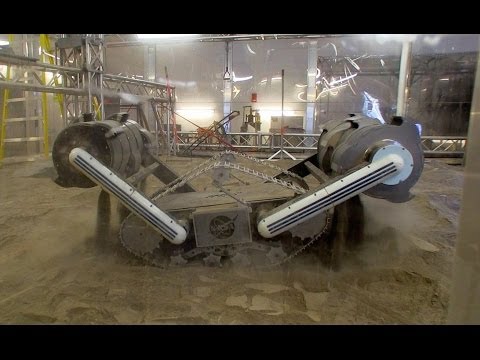
Alongside nutrient leaching, the required 3,200 kg/day implies a robotic capacity of moving regolith of 4 tonnes per day, which is within the capacity of already conceptualized rovers like Astrolab FLEX or NASA’s RASSOR.
Quick And Efficient
The first habitat should be built after just 210 days. After about 50 Earth months (1,500 sols) of operation, this process produces 870 m2 of livable area.
In general, one habitat is considered by NASA as enough for two people at about 35 m2 per person, making the 870 m2 surface adequate for a relatively large crew of up to 20-24 people.
It is also efficient in terms of energy utilization, as the 40 kWe nuclear reactor creates 130 kW of waste heat, which is used to keep the bioreactors warm and the well flowing with melted ice.
Similarly, the production of acetate to feed the bacteria creates surplus oxygen, which can be stored for the arrival of astronauts. This is superior to the original MOXIE design (Mars Oxygen In-Situ Resource Utilization Experiment) to produce oxygen on Mars, which treats the CO generated as a waste product, while it is here used to produce acetate and oxygen.
Overall, the electrolysis is by far the most energy-intensive part of the process, with every other operation consuming only 1/3 of the total energy required.

Source: Pioneer Labs
The purification of the plastic can be accomplished with supercritical CO2, a molecule making up the majority of Mars’ atmosphere.
Lastly, the leaching of nutrients from regolith is also rather simple and would require stirring the mix, consuming only 0.5 kW under Martian gravity.

Source: Pioneer Labs
Overall, each piece of the Mars Seed project is made of known technology and relies on existing machines or already created prototypes, greatly reducing the risk from new and untested technologies.
It is also a remarkably “mass-efficient” design, with the nuclear reactor as the larger component, a type of machine that would anyway need to be shipped to supply the astronauts with energy for electricity, heating, food production, and fuel production.

Source: Pioneer Labs
The Right Scale
This level of efficiency puts the Mars Seed in a league of its own when it comes to creating Mars habitats.
For example, an alternative could be sending a 1,000-kg nuclear power system, the necessary robotics for regolith mixing and extrusion infrastructure, with a total mass of 6,500 kg. Remaining mass up to 20,000 kg can be used to launch raw polymer, which would be enough for 800- 1,200 m² of habitable surface.

Source: Pioneer Labs
But Mars Seed, in comparison, can produce this result in 1,400, and then continues producing 2,100 m2 of habitable area over a ten-year timeframe, the equivalent of shipping 43,000 kg of extrusion infrastructure and polymer materials to Mars.
Continuous production also helps to create more flexibility, for example by providing material for repair or small extensions.
Alternatively, the modular design of the system also allows for a “mini-Mars Seed,” creating only 210 m2 of floor space for a six-person crew for only 40% of the mass of Mars Seed. This would only use a fraction of the weight and power of the initial design, freeing these resources for other applications.

Source: Pioneer Labs
Making It Happen
Creating The Right Bacteria
The team at Pioneer Labs started with Cupriavidus necator, a bacterium that can accumulate bioplastic polymers such as polyhydroxyalkanoates (PHAs) at up to ∼90% dry cell mass in as little as 24 to 48 hours (as a form of biological energy storage).
A strain of this microbe, especially selected for its adaptation to Martian conditions and growth from consuming acetate, was chosen. It was successfully grown in Mars-like conditions in a 550 kg bioreactor made with a three-millimeter outer shell of 316 stainless steel, pumps, instrumentation, and a carbon fiber skid.
An important element is also that this bacterium would be completely unable to survive outside the bioreactor.
“We chose an organism that would be tremendously useful when fed by humans and grown inside a bioreactor on Mars, but that has absolutely no chance whatsoever of growing outside. We even measured just how dead this microbe would be if it escaped the confines of its bioreactor. sPL.001 is rapidly sterilized by exposure to the harsh conditions on Mars”
This is important as we are still not sure whether non-native lifeforms exist on Mars or not. So avoiding contamination is still a strict policy from NASA.
“sPL.001 is a useful tool for humans to use as part of living on Mars, but has no chance of terraforming Mars on its own. When humanity terraforms Mars, it’s important that it is on purpose, not by accident.”
Dealing With Martian Problems
The bioreactors are designed to shelter the bacteria from the cold, low pressure, and radiation that make the surface of Mars deadly even for such resistant organisms.
However, the design needed to address another risk: perchlorates. These compounds are highly oxidative and often cited as a reason why Mars’ soil is “toxic”. And it is true that most plants would struggle to adapt to the concentration found in Martian regolith.
However, Mars Seed intends to mix 400 grams of regolith with a liter of water; this will create a non-negligible concentration of perchlorate, but not a concentration that the microbe used by Pioneer Labs cannot handle (30 mM).
Another issue with perchlorate could be the residual amount in the liner post-purification. Pioneer Labs acknowledges that this is an unknown factor, and that more studies might be needed to check that the final product meets human-safe levels.
Beyond Construction Materials
On Earth, biofermentation is a key ingredient in the production of many chemicals and industrial processes.
The first improvement could be the production of other useful plasting, including from other bacterial species.
“With genetic engineering, C. necator can produce a number of different bioplastics, such as longer chain length PHAs or PHA co-polymers, like with PLA, that expand the potential physical properties of the resulting material to include flexible or rubber-like polymers.”
Other organisms could also be used to produce recombinant proteins, isopropanol, terpenes, 2,3-butanediol, and acetoin.
Another option could be using sugar instead of acetate as the feedstock for the bioreactor. However, this requires establishing a parallel line of production for sugar, either through algae cultivation or a chemical process. Similarly, hydrogen-oxidizing microbes could live off hydrogen and CO2 directly, but here too, a parallel supply chain for hydrogen (electrolysis from water?) needs to be established.
Later on, in-situ production of pharmaceuticals and recombinant protein in bioreactors could avoid imports from Earth, but such production often requires specialized consumables (resins, membranes, solvents, adsorbents), which would then need to be imported or also produced locally.
Conclusion
What makes the Mars Seed bioreactor proposed by Pioneer Labs revolutionary is not so much its technical design, as it relies on known technology.
It is that we are finally getting to a stage where continuous local production of material for Martian exploration can be considered as a project that theoretically could be deployed as soon as SpaceX achieves reliable in-orbit refueling of its Starship rocket, which might be only a few months away, a few years at most.
In addition, the proposed design only requires 20 tons of cargo, which is much lower than most modern reusable rocket designs’ capacity to Mars. So, depending on budgets, surviving on Mars might no longer be a limiting factor in exploring the red planet. Instead, developing safe manned travel for 6-18 months is the last roadblock to remove.
Most likely, the next important step will also be to develop a method for reliable in-situ food production, which, after fuel, habitat, and water, is the heaviest type of good required by a future Mars base and Martian colonies.
Once all these four productions are set up, likely with a mix of nuclear power and bioreactors, most of the 100 tons of cargo in a Starship rocket can be dedicated to crews, scientific instruments, and other key equipment.
In that respect, this also means that with the exception of travel time, the exploration of Mars could paradoxically be easier than building bases on the Moon, where the lack of water and atmosphere are putting a hard limit on human presence.
Investing In Space Exploration
SpaceX
SPCX Price Chart
In recent years, no other company or institution has been contributing as much to restart interest in space exploration as SpaceX.
This is because the company achieved what was long thought impossible: fully reusable rockets. This radically cut the cost of reaching orbit by an order of magnitude, and this before the routine flight of SpaceX’s latest rocket: Starship, a super-heavy rocket with 100 tons of lift capacity, and potentially up to 200 tons for a later iteration of the design.

Source: Visual Capitalist
Combined with the in-development refueling in space, this makes Starship the perfect rocket for delivering hundreds of tons of cargo for established lunar and Martian bases.
The company has recently performed its long-awaited IPO, which turned out to be the largest in history, with a valuation at the time of $1.75T.
In addition to space launches for private customers and public institutions (NASA, US Space Force, etc.), SpaceX is also becoming a major telecom company with its Starlink Internet satellite system, which now makes up more than half of all satellites ever sent into orbit.

Source: ARK Invest
Besides rocketry and telecom, SpaceX is also now a leading AI company, after its absorption of xAI (also owning the social media X.com) ahead of the IPO. The connection between space and AI is not just trend-following, as SpaceX plans to launch orbital AI data centers that would leverage the lower regulatory constraints and free 24/7 sunlight to offer compute at a lower price than land-based AI data centers.
The merger with xAI has also triggered rumors of a future SpaceX-Tesla merger, bringing together under one umbrella all of Elon Musk’s ventures.
All these factors made the SpaceX IPO one of the most followed and discussed events in finance in 2026. At the time of writing this article, the initial boom and then decline of the stock price has somewhat calmed down, bouncing back from the lows of August 2026.
Investors in SpaceX will need to determine not if the company is impressive technically (a given considering its past achievements), but also if the future growth of revenues from Starlink and AI data centers justify the relatively high current valuation relative to current earnings.
(You can read more about SpaceX in our articles about the company’s IPO and the immediate follow-up)
Latest SpaceX (SPCX) Stock News and Developments


