

Aerospace
SpaceX’s Lunar Pivot After the xAI Merger

Securities.io maintains rigorous editorial standards and may receive compensation from reviewed links. We are not a registered investment adviser and this is not investment advice. Please view our affiliate disclosure.

SpaceX has always stated the company’s mission as a variation of “making human civilization multiplanetary”. Until very recently, this was assumed to mean a permanent base on Mars, with the long-term goal of building a self-sufficient city or network of smaller bases of at least a million people in total.
In that context, any other space exploration project was either a good option for SpaceX to develop new capabilities with NASA research budgets, like the Artemis missions, but the real goal remained Mars. So even if the USA and China were in a tight space race to get back to the Moon, SpaceX looked at a different target. Or as Musk explained less than a year ago in X post:
“No, we’re going straight to Mars. The Moon is a distraction.”
This seems to have changed, as SpaceX recently announced that it shifted its focus to building a “self-growing city” on the Moon, which Elon Musk claims could be achieved in less than 10 years.
So why the sudden shift, and what do the space colonization plans of SpaceX look like now?
Moving Into Space
So Much To Build
The idea of building outposts and then population centers on other planetary bodies is as old as our discovery that Earth was just one among many planets in our solar system.
To do so, a few key issues need to be solved, in addition to cheaper transport, a problem that is almost already resolved with SpaceX’s super-heavy rocket Starship now operational.
The first one will be to learn how to handle all the life support infrastructure (air, water, food, radiation shielding, etc.) for tens or hundreds of people, instead of the 2-10 astronauts sent at a time in space so far.
Another one will be to learn to use local resources to provide the bulk of the material needed, reducing the “imports” from Earth to machinery, electronics, and humans. This includes water, fertilizers for growing food, metals, fuel production, energy generation, etc.
Lastly, the infrastructure to support people will also need to be developed, from living quarters to entertainment and hospitals, and ultimately, schools and good living conditions for families.
Moon Vs Mars
The debate between using the Moon or Mars as a first colony site outside of Earth has been ongoing for a while.
The Moon has a few serious problems compared to Mars, which justified the initial stance of SpaceX:
- No atmosphere means zero protection against radiation and micrometeorites, nor any possibility of getting resources from the ambient air.
- No air also means no liquid water, and overall, very limited water resources.
- The lunar night lasts 14 days, making it very inconvenient for any solar energy generation, virtually forcing the use of nuclear power and/or needing massive battery systems.
So from that perspective, the larger Mars, with relatively abundant water and mineral resources, seems just better.
However, the Moon has a serious advantage in one respect: proximity.
It currently takes only a few days to reach the Moon. This means that any experimental offworld city will be able to be resupplied or rescued from Earth resources very quickly if needed.
In contrast, Mars is 6-18 months away, with even light and radio signals taking up to 40 minutes to reach the red planet. But this is nothing new, so what changed Elon Musk’s and SpaceX’s opinion about where the first human colony should be founded?
Why the xAI–SpaceX Merger Changes the Strategy
xAI/ SpaceX Merger
To understand this news, we need to see what changed in SpaceX’s business plans. The rocket company recently merged with another of Musk’s ventures, xAI, one of the top 5 artificial intelligence startups in the world, and the owner of X.com (formerly Twitter).
The merger was motivated by the emerging business possibility of powering AI data centers not with Earth-bound power grids, but abundant orbital sunlight. As the company explains its logic:
“Current advances in AI are dependent on large terrestrial data centers, which require immense amounts of power and cooling. Global electricity demand for AI simply cannot be met with terrestrial solutions, even in the near term, without imposing hardship on communities and the environment.”
In total, no less than a million satellites are envisioned.
Still, no matter what, sending material into orbit from Earth will always carry a certain cost, so the economics of orbital data centers will always somewhat suffer from this fact. Except that Earth is not the only potential source of material to build massive satellite constellations.
Mining The Moon
The surface of the Moon (regolith) is actually rather mineral-rich. It is made mostly of oxygen (43%) and silicon (20.1%), but also a lot of metals: 12.5% iron, 7.4% aluminum, 6.1% magnesium, and 1.8% titanium. This means that it could provide all the metals we would need to build large habitats and solar panels for a Moon Base.
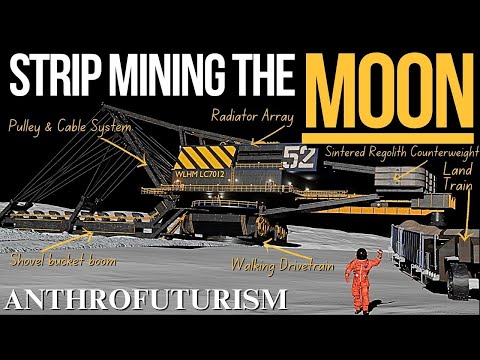
But the same resource could also be used to manufacture the building blocks of AI data centers, or at the very least the solar panels to power them, with that abundant silicon supply.
As the Moon has only 1/6th of Earth’s gravity, sending material into space, be it deep space or Earth orbit, is incredibly easier than from Earth.
So now that SpaceX has a plan for a new near-Earth massive market, which will benefit from manufacturing being set up on the Moon, the benefits of a lunar city have improved massively.
In addition, the Moon has the extra advantage of having no atmosphere. Combined with low gravity, this means that any object moving sufficiently fast, even horizontally, can reach escape velocity.
So the idea emerged to use a maglev/mass driver (space catapult) to launch off the Moon satellites, removing the need for rockets almost entirely. This is also exactly what Musk describes in his plans for the xAI / SpaceX merger.
“By using an electromagnetic mass driver and lunar manufacturing, it is possible to put 500 to 1000 TW/year of AI satellites into deep space, meaningfully ascend the Kardashev scale and harness a non-trivial percentage of the sun’s power.”
A Global Crisis Looming?
Another less acknowledged motivation is that building on the Moon will be quicker and cheaper. The closer proximity reduces the need for redundancy, makes catastrophic failure less likely, and overall reduces the need for a lunar city to be fully self-sufficient from day 1.
It will also take a lot less time to be up and running.
“The mission of SpaceX remains the same: extend consciousness and life as we know it to the stars. SpaceX will also strive to build a Mars city and begin doing so in about 5 to 7 years, but the overriding priority is securing the future of civilization and the Moon is faster.”
The broader context is a degrading international stability, including the war in Ukraine, a possible war with Iran soon, growing tensions with China, the recent Venezuela intervention, and even the talks of the USA annexing Greenland. AI and high global debt levels could also cause high volatility in the global economy. If a global crisis were to unfold, it could dramatically affect supplies to any offworld base or nascent colony and its potential survival, especially if the required technologies and infrastructures are not mastered yet.
So it is possible that beyond the business case for AI satellites made on the Moon, a more crisis-proof plan that first tests the method on the nearby Moon, and then deploys the first Martian base in 10+ years, is being preferred.
Conclusion
It is possible that the idea of jumping straight to a Martian colony was always more an effect of Elon Musk’s famous optimistic forecasts than a realistic plan. In practice, making sure hundreds of astronauts can be kept healthy for months and years, and setting up even basic manufacturing on another world, is completely unprecedented. So it was maybe unavoidable that the less ambitious but safer alternative of a Moon colony would happen first.
Combined with the promises of orbital AI data centers, and maybe even power satellites beaming back energy to Earth grids, this would make the Moon the first stepping stone in truly making mankind a space-faring species. And from there, the lessons learned could be applied not just to a Martian outpost, but even more distant projects, including asteroid mining.
Investing In Lunar Colonization
Intuitive Machines
Building interplanetary colonies is going to require a strong expertise in building large space probes and making them arrive in the right place intact. This is changing as we are getting closer to the point where private companies could start sending automated or manned missions to mine asteroids, especially near-Earth objects.
Founded in 2013 in Houston, Texas, Intuitive Machines is, for now, a very “Moon-focused” company, as indicated by its stock ticker LUNR, and has already been selected for 4 NASA lunar missions, and employs 400+ people.

Source: Intuitive Machines
It was the first commercial company to successfully land and transmit scientific data from the Moon. The company is working on many projects that will form the base of a lunar infrastructure for exploration and settlement.
The first one is the “data transmission service”, with the technology being tested, and ultimately looking to end with a lunar data transmission constellation around the Moon’s orbit.

Source: Intuitive Machines
The second part is the “Infrastructure as a Service”. It should include an LTV capable of autonomous operations, the telecommunication service, and GPS localization services.

Source: Intuitive Machines
The last segment is the delivery of material to the lunar surface. The next step will be with the Nova-D lander, able to deliver 1,500-2,500 kg of material to the Moon. This payload capacity and size will be the one required for delivery of the Lunar Terrain Vehicle (LTV), as well as the 40kW Fission Surface Power nuclear reactor expected to power the Moon base.

Source: Intuitive Machines
The company has landed many valuable contracts with NASA, for example, the Near Space Network contract, with a maximum potential value of $4.82B. Besides NASA, the company is trying to diversify its client base, having been selected in April 2025 for a grant of up to $10M by the Texas Space Commission.
As the company reaches a positive free cash flow point in Q1 2025, it is now becoming a lot safer for investors, moving away from a cash-burning startup to an established services provider to the growing space economy. It could form the building block of further deep space exploration, especially as it becomes a trusted partner of NASA on par with SpaceX or Rocket Lab (RKLB +10.21%).
(You can read more about Intuitive Machines in our investment report dedicated to the company.)



