

Megaprojects
Under-Ice Arctic Observatories: Data, Power, and TDY

Securities.io maintains rigorous editorial standards and may receive compensation from reviewed links. We are not a registered investment adviser and this is not investment advice. Please view our affiliate disclosure.

The Importance of the Arctic
The Arctic region has long been a mostly neglected region, due to its being almost uninhabited, extremely cold, and difficult to access. It is nevertheless a crucial area of the world for several reasons.
The first reason is that technological progress and humankind’s hunger for resources have made the Arctic more economically important today than ever. Global warming is also making these resources more accessible and opening new trade lanes.
This is also a region bordered by many nations, each with its own strategic interest, and mounting tensions between Russia and NATO countries (Canada, Norway, the USA, and Denmark, through Greenland, have all direct presence in the Arctic).

Source: Geological Survey Of Norway
Even with climate change, understanding and monitoring the Arctic is a massive technical and scientific challenge.
For this reason, a new generation of underwater probes and drones is being created to analyze the ice cover, survey underwater resources, and monitor the region.
Arctic Warming: Trade Routes, Climate, and New Resources
New Trade Routes
The Arctic region is warming 4 times faster than the global average.
This has led to the Arctic summer period seeing a lot more ice-free water than before, and the residual ice being a lot thinner as well, helping icebreakers to make it navigable for more months.

Source: BBC
As a result, the so-called Polar Silk Road, connecting Europe to China by passing through Russia, is becoming a strategic trade route. It can connect China and the UK in just over 20 days using an ordinary non-polar containership, thanks to Russia’s breakers clearing the ice on the way.
Sea Legend, which lists a fleet of 18 vessels on its website, said the new services took three years to plan. It had to overcome challenges, including upgrading the ship’s equipment, personnel training, and certification, as well as developing accurate weather and navigation forecasts.”
Importance For The Climate
The mass of cold air in the Arctic is an important factor in global weather patterns.
A change in the regional climate could also affect sea levels. Melting ice on the ocean does not directly affect sea level, as this is already floating ice. But the Arctic ice cap over the massive surface of Greenland could cause a significant sea level rise if it were to melt.
In addition, more melted ice means that instead of high-reflectivity ice, the surface is a lot darker, absorbing more of the sun’s energy, potentially causing further warming, both locally and globally.
Lastly, too much ice melting could disrupt the ocean current, especially in the North Atlantic, which is a key regulator of the global climate.
New Economic Zones
Besides trade routes, the warming of the Arctic waters creates new potential for economic activities. For example, easier navigation and warmer waters are likely to open new fisheries.
The Arctic region is also rich in minerals and energy:
- 97% of Russia’s reserves of platinum are in the Arctic.
- 93% of the iron ore used in the EU is produced in Sweden.
- 50% of Canada’s Northwest Territories’ income comes from mining.
- The region might contain 13% of the world’s undiscovered conventional oil and 30% of its undiscovered conventional natural gas.
Meanwhile, the mostly unexploited resource of Greenland includes significant reserves of rare earth minerals such as neodymium and dysprosium, enough to meet at least a quarter of future global demand at 38.5 million tonnes.
A situation that attracted the attention of a great power, most famously with the intent of Donald Trump to purchase Greenland at some point.
Greenland also has reserves of gold, iron, aluminum, uranium, zinc, lead, oil, gas, etc.

Source: Geological Survey Of Norway
Underwater resources could also become a new contested territory, with the Arctic especially rich in underwater mineral deposits containing metal-rich sulphides and mineral-rich hydrothermal sites.
Why the Arctic Needs New Under-Ice Data
Hard & Expensive To Collect
Arctic observatories provide the data backbone for safe development and environmental protection. A better understanding of the available resources and the surrounding ecosystem is really the only way to use these resources responsibly.
But traditional data collection tools are put to the test in the Arctic weather conditions:
- Surface buoys are destroyed by shifting ice.
- Satellites can’t see through thick ice sheets.
- Crewed missions are expensive and dangerous.
This is not to say that none of these are used. For example, the 2019-2020 Multidisciplinary drifting Observatory for the Study of Arctic Climate (MOSAiC) saw more than 600 people working in the Central Arctic to collect data during winter, when icebreakers could not penetrate the ice as it was too thick.
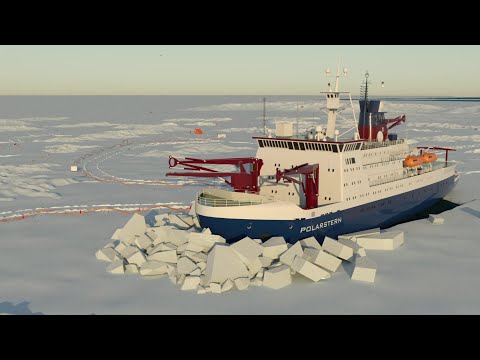
The scientists of the MOSAiC expedition studied the atmosphere, snow, sea ice, the ocean, and the local ecosystem. But at a $140M budget, such an expedition stands as an oddity.
Similarly, the “City Under the Ice” of Camp Century, in Greenland, is a relic of the Cold War. The U.S. Army Corps of Engineers built the military base in 1959 by cutting a network of tunnels within the near-surface layer of the ice sheet.

Source: NASA
The facility was abandoned in 1967 due to the complexity and costs of establishing a permanent settlement in these harsh conditions.
Autonomous Alternative
Progress in autonomous vehicles and battery systems has completely changed how the Arctic can be studied.
With autonomous underwater vehicles (AUVs) using long-duration battery systems, scientists can deploy observation points under the ice at much longer distances than in the past.
They can also use new types of sonar and LiDAR arrays that are both more powerful and less energy-intensive.
Finally, real-time satellite uplinks and AI-driven detection models allow these drones to be a lot more capable and independent than in the past, not having to be tethered to an observation ship or a land-based station to perform their mission.
As a result, continuous year-round Arctic monitoring is finally feasible.
Geopolitics
Better monitoring is also a strategic imperative for the military to monitor the region and ensure that each nation sees its territorial rights respected.
“There’s been so much change happening in the last 10 to 20 years, with climate change driving increased activity, geopolitical change, and technological change in the Arctic.
The warming trend is also allowing our adversaries to have a greater presence and access to the region.”
Iris Ferguson – Deputy assistant secretary of defense for Arctic strategy and global resilience.
Poor cartography and no direct presence can lead to one nation’s claim to the region’s resources to being challenged by another.
Overall, under-ice observatories will decide future territorial disputes and resource assessments.
So this makes under-ice drones and observation probes a key 21st-century geostrategic megaproject.
How Under-Ice Arctic Observatory Networks Work
Swipe to scroll →
| Component | Primary Role | Example Technologies | Key Arctic Use Cases |
|---|---|---|---|
| Autonomous under-ice drones (AUVs) | Mobile sensing platform that maps ice thickness, bathymetry, and ecosystems. | Sonar & LiDAR arrays, cameras, chemical sensors, long-duration battery packs. | Ice–ocean interface mapping, fisheries research, subsea infrastructure inspection. |
| Permanent seafloor stations | Fixed node for continuous monitoring of geology, chemistry, and acoustics. | Microseismometers, methane & CO₂ sensors, ocean chemistry probes, hydrophones. | Methane release tracking, seismic activity, long-term ecosystem and noise monitoring. |
| Acoustic communication network | Provides underwater positioning and data links when GPS and radio can’t penetrate ice. | Acoustic modems, positioning “beacons,” synchronized timing systems. | Safe navigation for AUVs, covert tracking of ships and submarines, data backhaul to hubs. |
| Surface uplink & satellites | Relays data from under the ice to global networks in near real time. | Cabled buoys, Iridium terminals, polar-orbit satellites, future Arctic constellations. | Real-time climate monitoring, maritime safety, strategic domain awareness. |
| AI climate & navigation models | Turns raw sensor data into forecasts, risk maps, and route guidance. | Machine learning models for sea-ice drift, storm risk, and ecosystem changes. | Shipping route optimization, military mission planning, fisheries and conservation policy. |
Autonomous Under-Ice Drones
While a lot of focus on drone technology is given to flying drones, in part due to their increasing role in military conflict, as illustrated by the Ukraine war, underwater drones are also progressing quickly.
The MOSAiC expedition already used an early version of this technology to analyze the interfaces between sea ice and ocean.

Source: Nature
It collects samples of ice, algae, zooplankton, and measures ice thickness thanks to sonar, imaging, chemical sampling, and upward-looking radar to map melting ice from below.
Permanent Seafloor Stations
Moving under-ice drones are a great option for dynamic analysis of the Arctic region and regular sampling.
However, other data points need a much more continuous form of observation, which can be achieved with seafloor measuring stations.
They can incorporate diverse instruments to monitor different phenomena:
- Microseismometers to detect geological activity.
- Ocean chemistry sensors to measure biological and environmental changes.
- Methane and CO₂ detectors to assess the contribution of the area to climate change.
- Hydrophones to detect the movement of ships and submarines.
Traditionally, such seafloor stations have been powered by cable from a nearby ship or ground station. For example, the MOSAiC mission used supplied power (6 kW) from the Polarstern ship by cable to heat the installations and to power the seafloor stations.
But long-term observation of the deep Arctic requires a different solution. Instead, sea current or tidal power can be used to generate a small but steady power supply to power these sensors.
If the power generation is sufficient, these subsea stations could also be used as underwater power stations and a recharging point for autonomous underwater drones.
Acoustic Communication Networks
As GPS doesn’t penetrate water, and ice blocks the possibility of easy access to the surface with a floating antenna, under-ice drones triangulate via acoustic modems and seafloor “beacons.”
This can be an additional function of an under-ice seafloor station, serving as a fix point that the drones can use to orient themselves.
Satellite Integration
Acoustic communication can be used to collect and centralize data, but it still needs to then escape the sea and under the ice to reach the researchers.
The solution is to use a data hub concentrating the acoustic signal into one point, and then using a cable to connect to a surface data uplink system.

Source: ResearchGate
The data uplinks can be connected to a polar orbit satellite, the Iridium network, or future Arctic-focused constellations.
AI Climate Models
All of the data collected in real time and all year round will then need to be integrated into useful predictive models.
Most likely, next-gen Arctic climate models will extensively use AI technology to improve their predictive capabilities. They will, in turn, be used by meteorologists, shipping companies, military/naval operators, fisheries regulators, and environmental agencies.
Conclusion: Why Under-Ice Arctic Observatories Matter
The new generation of under-ice observatory systems, from underwater drones to subsea stations, is going to revolutionize our understanding of the Arctic. This will be the first time we can get continuous observation of the region during the winter months, and with a much more detailed picture of the summer months.
This is not only a scientific project, but will have enormous ramifications for both economic activity and the geopolitical & military conditions of the Arctic.
So whether it is about monitoring methane emissions, ice thickness, local ecosystems and fisheries, detecting precious mineral deposits, or monitoring commercial and military ship activities, it is likely that under-ice observations will be a very important technology in the late 2020s and the 2030s onward.
Investing In Arctic Monitoring
Teledyne Technologies
Teledyne Technologies Incorporated (TDY -0.79%)
Founded in 1960, Teledyne Technologies is a technology conglomerate that leads in underwater drones and general marine instrumentation.
This includes hydrophones, sonar, fish tracking, measuring ice and waves, etc. It can be used for all sorts of scientific programs at sea.

Source: Teledyne
Teledyne’s underwater vehicles are used by initiatives like the Real-Time Aquatic Ecosystem Observation Network (RAEON), a Canadian research network that deploys Teledyne Slocum gliders and other autonomous platforms to monitor aquatic ecosystems in real time.
Among Teledyne’s AUVs are the self-contained, low-logistics Gavia Platform (500 m–1,000 m depth rating), the Osprey Platform (2,000 m depth rating), and the SeaRaptor Platform (3,000 m or 6,000 m depth rating), which can be used for both civilian and military applications (including demining).
It also provided supplies and instrumentation to the Canadian and European polar research expeditions.

Source: Teledyne
Among the most remarkable other scientific projects the company participated in are NASA’s mission to Jupiter’s moon Europa, the Habitable Worlds Observatory (HWO) to be launched in the late 2030s, or the Mars rover Perseverance.
The company is also active in digital imaging & sensors, aerospace and defense electronics, and advanced machinery and systems. These sensors and systems can be used by many industries, from healthcare to defense or energy.

Source: Teledyne
The company has grown through a mix of new R&D projects and acquisitions, with 74 acquisitions since 2001.

Source: Teledyne
This strategy has driven rapid top-line growth, with revenue rising from roughly $875 million in 2004 to more than $4.6 billion in 2020 and an estimated ~$5.6 billion in 2024, according to recent investor presentations.
The company’s largest market is the US (equally split between government and commercial sectors), followed by Europe.

Source: Teledyne
Today’s Teledyne is a leader in bringing autonomous and automated systems to the real world, including in the ultra-demanding conditions of the open sea or the Arctic. As the West reindustrializes and relocalizes its supply chain, companies like Teledyne will likely benefit from the trend and become an even more important industrial national champion for the USA.
This makes Teledyne a solid “picks & shovels” stock for underwater and space exploration, perfectly aligned with this megaproject.
Latest Teledyne (TDY) Stock News and Developments
Defender Capital LLC. Takes Position in Teledyne Technologies Incorporated $TDY
defenseworld.net
•
March 26, 2026
Assenagon Asset Management S.A. Boosts Stake in Teledyne Technologies Incorporated $TDY
defenseworld.net
•
March 26, 2026
Teledyne eXtreamer Receives 2026 Spotlight on New Technology Award
businesswire.com
•
March 25, 2026
Axon vs. Teledyne: Which Defense & Security Stock has Greater Upside?
zacks.com
•
March 24, 2026
Grove Bank & Trust Has $584,000 Holdings in Teledyne Technologies Incorporated $TDY
defenseworld.net
•
March 23, 2026
Teledyne to Demonstrate Integrated Satellite Communications Capabilities at SATShow Week 2026
businesswire.com
•
March 20, 2026



