
Robotik
Köpük Akışkanlarından Yararlanacak Yumuşak Robotik

 Securities.io sitesini Google'daki tercih ettiğiniz kaynaklara ekleyin

Sert Robotlardan Yumuşak Robotlara
When we think of robots, we either think of massive and bulky industrial robots or futuristic robots from science fiction, from the tamamen metal korkutucu Terminator'dan daha şık ve pürüzsüz iRobot tasarımına ve gerçek modern insan benzeri robotlara .

Kaynak: Sanctuary
Her durumda, pürüzsüz metal ve plastik yüzeylerin her yerde bulunması, hareketlerin pistonlar, hidrolik sistemler ve elektrik motorlarıyla oluşturulması sabittir.
Ancak, bu robotik tasarım, daha ince bir yaklaşım gerektiren birçok uygulama için sınırlayıcı olabilir. Örneğin, insan vücudu ile etkileşime giren robotlar ya da meyve toplama görevini üstlenen robotlar, hasar oluşmasını önlemek için daha esnek malzemeler ve daha nazik bir dokunuş gerektirir.
Bu ihtiyaca yanıt olarak, yumuşak robotik adı verilen yeni bir alan ortaya çıkıyor. Bu alan, yeni malzemeler kullanarak yumuşak ve esnek robotik sistemler oluşturmayı araştırıyor. Bu fikri daha önce, özellikle 3D baskının yumuşak robotlar inşa etmesine nasıl yardımcı olabileceği ve hidrojelin robotların çevikliğini nasıl artırabileceği konularında incelemiştik.
A new idea can now be added to this array of soft robotic techniques: köpük akışkanları.
Pnömatik Mantıktan Köpük Akışkanlarına
Researchers at the University of Texas studied how foam could be a new material from which to build robots. They discovered that the flow of air through the meshlike structure of open-cell foam can replace electronics, and published their results in a scientific paper titled “Embedded Fluidic Sensing and Control with Soft Open-Cell Foams”.
The key idea started from studying a scientific field called pneumatic logic circuits. The concept is to replace electronic computation based on electricity by fluctuation of air flows.
Until now, this concept has mostly mimicked the design of electronic circuits. This greatly reduced its potential, as for more complex calculations and sensors, the size and weight of the device would become a problem.
Instead, the Rice University researchers looked to use the pressure differences created by air flowing through the microscopic pores in foam sheets. When adding multiple layers of such foam, they could fine-tune the way the air flows through it. This way, they could perform complex pneumatic computations and control tasks but with a much simpler circuit design than traditional pneumatic logic.

Kaynak: Rice University
Analog Yerleşik Devre
A good example is how a section of the robot can respond to pressure. Traditional robotics would need complex electronic sensors, elaborate arms with multiple components to bend, and a battery-powered electric motor or hydraulic system to transmit and regulate the force.
Foam fluidics can instead have the reaction “built-in” the robot arm, bending when under pressure and reacting in proportion to the stimuli, like bending only half when pressed with less force.

Kaynak: Rice University
Achieving it was not without challenges. One was that air density changes with changes in pressure, requiring complex calculations to model the airflow through the foam.
Creating a theoretical model that accurately predicts the airflow and reaction of the foam was one of the most important parts of this research project. Only once this was done could a design with predictable foam fluidics be built.
Uygulamalar
Because foam fluidics does not rely on electronics and batteries, it can be much lighter than conventional robotic solutions. This is great for incorporating it into fabrics and clothing. Its ability to bend and move without damaging or increasing the rigidity of the fabrics also helps.
Eksozütler
One first application could be to help people with limited mobility, due to handicaps or injuries. There is already a growing market of exoskeletons based on “classic robotics” to help in such cases, something we discussed in “Independence and Mobility through Robotics – How Exosuits Can Help Those with Parkinson’s Disease“.
The same technology could help to reduce injury from work requiring lifting heavy loads as well, like in warehouses, factories, or the military.
We can easily imagine how foam fluidic-based robotics could be incorporated into such exosuits or even replaced entirely as part of custom-designed pants, shirts, etc., as they are easier to wear and more discreet.
VR / Haptik Teknolojisi
Haptic systems create a sense of touch in reaction to a stimulus. For a while, this was the next frontier of virtual reality and other simulation systems.
Foam fluidics can help create new types of haptic sensors, detecting movement, for example, and converting it into a message on a touch sensor. This could be used, for example, to create more accurate digital replicas of movement in simulations used in training doctors, emergency responders, or other professional training.

Kaynak: Rice University
Yumuşak Robotik’e Yatırım
Soft robotics is likely to be a growing part of the growing robotics market, as robots are progressively exiting the factory floors to help with patient care in hospitals, move goods in warehouses, or pick fruits in fields and orchards.
You can invest in robotic-related companies through many brokers, and you can find here, on securities.io, our recommendations for the best brokers in the USA, Canada, Australia, the UK, as well as many other countries.
If you are not interested in picking specific robotic companies, you can also look into robotic ETFs like GlobalX Robotics & Artificial Intelligence ETF (BOTZ), iShares Automation & Robotics UCITS ETF (RBOT), or Global Robotics & Automation Index ETF (ROBO), which will provide a more diversified exposure to capitalize on the growing robotic industry.
Yumuşak Robotik Şirketleri
1. Ekso BIONICS
Ekso BIONICS, ekzoskeleton teknolojisinde lider bir firmadır. 2012 yılında ilk ticari medikal rehabilitasyon ekzoskeletonunu piyasaya sürdü. O zamandan beri ABI ve EVO takımları için onay almıştır.
Şirket, iş/ ağır hizmet segmentinde genişlerken, hâlâ çoğunlukla terapi ve medikal hareketlilik üzerine odaklanmaktadır.

Şirketin gelirleri hızlı bir şekilde artmaktadır (+38% year-to-year in 2023).

Kaynak: Ekso
It recently acquired the Human Motion and Control (HMC) Business Unit from Parker Hannifin Corporation to add its powered exoskeletons for people with paralysis to its offering.
This could indicate that Ekso has good potential to become a serial acquirer in the exoskeleton sector, growing its offering through a mix of internal R&D and strategic acquisitions.
It also makes it a good candidate to adopt soft robotic and foam fluidics to its future designs, while capitalizing on its early presence in the medical and work exoskeleton markets.
2. Soft Robotics
This company is privately listed and in 2018, ABB Technological Ventures struck a partnership with Soft Robotics to speed up the development of microfluidic computation and soft gripper for robots.
Since Soft Robotics is focused on developing mGripAI, a robot with a soft grip for the food processing industry, combined with a full 3D vision and AI system and using ABB’s IRB360 FlexPicker gripping system.

Kaynak: Soft Robotics
The company’s approach could potentially integrate foam fluidics as well, considering its experience in applying to real-world applications microfluidic technology.
You can also see mGripAI in action in this video.
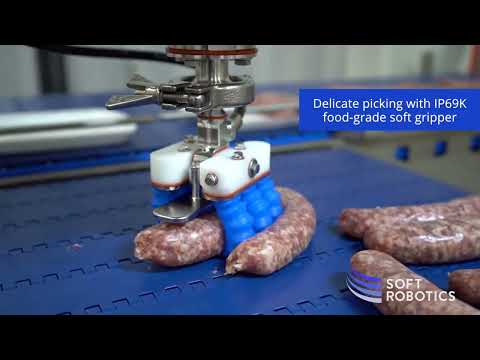
For now, the main application of soft actuators and grips is in industrial processes, especially in the food industry.
Further down the road, progress in AI, machine vision, battery tech, and soft robotics should allow for the creation of robots able to assist nurses, shopkeepers, cleaners, and other tasks that are currently reliant almost 100% on human labor.



