
Megaprojects
JUNO Observatory: Unlocking Neutrinos’ Mass Secrets

Securities.io maintains rigorous editorial standards and may receive compensation from reviewed links. We are not a registered investment adviser and this is not investment advice. Please view our affiliate disclosure.

Catching A Glimpse Of The Most Elusive Particle
Fundamental physics has always relied on a mix of theory and experiments to progress our understanding of the Universe.
To this day, one of the most difficult to answer questions is about the fundamental nature of gravity and the forces that direct the Universe. It has long been known that the answer is likely to be found in an elusive and almost impossible-to-study particle: the neutrino.
A deeper understanding of neutrinos’ nature might soon be achieved thanks to a Chinese megaproject: JUNO, or the Jiangmen Underground Neutrino Observatory.
This is a massive facility, involving extensive international cooperation and years in the making.
It should complement the results of the Deep Underground Neutrino Experiment (DUNE), an American neutrino detector measuring neutrinos through 800 miles of the Earth (follow the link for a full explanation of this megaproject).

Source: DUNE
What are Neutrinos?
Neutrinos are electrically neutral particles with an extremely small mass, so small that it had long been thought to be null.
Currently, we do not know why neutrinos have mass, except that it seems to work in a different way than for other particles.
What makes neutrinos unique is that they are essentially “ghost” particles, barely interacting with other forms of matter at all. This is because neutrinos only interact with 2 out of the 4 fundamental forces in the Universe: gravity and weak interaction.
As the weak interaction has a very short range, and gravity barely affects the low-mass neutrinos, neutrinos usually pass through matter without interacting or being slowed down. As a result, neutrinos usually travel at almost the speed of light.

Neutrinos are fundamental particles that cannot be broken into smaller components and come in 3 variants: electron neutrinos, muon neutrinos, and tau neutrinos. To complicate matters even further, neutrinos seem to regularly shift between these 3 variants.
The transition between all 3 variants of neutrinos is linked to the mass of each neutrino’s type and contains answers about the fundamental nature of matter and the Universe itself.
It is also possible that a 4th type of neutrino exists as well, sterile neutrinos, that would interact with matter only through gravity, making it even harder to detect than the others.

Most neutrinos are produced by nuclear reactions, from nuclear fusions in stars to radioactive decay at the center of the Earth. And inside man-made nuclear reactors, a fact important for the design of JUNO.
Despite their elusiveness, neutrinos are thought to be the most abundant particle in the Universe. Roughly a thousand trillion neutrinos pass through our bodies every second.
(You can learn more about neutrinos on the dedicated website “all things neutrinos” created by Fermilab.)
JUNO’s Goals – Figuring Neutrino Hierarchy
JUNO is built specifically to answer the question of the “neutrino mass hierarchy”, the question of which neutrino type has which weight.

Source: Berkeley Lab
This is still unclear, despite neutrinos’ masses having been measured, because what is actually measured is the “square of the mass” of the particles. As a result, mathematics allows for 2 different possible solutions to the results observed, the normal or inverted hierarchy.
“We hope to learn how leptons” — electrons and their relatives — came into existence in the moments after the Big Bang, a process that could account for why there is more matter than antimatter in the universe.
Answering such fundamental questions will only be possible if the value of a term referred to as “neutrino mixing angle theta one three,” written θ13, turns out to be more than zero.
Swipe to scroll →
| Hierarchy Type | Mass Ordering | Implication |
|---|---|---|
| Normal Hierarchy | Lightest = electron neutrino; heaviest = tau neutrino | Supports standard model extensions |
| Inverted Hierarchy | Lightest = tau neutrino; heaviest = electron neutrino | Points toward new physics beyond the Standard Model |
JUNO’s Design
The Heir to Daya Bay Reactor Neutrino Experiment
JUNO’s follow-up work was conducted at the Daya Bay Reactor Neutrino Experiment, which was then being carried out in collaboration with the US Department of Energy, at a time when scientific collaboration with China was less contentious.

Source: Wikipedia
After the Nobel Prize-winning discovery around 2000 of the oscillation phenomenon of atmospheric and solar neutrinos, the Daya Bay facilities discovered a new mode of neutrino oscillation for the first time in 2012, by precisely measuring the previously mentioned theta-13 angle, exactly what it was designed for.
This discovery completed the theoretical framework of neutrino oscillation. It also provided guidance for next-generation experiments in determining the mass ordering of neutrinos.
Picking The Right Location
The Daya Bay detector was conceived to detect the neutrinos produced by the Daya Bay Nuclear Power Plant and the Ling Ao Nuclear Power Plant.

Source: ResearchGate
Initially, JUNO was going to be built in a nearby location. But the construction of a third nuclear reactor (the Lufeng Nuclear Power Plant) would have disrupted the experiment, as it depends on maintaining a fixed distance to nearby nuclear reactors.
So instead, it was built on a site 53 km (33 miles) from both the Yangjiang and Taishan nuclear power plants.

Source: ResearchGate
The reason why the distance to the nuclear power plants is important is that neutrinos interact very little with matter, but they still do.
And the interaction with the electrons of Earth’s atoms, over enough kilometers of rocks, affects the oscillation between the types of neutrinos into one another.
The longer distance, compared to the 2 km of the Daya Bay facility, allows for a greater sensitivity and ability to detect neutrino oscillation.
However, it also requires a much-improved level of shielding and a much larger detector for a sufficient number of reactor neutrinos to be captured.
The entire facility is buried 700 meters deep under a mountain to reduce the event rate of cosmic rays that would interfere with the detection of the closer nuclear power plants.

Source: Global Times
This design choice reduced the effect of cosmic rays, otherwise muddying the signal from neutrinos by nearly 100,000x.
Proposed in 2008 and approved by the Chinese Academy of Sciences and Guangdong Province in 2013, JUNO began underground construction in 2015.
The detector installation started in December 2021 and was completed in December 2024.
JUNO holds a first-mover advantage and features a unique experimental design in terms of physics.
As an international collaborative project led by China, JUNO will further strengthen China’s leading position in this field.”
A Giant Scintillating Pool
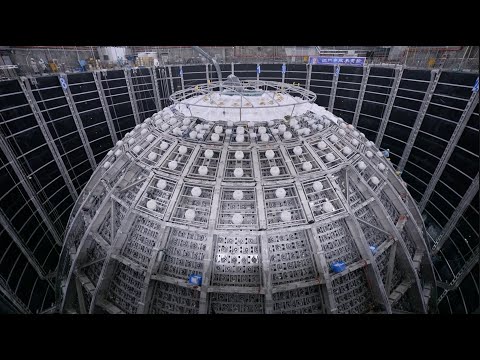
The main structure of JUNO resembles a watermelon submerged in water, with the entire sphere forming the world’s most precise and largest neutrino detector.
In order to detect interaction of normal matter with neutrinos, a scintillating liquid is used. When a neutrino hits it, the energy is converted into light.

Source: The European Physics Journal
This light is then captured and amplified by the photomultiplier tubes (PMTs) of 20 inches and photomultiplier tubes of three inches, as well as cables, magnetic shielding coils, light baffles, and other components.
The central liquid scintillator detector at the heart of JUNO weighs an effective mass of 20,000 tons, housed at the center of a 44-meter-deep water pool.

Source: Global Times
A 41.1-meter diameter stainless steel truss supports the 35.4-meter acrylic sphere, the scintillator, 20,000 20-inch photomultiplier tubes, 25,600 3-inch PMTs, frontend electronics, cabling, antimagnetic compensation coils, and optical panels.
All PMTs operate simultaneously to capture scintillation light from neutrino interactions and convert it to electrical signals.

Source: ResearchGate
Massive Volumes
Since December 2024, the pool surrounding the system has been filled with ultra-pure water at the rate of 100 tons per hour.
Within 45 days, the team filled 60,000 tons of ultrapure water, keeping the liquid level difference between the inner and outer acrylic spheres within centimeters and maintaining a flowrate uncertainty below 0.5%, safeguarding structural integrity.

Source: IIHE
This level of precision and careful maintenance will allow the detection of neutrinos to be comparable, even if there are several years in between each event.
Overall, the whole facility is expected to operate for 30+ years.
“It demanded not only new ideas and technologies, but also years of careful planning, testing, and perseverance. Meeting the stringent requirements of purity, stability, and safety called for the dedication of hundreds of engineers and technicians.”
The pool protects the detector from interference by the rare cosmic rays, producing a signal similar to neutrino detection that managed to pierce through the mountain above, as well as natural radioactivity from the surrounding rock.
The liquid injection will occur in two stages. During the first two months, ultra-pure water will fill the spaces inside and outside the acrylic sphere of the central detector.
In the following six months, the ultra-pure water inside the sphere will be replaced with a liquid scintillator.
JUNO has successfully completed filling its 20,000-ton liquid scintillator detector and begun data collection on August 26th, 2025.
An International Collaboration
JUNO is built by a large international team with more than 700 members from 17 countries and regions. Even the USA is present in the collaboration, through the University of California (7 persons) and the University of Maryland (2 persons), with most of the other international partners being European countries.
The data generated will also be treated through international research resources, with participation of the Chinese Institute of High Energy Physics, the Italian Istituto Nazionale di Fisica Nucleare CNAF, the Russian Joint Institute for Nuclear Research, and the French Centre de Calcul de l’IN2P3.
First Results
On August 24th, the first neutrino collision with the scintillating liquid was detected, demonstrating that the facility is now ready to produce scientific data.

Source: EyesOnSci
These initial data points indicate that if anything, JUNO is performing even better than expected in terms of sensitivity and precision of measurement.
But it will still take a few weeks or months for the first concrete measurement of neutrinos’ mass to be confirmed, and longer for the scientific community to validate these initial results.
Future Upgrades and Global Neutrino Experiments
Upgrade To Detect Antineutrino
JUNO’s first task is to allow mankind to know for the very first time the actual neutrino mass hierarchy. This has been, for decades, a missing piece of the puzzle to understand subatomic particles, and the foundation of the Universe at large.
Armed with not only an answer, but much more precise measurements than ever before, physicists will be able to use neutrino masses to push further into other fields of sub-atomic and quantum physics.
Later on, JUNO’s high sensitivity should make it possible to upgrade the facility for solving the other major question regarding neutrinos: are neutrinos their own antiparticle?
Most particles have an antiparticle, with inverse characteristics like their electrical charge (and maybe mass). But as neutrinos are neutral and low in mass, it is not clear what exactly the characteristics of antineutrinos are.
By eventually making possible the detection and measurement of a reaction called neutrino-less double-beta decay, which is still a theoretical radioactive decay process, it could prove that neutrino particle are their own antiparticles, also called a Majorana-type particle or Majorana Fermion.
Hyper-Kamiokand, DUNE, & Others
Hyper-Kamiokand, or Hyper-K, is the successor of Super-Kamiokand, which found in 1998 the first strong evidence of neutrinos’ oscillation between neutrino types. Super-Kamiokande was also instrumental in proving neutrinos have mass.
Contrary to DUNE or JUNO, which are looking at building an entirely new design of neutrino experiment, Hyper-K is more of an upgrade on existing technology. This is likely to help it progress faster, with the beginning of operation as soon as 2027, around the same time as the American DUNE.
This could help it make a rough estimate of the imbalance between neutrinos and antineutrinos.
DUNE, Hyper-K, and JUNO are the neutrino projects that are already under construction. Others are still in the concept stage but might unlock further understanding of particle physics.
One of them is Enhanced NeUtrino BEams from kaon Tagging (ENUBET), a European project. It will try to detect the charged lepton created each time a neutrino is produced. This could further our understanding of the imbalance between matter and antimatter.
Another is NuTag, using a novel experimental technique: neutrino tagging. This would use a new type of neutrino beamline. This is a design which was already proposed in 1979, but only recently have silicon detectors become able to survive direct exposure to a hadron source beam, making it possible to be built.
Conclusion
JUNO is likely going to be a very important science experiment to finally solve questions regarding physics that have been unanswered for decades, and have blocked the development of further progress in theoretical physics.
While this might sound a little far from our daily concerns, many of our cutting-edge technologies actually need a better understanding of neutrinos to progress.
For example, a quantum computing chip (Majorana-1) built recently by Microsoft (MSFT ) literally created a new state of matter (topoconductors) using a Majorana particle, the very type of particle JUNO might help understand better.
So advanced international science projects like JUNO are there to establish the building blocks that are later turned into groundbreaking innovations.
Investing in Neutrino & Majorana Particles Innovators
Microsoft
(MSFT )
Microsoft is one of the world largest tech company, having a quasi monopoly on operating systems, and a very strong position on B2B software, through its Office365 software, its Azure cloud computing systems, LinkedIn social media, as well as a strong presence in videogame (Xbox and many of the world’s largest videogame studios), ads, and programming tools (GitHub).
The company is also very active in AI, notably with the deployment of its Copilot AI throughout all its products. Microsoft AI efforts were initially through a collaboration with OpenAI, and now it is more on its own.

Source: Microsoft
Microsoft is also active in quantum computing, with the stunning announcement of its Majorana-1 chip. When cooled to near absolute zero and tuned with magnetic fields, these devices form topological superconducting nanowires, containing so-called Majorana Zero Modes (MZMs) at the wires’ ends.

Source: Microsoft
(You can read more about all the business activities and opportunities of Microsoft in our dedicated investment report on the company.)
Neutrino Energy
While rich in potential future applications, neutrino science seems far from being regularly used for commercial applications. This could be changing, according to a very ambitious German private startup, Neutrino Energy.
The company is exploring the very novel concept of neutrinovoltaics, or the generation of electricity from the constant flux of neutrinos around us. How this works, is by using a layer of graphene, a 2D material made of carbon (follow the link for a complete explanation of 2D materials like graphene or goldene).
This method aims to convert the constant motion of graphene atoms, influenced by surrounding radiation and particles like neutrinos, into usable electricity. While promising in theory, the process is still unproven and remains highly experimental.. A similar phenomenon is happening to graphene, with neutrinos “pushing” the atom nuclei, as with argon atoms in the DUNE neutrino detector.
The company has been announcing its upcoming first prototype, called the Powercube, which is supposed to demonstrate the technology developed with the assistance of AI.
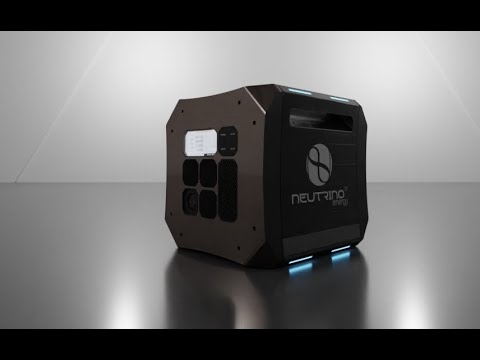
The company has also been working with the Centre for Materials for Electronics Technology (CMET) in India, aiming “to create a self-charging electric vehicle powered by neutrinovoltaic technology”.

It is hard to tell how close to any commercialization the concept is, as it seems that, for now, it is just that, a concept with little reveal about the potential power output or economics. But this is definitely the closest to a “neutrino company” currently on the market.



