

Material Science
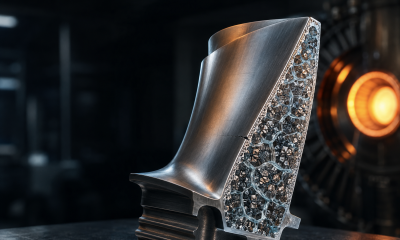
Stronger Turbine Materials: The Case for GE Aerospace
Investor note: In the final sections, we examine how GE Aerospace provides public-market exposure to the broader commercialization of advanced turbine materials. Materials used in jet engines, power-generation turbines, and other extreme environments face a persistent engineering trade-off. They must…


Solar-Powered Polymer Tech Halves Desalination Costs
A lot of the modern world is dependent on often forgotten infrastructure like roads, harbors, electric lines, etc. Another critical infrastructure is water, from collection to wastewater purification and treatment. Access to clean water is not just important for everyday…
 Jonathan Schramm

Passive 6G Communication Enhancements With 3D Printed Panels
Materials science is the domain of understanding materials at the microscopic, often atomic, level to improve them. The most common goal is to make a material stronger than in its classical form, be it steel, glass, or ceramic. Metamaterials bring…
Jonathan Schramm

Atomic Engineering: New AI Chips Shatter 1300°F Heat Barrier
The backbone of modern computing is facing a silent but definitive thermal wall. For decades, we have relied on silicon-based chips to process and store the world’s data. This is how your laptop functions and how the servers powering the…

How Pressure Quenching Broke the Superconductor Record
In a notable and positive development1 for material science, researchers at the University of Houston (UoH) have shattered a long-standing record in the field of superconductivity. On March 19, 2026, the team led by physicists Ching-Wu Chu and Liangzi Deng…

Rethinking Battery Design Assumptions
New Understanding of Cathode Cracking in Lithium-Ion Batteries Improving battery power density is a key driver for the adoption of EVs over internal combustion engines. Consumer safety is another major concern, though the public perception of fire risk often exceeds…
Jonathan Schramm

Paper Mill Waste Becomes a Catalyst for Green Hydrogen
Turning Paper Mill Waste Into Hydrogen Catalysts The key to green hydrogen production becoming a cornerstone of our economy is to make it cheap enough to compete with fossil fuels or other artificial liquid fuels. The process also needs to…
Jonathan Schramm

Engineered Graphene Defects Unlock New Tech Potential
How Engineered Defects Improve Graphene Performance 2D materials, forming a single layer of atoms, of which graphene is the most understood and commonly studied, alongside borophene, goldene, and others, display remarkable properties that are strongly different from the same atoms…
Jonathan Schramm

A New Way to Control Light for Faster Future Computers
Scientists have created a new type of metamaterial that can offer comprehensive light-blocking functionality for photonic computing. A metamaterial is an engineered material whose properties do not arise from the chemical composition of its base components but from their carefully…


Boron Arsenide Just Surpassed Diamond in Heat Transfer
An international team of scientists led by University of Houston engineers just proved a long-held thermal conductivity theory incorrect. Their work pushed the boundaries of material science further and could inspire several corresponding breakthroughs in the coming months. As such,…


MIT Confirms Unconventional Superconductivity in MATTG
Superconductivity occurs when electrons pair up, rather than scattering apart as they do in normal conductors or in everyday materials. These paired electrons are called “Cooper pairs,’ which creates a perfect, resistance-free flow of current. This remarkable property is observed…

3D Knitting: The Future of Advanced Textiles
A team of innovative engineers has developed a novel 3D stitching machine capable of producing complex shapes and structures. Their design pushes the boundaries of computational fabrication research and opens the door for more durable and capable textiles. Here’s how…

Retina E-Paper Reaches Human-Eye Resolution (WO₃)
Display sizes have steadily shrunk while resolutions have soared, bringing screens ever closer to our eyes. In the early days, televisions and projectors were designed for shared distant viewing. This resulted in them being large, heavy, and fixed, forcing users…

New Cr-Mo-Si Alloy Could Rewrite Jet Engine Heat Limits
Researchers have developed a new material with remarkably high temperature resistance, demonstrating strong potential for use in jet engines. Powerful technologies like jet engines, gas turbines, industrial machinery, and X-ray equipment require materials that can withstand extremely high temperatures. Refractory…

5 AI Breakthroughs Transforming Materials Discovery Today
Artificial intelligence (AI) continues to transform the world and reshape the future of humanity. The technology is driving changes across nearly every sector by performing tasks that typically require human intelligence. AI systems utilize vast amounts of data to identify…


