Commodities
Rio Tinto (RIO): Mining the Metals Of The Future

Securities.io maintains rigorous editorial standards and may receive compensation from reviewed links. We are not a registered investment adviser and this is not investment advice. Please view our affiliate disclosure.
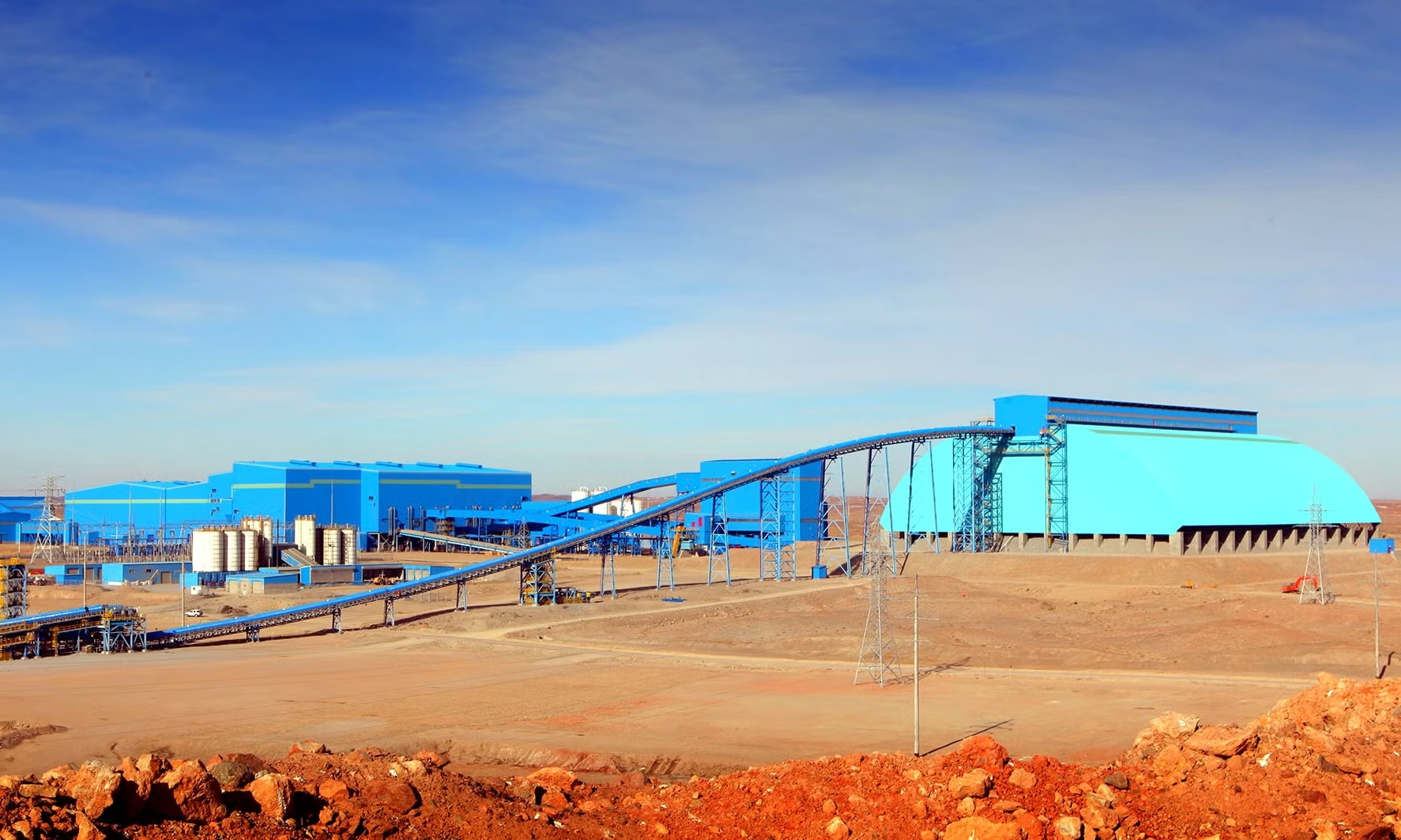
Preparing Mining for the Energy Transition
Mining is often seen as a dirty and low-tech industry by the broader public and as a poor investment compared to more innovative industries.
And this is certainly true for many parts of the industry, where there is more concern about extracting resources in the cheapest way possible.
But at the same time, the modern world is built on metals extracted by miners: lithium, copper, aluminum, titanium, and rare earths. All of these materials are the basis of AI data centers, EVs, solar panels, batteries, spacecraft, and more.
(RIO )
So, while not the most glamorous part of the energy transition and innovation, it is nevertheless a crucial component of it. And some companies are going beyond just extraction.
The largest miners are also R&D powerhouses, using their massive scale to reduce energy and water consumption, pollution, and overall improve how these critical metals are produced. They are also evolving, turning away from coal and base metals toward more strategically important metals in the future, like lithium and copper.
Among the top 5 miners in the world, none illustrates better this transition to a more sustainable mining industry than Rio Tinto.
Summary
- Rio Tinto is still driven by iron ore, but its future is increasingly tied to copper, lithium, aluminium and other critical metals.
- The company is expanding beyond Pilbara iron ore with Simandou in Guinea, Oyu Tolgoi in Mongolia, new copper projects in the Americas and the Arcadium Lithium acquisition.
- Growth projects like Rincon and Arcadium give Rio leverage to batteries, EVs and grid build-out across the energy transition.
- Rio is rolling out new technologies including Nuton bioleaching for copper, direct lithium extraction (DLE) and ELYSIS low-carbon aluminium smelting.
- Management targets returning 40–60% of underlying earnings to shareholders and has delivered close to 60% payout for nine years, though dividends remain cyclical with commodity prices.
Rio Tinto Business Overview: Core Metals and Strategy
Rio Tinto is the world’s second-largest mining company. The largest part of the company’s business is in iron ore, with significant historical assets in Australia, and a new mega mine in Africa.
But it is also a very large producer of copper and aluminum, with strong expansion plans for copper production.
Lastly, it has been expanding quickly into the lithium market thanks to a few projects and a major acquisition in 2024 of Arcadium Lithium.
Meanwhile, the company is also a leader in the production of titanium, boron, and aluminum, with the last metal giving it the opportunity to expand into rare earth (see below).

Source: Rio Tinto
This positions Rio Tinto as a major producer in some of the largest commodity markets in the world. More importantly, most of its mines are either very large or contain rich ores, leading to efficient mining operations and production costs among the lowest on the globe.

Source: Rio Tinto
Due to its focus on mines in Australia, the Americas, and Africa, Rio Tinto is one of the most important strategic providers of these metals to the West, with over 81% of its production in OECD countries. This can be crucial as nationalization and abuse of property rights can be a significant danger for investors in mining companies in riskier jurisdictions.

Source: Rio Tinto
Iron Ore: Pilbara and Simandou as Rio Tinto’s Core
Pilbara – Australia
While the other metals are generating extra cash or might form the future of the company, the production of iron ore is the historical origin of the company and still the center of Rio Tinto’s activity.
Iron production is going to be insufficient in the years to come, with a massive supply gap developing in the late 2020s, due to smaller producers’ resources depleting.

Source: Rio Tinto
And investments in new resources have been historically low in the 2016-2023 period. As new mines take years or even more than a decade to go from projects to full production, this almost guarantees that iron ore will be in tight supply in the coming decade.

Source: Rio Tinto
A lot of Rio Tinto and the world’s iron is coming from the red soil of Western Australia, especially the Pilbara region, where Rio Tinto operates alongside other iron mining giants like BHP (BHP ) and Fortescue (FMG.AX).
Rio Tinto’s operations in the region cover 345 – 360 Mtpa (million tons per year) capacity with 13 mining hubs and 2,000 km (1,240 miles) of railroads to transport the ore to dedicated harbors.

Source: Rio Tinto
Simandou – Guinea
The company has been working hard to add the African Simandou deposit in Guinea, worth 60 Mtpa when completely developed.

Source: Rio Tinto
It is a major endeavor in a country that until now has lacked the proper infrastructure to bring its ore to the sea and therefore, international markets. With the construction of 600km of railroad making the logistics possible, the operations at the mine co-owned by the Guinean government, a Chinese consortium, and Rio Tinto started in November 2025.
“Today we are unlocking an exceptional new source of high-grade iron ore that is in demand from customers for low-carbon steel making, enhancing our world-class portfolio of iron ore mines in the Pilbara and Canada.”
Today, the rail and ports are completed at 61%, and the mine is completed at 60%, with $3.3B spent on the project so far.
“The start of operations of the Simandou project is an important achievement guided by the consensus reached by the heads of state of the two countries. It reflects the joint efforts and pragmatic cooperation between China and Guinea, contributing to Guinea’s industrialisation and modernisation process.”
Growth in Copper, Lithium and Critical Metals
Swipe to scroll →
| Project | Metal | Region | Role in Strategy | Indicative Scale / Timing |
|---|---|---|---|---|
| Pilbara Iron Ore System | Iron ore | Western Australia | Cash-cow core business funding growth and dividends. | Pathway to ~345–360 Mtpa system capacity in the mid-term. |
| Simandou | High-grade iron ore | Guinea, West Africa | Diversifies iron ore away from Australia; supplies premium ore for low-carbon steel. | Operations started November 2025; up to ~120 Mtpa combined export capacity. |
| Oyu Tolgoi | Copper, gold | Mongolia | Flagship copper asset underpinning Rio’s electrification exposure. | Key driver of 2025 copper guidance of 860–875 kt group-wide. |
| Rincon | Lithium (brine) | Argentina, Lithium Triangle | Builds a long-life, large-scale lithium position for EV batteries. | US$2.5B project; up to ~60,000 t/year Li₂CO₃, 40-year mine life; first output expected 2028. |
| Arcadium Lithium | Lithium (various) | Global assets | Transforms Rio into a top-tier lithium producer with leading DLE technology. | Acquired in early 2025; third-largest lithium producer with the largest resource base. |
| Nuton | Copper (from low-grade ores) | Global applications | Technology platform to unlock stranded copper resources and waste. | Bioleaching process with up to ~85% recovery; first real-world copper produced in 2025. |
The World’s Hunger For Metals
A few structural trends underline the need for more metal production in a world where most of the best ore bodies are already exploited or depleted.
The first one is population growth, with many of the largest countries on Earth in a phase of development that demands a lot of metal for infrastructure, basic consumer goods, etc., like China, India, Indonesia, and South-East Asian countries.
The other trend is electrification, which requires more batteries, electric motors, transformers, power lines, etc.

Source: Rio Tinto
Meanwhile, it has never been slower and more expensive to develop new mines, limiting the development of large resource deposits to a handful of companies like Rio Tinto.

Source: Rio Tinto
As a result, Rio Tinto has embraced a new strategy of increasing its production by 3% CAGR throughout the 2024-2033 period. We already discussed Simandou to keep growing the iron business and diversify from Australian sources. But the most transformative move by Rio Tinto is in copper and lithium.
Copper for Electrification: Oyu Tolgoi & Other Projects
As the key metal for electrification, required in large quantities in every EV, battery, transformer, power cable, etc., copper is moving from an industrial commodity to a valuable strategic resource. Except that most of the largest copper ore deposits are already developed and depleting.
But the Mongolian mine of Oyu Tolgoi is a major driver of Rio Tinto’s copper growth, as the underground expansion ramps up. Rio Tinto expects its total mined copper production to reach 860–875 kt in 2025, with Oyu Tolgoi contributing a significant share of that increase after years of investment in developing the ore body and infrastructure.

Source: Rio Tinto
The copper from Mongolia is adding to the existing production in Chile and the USA, and will be joined in the long-term by the other projects of Nuevo Cobre in Chile (developed in partnership with Codelco), La Granja in Peru, Winu in Australia, and Resolution in the US.

Source: Rio Tinto
Nuton
Another major endeavor in copper for Rio Tinto is Nuton, a technology venture for sustainable copper production. It has developed over 30 years an advanced bioleaching method to extract much more copper from ore than previous technologies.
This could radically change the world’s supply of copper by making hard-to-exploit ore economical. It uses bacteria and electromining to achieve recovery rates of up to 85%.
“The Nuton technology has the potential to change the game by making historically difficult-to-leach sulphide ores economically viable. We accomplish this by achieving industry-leading copper recovery rates of up to 85%, surpassing current industry norms.”
It could also help extract more copper from mining waste that until now could not be used fully. Nuton was produced for the first time in real-life conditions in early 2025.
Watch: Rio Tinto’s Nuton Technology in Action (Video)
Lithium: Arcadium, Rincon and Rio Tinto’s Battery Metals Push
Arcadium
New to the sector, Rio Tinto made a massive splash in the lithium industry when it completed the acquisition of Arcadium Lithium in early 2025.
Arcadium Lithium itself was the result of the merger of major lithium miners Livent and Allkem.

Source: Arcadium
It was the third-largest lithium miner in the world, and the one with the world’s largest resource base, so also the one in the best position to grow its production.
“By combining Rio Tinto’s scale, financial strength, operational and project development experience with Arcadium’s Tier 1 assets, technical and commercial capabilities, we are creating a world-class lithium business which sits alongside our leading iron ore, aluminium and copper operations.”
It is worth noticing that the acquisition was done in the tail end of a deep bottom in the lithium market, and that despite the low price of lithium in that period, Arcadium’s EBITDA margin in F1 2024 was still 40%, thanks to high-grade resource and best-in-class direct lithium extraction (DLE) technology.
Arcadium has been working on DLE since 1996, in combination with evaporation ponds, and recently made significant progress in making it commercially viable as a stand-alone extraction method.
Arcadium also developed LIOVIX, a form of printable lithium foil that could be used to boost battery performance, reduce manufacturing costs, and reduce lithium use.

Source: Arcadium
Another major lithium project is Rincon, in the lithium triangle in Argentina. With a $2.5B of investment announced in December 2024, this will turn into a large lithium producer, up to a capacity of 60,000 tonnes of battery-grade lithium carbonate per year.
The Rincon mine’s lifespan is expected to be 40 years, with first production in 2028, followed by a 3-year ramp-up to full capacity.
Another project, Jadar, in Serbia, was supposed to add even more lithium production to Rio Tinto, with a target of the EU market. But protests and political instability have, for now, frozen the project.
Aluminum
Rio Tinto is also a large aluminum producer, with a complete presence in this metal supply chain, from bauxite ore to alumina to aluminum.
The company has based its aluminum operation in regions where it can source low-carbon, cheap energy, notably hydropower in Canada and hydro+geothermal energy in Iceland, but also in the USA.
The sector can benefit from the US tariffs, as local production is more profitable, and prices in the region moved to reflect the new tariff-including prices.
Another potential of the aluminum segment is that alumina is often rich in rare earth elements. One reason why China has become an expert at rare earth refining and production is that it mandated its aluminum refiners to also purify rare earths.
Rio Tinto is considering engaging in the same activity, which could provide a domestic and “friendshored” production of rare earth elements outside of China’s influence. It could also produce gallium from its aluminum production.
But a clearer market incentive for the move, or new policies, is likely needed for it to happen.
“The next thing is to look a little bit deeper at critical minerals, and you have to think about that, not necessarily as separate mines. The absence of a robust spot market for many critical minerals is why you don’t typically see the top five largest miners in this space.”
Other Projects & Metals
While non-essential to the company’s main activity, Rio Tinto also has several other mines worth mentioning:
- Diavik in Canada, producing diamonds.
- Dampier Salt, in Australia, producing sea salt.
- Burra, in Australia, a project for potential scandium production, used in aluminum alloys to improve flexibility and resistance to heat and corrosion.
- Boron production in California, providing 30% of global demand.
- Rio Tinto Iron and Titanium (RTIT), in Quebec, Canada, producing iron but also 19% of global titanium demand, as well as scandium, and Richards Bay Minerals, in South Africa, and QIT Madagascar Minerals (QMM) in Madagascar.
Innovation & Sustainability
Besides Nuton’s new technology for copper extraction and Arcadium’s direct lithium extraction technology, Rio Tinto is heavily investing in reducing its carbon footprint and adopting new technologies quickly.
For example, it has started to use the first Caterpillar battery-electric haul trucks in the Pilbara jointly with BHP, replacing diesel trucks. (CAT )
“These trials will help us understand how all the pieces of the puzzle fit together: the battery technologies, generation and charging infrastructure, power management, as well as the supply chains to potentially deliver this at scale.”
The company is promoting sustainability labels for aluminium, copper cathode, and metal powders.
It is developing the ELYSIS technology to produce low-carbon aluminum, allowing carbon-free electrolysis at scale for the first time ever in August 2025.
Cadmium telluride (CdTe), used in thin-film solar panels like First Solar (FSLR ), is also produced from Rio Tinto Kennecott copper mine.
”More than 90% of tellurium is produced as a byproduct of copper smelting and refining, and Kennecott is one of two primary copper smelters left in the U.S.”
Rio Tinto also invested money in sustainability, like hydrogen-based alumina refining in partnership with the Australian Renewable Energy Agency and the Sumitomo Corporation, using marine biofuel for its ships, carbon capture with the Icelandic Carbfix and many other partners, biocarbon production with Amyium, etc.
Lastly, Rio Tinto has a venture capital (VC) branch, investing in startups working in mining, refining, metal alloys, and sustainability.
Investor Takeaways
- Core cash engine: Pilbara iron ore and now Simandou provide low-cost, high-margin iron ore exposure that underpins Rio Tinto’s dividend capacity.
- Energy transition leverage: Copper and lithium growth (Oyu Tolgoi, Rincon, Arcadium) position the company as a key supplier to EVs, grids and batteries.
- Low-carbon metals optionality: Hydropower-based aluminium, ELYSIS technology, and by-products like tellurium and potential rare earths create upside if green premiums emerge.
- Attractive capital returns: Rio Tinto targets 40–60% of underlying earnings returned to shareholders and has delivered ~60% payout for nine years, although dividends remain cyclical.
- Risks to watch: Commodity price cycles, project execution (Simandou, Rincon, Resolution), ESG controversies and jurisdiction risk mean RIO remains a cyclical, not a bond proxy.
Conclusion: Is Rio Tinto (RIO) a Metal-of-the-Future Stock?
Rio Tinto is a company whose products are absolutely essential to the modern industrial economy, from abundant iron for steel production to low-carbon aluminum, titanium, copper, lithium, and more.
The company also has a solid track record of maintaining a shareholder returns policy of 40 – 60% dividend payout, with a 9-year track record of 60% dividend payout.
Combined with the world’s ever-increasing demand for metal, the energy transition, population growth, and Rio Tinto’s steady increase in production for the next decade, this makes the stock a good pick for investors looking for strong dividends with some growth as well.
It is also a relatively safe mining stock in regard to jurisdiction risks, although investors should remember that such an issue is never perfectly safe with the mining industry.
Lastly, it is a force of innovation in the mining industry, from more efficient technology for copper and lithium extraction to low-carbon production of steel & aluminum, electrification of mining equipment, and thin-film solar’s raw material.
So, in a period of instability and inflation, or maybe even stagflation, gaining exposure to strategic commodities while also benefiting from the trend of electrification and the green transition could be the right move, while collecting dividends in the meantime.
Latest Rio Tinto (RIO) Stock News and Developments