

Robotics
Oceaneering (OII): Subsea Robots to Autonomous Systems

Securities.io maintains rigorous editorial standards and may receive compensation from reviewed links. We are not a registered investment adviser and this is not investment advice. Please view our affiliate disclosure.

Summary: Oceaneering (OII) has evolved from a niche offshore oil & gas services provider into a global leader in subsea robotics, autonomous underwater vehicles (AUVs), and high-reliability systems for defense, space, and industrial automation. While offshore energy still represents the majority of revenue, Oceaneering’s deep expertise in operating robots in extreme environments is now being redeployed into U.S. Navy unmanned systems, spaceflight hardware, nuclear inspection, and autonomous logistics robots. This positions the company as a rare pure-play industrial robotics and autonomy contractor with both defensive cash-flow stability and long-term growth optionality.
Industrial Robots Are Already Deployed at Scale
As AI and automation improve, the dream of humanoid robots helping humans in daily tasks is getting closer to reality than ever. Still, this is unlikely to be the first use of autonomous and semi-autonomous devices.
Instead, one immediate application of robots is to deploy them where it is generally unsafe for humans to do so. So far, this has mostly been done with remotely controlled systems, but with increased capacity and autonomy of the AI controlling these robots, many more common uses will spread.
For example, offshore and underwater work environments are notoriously dangerous, with, for example, oil rigs famous for being some of the world’s most dangerous work sites. So the sector has been at the forefront of the adoption of autonomous systems.
Other sectors where automation and autonomous robots are in high demand are defense and aerospace.
One company greatly benefited from offshore and subsea demand for robotic systems and is now using this technological base to quickly expand into other domains: Oceaneering.
Oceaneering Overview
History
Oceaneering was founded in 1964 and quickly merged with three other diving companies servicing the oil & gas industry.
In the 1970s, the company mostly focused on improving the diving technology to improve the safety of its divers and the efficiency of underwater work, such as working on offshore oil rigs or installing undersea pipes and cables.
In the 1980s, the company started to explore the possibility of using robotic systems for underwater work. This technology immediately attracted the attention of NASA, helped by the common location in Houston. This led to the foundation of Oceaneering Space Systems in 1988, looking to transfer subsea technology and operational experience to the US space station program for the ISS (International Space Station).
The experience of Oceaneering in engineering equipment for extreme conditions also extended to other sectors of space exploration, and it was notably granted a USD$745 million contract in 2008 to create and manufacture the new Constellation space suit. Unfortunately, the Constellation program, which aimed for a return to the Moon no later than 2020, was canceled in 2010 by the Obama administration.
In parallel to the space program, Oceaneering also expanded in the defense sector, notably for modules used in submarines, cranes to transfer cargoes between moving ships.
In the period from the 1980s to today, the company also performed several acquisitions in the aerospace and defense sector to acquire key technologies, increasing the size of the company’s Aerospace and Defense Technologies (ADTech) department.

Source: Oceaneering
Until recently, these activities were a small portion of the company, still dominated by its offshore business. But as it now deploys its robotic technology to new segments, this might change thanks to new defense contracts and expansion into the autonomous vehicles market (see below).
Oceaneering Business Overview
The company employs 12,000 people and works in 50 countries.
Today, Oceaneering is still tightly linked to the offshore energy market, both oil & gas and offshore wind, with 70-75% of total revenues coming from this sector. Another 20% of revenues come from aerospace and defense markets, and 5% –10% of revenue from other industrial markets.

Source: Oceaneering
In offshore work, the services range from subsea robots or specialized products to complete project management and software solutions.

Source: Oceaneering
In oil & gas, the company is mostly active in the development and production phases of a given oilfield.

Source: Oceaneering
The company is profitable, with positive free cash flow in 14 of the last 15 years, standing at $96.1M in 2024 and estimated at $110M-$130M for 2025.
Offshore Segment
Oceaneering owns and charters 11 deepwater multi-purpose ships, mostly active in the Gulf of Mexico and West Africa. These ships are equipped with cranes, diving equipment, robots, and other tools to build, repair, and maintain offshore facilities.

Source: Oceaneering
The subsea robotic segment is made of many specialized pieces of equipment, each adapted to a specific task, depth, or sea conditions, with more than 250 systems deployed worldwide.

Source: Oceaneering
This includes Remotely Operated Vehicles (ROV), ROV toolings, and survey and positioning services by Autonomous Underwater Vehicles (AUVs). Together, they have cumulated 420,000+ hours of diving and surveyed 400,000+ kilometers (250,000 miles).
On average, an ROV brings more than $11,000 per day utilized, and the company has been billing more than 15,000 days of utilization every quarter.

Source: Oceaneering
It is worth noticing that this is a sector that Oceaneering is completely dominating, with a 60% market share, when its closest competitor only control 18% of the market.
Besides vessels and robots, the company’s manufactured product segment sells umbilicals that supply electric and hydraulic power, connectors and valves for critical oil and gas systems, delivery vehicles for people & products, and logistics solutions to load carriers.

Source: Oceaneering
Renewables Energy
While oil & gas has been the center of the company historically, its expertise in offshore work transfers well to offshore wind, both fixed and floating.
This includes many important tasks like site characterization, survey & positioning, ROV services, installation with specialized vessels, cable installation & repair, etc.

Source: Oceaneering
This dual presence also puts Oceaneering in a privileged position to accelerate the electrification of offshore fossil fuel production, an important ESG goal for most oil & gas producers.

Source: Oceaneering
Defense & Aerospace Segment
Defense – Navy
The initial entry of Oceaneering in this segment was through its collaboration with NASA for space systems. But it is with the US Navy that its expertise has been the most important.
The first defense-related activity is the deployment of its commercial robotic systems and other subsea technology for military applications, like Remotely Operated Vehicles (ROVs), Autonomous Underwater Vehicles (AUVs), subsea habitats, and submarine rescue, as well as critical underwater infrastructure protection and monitoring services.

Source: Oceaneering
Another segment is the Marine Services Division (MSD), which produces modules for US submarines, including the massive and central to US defense strategy Virginia and Columbia class submarines.
One of them is the Dry Deck Shelter (DDS), a removable module that can be attached to a submarine, allowing easy exit and entrance for divers, all while the submarine stays submerged.

Source: Navy Outlook
Oceaneering is also providing repair and maintenance to the submarine fleet, as well as for surface ships, and is one of only three private companies certified to perform work on critical Submarine Safety (SUBSAFE) systems and Deep Submergence Systems Scope of Certification (DSS-SOC) systems.
As submarine systems grow in importance in the US Navy strategy in response to the threat of drones and hypersonic missiles, this activity is likely to grow steadily.
Oceaneering is equally contributing to the issue of military logistics at sea and abroad with its cargo transfer at sea technology, which allows for the secure transfer of standard containerized cargo between ships with a series of interconnected systems: Advanced Mooring System (AMS), Interface Ramp Technologies (IRT), and self-correcting cranes.

Source: Oceaneering
Lastly, the company performs manufacturing of complex maritime systems, using its experience on offshore rigs for equipment like communication systems, submarine battle management centers, payload trays, U.S. Special Operations Forces (SOF) stowage canisters, wet stowage modules, etc.
It also performs non-destructive testing of new and used equipment, relying on ultra-specialized equipment and technicians (underwater magnetic particle inspections, ET—Eddy current inspections, ultrasounds, etc.).
Space
The experience in providing divers with air and protection under sea translates to the same task in space suits, with similar requirements for valves, oxygen supply, hygiene solutions, etc. This led the company to deliver more than 5,000 extra-vehicular activity (EVA) items to NASA.

Source: Oceaneering
Diving is also heavily used as a training method for astronauts in specialized pools, with Oceaneering a key partner in building these training facilities.

Source: Oceaneering
The company’s experience with extreme conditions also made it a NASA partner for the production of Thermal Protection Systems (TPS) shielding ships from the heat of reentry, flight controls, latching devices, and space robotic arms.
Oceaneering Growth & New Segments
Swipe to scroll →
| Segment | Core Technology | Revenue Profile | Growth Driver |
|---|---|---|---|
| Subsea Robotics (ROVs/AUVs) | Deepwater autonomy, intervention robotics | High-margin, utilization-based | Offshore energy, seabed security |
| Defense & Navy | UUVs, submarine modules, logistics systems | Long-cycle contracts | Autonomous naval doctrine |
| Industrial Mobile Robotics | Autonomous forklifts & movers | Recurring fleet deployments | Warehouse automation & labor shortages |
| Space Systems | EVA, TPS, astronaut training | Low-volume, high-value | NASA & next-gen missions |
Overall, Oceaneering would be an impressive technology provider if it had limited itself to offshore and subsea activities, both civilian and defense-related, as well as a small space-focused activity.
But its expertise is starting to translate into markets that are potentially much larger and with long-term growth potential.
Other Energy
For example, Oceaneering is building components for nuclear power plants, using its expertise working in hazardous environments. This includes inspection services through a robotic system of nuclear reactors, turbine blades, pipeworks, and waste disposal boxes. The same non-destructive testing used on military ships can also be used to inspect nuclear power plant components.
Oceaneering’s selection of valves, pipes, and fittings can also be used by nuclear power plants, hydrogen production, and carbon capture. As more and more of these projects are built (including SMRs), this could become a growth sector for Oceaneering.
Defense
So far, the defense segment mostly repurposed the company’s expertise and existing tools into military applications. But in the long run, it seems that Oceaneering might become a full-fledged military contractor on its own.
A clear indication of this direction was awarded by the Defense Innovation Unit (DIU) of the Pentagon to build a ”Freedom“ Autonomous Underwater Vehicle (AUV) and establish an Onshore Remote Operations Center (OROC) for the U.S. Navy.
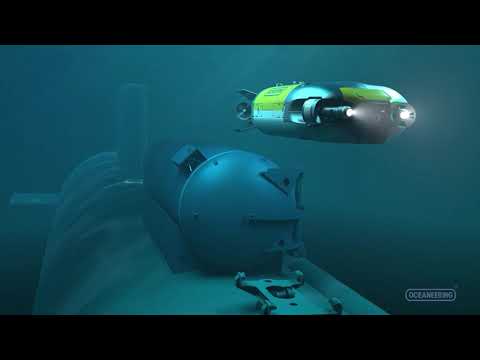
The Freedom AUV is 2-3x quicker than traditional AUVs in data collection, and can autonomously detect anomalies and investigate them further, and can work up to a 6,000m depth (20,000 feet).

Source: Oceaneering
In the long term, long-range AUVs are likely to become as central to the US Navy doctrine as its nuclear submarine flagships.
“Ultimately, advanced UUVs will augment submarine fleets by autonomously sensing and delivering payloads in demanding, dispersed, deep-sea environments. These activities serve as crucial foundational assessments to comprehend capability gaps and shape future development priorities.”
Peter Buchanan – Senior director for Oceaneering’s Subsea Robotics segment
Autonomous Vehicles & Logistics Robots
Besides new energy and new defense segments, the greatest possible extension of Oceaneering activity is in terrestrial autonomous vehicles.
The company has been investing heavily in redeploying its existing expertise to land systems, including the Autonomous Transit Systems, a self-guided, battery-powered, driverless transit vehicle, each capable of transporting up to 22 passengers, up to 25mph (the fastest and highest capacity shuttle on the market).
But more immediately, material handling and logistics robots are the models with the most potential for immediate large-scale deployment. The company currently has 3 different models, with already 1,700 deployed globally, of which 100+ are in just one fleet.

Source: Oceaneering
The MaxMover is more focused on replacing human-operated forklifts. It can be used for trailer loading, organizing a warehouse, receiving goods, etc, with a max payload of up to 4,400 lb / 2000 kg and height up to 500cm (16 feet).
The UniMover is an underride mobile robot designed for the stringent intralogistics demands of medical facilities and for use across light industrial environments, with a max payload of up to 1,322 lb / 600 kg. The stainless steel deck is easy to keep clean /sterile, and the small size allows it navigate spaces with poor maneuverability.
The CompactMover is designed to replace conventional electric pallet stackers, used in warehouse logistics, manufacturing, distribution centers, and assembly lines. The fully electric solution does not use hydraulics, reducing maintenance complexity and lifetime costs.
In 2025, the company revealed several innovations in this field:
-
- Fork Pitch Adjustment (FPA), which automatically modifies fork width to accommodate varying pallet sizes, eliminating manual adjustments and enabling seamless load handling with a single vehicle.
- EOD, which detects and stops for high obstacles
- Automatic Pallet Tracking, which seamlessly handles misaligned pallets on the floor.
- Available Location Detection (ALD), which scans rows and finds available spaces efficiently.
Investor Takeaway: Oceaneering offers an uncommon blend of downside protection and asymmetric upside. Its dominant subsea robotics franchise generates recurring, utilization-driven cash flow tied to offshore energy and infrastructure maintenance, while its expanding defense, space, and autonomous logistics segments provide exposure to long-cycle government contracts and secular automation trends. Near-term returns are anchored by offshore and defense spending, but the greatest upside lies in unmanned naval systems and warehouse robotics—areas where Oceaneering’s safety-critical engineering reputation creates high barriers to entry.
Conclusion
Oceaneering has built over the past decades a dominant position in its niche of undersea services and robotics. Initially solely focused on oil & gas exploitation, it has been able to deploy its subsea technologies, as well as expertise in high-quality valves and other parts, into offshore wind, hydrogen production, nuclear energy, carbon capture, etc.
Its dominant position has helped it fund and improve many key technologies that have found further applications in new domains, be it military or space exploration.
This trend is continuing, with the company perfectly positioned to become an important contractor in the commissioning of future fleets of underwater drones and other submarine-related equipment.
Overall, these solid pillars of activity form a supporting level for potential investors, making the stock a solid defensive position, especially in the midst of a new space race and military build-up likely to help it grow its side business.
But it is the logistics / autonomous vehicles segment that may have the most potential. As AI technology progresses, integration to electrify logistical systems will become commonplace, as the reputation of Oceaneering for high-quality engineering and the highest standard of safety will help sales.
So overall, while mostly a defensive investment in the short term, medium and long term show strong growth potential, be it defense or robotics related.
Latest Oceaneering (OII) Stock News and Developments
Dynamic Technology Lab Private Ltd Invests $457,000 in Oceaneering International, Inc. $OII
defenseworld.net
•
March 12, 2026
Are You Looking for a Top Momentum Pick? Why Oceaneering International (OII) is a Great Choice
zacks.com
•
March 4, 2026
Are Investors Undervaluing Oceaneering International (OII) Right Now?
zacks.com
•
March 2, 2026
Oceaneering's SVP Sells 10k Shares as Company Shifts Away from Oilfield Services
fool.com
•
March 1, 2026
Oceaneering International (NYSE:OII) Trading 6.5% Higher on Analyst Upgrade
defenseworld.net
•
February 24, 2026
CenterBook Partners LP Invests $409,000 in Oceaneering International, Inc. $OII
defenseworld.net
•
February 22, 2026



