

Megaprojects
Occidental’s STRATOS: A New Era for Carbon Capture Stocks

Securities.io maintains rigorous editorial standards and may receive compensation from reviewed links. We are not a registered investment adviser and this is not investment advice. Please view our affiliate disclosure.

Even though global warming made the headlines less often lately, in part due to political instability and geopolitical turmoil, the effort to reduce carbon emissions is ongoing, notably with the exploding capacity in renewable energy.
However, most of the world’s primary energy consumption is still coming from fossil fuels, with coal in developing countries massively used for electricity, and gas and oil used for transportation, heating, and industrial applications.
As a result, it appears more and more clearly that to fight carbon emissions, removing and not just reducing emissions will be needed. This is the key idea behind carbon capture, a technology looking to remove CO2 from the atmosphere and put it back locked underground.
A new project, STRATOS, is soon opening and will be the world’s largest direct air carbon capture operation, able to remove up to 500,000 tons of carbon dioxide annually. It is getting ready for a commercial launch in 2026 by Occidental Petroleum through its subsidiary 1PointFive.
(OXY )
The Economics of Carbon Removal: Why DAC is the New Net-Zero Standard
Carbon capture is the process of taking CO2 from either CO2 sources like power plants powered by fossil fuels or directly from the ambient atmosphere, and trapping it in a durable form.
In general, only carbon capture taking form the atmosphere (direct air capture) will be able to actually reduce CO2, while localized capture in emission sites is mostly limiting new emissions.
In most cases, this is done by locking the carbon in underground rock layers, often in depleted natural gas & oil deposits, the “sequestration stage” that puts away the previously captured carbon.
As carbon emissions have been steadily rising in two of the most populous countries (China & India), and overall in Asia, the world’s most economically dynamic region, it is clear that even reaching a stabilization of emissions is so far a lofty target.

Source: Our World In Data
Actually, even if emissions stopped tomorrow, reducing the amount of carbon in the atmosphere will take a whole new set of technology, which are now reaching a more mature stage, after 2 decades of experimentation and progress.
Carbon capture is today a still small market, worth $5.31B, but growing quickly with the effort of decarbonization and further carbon emissions regulations and taxes, at 18% CAGR, expected to reach $19.98B by 2034. North America dominated the carbon capture and sequestration market with a market share of 59.65% in 2025.

Source: Fortune Insights
Inside STRATOS: Scaling 1PointFive to 500,000 Tons Annually
The Roadmap to 2026: BlackRock’s $550M Bet on 1PointFive
This project, championed by the oil & gas company Occidental Petroleum, will be both the largest direct air carbon capture project ever made, and also a symbol of the technology having reached a level of technological maturity that allows for quick scaling up.
It uses a mix of tried and tested technology, with an innovative design to link them together and capture massive amounts of carbon, and a large array of solar energy to power the facility. It is located in Texas, USA.
It is managed by the company 1PointFive, a subsidiary of Occidental Petroleum founded in 2020, named after the Paris Agreement that set a target to limit global temperature rise to 1.5°C. Unfortunately, a target we are very likely to miss.
In 2023, the large investment firm BlackRock invested $550M in the company to help fund the STRATOS facility.
“Occidental’s technical expertise brings unprecedented scale to this cutting-edge decarbonization technology. STRATOS represents an incredible investment opportunity for BlackRock’s clients to invest in this unique energy infrastructure project and underscores the critical role of American energy companies in climate technology innovation.”
Larry Fink, Chairman and CEO, BlackRock.
This project is essentially creating a new investable asset class: the “Negative Emission” credit.
1PointFive has already signed since 2023 and later CO₂ removal credit purchase agreements with customers, including Amazon, Airbus, British Airways, Shopify, AT&T, Eneos, Microsoft, NexGen, Mitsui, All Nippon Airways (ANA), TD Bank Group, etc.
STRATOS Performance Metrics: $580+ Per Ton and 2026 Revenue Projections
1PointFive’s first direct air capture (DAC) facility is called STRATOS, and when fully operational, it will have the capacity to remove up to 500,000 tonnes of CO2 from the atmosphere every year.
This is a massive jump in global capacity, as, for example, all the carbon capture plants in operation in 2024 had a cumulated capacity of just 10,000 tons/year.
The next generation of 1PointFive’s DACs, already in development, has the potential to double that, and STRATOS could potentially be upgraded to that scale as well. They will likely also be located in Texas and nearby Louisiana.

Source: 1PointFive
STRATOS covers around 65 acres and includes a 145 MW solar farm to power the facility.
It has cost an estimated $1.3B, required up to 1,000 workers for the construction, and will employ a permanent 75 people on site when operating.
Construction started in 2023, with launch scheduled just 3 years later, making a relatively quickly executed project compared to competitors and similar large industrial projects, in part due to the good understanding of the technology and the design.
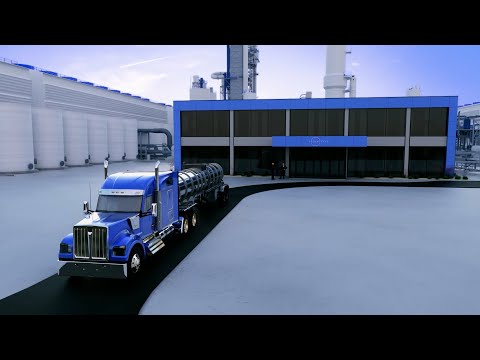
The project is projected to generate up to $290M to $405M in annual revenues, or $580 to $810 per ton of captured carbon. This price includes the market price for Carbon Dioxide Removal (CDR) credits plus federal tax incentives, which might change in the future.
Operating costs are estimated between $400 and $500 per ton, leaving a potentially small margin for the company, but anyway making the operations profitable from day 1 of operation. Still, as almost 80% of the next 5 years of production after launch are already pre-booked by the company’s partners, themselves mostly large companies, this is a relatively low-risk investment for Occidental.
STRATOS Design & Technology
Process Overview
Like most carbon capture operations, the process can be simplified into 3 steps:
- Absorbing carbon from the source, be it air or a power plant’s fumes.
- Concentrating the carbon into an almost pure form.
- Locking the carbon in a stable form, ideally in deep geological layers, similar to how untapped natural gas deposits can stay stable for millions of years.

Source: Carbon Engineering
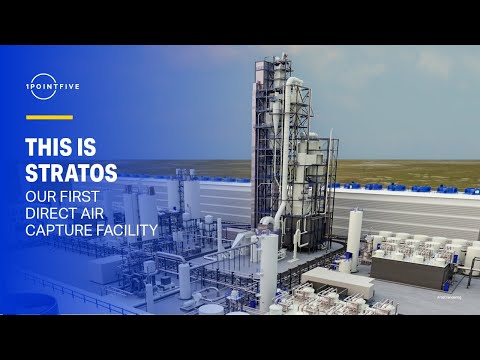
The way this is done in STRATOS is by first letting air flow through massive “contactors”, where the atmospheric CO2 enters in contact with a chemical (an alkaline liquid form of potassium hydroxide) that absorbs the CO2.
This liquid is then pumped to the pellet reactors, where calcium hydroxide absorbs the CO2 and concentrates it into a solid form. A centrifuge separates the solid pellets from the now CO2-free liquid potassium hydroxide, which can be sent back to capture more CO2.
The pellets are sent to the calciner, which extracts the CO2 from the pellets by burning them at 900°C (1650°F) and concentrates it in an almost pure form. This CO2 flux is now ready to be stored away.
Tried & Tested Technology
The advantage of this method is that it uses a liquid for capturing the CO2. This means that there is no slow moment of releasing the CO2, and waiting to bring it back for adsorption of more CO2. A liquid form is also easier to pump back and forth, limiting the complexity and energy consumption of the process.
Another advantage to this design is that it relies on well-understood technology with a solid supply chain.
For example, the contactors are redesigned air-cooling towers, and the calcinator is a common system in cement manufacturing. So none of these are risky first-of-a-kind technologies that might fail in unexpected ways.
“This time the earth has some serious complications, and it needs the brightest minds. But you also know that it’s just engineering and chemistry, that the world is watching and counting on us, and that the team’s will to overcome is quiet, steady and unwavering.”
Lori Guetre, VP at Carbon Engineering
The calcinator, a tower standing in the middle of the site at 80m height (262 feet), will be one centralized unit, instead of the larger and more spread-out contactors and pellet reactors, as a more powerful and centralized process for this step is more energy efficient.
As the entire design is built out of modular trains, it can take full advantage of mass manufacturing and will likely see future iterations costing even less from both design and capital expenditure, in a strategy that the company calls “design one, build many”.
The company is looking to avoid any impact on local water sources by using non-potable water and by burying the captured CO2 thousands of feet deep, much below any underground source water for drinking water.
Lastly, the company will also invest in a conservation project that will reduce as much as possible the impact on local residents and wildlife.
Geological Sequestration: Turning Texas Oilfields into Permanent Carbon Sinks
The company also played it safe when it came to the sequestration that follows the carbon capture. Occidental Petroleum has been operating in the Texas oilfields for many decades, and knows in extensive detail all that can be known about the region’s geology.
As a result, it can be confident that the underground deposit in which STRATOS will inject the captured CO2 will be able to hold it, if undisturbed, for tens of thousands of years at least, likely millions of years.

Source: 1PointFive
This is well-known technology for Occidental, as with many oil companies, they have been using CO2 injection into oil & gas wells for several decades already.
In total, the company has already secured the land rights and permits for sequestrating up to 8 to 55 billion tons of CO2, or the emission of the entirety of the USA in almost 2 years, to 11.4, depending on the estimate.
Once inside porous, permeable formations, the CO2 is physically trapped and eventually is dissolved into existing brine or undergoes mineralization, becoming part of the rock around it, permanently locking it in.
Because the measure of the volume & purity of the gas injected, as well as the monitoring of any potential leak, requires relatively simple sensors, the whole process can also be trusted to accurately measure the amount of CO2 the plant will lock away.
Utilizing captured carbon
The primary goal of STRATOS is the capture and sequestration of carbon, and its business model is built upon carbon credits.
But a pure, refined flux of CO2 can also be used in other ways, and the company is anticipating it.
It is now looking to build in the direct vicinity of STRATOS an industrial park of startups and industrial companies that could utilize the captured CO2 in some way.
For example, it can be used for the production of synthetic and carbon-neutral fuels, usable by ships or airplanes without needing a retrofit of their engines.
1PointFive technology and its partner Carbon Engineering produced its first atmospheric CO2-derived fuel at its pilot plant in 2017. This process lets the company produce what it calls “net zero oil”, which it started selling in 2022.
Captured CO2 can also be used for the production of plastic or concrete without the need for other raw materials, and without the usual CO2 emissions.
“CO₂ is going to be much needed for the U.S. for our extended energy independence. Taking CO₂ out of the atmosphere is a technology that needs to work for the United States.”
Vicki Hollub, CEO of Occidental
We previously discussed in further detail such technologies, notably in the following articles:
- “Alternative Fuels – How Light Can Help Repurpose Carbon Dioxide“
- “Carbon-Negative Building Materials Could Replace Concrete“
- “Cyclical Emissions – Creating Methane from Carbon Dioxide“
So, overall, even if the climate urgency of capturing carbon became somewhat less intense, the infrastructure to provide feed of purified CO2 to innovative industries will stay a very valuable asset.
STRATOS’ Future
The project was 94% completed by the end of February 2025, with both Train 1 & 2 already finalized in December 2025. Trains 3 & 4 will be commissioned in Q2 2026.
The startup operations are expected for Q3 2026, and full-speed production is already running by the end of the year. The commissioning will begin with a few successive steps:
- Water runs in the pipes, and the fan is activated for CO2 capture.
- Mixing of potassium hydroxide and lime into the water.
- Initial capture of CO2 and test of the underground injection.
Each phase will assess the proper functioning of all the piping, pumps, cooling, heating, and other machinery the project utilizes, trying to optimize energy consumption and operational costs.
Occidental is also in talks with XRG, the energy investment arm of the United Arab Emirates-owned Abu Dhabi National Oil Co., to form a joint venture for the development of another DAC facility in South Texas.
It would be planned for an initial 500,000 tons/year, like STRATOS, but with the possibility to grow it to up to 3 million tons/year.
“The U.S. is a priority market for XRG and we look forward to building on this partnership as we continue to invest in strategic projects across the energy value chain.”
Khaled Salmeen, Chief Operating Officer, XRG
However, the company, as well as all carbon capture companies and renewable energy companies, will need to prepare for potentially unstable carbon prices, especially as the topic is still hotly political between Democrats and Republicans.
For example, the company receives a large federal grant for the project, which has been criticized as “corporate welfare” by its opponents.
Conclusion
STRATOS is a very ambitious project, and by far the most likely to first make a true dent on global carbon emissions when launched at full speed. With half a million tons of CO2 directly and permanently removed from the atmosphere, it will also make the concept of carbon credit a much more straightforward proposition than the sometimes byzantine calculation of other methods of compensating for carbon emissions.
STRATOS is just one of many such facilities that Occidental is planning to build, and considering this pilot plant took only 3 years to finish, future projects are expected to come online relatively quickly as well.
Investing In Stratos
Occidental Petroleum
For a long time, investors looking for green credentials scoffed at any green initiative pursued by oil companies as greenwashing.
But with more than a billion dollars in investment, and the world’s largest direct air carbon capture facility ever made, it becomes hard to doubt Occidental’s intention to prepare for the post-oil era.
Carbon capture is also a sector that makes sense for an oil company, as moving gas and liquid, dealing with high-temperature and heavy industrial equipment, as well as drilling miles underground, are all core competencies of the company.
Still, the core of the company is today its oil & gas production, which is what initially interested legendary investor Warren Buffett, whose investment firm today owns 25-29% of the company, having started to accumulate his position since 2022.
It produced 1.434 thousand barrels of oil equivalent per day (Mboed) in 2025. It produces its oil mostly from the Permian shale oil Basin, other US sites (including the Rockies and the Gulf of Mexico), and ventures in the Persian Gulf, with most of its reserves being unconventional oil deposits (shales).

Source: Occidental
Moving into 2026, it is looking to mostly invest in the Permian Basin.

Source: Occidental
The company has been reducing its debt and plans to improve its free cash flow by $1.2B in 2026.

Source: Occidental
Occidental could be a good bet for investing in carbon capture while recognizing that oil & gas are still a key part of our energy mix, and will likely stay this way for at least the upcoming decade.
The more flexible production profile of shale and the progress of STRATOS make the company more likely to adapt quickly to a post-oil future, with the optionality to embrace in a few years or a few decades, depending on the global economic context and the pressure of climate change.
(You can also read about other carbon capture companies in our article “Top 5 Carbon Capture Stocks To Invest In“)
Latest Occidental (OXY) Stock News and Developments
