Material Science
Flat Bands in Kagome Metals May Unlock Future Superconductors

Securities.io maintains rigorous editorial standards and may receive compensation from reviewed links. We are not a registered investment adviser and this is not investment advice. Please view our affiliate disclosure.

New Progress In Kagome Superconductors
Superconductors are materials that carry electricity without resistance, but until now, they have only worked under extreme conditions. Kagome metals may change that.”
This grounds readers who may not be physics-savvy.
In November 2024, we discussed a new material for new magnetic theories, developed by researchers at Rice University.
This discovery was built upon a 2022 publication, in which researchers discovered that “kagome material,” a type of metallic crystal, exhibits surprising magnetic properties.
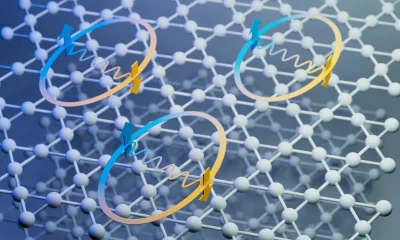
It takes its name from the kagome weaving pattern used in traditional Japanese craft, or trihexagonal tiling, with overlapping triangles and large hexagonal voids.

Source: Research Gate
In a similar way, kagome materials, like, for example, magnetic iron-germanium crystals, are organized in this pattern at the atomic level.
Another chromium-based kagome metal, CsCr₃Sb₅ (cesium-chromium-antimony), seems to have massive potential for future electronics components, including superconductors, topological insulators, and spin-based electronics, according to the latest paper by Rice University researchers, published in Nature Communications1, under the title “Spin excitations and flat electronic bands in a Cr-based kagome superconductor”.
Magnetic & Electronic Properties of Kagome Materials
Already in 2022, unique properties of the kagome material had been noticed:
- Magnetic effects require electrons to flow around the kagome triangles, akin to superconductivity.
- Although these magnetic and charge density wave effects are not superconductivity in the conventional sense, researchers have confirmed that such phenomena in kagome materials can persist even at room temperature and normal pressure conditions. This makes them valuable stepping stones toward discovering higher-temperature superconductors.
- The presence of a “charge density wave“, where the electrons “merge” into each other into a collective wave, collectively carrying an electric current.
- Unlike “normal” superconductivity, this comes in spikes, like water dripping from a faucet, more than a continuous electron flow.
- Despite displaying charge density waves, kagome materials also display magnetic properties, which are usually 2 incompatible properties.
Overall, the very organized nature of kagome materials could make them easier to study phenomena at the very edge of our understanding of electromagnetism, like “unconventional superconductivity” or “the continual fluctuations between magnetic states in quantum spin liquids”.
Making A Kagome Superconductor
Flat Band Electrons
Flat band electrons are electrons in a special type of electron energy band that has a constant energy, or “flat” dispersion, meaning electrons have the same kinetic energy regardless of their momentum.
Less technically, this means a super-dense state, where electrons can behave like superconductors, but without the usual pre-requisite conditions for superconductivity (ultra-cold, or ultra-high pressure).
So far, stabilizing kagome lattices to bring flat bands to the energy level required has been difficult to achieve. Until CsCr₃Sb₅ was used.
“Our results confirm a surprising theoretical prediction and establish a pathway for engineering exotic superconductivity through chemical and structural control,”
Building The Right Crystal
CsCr₃Sb₅ naturally crystallizes in a layered hexagonal lattice.

Source: Nature Communications
However, to observe the effect at scale and have a material that will be useful for later commercial applications, a much larger crystal was required.
Refining on their previous methods, the researchers managed to produce samples 100x larger than previously done.
ARPES and RIXS Analysis of Kagome Superconductor CsCr₃Sb₅
To visualize the electronic structure of CsCr3Sb5, the researchers used a technique called ARPES (angle-resolved photoemission spectroscopy ). It creates a map of the electron under light generated by a particle accelerator (synchrotron).

Source: Nature Communications
It revealed distinct signatures associated with compact molecular orbitals, a sign of electronic flat bands, and confirmed that all of the polarization geometries contribute to the formation of flat bands.
“The ARPES and RIXS results of our collaborative team give a consistent picture that flat bands here are not passive spectators but active participants in shaping the magnetic and electronic landscape.
They then used RIXS (resonant inelastic X-ray scattering) to measure the magnetic excitation states.
This too confirmed the presence of flat bands, independent of the ARPES’ results.

Source: Nature Communications
Temperature Effects on Kagome Superconductivity Potential
The scientists then checked the effect of temperature variation on the properties of this new material.
Contrary to other potential superconducting materials, the properties were better at 140°K (-133°C / -207°F) than at 10°K (-263°C / -441°F).

Source: Nature Communications
Overall, these experiments not only identified a very promising new material but also demonstrated that the lattice geometry is directly connected to emergent quantum states.
“By identifying active flat bands, we’ve demonstrated a direct connection between lattice geometry and emergent quantum states,”
Ming Yi – Rice’s Associate Professor of Physics and Astronomy.
Potential Applications
The density of states from the flat bands is at the energy levels near a quantum critical point, potentially enabling superconductivity.
This is also an improvement over the previous kagome metal lattice, as kagome flat bands provide a high density of states across a much larger portion of the material.
CsCr3Sb5 also suppresses the density wave observed in other kagome materials, improving its superconductivity potential further.
A high- or room-temperature kagome superconductor would be revolutionary for quantum computing, spintronics electronics components (low energy consumption electronics), and topological materials (similar to the new state of matter developed by Microsoft’s (MSFT -2.68%) quantum computing team).
It could also have potential as “just” a high-temperature superconductor, which would be usable in maglev, military technology, and power generation.
Swipe to scroll →
| Application | Benefit of Kagome Superconductors |
|---|---|
| Quantum Computing | Stable qubits from flat band states |
| Spintronics | Low-energy magnetic memory & logic |
| Maglev & Transport | High-speed, frictionless travel |
| Military Tech | Stealth & power-efficient systems |
| Power Generation | Reduced grid losses, higher efficiency |
Leaders in Superconductivity Solutions
American Superconductor Corporation
American Superconductor Corporation (AMSC +4.68%)
AMSC is a company providing energy solutions for the power grid, ships, and wind energy. In general, the more power-hungry or massive a system is, the more it requires superconducting technology to avoid overheating.
Despite its name, ASMC provides not only superconductor systems but also, for example, gear drivetrains for wind turbines.
The company is riding multiple growth drivers, from the trend of electrification and digitalization (including AI datacenters), but also the reshoring of US manufacturing capacities and the need for Navies of the Anglosphere to modernize in response to growing geopolitical risks.

In the power supply segment, AMSC has seen a steady rise in orders. This was driven by semiconductor fabs looking to be protected from power grid fluctuations, helping the grid deal with the intermittent nature of renewables, and power supply & controls at industrial sites.
In the wind turbine segment, AMSC is mostly active with its Electrical Control System (ECS). Historically, ESC was a strong segment for the company with the 2MW wind turbines, but it has progressively declined. AMSC aims for a rebound thanks to the new 3MW turbine design, with a special focus on the Indian market.

For military ships, ASMC provides the “AMSC’s High Temperature Superconductor Magnetic Mine Countermeasure,” a system to alter the magnetic signature of the ships to protect them from sea mines. This is sold to the US, Canadian, and UK navies, with $75M worth of orders so far.
Overall, ASMC is doing best with leveraging superconductor technology in niche applications viable today, while likely being ready to deploy further advances in the future. It should also be noted by investors that the stock has experienced extreme volatility in the past, and they should calculate the risks accordingly.
Latest American Superconductor Corporation (AMSC) Stock News and Developments
Critical Analysis: Yaskawa Electric (OTCMKTS:YASKY) & American Superconductor (NASDAQ:AMSC)
defenseworld.net
•
March 21, 2026
Algert Global LLC Increases Holdings in American Superconductor Corporation $AMSC
defenseworld.net
•
March 15, 2026
How Low Can American Superconductor Stock Go?
forbes.com
•
March 9, 2026
Should You Chase The Momentum In AMSC Stock?
forbes.com
•
February 19, 2026
Merit Financial Group LLC Has $1.89 Million Holdings in American Superconductor Corporation $AMSC
defenseworld.net
•
February 18, 2026
Principal Financial Group Inc. Invests $2.34 Million in American Superconductor Corporation $AMSC
defenseworld.net
•
February 17, 2026
Study Referenced
1. Wang, Z., Guo, Y., Huang, HY. et al. Spin excitations and flat electronic bands in a Cr-based kagome superconductor. Nature Communications 16, 7573 (2025). https://doi.org/10.1038/s41467-025-62298-5