

Megaprojects
Hyperloop: The Future of High-Speed Rail Takes Shape

Securities.io maintains rigorous editorial standards and may receive compensation from reviewed links. We are not a registered investment adviser and this is not investment advice. Please view our affiliate disclosure.

The Importance Of Rail
We might think of the modern era as dominated by the combustion engine, planes, and, more recently, electric motors. But the industrial age was built on the back of another technology: railroads.
By creating a low-cost way to move goods inland, railroads and trains massively boosted productivity.
To this day, every industrial economy relies on trains to sustain its manufacturing beyond the coastal regions (which are supported by sea trade). Trains are especially crucial for moving raw materials and bulk industrial products like mineral ore, steel, cars, etc.
In some cases, it can take extreme forms, like the 704-kilometer (437 mi) railway line linking the iron mining center in the middle of the Sahara in Mauritania, with a 3-kilometer-long train, carrying 200 – 300 freight carriages, carrying a total of 25,000+ tons of material in one go.

Source: CNN
A key advantage of trains is that they are by far the most energy-efficient transport method to operate over land, which is why they are the preferred option for moving millions of tons of cargo.

Still important for industries, in most countries, trains have taken a backseat when it comes to personal transportation. Trains are slower than planes, and less flexible than cars and highways. It means that, besides subways and some commuter trains in metropolitan areas, trains are often not viewed as a way to carry people between cities.
Existing conventional modes of transportation of people consist of four unique types: rail, road, water, and air.
These modes of transport tend to be either relatively slow (e.g., road and water), expensive (e.g., air), or a combination of relatively slow and expensive (i.e., rail)
This, of course, can vary, with Europe to some extent, and China especially, having made massive investments in high-speed train networks.

Source: Reddit
However, current technology of high-speed trains still makes them 3x slower than most air travel, making it only viable for high traffic regions, relatively short distances, and for passengers willing to spend more time travelling.
A complete rethinking of trains & railroads could change that, first proposed in its current form by Elon Musk in a white paper published in 2013, giving it its current moniker of “Hyperloop”.
(You can read a longer overview of train technologies and other future potential technologies besides hyperloop in our previous article, “Maglev, Hyperloop, And The Future Of Trains.”)
Ultra-High-Speed Challenges
At low speed and up to 200-300 km/h (125-185 miles/hour), the main issue for trains is to stay on their tracks safely and comfortably enough. This is a problem that has been solved over the past century, and is now a well-understood technology, even if it requires state-of-the-art manufacturing and maintenance for high-speed trains.
When going at a higher speed, a few other issues start to cause problems.
Rail Friction and Maglev as a Solution
The first issue is friction with the rails. This is already an issue for “normal” high-speed trains. The way to solve it is for the train to never actually touch the rail track, but instead levitate above it.
This is the principle of maglev (magnetic levitation) technology, with a succession of magnets pushing the train up and forward.

Source: Department Of Energy
This is not a solution without challenges, as this requires superconducting magnets, which need to be cooled at very low temperatures.
It makes it expensive, but it is feasible. There are several commercial maglev lines in operation today, including Shanghai, Beijing S1, and Changsha in China, and Linimo in Japan. South Korea’s Incheon Airport maglev has been closed since 2023.
The Air Resistance Barrier at Ultra-High Speeds
The second issue is air resistance. It goes up exponentially as speed increases, forcing high-speed trains and maglev to adopt a profile that is as aerodynamic as possible.
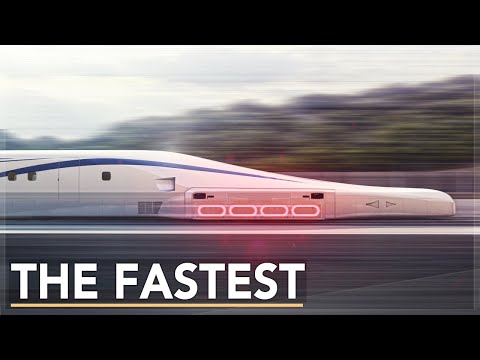
An additional problem caused by air resistance is that if a train could reach the 1,000 km/h range (620 mph), it would cause a sonic boom, which is highly undesirable for both the surrounding people and buildings, and the railroad infrastructure itself.
This is why the upper limit of high-speed maglev technology is believed to be in the range of 600 km/h (372 mph), which is the goal of China’s latest maglev design.
Ultimately, while a more aerodynamic profile can help, air resistance will forever limit the speed of conventional railroad transportation.
This is why, at the core of the Hyperloop concept, is the idea to do for air resistance what maglev did for rail friction: remove the problem.
Swipe to scroll →
| Transport Mode | Typical Speed | Max Demonstrated Speed | Main Limitation |
|---|---|---|---|
| Conventional Rail | 120–200 km/h | 320 km/h | Rail friction |
| High-Speed Rail | 250–350 km/h | 400 km/h | Air resistance |
| Maglev | 400–500 km/h | 600 km/h (China goal) | Sonic boom threshold |
| Hyperloop | 600–1000 km/h (projected) | 387 mph tested (China 2024) | Vacuum engineering, safety |
Hyperloop’s Initial Concept
The idea of hyperloop is to put a maglev train inside a vacuum tube, from which air is almost totally removed.
This should completely remove air resistance, allowing for speeds of 1000 km/h. This speed could allow for travel from Los Angeles to San Francisco in only 30 minutes.
Even higher travel is theoretically possible with Hyperloop-like designs, with speed as high as 4,000 km/h discussed (2,500 mph).
Key Advantages
The strongest argument in favor of Hyperloop is that it would be likely to be boarded and used like a train more than a plane, despite comparable speed.
It would mean much lighter restrictions on luggage, as well as the cumbersome security check and boarding procedure of airports, often taking as much time as the travel itself, especially for short and medium-range flights.
So while Hyperloops are not anytime soon going to compete with Paris-Beijing flights anytime soon, they might on shorter distances, providing much quicker travel.
Compounding this effect is the possibility of Hyperloop stations to be built much closer to city centers. While Hyperloop train/capsules can travel at 1,000km/h, they can also go slower. So they also reduce the need for travelers to commute from a distant airport to a metropolis center, further improving the total travel time.
Safety could be another argument. It is yet to be seen how the safety of Hyperloop will be handled (see below), but it could prove a lot safer than air travel.
Lastly, here too yet very uncertain, the cost of infrastructure may be compensated by lower operating costs than air travel. The possibility of using the local power grid or solar energy would also reduce the carbon emissions of such travels, potentially having an important impact on the total ticket price in a future with carbon taxes.

Source: Visionas
Technical Limitations
Vacuum Engineering Challenges
While the concept of Hyperloop is simple in its principles, implementing it in practice is rather complex. There is a whole range of engineering to do, and questions about the materials or design to ultimately pick.
The largest issue is the creation and handling of the required air vacuum. The initial white paper envisioned 0.015 psi (100 Pa), which is about 1/6 of the pressure on Mars or 1/1000 of the pressure on Earth.
The efficiency of industrial vacuum pumps decreases exponentially as the pressure is reduced, so further benefits from reducing tube pressure would be offset by increased pumping complexity.
Such levels of vacuum would need to be handled safely as well, as uncontrolled re-pressurization could cause a catastrophic accident.
Proper airlocks and docking systems for connection to a normally pressurized train station will also be needed.
Energy Supply
The low-pressure environment will require a constant supply of energy. The initial design imagines a series of solar panels accompanying the Hyperloop tube, which, combined with batteries, would provide its energy and make it “self-powering”.
Overall, energy consumption should not be a major issue when compared to the equivalent alternative for these speeds: airplanes.
However, this could reduce the economic case for Hyperloop, and it is likely that the high energy consumption of keeping magnets superconductive and the tube in a vacuum will make this mode of transport a lot more expensive than normal train lines, even without taking into account the cost of infrastructure.
Material Challenges in Near-Vacuum Environments
Another problem caused by vacuum is that a lot of materials start to behave differently at very low air pressure.
Notably, traditional steel reinforcements in concrete can warp or crack in near-vacuum conditions, and standard concrete might crumble when internal air pressure approaches zero.
Most likely, new materials will be needed, with some already being tested (see below).
Vibration and Ride Comfort Issues
Another potential failure point the initial tests of Hyperloop revealed is the appearance of strong vibrations past the 600km/h mark.
If not dealt with, these vibrations would render the passenger experience physically intolerable, even unbearable, and would also likely damage the Hyperloop components in regular use.
Passenger Safety and Emergency Protocols
When moving at such speed, a major concern is, of course, safety. Any crash at full speed would be instantly fatal for all passengers, and likely for people around the crash site as well.
This will likely force Hyperloop to be built either underground or high enough above ground to be shielded from traffic incidents, crossings, etc.
The track path will also have to be almost perfectly straight and level, as turning at these speeds is going to be very difficult. This could limit the implementation of this idea in mountainous areas.
Similarly, earthquakes or other natural catastrophes will need to be detected in time for the Hyperloop vehicles in transit to power down quickly.
Another concern is how to deal with any emergency on board. Most likely, similarly to airplanes, a quick trip to the nearest station will be needed to provide the required medical assistance.
If a vehicle ends up somehow stranded or stuck midway, a quick re-pressurization system and regular evacuation point for passengers will also have to be incorporated in the track design.
Initial Trials
The idea immediately gathered a cult following, thanks to Elon Musk’s popularity, and was under development by Hyperloop One, formerly Virgin Hyperloop. However, this company closed definitively in 2023, after running out of money.
This setback has led many to prematurely claim the death of the concept, calling it (pun intended) a pipe dream. This was premature, as other hyperloop-like initiatives are moving ahead.
Europe & USA
One active Hyperloop company is the Dutch Hardt Hyperloop, which announced that it had successfully tested its Hyperloop vehicle in September 2024. This is only proof of the vehicle moving and vacuum being maintained, but it is a first step. It was followed by a successful line switching test in December 2024.
The Italian HyperloopTT unveiled prototype capsules in 2023 and signed a joint venture with Italian aerospace industry giant Leonardo and WeBuild (Italy’s largest engineering contractor) for a Venice-Mestre and Padua “Hyper Transfer”. This test line would put Italy and HyperloopTT ahead of most of its competitors globally.
Overall, the company is more focused on freight transport, with a recent feasibility study for a 549 km (341 miles) route connecting the Brazilian Port of Santos to São Paulo, extending through major cities like Campinas and São José do Rio Preto.
The two-way system would transport 5,600 TEUs per day at 600 km/h (370 mph), reducing transit times from hours or days to mere minutes.
Another somewhat active company on this topic in Western countries is Musk’s Boring Company, with its last hyperloop test in 2022. Still, for the moment, the company seems more focused on simpler “loops” transporting cars at high speed between given destinations.
“The Loop is a stepping stone toward Hyperloop. The Loop is for transport within a city.
Hyperloop is for transport between cities, and that would go much faster than 150 mph.”
Elon Musk
India
TuTr Hyperloop, a startup at the Indian Institute of Technology Madras, is working on its own Hyperloop design to connect Jawaharlal Nehru Port Trust (JNPT) in Navi Mumbai with the proposed Vadhavan Port in Palghar district.
The very ambitious project would put India ahead in high-speed rail, a field where the country has so far heavily lagged behind, with previous efforts widely considered as having failed.
China
It is in high-speed train-enthusiast China where Hyperloop is making the most progress recently.
In August 2024, a maglev train recently completed a test at a 2-kilometer-long (1.2-mile) pipeline with a low-vacuum environment in Shanxi province, performed by China Aerospace Science and Industry Corporation (CASIC).
Renamed T-Flight, Hyperloop is currently achieving 387 mph, with plans to reach the hoped-for 621 mph.

Source: South China Morning Post
In mid-2025, several news outlets revealed that Chinese engineers are also quickly fixing the technical issue with the initial design concepts.
One such fix is the use of an AI-guided suspension system and laser-guided sensors that counter the worst of these vibrations. Even minor flaws in the track, such as uneven coils or bridge deformations, can lead to severe turbulence inside maglev pods.
Scientists at the CASIC said that their suspension system reduced vertical vibrations by 45.6 percent and achieved comfort scores below the Sperling Index threshold of 2.5, a scale for assessing ride comfort and quality in rail vehicles.
Another fix is changing the material used for the vacuum tube. A China Railway Engineering Consulting Group (CREC) team developed a steel-concrete tube design sealed with epoxy-coated rebar and corrugated steel expansion joints.
This novel combination merges steel’s tensile strength and concrete’s compressive durability, ensuring the tubes remain airtight under harsh conditions ranging from sub-zero winters to 45 °C (113 °F) summers.
The inside of the tube uses low-carbon steel grids that reduce the eddy currents (circulating loops of electric current) plaguing existing maglev designs, particularly when speeds surpassed 1,000 km/h.
To counter the effect of the vacuum, they also used basalt-fiber concretes and glass-fiber reinforcements, and pre-vacuum curing.
Best of all, the prefabricated tube segments are expected to offer up to 60% lower costs than traditional all-steel piping, allowing for easier scalability.
Still, issues like thermal expansion over long distances and swift, reliable emergency response design remain under examination.
Hyperloop’s Future
Economic Viability
Considering how uncertain the final design of the Hyperloop systems is, as well as the actual performance and maintenance requirements, it is hard to determine its potential economic viability. A few elements can already be discussed:
- Hyperloop systems will have to be installed in routes that match a few key requirements:
- Point-to-point transportation, with not many stops on the way, or none at all.
- Heavy traffic load, to ensure maximum utilization of the expensive infrastructure to be built.
- Relative straight line between stations, both in altitude and overall direction.
In addition, Hyperloop tracks will not be compatible with other existing railroads, requiring the Hyperloop stations to be near important enough points of interest (downtown, airports, harbors, etc.) or nearby other high-speed railroad stations.
These constraints, combined with the advanced technology required and the infrastructure even more complex than a regular high-speed train, might put a limit on which routes will be profitable.
Most likely, only city-to-city traffic that is currently served by airlines at a large scale will justify Hyperloops.
Paradoxically, the more expensive and complex Hyperloop might have more promising economic prospects than simpler maglev lines, which fall in an awkward position of being too slow to compete with airplanes over long routes, but too expensive to compete with traditional high-speed rail as well, an issue that has so far severely limited their deployment.
As an electric-powered system, Hyperloop costs will also be tied to electricity prices. It would be easier to decarbonize than air travel, potentially giving it a discount in the face of carbon taxes.
Potential Hyperloop Sites
Due to the economic requirement of having to replace not car and train traffic, but more expensive plane travel, Hyperloop is likely to be first implemented in areas that are both easy to build and densely populated, or at least between large urban centers somewhat close to each other. Among the potential regions matching these criteria can be mentioned:
- USA’s West and East coasts.
- The North-Western European plain (from France/The Netherlands to Poland)
- The Western part of Russia, especially the St. Petersburg-Moscow-Kazan Axis.
- China’s East Coast.
- India’s main population centers
- The Middle East, especially the Kuwait-Qatar-UAE-Dubai line.
- Brazil’s coastline.
One day, the Hyperloop concept might even be deployed on the Moon. Paradoxically, space would be an easier place to build Hyperloops than on Earth, especially in airless places like the Moon, where a vacuum does not need to be created in the first place but exists naturally.
This is definitely not an immediate possibility, but it could be part of the very long-term Chinese plans for industrializing Earth’s satellite, together with the redesign of Hyperloop into mass drivers.
Which Techs Could Help Hyperloops?
Of course, more research, prototyping, and investment will be the key to ever seeing a Hyperloop system running in real life.
Independent progress in related technologies could also make Hyperloop a lot more viable.
One possibility is better superconducting materials, especially high-temperature (or ideally room temperature) superconductors. By reducing the complexity of the superconducting magnet systems, they would make maglev a lot cheaper, easier to maintain, and less energy-intensive to operate.
Better tunneling technology would also help, as Hyperloop will either be entirely buried or require even more tunnels than traditional high-speed rail, due to its inability to turn at any sharp angle.
As illustrated by the use of AI to reduce vibration, artificial intelligence could also contribute significantly in many ways: developing better materials, self-driving trains, predictive maintenance, connectivity, automated train control & digital signaling, and real-time updates.
Investing In Train-related Technology
Despite gathering a lot less attention than aerospace or EVs, high-speed trains, maglev, and maybe in the future, Hyperloop, are at the forefront of revolutionizing mankind’s means of transportation and the economy.
China has been leading the way so far, but the rest of the world is taking note and looking to massively expand its railroad capacity as well.
If you are not interested in picking train-related companies, you can also look into ETFs like SmartETFs Smart Transportation & Technology ETF (MOTO), iShares US Transportation ETF (IYT), or SPDR S&P Transportation ETF (XTN), which will provide more diversified exposure to capitalize on the strategically vital transportation and railroad industry.
Conclusion
Hyperloop has been intensely discussed since Elon Musk promoted the idea in 2013, and has had quite a few false starts since.
The death of the concept, already announced several times, seems to have been declared prematurely. In fact, many of the more serious initiatives are now moving forward, with the largest technical constraints being slowly solved.
This leaves the open question of the economic viability of Hyperloops, something that is yet to be seen with real use cases. But considering it would directly compete with airports and airlines, it might have a more promising future than at first glance, when it could be misunderstood as just “a fast train”.
Leader in Superconductivity Solutions
American Superconductor Corporation
American Superconductor Corporation (AMSC -3.2%)
AMSC is a company providing energy solutions for the power grid, ships, and wind energy. In general, the more power-hungry or massive a system is, the more it requires superconducting technology to avoid overheating.
Despite its name, AMSC provides not only superconductor systems but also, for example, gear drivetrains for wind turbines, and could be an important partner for domestic maglev components.
The company is riding multiple growth drivers, from the trend of electrification and digitalization (including AI datacenters), but also the reshoring of US manufacturing capacities and the need for Navies of the Anglosphere to modernize in response to growing geopolitical risks.

In the power supply segment, AMSC has seen a steady rise in orders. This was driven by semiconductor fabs looking to be protected from power grid fluctuations, helping the grid deal with the intermittent nature of renewables, and power supply & controls at industrial sites.
In the wind turbine segment, AMSC is mostly active with Electrical Control System (ECS). Historically, ESC was a strong segment for the company with the 2MW wind turbines, but it has progressively declined. AMSC aims for a rebound thanks to the new 3MW turbine design, with a special focus on the Indian market.

For military ships, AMSC provides the “AMSC’s High Temperature Superconductor Magnetic Mine Countermeasure,” a system to alter the magnetic signature of the ships to protect them from sea mines. This is sold to the US, Canadian, and UK navies, with $75M worth of orders so far.
Overall, AMSC is doing best with leveraging superconductor technology in niche applications viable today, while likely being ready to deploy further advances in the future. It should also be noted by investors that the stock has experienced extreme volatility in the past, and they should calculate the risks accordingly.
Investing in Transportation
Siemens Aktiengesellschaft (SIE.DE)
Siemens is a strong company in the industrial sector, with activity in electronics, heavy industries, infrastructure, mobility, and healthcare.

Source: Siemens
The company’s activities in IoT are spread across several segments, including automation (62% of total digital industries) and smart infrastructure.
The healthcare activity focuses more on imaging, analyses, and robotics, while the mobility segment is mostly about train and rail infrastructure.
The company sees a large opportunity in automation from the globally declining population and “glocalization” (or “re-shoring” of industrial capacity closer to the final markets). The increasing presence of renewables in the electric grid also increases the demand for a “smart grid” able to handle these more intermittent and variable power sources.
In the niche where it is active, Siemens is a very strong competitor, ranking #1 for factory automation, rail automation, grid automation, and vertical industrial software (including 1,300 cybersecurity experts).

Source: Siemens
Siemens is a stock positioned to benefit from electrification, re-shoring, IoT, automation, railroads, and the increasing level of technology in industrial processes overall.
As a leader in railroad equipment manufacturing, it will benefit directly from investment in the sector, as well as indirectly from the re-industrialization trend.
Thanks to its wide range of technology, it will be at the forefront of building smart railways, leveraging its experience in automation and IoT from other already more digitalized industries.



