

Aerospace
Next-Gen Heavy-Lift Rockets Enabling Multiplanetary Economy

Securities.io maintains rigorous editorial standards and may receive compensation from reviewed links. We are not a registered investment adviser and this is not investment advice. Please view our affiliate disclosure.

Bigger, Reusable Heavy-Lift Rockets
Since the very first orbital missions of Sputnik and Yuri Gagarin, space exploration has been constrained by the capacity of rockets able to launch payloads into orbit.
The first rockets had very limited capacities, with the first satellite Sputnik just a 58 cm (23 inches) diameter polished aluminum sphere. The Vostok-1 rocket, responsible for the first manned flight, could only bring 4.7 tons to LEO.
In comparison, the Saturn-5 that would bring astronauts to the Moon could carry as much as 140 tons (310,000 lbs) to LEO, a feat still to this day unmatched.

Source: NASA
However, all these rockets were “consumable” one-launch devices. It was enough to reach the Moon for a prestige-driven, state-funded space race between the USA and the USSR.
But this is equivalent to throwing away an entire Boeing 777 after each flight. If we did that, plane travel would be horrendously expensive and never make sense from an economic point of view.
This is why the invention by SpaceX of reusable rockets changed everything. While at first of lower capacity, the reusability of Falcon-1, and then of Falcon-9 and Falcon Heavy, made the cost of reaching Earth’s orbit collapse.
Today, a new generation of heavy-lift rockets is in the making, and the competitors of SpaceX are on its heels. With reusability now a must, as illustrated by the likely abandonment of the SLS program after 2028, these rockets will allow for the building of more infrastructure in space than ever before.
In the long run, this will likely be viewed by history as the inflection point where our species turned multiplanetary, as these launchers will enable the building of space infrastructures, Moon bases, Martian colonies, and an unlimited energy supply from orbital solar arrays, altogether forming an entirely novel space-based economy (follow the links for in-depth articles on each topic).
Why Size Matters
The first and most obvious effect of reusable rockets and larger ones at that, is that it cuts the cost of reaching Earth’s orbits and deep space.

Source: ARK Research
With an expected capacity of 100+ tons, SpaceX’s Starship is completely changing what is possible to bring into orbit. For reference, the entire ISS weighs 420 tons (925,000 pounds) and required more than 40 orbital launches for its assembly. Starship could do something similar with just 3-4 launches, and likely 1/100th of the total cost.
Swipe to scroll →
| Rocket | Company / Country | Approx. LEO Payload (t) | Reusability | Status (2025) | Notes |
|---|---|---|---|---|---|
| Starship | SpaceX / USA | 100–150 (design) | Fully reusable booster + ship | Flight-proven prototype | In-orbit refueling and deep-space missions under development. |
| New Glenn | Blue Origin / USA | ≈45 | Reusable first stage | First flights in 2025 | Designed for crew, cargo, and planetary missions. |
| Falcon Heavy | SpaceX / USA | 63.8 | Reusable side boosters | Operational | Currently the most capable operational heavy-lift rocket. |
| Neutron | Rocket Lab / USA–NZ | ≈13 | Reusable first stage | In development | Targets LEO, constellations, and potential point-to-point cargo. |
| Terran R | Relativity Space / USA | 23.5–33.5 (design) | Reusable first stage (planned) | First launch target 2026 | 2 stage reusable rocket sized to serve the Low Earth Orbit (LEO) constellation market |
| Long March 10 | CALT / China | ≈70 | Partially reusable variant (10A) | In development | Crewed lunar missions targeted before 2030. |
Beyond economy of scale and cost reduction, larger launch rockets radically change what can be done in space. For example, as launches are cheaper, in-orbit refueling is now a possibility.
This means that bringing hundreds of tons of materials to deep space, like the Moon or even Mars, is now possible with just the initial flight, plus a few refueling flights. In addition, a refueled rocket will not need to keep fuel for landing back, so it can carry even heavier loads to LEO.
This also changes the type of equipment that can be brought into space. Until now, every satellite, space station element, space telescope, and interplanetary probe had to be designed with weight as the very first engineering constraint, sacrificing durability, costs, ease of maintenance, and robustness on the altar of cost launches.
Another constraint lifted is space. Launch vehicles like Starship will have a massive volume for their payload, limiting the need for complex design unfolding once released.

Source: University Of Chicago
Most likely, heavier launch vehicles will mean a radical redesign from first principles of space equipment, with construction costs falling and durability, reparability, and possibility for upgrade as the new focus.
Another possible scenario is that reusable rockets reaching the end of their life cycle could be launched one last time and left in orbit, with the now hollow tank to be refurbished into massive and spacious space stations.
The Heavy Rockets Leader: SpaceX
Due to its remarkable track record and its head start in this new space race, SpaceX is the company carrying the most expectations for this new generation of heavy launchers.
The next step is Starship, a super-heavy rocket that was originally targeting a 200-ton capacity to LEO.

Source: SpaceX
The latest estimate puts the capacity closer to 100 tons, due to a change in the design, notably making the many rocket nozzles more resistant to failure.
The rocket is remarkable for a few elements of its design, departing from previous rockets of both SpaceX and the space industry in general:
- A body made of steel instead of a high-performance alloy more commonly used in other rockets.
- Methane-fueled Raptor engines, a rarely used type of fuel until now.
- 3D printed parts.
Starship’s first tests have been … difficult to say the least, with many prototypes exploding at launch or failing to land back safely.

Later tests went a lot better, with notably test 11, performed in October 2025, which was a complete success. This means that now, SpaceX has a reliable Starship model, which can be further improved.
This improvement stage is likely going to be very important for SpaceX, as the company has a history of first creating a proof-of-concept model, and then iterating until the performance improves significantly.

For example, Falcon 9’s payload to LEO grew from 10.1 tons for its v1.0 to 22.8 tons for its latest “FT” version. The engine used has also increasingly become simpler, despite delivering much greater thrust.
Starship V3, which will be 5 feet (1.5 m) taller than its predecessor, will see its first tests at the beginning of 2026. It will also use Raptor 3, a stronger version of the engine powering the previous versions of Starship.

Source: Elon Musk
The launchpad will also be upgraded.
“Among many other things, we’re installing a new orbital launch mount, a new flame trench system and upgrading the chopsticks for future catches.“
Jake Berkowitz, a SpaceX lead propulsion engineer
This stage will also be the one testing in-orbit refueling. This will demonstrate the ability of Starship to service not just LEO, but also more distant orbits and handle missions to the Moon and Mars.
Later on, an even bigger and more powerful version, V4, is expected for 2027 or 2028.

Source: Elon Musk
It is likely that a future rocket will one day replace Starship, but none has officially been discussed yet. Most likely, a custom version dedicated to Martian travel will be developed first.
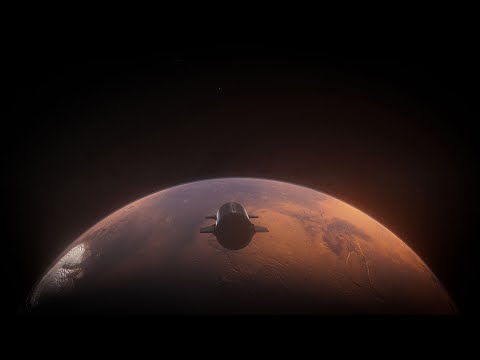
SpaceX is not publicly traded, but you can read how you could eventually buy stock in the company in this article (follow the link).
Blue Origin’s New Glenn Heavy-Lift Rocket
Another billionaire-funded company, this time by Jeff Bezos, Blue Origin has been slower than SpaceX to develop a large rocket, preferring a slow and steady approach to the quicker but more error-prone method of SpaceX.
A lot of the company’s future will depend on its new heavy-launch vehicle, the partially reusable New Glenn rocket.

Source: Ars Technica
The launch on November 13th, 2025, of the ESCAPADE (“Escape and Plasma Acceleration and Dynamics Explorers”) mission, a NASA mission studying Mars, saw the company successfully retrieve the rocket’s first stage.
Currently, New Glenn has a payload capacity to LEO of 45 tons, putting it on par with Falcon Heavy, although it is not fully reusable.
Blue Origin released a statement outlining the next steps for its heavy-lift vehicle, which will include structural enhancements, as well as upgrades in propulsion, avionics, reusability, and recovery.
The company also plans to develop a “super-heavy” version of this vehicle, likely intended to make the New Glenn a fitting rival for SpaceX’s Starship.
The next step for Blue Origin will be to test its lunar lander, the Blue Moon MK1, the precursor to Blue Origin’s human lander, MK2.
MK1 mission will demonstrate and validate the lander’s hardware and systems, and carry a NASA payload called SCALPSS (Stereo Cameras for Lunar Plume Surface Studies), which will collect images from the Moon while landing.

Source: Jeff Bezos
Full reusability is the target for Blue Origin which would allow it to catch up with SpaceX and keep ahead of other competitors. The rumored “Project Jarvis”, discussed for several years, is how the company aims to reach this target.
Still, Jeff Bezos seems unconvinced that full reusability is a required step, and apparently has set up a race between the teams working on a reusable and an expendable second stage.
“When you do that trade on paper, it just isn’t obvious. The goal for the expandable stage is to become so cheap to manufacture that reusability never makes sense.
The goal for the reusability stage is to become so operable that expendability never makes sense.”
Source: PayloadSpace
Rocket Lab’s Neutron: Medium Heavy-Lift Challenger
Rocket Lab USA, Inc. (RKLB -9.52%)
One of the most serious contenders to SpaceX’s crown in reusable launches is Rocket Lab.
The latest rocket in development at Rocket Lab is the Neutron.
With 13 tons of payload to Low-earth Orbit (LEO), Neutron is lifting 43x more mass than the company’s current rocket, Electron. It could even send up to 1.5 tons to Mars or Venus, making it a credible option for NASA missions sending rovers and experimental equipment to the nearest planets. This includes the potentially very lucrative Mars Sample Return mission.
Neutron could also be used by the US Air Force for a Rocket Cargo mission that supports point-to-point cargo transportation.
“This opportunity for the U.S. Air Force not only helps to advance space logistics, it also demonstrates a high degree of confidence by the DOD in Neutron’s capabilities. Anticipation is high for Neutron’s inaugural flight this year, and we’re excited to showcase Neutron as a platform for R&D for point-to-point logistics for the DoD.”
Neutron will use a liquid oxygen/methane propellant, following Starship’s lead. Its structure will be made of lightweight carbon composite.
(You can also read more about Rocket Lab in our dedicated investment report on the company.)
Relativity Space and the 3D-Printed Terran R
While SpaceX invented the reusable rocket, it mostly produced them through traditional manufacturing methods, tried and tested by the space industry before, but did so more efficiently.
Relativity Space is even more ambitious, having since inception used 3D-printed technology for its Terran 1 (LEO payload of 1.25 tons) and the Aeon R engine powering the upcoming reusable Terran R.
Terran R is expected to carry 23.5 tons to low-Earth orbit (LEO), or even up to 33.5 tons in its largest version.

Source: Relativity Space
While it will be much smaller than Starship, it compares somewhat to SpaceX’s current functional rocket, the Falcon Heavy, and its 50 tons of LEO payload.
The first launch of Terran R is expected for the end of 2026 from Launch Complex 16 (LC-16) at Cape Canaveral Space Force Station.
The company uses vertically integrated, proven smart manufacturing methods across Terran R to optimize for cost, scalability, and speed, and enable high-frequency launch. This approach allowed Relativity Space to achieve rapid iteration cycles for components that benefit from rigorous hardware testing, as well as progress well into flight production of primary structures and systems for Terran R.
Relativity notably uses the NASA-developed Glenn Research Copper, or GRCop, a combination of copper, chromium, and niobium.
GRCop is optimized for high strength, high thermal conductivity, high creep resistance – which allows more stress and strain in high temperature applications – and good low cycle – which prevents material failures –above 900 degrees Fahrenheit.
While 3D printing is important for Relativity, larger pieces, like the panels of the rocket’s body, are still manufactured the traditional way.
This hybrid approach optimizes for rapid development and scalability, ensuring we can bring Terran R to market quickly for our customers.
For now, Relativity Space is also still private and backed by VC firms.
As one of the highest-profile rocket companies, it is expected to IPO in a few years, most likely after several successful launches of the Terran R, which would confirm the success of the technical approach of the company.
Chinese Rockets
Long March 10
So far, the landscape of reusable launchers has been dominated by American firms. But Chinese programs, both public and private, are catching up fast.
The most remarkable is the Long March 10, a partially reusable rocket developed by the Chinese government, and the latest of the Long March rocket series.
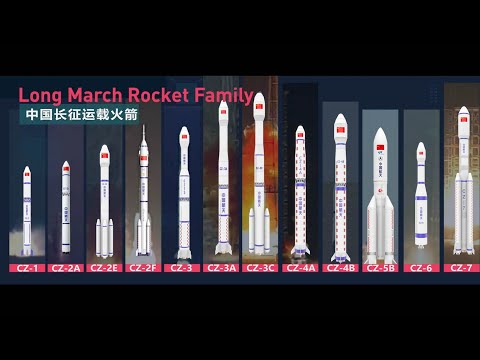
The full Long March 10 will use three first stages bundled together. Long March 10 aims for a 70-ton payload to LEO, and it will be in large part in charge of building further and supplying the Tiangong space station.
It should see its first launch in 2026, preparing for a 2030 lunar mission.
As NASA’s Artemis program gets delayed, and Starship is yet to be ready for lunar landing, this could potentially give China a winning step in the return to the Moon in the new space race.
Full reusability is expected for Long March 12A, developed in parallel, and which conducted a successful hot fire test of the second stage for the rocket in 2025.
Chinese Private Reusable Rocket Companies
Many Chinese private companies are working on reusable rockets, looking to replicate with domestic engineering talent SpaceX’s playbook of first building small reusable rockets, and then scaling up to larger rockets. This includes:
- Space Epoch (Yuanxingzhe-1 )
- LandSpace (Zhuque−3)
- iSpace (Hyperbola−3)
- Orienspace (Gravity−2)
- Space Pioneer (Tianlong−3)
- Galactic Energy (Pallas−1)
- CAS Space (Lijian-2 rocket)
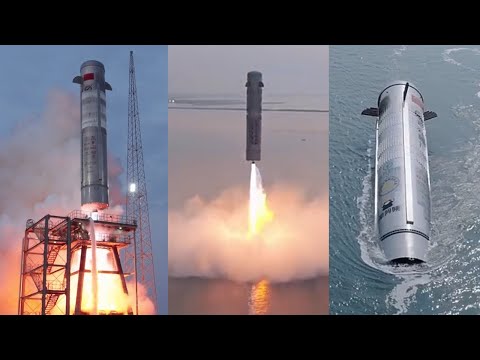
Of these, the most recent success was Space Epoch’s first known successful maritime vertical takeoff and vertical landing by a Chinese rocket company in May 2025.
Chinese Competition Overview
Overall, it seems that the competition for reusable rockets is heating up, with an onslaught of new Chinese companies on the heels of American rockets.
For now, most can be qualified as 2 steps behind, only starting to catch up with Rocket Lab and Relativity Space, and lagging behind SpaceX and Blue Origin.
Still, if the past 20 years have taught investors something, it is that the entry of China into a new technical field almost always means brutal competition is arriving soon.
This has been true for batteries, solar panels, and is now becoming true for semiconductors and space rockets as well. For example, China’s cumulative launch cadence in 2025 reached a little less than half that of SpaceX.
This will also include Guowang, a proposed 13,000-satellite low-Earth-orbit constellation to rival Starlink.
So investors in Western space companies should keep an eye on these competitors.
Other Emerging Reusable Rocket Programs
Russia’s Korona and Amur-SPG Reusable Rocket Plans
The previous contender in the first space race, Russia, has fallen behind in the past decades when it comes to space technology, especially in orbital launch rockets. Still, it is trying to finally catch up.
Development work for the Korona reusable rocket should begin in 2026.
“The launch vehicle will have an extremely low cost of launching a payload into orbit, and the rocket can be used up to 100 times.
The mass of the payload launched from the Vostochny Cosmodrome will be 5.5 tonnes.”
In parallel, Soyuz-7, also called Amur-SPG, a methane-powered, reusable rocket, with a payload to LEO of 10.5 tons, is expecting a launch date by 2030.
The rocket is expected to integrate composite materials, 3D printing, and bionic design to reduce weight while maintaining structural integrity and reducing costs.
“Roscosmos intends to have their Amur-SPG cost around $22 million per launch, a significant reduction compared to SpaceX’s $50 million per launch for their Falcon 9 reusable rocket.”
Japan’s Reusable Rocket Experiments (Honda & JAXA)
The Japanese company Honda conducted a successful launch and landing test of its experimental reusable rocket in June 2025.
While the rocket is relatively modest (6.3 m in length, 85 cm in diameter, 900 kg dry weight/1,312 kg wet weight), it was developed entirely and independently by Honda.
This is one part of space activity for the company, together with a pressurized, crewed moon rover developed in partnership between Japan’s space agency (JAXA) and Toyota.
India’s Private Reusable Launch Efforts (Agnikul & ISRO)
Indian Space Research Organisation’s (ISRO) Reusable Launch Vehicle-Technology Demonstrator (RLV-TD) is the nation’s reusable rocket program. It is still in the early stages of development.
Agnikul Cosmos is a private Indian company that achieved its first suborbital test on 30 May 2024, making it the world’s first flight with a single-piece 3D-printed engine and India’s first semi-cryo engine launch and first launch from a private launch pad.
Conclusion
The future of rocketry is being written, with heavy launchers like Starship, New Glenn, Neutron, and Terran R likely to bring the payload capacity of reusable or partially reusable rockets to the 70-200 tons per launch in the coming years.
In parallel, Chinese state and private programs are progressing fast, making sure that the space industry landscape stays as competitive as possible for the decades to come.
This almost guarantees that, as a species, not only will we soon be back on the Moon, likely with a permanent presence, but also might see in the next 10 years the first manned landing on Mars.
Meanwhile, an entire orbital economy is being built, starting with LEO satellite constellations with tens or hundreds of thousands of telecom satellites, as well as the capacity to build ever larger orbital stations or large solar power arrays.
For now, most of the main actors are not publicly listed, but this is likely to change as well, with the much-anticipated IPOs of SpaceX, Blue Origin, or Relativity Space joining Rocket Lab and likely to be highly popular with investors.
What Will Happen To Rocket Lab After SpaceX's IPO
seekingalpha.com
•
March 26, 2026
Defense ETFs: Space, Drones & More
etftrends.com
•
March 26, 2026
Rocket Lab Corporation $RKLB Shares Sold by Connective Portfolio Management LLC
defenseworld.net
•
March 26, 2026
Comparing Environmental Tectonics (OTCMKTS:ETCC) and Rocket Lab (NASDAQ:RKLB)
defenseworld.net
•
March 26, 2026
Why Rocket Lab Stock Rocketed Today
fool.com
•
March 25, 2026
AST SpaceMobile and Rocket Lab Climb 12%: SpaceX IPO Hype and BlueBird 7 Put Space Stocks in the Spotlight
247wallst.com
•
March 25, 2026



