
Megaprojects
Extremely Large Telescope (ELT): Astronomy’s Biggest Marvel

 Add Securities.io to your preferred sources on Google
Securities.io may receive compensation when you use links to products we review. This does not influence our editorial evaluations. We are not a registered investment adviser; this is not investment advice. Read our affiliate disclosure.

The Extremely Large Telescope Will Break Astronomical Records
The progress of astronomy is in large part in sync with the technical progress in the production of telescopes. From the early models hand-made by Galileo, to the technological prowess from international collaboration of today, this is still true.
Another step has been moving telescopes out of Earth and into orbit, like with the Hubble telescope and more recently with the James Webb space telescope (follow the link for a detailed analysis of that science megaproject).
The reason space telescopes are more effective is that they are immune to interference by the Earth’s atmosphere and weather, which can reduce the quality of the image.
However, Earth-bound telescopes still have some advantages over space-based telescopes. Notably, their potential size, as lifting large equipment into orbit, is still an extremely complex and expensive task.
Power supply, maintenance, and technical upgrades are also all a lot easier to do on the ground, while space telescopes are pretty much impossible to repair or change later on, especially telescopes millions of kilometers from Earth, like the James Webb space telescope.
Still in construction, a project called the Extremely Large Telescope (ELT) is demonstrating the potential of ground-based telescopes. Based in Chile, it will be the world’s largest telescope ever built, several times larger than the previous record, and represents a marvel of engineering.
A Long Line Of Large Chilean Telescopes
The ELT is the latest project of the international community of astronomers to decipher the mysteries of the Universe.
In the same area as the ELT is located the Paranal Observatory, operated by the European Southern Observatory (ESO), and 23 kilometers (14 miles) from the construction site of the ELT.

Source: ESO
Paranal is the site of the Very Large Telescope (VLT), the ancestor of the Extremely Large Telescope (ELT), now in construction. The VLT has been operated since 1998 by ESO, and used what was at the time a record-breaking large primary mirror of 8.2 meters (27 ft) in diameter.
ELT is going to dwarf the VLT, with a primary segmented mirror of 39.3-meter-diameter (130-foot).
Why Chile?
The same Chilean location is used by the Vera C. Rubin Observatory, a survey telescope observing the entire visible sky all at once, and using advanced AI to detect changes in stars’ activity.
The ELT will also be located in Chile, which has some of the best conditions for astronomy.
The chosen location has 270 average clear nights per year.
Vera C. Rubin, VLT, and soon the ELT, are all located at high altitude, with the ELT being built at 3,046 m (9,993 ft) above sea level.
Cerro Armazones once stood 10,052 feet (3,064 m) above sea level, but in June 2014, the top was blasted away to level the mountaintop for construction, shaving 60 feet (18 m) off its height and removing ~220,000 m3 of rock (263,000 square yards).

Source: ELT
This high altitude helps reduce atmospheric disturbance, further helped by the very low humidity of the desert region, and also provides a rather isolated site, far from the light pollution of large cities.
Cerro Armazones’ location in the dry Chilean desert at high altitude makes it ideal for astronomical observations.
The altitude of the site above sea level does not pose logistical problems for operations, while meeting the science requirements for low precipitable water vapour and low operating temperatures.
The rainfall in one year is of the order of 100 mm, with a median relative humidity value of 15%.
ELT Overview
Construction
Discussed since 2005, the ELT project was started in 2010, when multiple sites in Chile and other countries (Argentina, Canary Islands, Morocco, Antarctica) were initially considered, before the top of Cerro Armazones mountain was chosen, in part due to its proximity to the existing infrastructure of the Paranal Observatory.

Source: ELT
In 2012, the project was approved by the ESO Council, and construction work started in 2014.
Initially called the European Extremely Large Telescope (E-ELT), the project name was shortened to ELT in 2017.

The construction hit the 50% mark in 2023, and the first segment of the mirror started to arrive in Chile in 2024, with the secondary mirror expected to be completed in 2025.
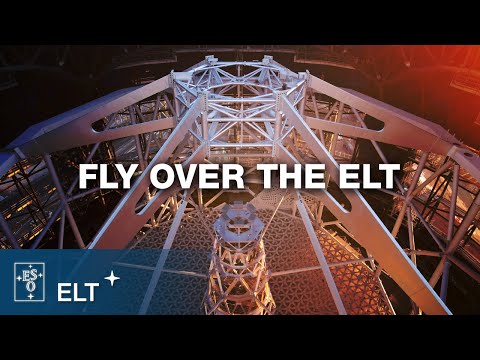
Further progress is expected in 2026 with the structure finally finished, and in 2027 with the tertiary mirrors and M4 and M5 completed, as well as the main primary mirror.
The ELT is expected to receive “first light” in 2029 and first scientific observations in 2030. It should operate for more than 30 years from that point.

Source: Cosmos Magazine
Overall, the entire construction is massive, almost as high and much larger than the Statue of Liberty.

Source: Space.com
During this initial phase, design options were discussed by the scientists and partner countries of the project.
The current design was favored over a more ambitious but less realistic concept, the Overwhelmingly Large Telescope, with a massive mirror of 100 m (328 ft) diameter, which had been considered too expensive and too complex to be built.
While most technical issues have been solved by now, it was a complex endeavor, bringing together the work of more than 170 scientists, organized in several work groups, creating a simulation of the future telescope and how to optimize its image generation capacity.

Source: ELT
In total, the ELT is expected to cost around €1.45B, with its budget already fully secured.
ELT Goals
The Extremely Large Telescope is designed to answer some of astronomy’s biggest questions. Its main scientific objectives include:
1. The Solar System
Study the atmospheres of gas giants, volcanic activity on the moons of Jupiter and Saturn, the asteroid belt, and frozen Kuiper Belt objects.
2. Exoplanets
Directly image rocky planets in habitable zones and analyze their atmospheres for water vapor, oxygen, and methane using the
ANDES spectrograph.
3. Stars
Investigate how stars form and evolve across different environments.
4. Black Holes
Track stars orbiting close to
Sagittarius A* to better understand the supermassive black hole at the center of the Milky Way.
5. Galaxies
Identify extremely distant galaxies and expand on discoveries made by the
James Webb Space Telescope.
6. Dark Matter
Explore the link between dark matter and gamma-ray bursts.
7. Fundamental Physics
Test whether constants of nature, such as the speed of light and the proton-to-electron mass ratio, have changed over cosmic time.
8. Surprises Yet to Come
Like Hubble’s unexpected discovery of dark energy in 1998, the ELT may uncover entirely new phenomena.
ELT Technical Specs
Swipe to scroll →
| Feature | Specification |
|---|---|
| Primary Mirror Diameter | 39.3 m (130 ft) |
| Mirror Segments | 798 hexagonal panels |
| Light-Collecting Area | 978 m² |
| Construction Start | 2014 |
| First Light | 2029 |
| Project Cost | €1.45 billion |
The ELT main mirror, of 39.3 meters in diameter (128 feet), will be built using 798 hexagonal mirror segments, resulting in a 978 square meters (10,527 square feet) of light-collecting area.
Together, all the mirrors in the ELT will consume 140 tons of glass-ceramic Zerodur (lithium-aluminosilicate glass-ceramic) in the telescope mirrors, a product owned by German company Schott AG, a subsidiary of the Carl Zeiss Foundation, and an expert in precision glass foundry technology.

Source: ELT
This telescope is designed to capture and analyze visible and near-infrared light. It will capture 20x more light than a unit of the VLT, 8,000,000 times more light than Galileo’s telescope, and 100 million times more than the human eye.
Among other impressive data points of the ELT can be mentioned:
- 30 million bolts were used for the dome structure, which weighs 6,100 tons.
- The main structure weighs as much as 3,700 tons, and a total of 10,000 tons of steel will be used.
- The telescopes and associated systems use 500km (310 miles) of electric cable and 1,500 km (930 miles) of optical fiber.

Source: ELT
ELT’s Mirrors
The ELT will use a 5-mirror design that will magnify the stellar images through a complex system, ultimately reflecting the image in one given spot.
The M1 mirror captures the stellar light, then redirects it to the convex mirror M2, the largest secondary mirror ever employed on a telescope, which reflects the image on M3.
The image is then sent to the adaptive flat mirror (M4) above it, which will adjust its shape a thousand times a second to correct for distortions caused by atmospheric turbulence.
Finally, the image is sent to M5, a flat, tiltable mirror that will stabilize the image and send it to the ELT instruments.

M1
This mirror, with its 798 individual hexagonal segments, each measuring 1.4 meters across. Each component weighs 250 kg and is about 5 centimeters thick (2 inches).

Source: ELT
Because each of the components needs to work as a unified mirror, their position needs to be extremely precisely controlled. They need to maintain an accuracy of tens of nanometers (10000 times thinner than a human hair) across the entire 39-meter diameter.
To keep them from bending or being impacted by thermal expansion, each segment is supported on a 27-point whiffletree, which is a mechanism to evenly distribute the support across the back of the segment using 27 points of contact across its surface.
In total, the mirror uses 2,500 positioning actuators (PACTs) and 9000 edge sensors to keep the mirror element perfectly aligned with each other.
M2 & M3
These 2 curved mirrors are used to form a usable image from the light collected by the M1 mirror.
The M2 is a 4.25-meter diameter mirror, the largest optical secondary mirror ever used on a telescope.
The M3 is a 4-meter diameter, and they weigh as much as 3 tons each.

Source: ELT
An additional difficulty was suspending M2 upside-down over M1, 60 m above ground.
In order to align the M2 mirror, the whole assembly will be moved using six position actuators (hexapods). The relative accuracy of this hexapod, which will move every few minutes, is in the sub-µm range.
M4
M4 is the largest adaptive mirror ever built and will correct for atmospheric turbulence and the residual vibration of the telescope itself.
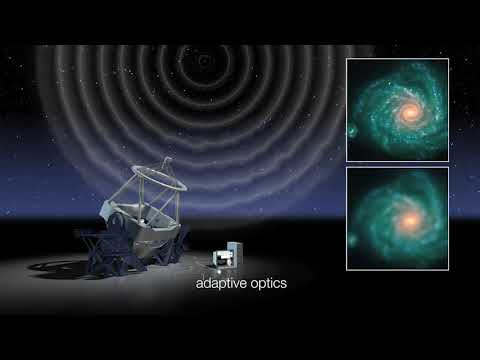
“Adaptive mirror” means that its surface can be deformed, thanks to more than 5000 actuators changing the shape of the mirror up to 1000 times per second.
The M4 mirror uses the same principle as a loudspeaker; the mirror is made of a very thin shell levitating 90 microns away from its reference surface (this corresponds to the thickness of a standard A4 sheet of paper), and it acts like a membrane which deforms under the effect of about 5000 voice coil actuators.
M4 measures 2.4 meters in diameter (8 feet). It will be made up of six thin segment mirrors, each only 1.95 millimeters (0.1 inch) thick and made of ceramic glass.
To determine the corrections required, the telescope will create “artificial stars in the sky” by using powerful lasers to excite sodium atoms in the Earth’s upper atmosphere and measuring their blurring. The more powerful the lasers are, the more sodium atoms they excite, making the artificial star brighter and improving the turbulence correction.

Source: ELT
M5
This mirror is the one in charge of sending the final image, corrected for interference by M4, to the digital camera recording the captured image.
M5 will be a flat, elliptical mirror measuring 2.7 by 2.2 meters, constructed from six lightweight silicon-carbide segments brazed together.
The unit also stabilizes the image movements, which are induced by telescope mechanisms and wind-shaking vibrations, by adjusting the mirror’s tip and tilt angles to a few tens of milli-arcsec accuracy.
ELT partners
To manage the production of these ultra-precise control mechanisms and equally ultra-specialized “glass”, industrial partners, mostly European firms, have been essential to the project.
Among the most instrumental, key in producing the glass and then polishing it to the precision required, were respectively the German company Schott AG, and the French Safran. VDL ETG Projects B.V. in the Netherlands is responsible for the production and testing of the segment supports, which act as the backbone of the mirror.
Many other industrial and academic partners to the ELT provided design, freight, construction, special equipment, measuring tools, mechanical implements, heat exchangers, cameras, etc.

Source: ELT
ELT Instruments
Besides the mirror capturing the distant planets and stars’ light, many instruments are going to analyze said light to allow scientists to analyze it. The most important instrument for ELT will be:
- MORFEO (Multiconjugate adaptive Optics Relay For ELT Observations): this instrument will not take an image itself, but will help compensate for the distortion of light caused by turbulence in the Earth’s atmosphere which makes astronomical images blurry.
- HARMONI (High Angular Resolution Monolithic Optical and Near-infrared Integral field Spectrograph): This instrument can decompose with high resolution an image into separate segments, and analyze for each the individual wavelengths using a powerful spectrograph, revealing the composition of planets and stars.
- MICADO (Multi-AO Imaging Camera for Deep Observations): it will take high-resolution images of the Universe at near-infrared wavelengths, helping identify exoplanets, distinguishing individual stars in other galaxies, and investigating the mysterious center of the Milky Way.
- METIS (Mid-infrared ELT Imager and Spectrograph): an imager and spectrograph that operates in the mid-infrared wavelength range. Its role will be to analyze the physical and chemical properties of stellar objects as diverse as exoplanets, the Solar System, circumstellar discs and star-forming regions, brown dwarfs, the center of the Milky Way, the environment of evolved stars, and active galactic nuclei.
- ANDES (ArmazoNes high Dispersion Echelle Spectrograph): a powerful high-resolution spectrograph that will be used for the detection of life signatures from Earth-like exoplanets, the search for the oldest stars in the Universe, testing for possible variations of the fundamental constants of physics, and the direct detection of the acceleration of the expansion of the Universe.
- MOSAIC: This Multi-Object Spectrograph can study up to 100 targets at the same time, and will be used to trace the growth of galaxies and the distribution of matter from the Big Bang to the present day. It will also provide synergies with upcoming multi-wavelength facilities (including Euclid, Rubin, Roman, SKAO).
What the ELT Means for Astronomy
The ELT is going to be the world’s largest telescope, and might stay so for at least a decade, as competing projects are being delayed.
This will make it one of the most important astronomical instruments, and likely the source of insight about rocky exoplanets, what is missing in our cosmological models, and a much deeper understanding of our own solar system, like the still mysterious (but geologically active) moons of Saturn and Jupiter.
This is also a remarkable technical achievement, pushing what is technically possible and demonstrating the scientific value of ultra-precise manufacturing methods, specialty glasses, and nanometer-scale measuring instruments.
All of these are equally important for the development of superior photonic and quantum computers, lasers, 3D printers, etc.
Investing in Advanced Optics
Corning Incorporated
GLW Price Chart
As telescopes push the boundaries of precision manufacturing in advanced glass, this also opens up numerous industrial possibilities in sectors as diverse as automotive, semiconductors, AI, defense, biotech, and healthcare. The advanced optic market is a $310B market, expected to grow by 9.2% CAGR until 2032.
Corning is a glass and optics company that has existed for 170 years. Over its history, it has produced the first glass bulbs for Thomas Edison’s electric light, the first low-loss optical fiber, the cellular substrates that enable catalytic converters, and the first damage-resistant cover glass for mobile devices.

Source: Corning
Today, the company is focused on core technologies related to manufacturing glass and ceramics, as well as optical physics technologies, which share common manufacturing processes and end markets.

Source: Corning
This interconnection of technologies allows the company to share common manufacturing, research, and engineering capabilities between its different product lines. With 52,000+ employees, 77+ manufacturing sites worldwide, and 10+ R&D facilities, the company is a large player in its niche.

Source: Corning
The company is benefiting from the boom in AI and data center building (optical fibers), as well as the overall consumption of specialty glass in screens and biotechnology.
Corning should not be impacted much by tariffs, as 90% of US revenues come from products with a US origin. Very little of the sales made in China originated from US facilities, with 80% of Chinese sales made in China.
Tariffs could even help, as Corning is entering the solar panel market, with the strategic control of Hemlock Solar, to produce US-made panels, as Asian solar panels (not just Chinese) are being submitted to quadruple-digit tariffs. 80% of the capacity has already been secured by customers’ commitments.
Solar makes a lot of sense for the company, with silicon handling a core manufacturing expertise of the company, having produced polysilicon for 60 years, including ultra-pure silicon (99.9999999999% pure) and now launching production of silicon wafer, a product imported at 100% in the USA.

Source: Corning
The company is also looking at other advanced technologies where its expertise in glass and ceramics could provide a solid edge, including bendable glass, AR, carbon capture, etc.

Source: Corning
Overall, Corning is a highly technical company with localized manufacturing that should not be affected by deglobalization. It also embraces new markets that match its core competencies, notably solar and optical communication / AI infrastructure. This makes it both a relatively conservative company, only digging deeper into its niche, but also a potential growth stock in high-tech markets.
Latest Corning Incorporated (GLW) Stock News and Developments



