

Agriculture
Corteva (CTVA): Building The New Generation Of Farming

Securities.io maintains rigorous editorial standards and may receive compensation from reviewed links. We are not a registered investment adviser and this is not investment advice. Please view our affiliate disclosure.

Farming: The Overlooked Frontier in Tech
Some sectors of the economy attract more attention than others. For example, IT, semiconductors, and tech stocks are remarkably popular with investors due to the sector’s extraordinary growth in the past 3 decades.
On the contrary, the physical production of cheap goods tends to be less discussed. This is especially true for farming, perceived as a low-innovation, “boring” industry.
This could not be further from the truth, as the past years have seen the sector innovating quicker than ever. A recent revolution was the adoption at scale of biotech and genetic engineering tools to create more productive crops.
A new revolution is coming, with fields becoming populated with drones and robots, harmful chemicals being replaced by biostimulants, modified microorganisms, while satellite imagery, IoT, & AI help make smarter decisions on the farm.
This is a direly needed improvement, as the growing global population (an additional two billion people in the next 25 years), climate change, and declining arable lands cause serious concerns.

Source: Corteva
It is estimated that agricultural yield needs to almost double in the upcoming decades to respond to this conjunction of problems hitting all at once.

Source: Corteva
Farming is a major economic sector, responsible for 4 trillion of the global GDP, employing 600 million farmers and directly supporting the livelihoods of 2.5 billion people.
As agriculture becomes increasingly technological, it is also growing in complexity. This wide array of new solutions will need to be integrated vertically into a package that farm owners can deploy seamlessly. And one company is well-positioned for this transition to smart farms: Corteva Agriscience.
Corteva, Inc. (CTVA +0.56%)
Corteva At A Glance
Corteva Financials
Corteva is a leader in farming technology, especially chemicals and seeds.
The company employs 22,000+ people, and works on 100+ different types of crops served by 400+ different products. It is a true global company, with 100+ manufacturing facilities in 110 countries.
Corteva is very active in new farming technology, like robotics and biological replacement for chemical treatment (see below). This comes on top of a long history of innovation, with 16,400+ patents granted to the company so far and 120 R&D centers.
Corteva made $16.9B in sales in 2024 for an operating EBITDA of $3.4B. The revenues can be split between the seed segment ($7.4B) and the crop protection segment ($9.5B – mostly chemicals like pesticides and herbicides).
By far, the most important region for the company is North America, with $8.6B of its sales coming from this area, with EMEA (Europe-Middle East-Africa) and Latin America the second most important regions.

Source: Corteva
Corteva History
Corteva is the result of a spin-off of the agricultural activities of chemical company DuPont in 2018, and the separate public listing of these activities. So while Corteva might seem a new company, it actually draws from the deep experience of DuPont, a company founded in 1802.
The company’s name comes from the combination of Latin roots “cor” (“heart”) and “teva” (an ancient word for nature).
Corteva Agrisciences’ history in farming chemicals means that it was associated with some toxic products, for example, chlorpyrifos ethyl, a pesticide banned in the UK in 2016, in the EU in 2020, and in 2021 in the USA. It is considered a Persistent Organic Pollutant (POP) and can affect the mental development of children.
The company is progressively moving from this chemical-heavy focus, notably with the acquisition of the Stoller Group, a maker of natural pesticides for $1.2 billion in 2023.
“These acquisitions illustrate Corteva’s commitment to providing farmers with sustainable solutions that bring value and productivity to the farm,”
Chuck Magro – Chief Executive Officer at Corteva Agriscience
It also acquired Symborg, an expert in microbiological technologies, providing biological solutions for agriculture.
“Symborg possesses a diversified portfolio, an emerging biocontrol pipeline, and skilled employees with robust technical knowledge and demand generation expertise.
The company’s strong technical expertise and exceptional commercial model built on sharing knowledge have earned it a trusted reputation throughout the Biologicals industry.”
Chuck Magro – Chief Executive Officer at Corteva Agriscience
Corteva’s Current Business
Seed Technology
Modern farming rarely sees farmers producing their own seed. Instead, they rely on the technical expertise and advanced biotechnology of companies like Corteva to provide seeds with the highest possible yield in the field.
This method has become the dominant option in the industry for a few reasons:
- Cultivation, selection, and storage of seeds are technical and labour-intensive tasks, distracting farmers from maximizing their production.
- Many of the modern seeds are complex hybrids of less productive subvarieties. These hybrids are often sterile, so farmers would need to cultivate separate crops to prepare for next year’s harvest if they want to use these high-yield hybrids.
- Controlling that the seeds have no infection from pests or pathogens is difficult, and best handled by specialized companies.
Modern seeds are also often pre-treated with chemicals to protect both the stored seeds and the early seedling when they are the most vulnerable, another activity individual farmers could not do.

Source: Corteva
The 2 main brands of Corteva in the seed category are Pioneer and Brevant, with an array of regional brands as well.

Source: Corteva
The goal to maximize production per acre is nowhere as important as in grain cultivation, and it is reflected in Corteva’s main activity in seeds. Corn is by far the most important crop for the company, making up around 3/4th of the seed sales, followed by soybeans and other oilseeds.

Source: Corteva
Crop Protection Innovations
| Innovation Area | Focus | Impact |
|---|---|---|
| Biologicals | Natural pest and disease control | Eco-friendly and high-growth potential (6–8% CAGR) |
| Genomics | Gene-edited seeds for yield and resilience | World-record yields, 350 patents granted |
| Biofuels | Sustainable Aviation Fuel (SAF) | Targeting 1M+ acres and 1M tons feedstock |
| AI & Precision Farming | Granular Insights platform, deep learning | Improves yields by 4–10 bu/acre |
This segment uses chemicals to improve crop growth and limit the damage caused by weeds, insects, and diseases.
Corteva’s presence is the strongest in the herbicide segment, with half of its sales in this sector. Insecticide and fungicide (protection against diseases caused by fungus) are the next largest segments.

Source: Corteva
Biological is still a small portion of sales, with only a small fraction of total revenues from this segment. It is, however, growing quickly, with 10% organic growth, while herbicide and insecticide sales are stagnant or declining.
Corteva’s Innovations
As it works in a very competitive sector, with most of its customers (farmers) having to deal with razor-thin margins, Corteva is actively developing new technologies to help them. It spends almost $4B per year to do so.

Source: Corteva
Biologicals
The current revenues and profits of the company are still largely driven by chemical treatments and traditional seed selection methods. But its management is also aware of the need and growing demand for more eco-friendly solutions, from farmers, consumers, and governments.
Biological sprayable solutions can, for example, contain bacteria that will kill insects attacking the crops, instead of spraying chemical insecticide. Pheromones can also disrupt the reproduction cycles of insects. Biologicals can be used alone or in combination with chemical treatment to boost their efficiency even further.

Source: Corteva
Another category is biostimulants, chemicals or microorganisms that help the plant to better intake nutrients, or resist drought, salt, heat, UV light, etc. Some microorganisms are even adding nitrogen to the soil by fixing inorganic nitrogen from the atmosphere.

The push into biologicals is an important part of that shift for Corteva. It is also a way to maintain growth, while the crop protection market is only growing at 2-3% per year, while the biological segment is expected to grow by 6-8% CAGR until 2035.
Biologicals could make up 25% of the total global crop protection market, with an anticipated market size of $30B annually.

Source: Corteva
Genomics
Part of the program to develop better seeds relies on a very complex and expensive to develop bank of more than one million different germplasts, stored cells of unique subvariety of plants (corn, soybean, etc.) that can contain beneficial genes.
By testing and studying this germplast bank, Corteva can constantly look for new ways to improve yield, improve disease resistance, tolerance to droughts, etc.
The progress made by the biotech industry in cheap genomic sequencing is a major driver in making these data and biological samples even more valuable than in the past.
Corteva achieved the world record yield in both corn and soybean with its proprietary seeds, and is the largest seller in the USA, with the country one of the world’s largest producers of both crops.
The company has a full pipeline of new plant varieties with improved traits coming in the next years, like corn more resistant to extreme weather, gene-edited plants resistant to disease, etc.

Source: Corteva
Corteva has its own gene editing technology adapted to its main crops, called Genlytix. It includes many partnerships, with 12 universities, 8 startups, and 4 food companies.
It already yielded 350 gene editing patents granted for 10 different crops, of which 70+ are multiplex editing (more than one gene edited at a time).

Source: Corteva
Biofuel
Biofuels are expected to grow 8x between 2024 and 2050, as some sectors of the economy are unlikely to switch to electric, but are still looking to cut their carbon emissions.
The growth in biofuel demand is mostly driven by the growing demand for Sustainable Aviation Fuel (SAF).

Source: Corteva
A number of countries around the world already have or are in the process of implementing incentives to promote the decarbonization of the aviation sector.
For example, in the EU, a SAF mandate beginning in 2025 will require fuel uplift at EU airports to contain at least 20% SAF by 2035 and 70% by 2050.
Corteva considers this activity a major potential source of growth, with 1 million acres in its target.

Source: Corteva
The company has made a partnership in 2024 with the oil company BP to develop low-carbon-intensity bio-feedstock used in biofuel production.
“This partnership is proof positive that agriculture can continue to be part of the solution to the world’s decarbonization opportunities, including by leveraging Corteva’s technology, global scale, and unique grower relationships.
The deal should see the two companies reach one million metric tons per year of biofuel feedstocks for SAF production by the mid-2030s.
“We see great potential in a partnership with Corteva – together, we are well positioned to deliver value through leveraging Corteva’s technology and grower relationships and bp’s refining and trading capabilities,”
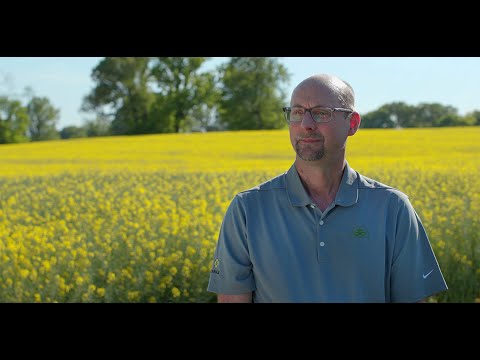
Biofuel production could be made not to compete with the usual crop season, with a partnership with Bunge Chevron Ag Renewables to grow winter crops for biofuels using canola. Not only does this provide an extra crop for farmers, but it also keeps more nutrients, water, and carbon in the soil. The deep taproot also breaks up soil compaction, and the dense canopy and rapid early growth reduce soil erosion.
AI, & Precision Farming
Besides seeds, biologicals, and biofuels, Corteva is embracing the AI revolution as well.
The company has been for years at the forefront of digitalizing farming with Granular Insights, a data-driven approach to increase farm yields. It is a full suite of software solutions, from land imagery data to farm management software and carbon credit monitoring and selling.

Source: Hoegemeyer
Granular Insights is now being re-invented as an AI tool, combining into a new system the old data from satellites to:
- Advanced connectivity to equipment.
- AI calculations for the timing of fungicide applications, already increasing yield by 4-10bu/A (bushel per acre).
- Better corn placement model increasing yield by 4.5bu/A.
- Optimization of fertilizers and other treatments for the crops.
- Applying image recognition & deep-learning models to identify harmful insects and recommend countermeasures.
The deployment of these AI functionalities is supported by the extensive sales network and representatives of Corteva, already in relation with the farmers. This is far from a case of Corteva jumping late into the AI bandwagon, as it was already deploying this technology in 2021.
“We can apply the right amount of nitrogen, and we can produce more with less nitrogen, making farms more productive, profitable, and sustainable.”
Dr. Rajiv Khosla – Head of the Department of Agronomy at Kansas State University
AI is helping as well in internal R&D efforts. Corteva claims that AI tools have increased 12x the speed of biotech protein discovery, and a 1,000x increase in speed of identifying molecular structures for biologicals.
AI is also leading to a 100x increase in the development of non-technical documents.
Emerging AgTech at Corteva
In addition to these other innovations, Corteva is equally active in leading in other fields of agricultural innovation.
One such initiative is the development of sorghum grain bio-fortified with vitamin A for improving nutrition in poor countries.
Another one is the development of walking robots for row crops, using a Spot robot from Boston Dynamics (now a part of Hyundai – HYMTF).
“The ability to leverage a robot to navigate row crop fields, while carrying and pulling instruments to collect data or apply chemicals more efficiently, has tremendous potential as we push the boundaries of what we can deliver to farmers.”
Geoff Graham – Leader of seed product development for Corteva Agriscience.
Shareholders Returns
Cash flows from operations are strong, with an expected approximate $8B in 2025-2027.
Most of this money will be returned to shareholders in the form of dividends and share repurchases. The rest will be divided into capex to sustain and grow operations, and further acquisitions of companies with key patents or technologies.

Source: Corteva
Conclusion
Corteva is one of the companies that help the world produce enough food despite mounting environmental, demographic, and land pressures.
As the creator of the world’s most productive corn and soybean varieties, it is essential in meeting the demand for more food production in the coming decades.
Currently, it is still very much an “old” agribusiness, with a focus on seeds and chemical treatments.
It is changing and making quick progress on the biological control of pests and diseases. Combined with advanced genetic engineering and AI-driven crop monitoring, it will be able to adapt to changing practices and benefit from this shift.
As farming becomes an increasingly complex and data-driven field, large companies like Corteva will have an advantage in the deployment of these technologies.
It is also active in the development of biodiesel and other carbon-neutral fuels, making it a key actor in contributing to reducing carbon emissions in sectors hard or impossible to electrify, like air travel and shipping.
As the company’s technological future combine with shareholder-friendly policies, it can be a good stock for investors looking for exposure to the agricultural sector, despite the mounting risks caused by chemical pollution to many of the largest actors in the industry, like for example Bayer’s (Monsanto) decade long legal and financial trouble from litigation linked to its herbicide RoundUp.
Latest Corteva (CTVA) Stock News and Developments
AGRO or CTVA: Which Is the Better Value Stock Right Now?
zacks.com
•
March 19, 2026
5 Agriculture Operations Stocks to Watch Despite Trade-Related Challenges
zacks.com
•
March 19, 2026
Danske Bank A S Invests $51.17 Million in Corteva, Inc. $CTVA
defenseworld.net
•
March 19, 2026
Banco Bilbao Vizcaya Argentaria S.A. Boosts Holdings in Corteva, Inc. $CTVA
defenseworld.net
•
March 16, 2026
Alliancebernstein L.P. Has $296.31 Million Stock Holdings in Corteva, Inc. $CTVA
defenseworld.net
•
March 16, 2026
Corteva Splitting Up: One Preferred Keeps Its Strong Buy Rating
seekingalpha.com
•
March 13, 2026



